Real estate income runs on a spectrum from truly passive REITs to a hands-on short-term rental business. Here is the time, capital, and tax trade-off at each level.
By J. MasseyApril 18, 2026· 12 min read
Share
Disclosure: This post may contain affiliate links. If you purchase through our links, we may earn a commission at no extra cost to you. We only recommend tools and services J. Massey's team actually uses. Read the affiliate disclosure
You build passive income with real estate by picking one of three positions and funding it: a REIT or crowdfunding stake that takes about 15 minutes a quarter to monitor, a long-term rental with a property manager that takes 2-4 hours a month, or a short-term rental that takes 10-15 hours a week until your systems are built and 2-5 hours a week after that. Those three positions need roughly $10 and up, $30,000 and up, and $5,000 to $50,000 of starting capital, in that order. The word "passive" covers all three, which is why so many first-time operators buy the wrong one.
I have been in real estate for more than 18 years and running short-term rentals since 2016. I have consulted on hundreds of properties and trained more than 10,000 operators. The pattern almost never changes: someone reads that rental income is passive, signs a lease or closes on a house, and six months later they are answering guest messages at 11 PM wondering what went wrong. Nothing went wrong. They bought a business and expected a dividend.
This article maps the spectrum so you can choose on purpose. You get the time cost, the capital cost, and the control trade-off at each level, plus how the IRS treats each one, which is a separate question from how much work it takes.
Passivity Is a Spectrum, Not a Category
Passive income means money that arrives without you trading hours for it directly. Most real estate content treats that as a yes-or-no question. Real estate does not work that way.
Own shares in a real estate investment trust and you may never think about it except when a distribution hits your brokerage account. That is passive. Own a long-term rental and spend two hours a month reviewing statements and approving a water-heater replacement. That is mostly passive. Run a short-term rental and you are coordinating turnovers, adjusting rates, replacing a door code, and answering a guest who cannot find the trash bins. That is a hospitality business with a rental attached.
All three get sold under the same label. The cost of that sloppiness is measured in years. Operators either buy a short-term rental expecting income with no work, or buy a REIT expecting property ownership and then watch it trade with the stock market.
Three variables decide where you belong: hours you will actually give it each week, capital you can deploy now, and how much control you need over the decisions. Answer those without flattering yourself and the model picks itself.
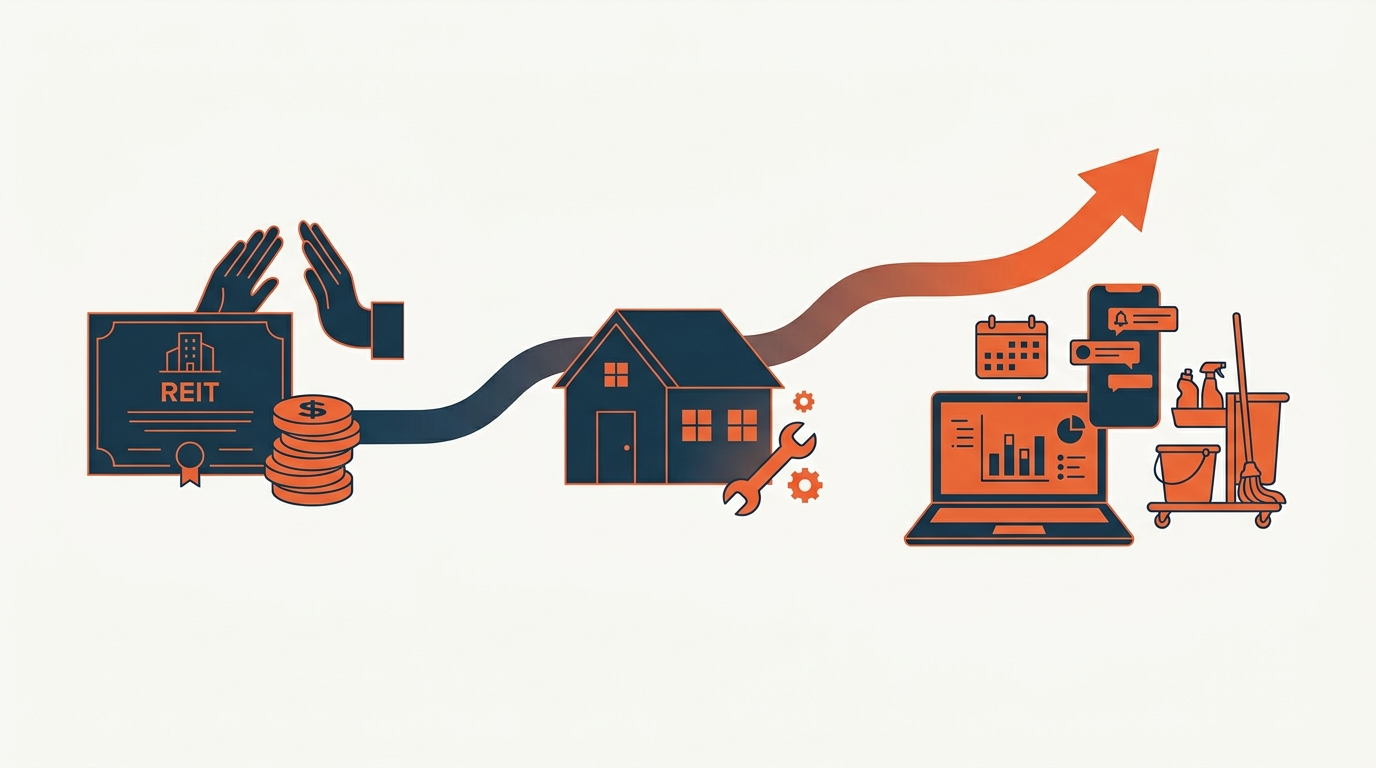
A left-to-right spectrum of real estate income from a hands-off REIT to a mostly passive long-term rental to an active short-term rental, with an arrow showing increasing effort.
Here is the framework I use with every operator who asks about passive real estate income. Each zone has a different trade-off structure, not a different quality level.
Time and capital ranges below are what I see in practice across the markets my operators work in.
Zone
Model
Operator time
Starting capital
Control
1 — Truly passive
REITs, crowdfunding, syndications, notes
Minutes per quarter
$10 to $50,000+
None to minimal
2 — Mostly passive
Long-term rental with a property manager
2-4 hours monthly per property
$30,000 to $100,000+
High on strategy, delegated on daily work
3 — Active business
Short-term rentals, rental arbitrage
10-15 hours weekly, then 2-5 with systems
$5,000 to $15,000 arbitrage, $50,000+ owned
Total
Most people start in Zone 1 or Zone 2, hear what short-term rentals cash flow, and jump to Zone 3 without registering that they just started a company. More passivity means less control and returns capped by whoever is operating. More involvement means higher cash flow and full control, paid for in hours. Neither is better. The operators who last pick a zone deliberately and build what that zone requires.
Zone 1: REITs, Crowdfunding, Syndications, and Notes
If you want real estate exposure with no operational involvement, this is the zone.
REITs are the most accessible entry point. You buy shares of a publicly traded trust through a normal brokerage account. The trust owns and operates apartments, storage, industrial, or retail property. You collect distributions. Your control is zero: the management team makes every decision, and the share price moves with the equity market in ways a duplex does not.
Crowdfunding platforms sit one step up. You fund specific projects or diversified funds, sometimes with as little as $10, while accredited-only deals typically start at $5,000 to $25,000. The trade-off is liquidity. Debt deals commonly run 12 to 36 months and equity positions 3 to 7 years, and exiting early means penalties or a thin secondary market.
Syndications work the same way with a closer relationship to the sponsor and minimums that usually start around $50,000. You are a limited partner, the sponsor operates, and distributions follow the operating agreement. Read the waterfall before the pitch deck.
Private notes are the least beginner-friendly option. You lend against real property, collect interest, and hold a lien if the borrower defaults. That last part is the job: underwriting and foreclosure process, not passive collection.
All four share one structure. You supply capital, someone else does the work, your upside is capped by their execution. That is investing, not operating, and there is nothing wrong with it as long as you know which one you bought.
Zone 2: Long-Term Rentals With a Property Manager
Long-term rentals sit in the middle. You own the asset, you control the big decisions, and a manager can absorb the daily work.
The mechanics are plain. Buy the property, place a tenant on a 12-month lease, collect rent, pay the mortgage, taxes, insurance, and maintenance, and keep what is left. Self-manage and you are handling tenant calls, repairs, rent collection, and renewals: call it 3-6 hours a month per property, more during a turnover. Hire a manager at a typical 8% to 12% of collected rent (verify locally; the range varies by market and service level) and it drops to 2-4 hours a month. That fee buys back hours and costs cash flow.
Run the arithmetic before you assume the fee is unaffordable. On $2,000 monthly rent, a 10% management fee is $200 a month, $2,400 a year. If self-managing costs you 5 hours a month, the fee is buying back 60 hours a year at $40 an hour. Whether that is a good trade depends on what your hour is worth and how close you live to the property.
The IRS lets you depreciate residential rental property over 27.5 years, which produces a paper loss against rental income even in a profitable year. Keep records that survive an audit: the IRS guidance on rental income, deductions, and recordkeeping is the baseline for what to track.
This model fits operators who want ownership and equity build-up without running a hospitality operation. The returns are lower than short-term rentals in the same market, and your exposure is vacancy, tenant quality, and the competence of your manager.
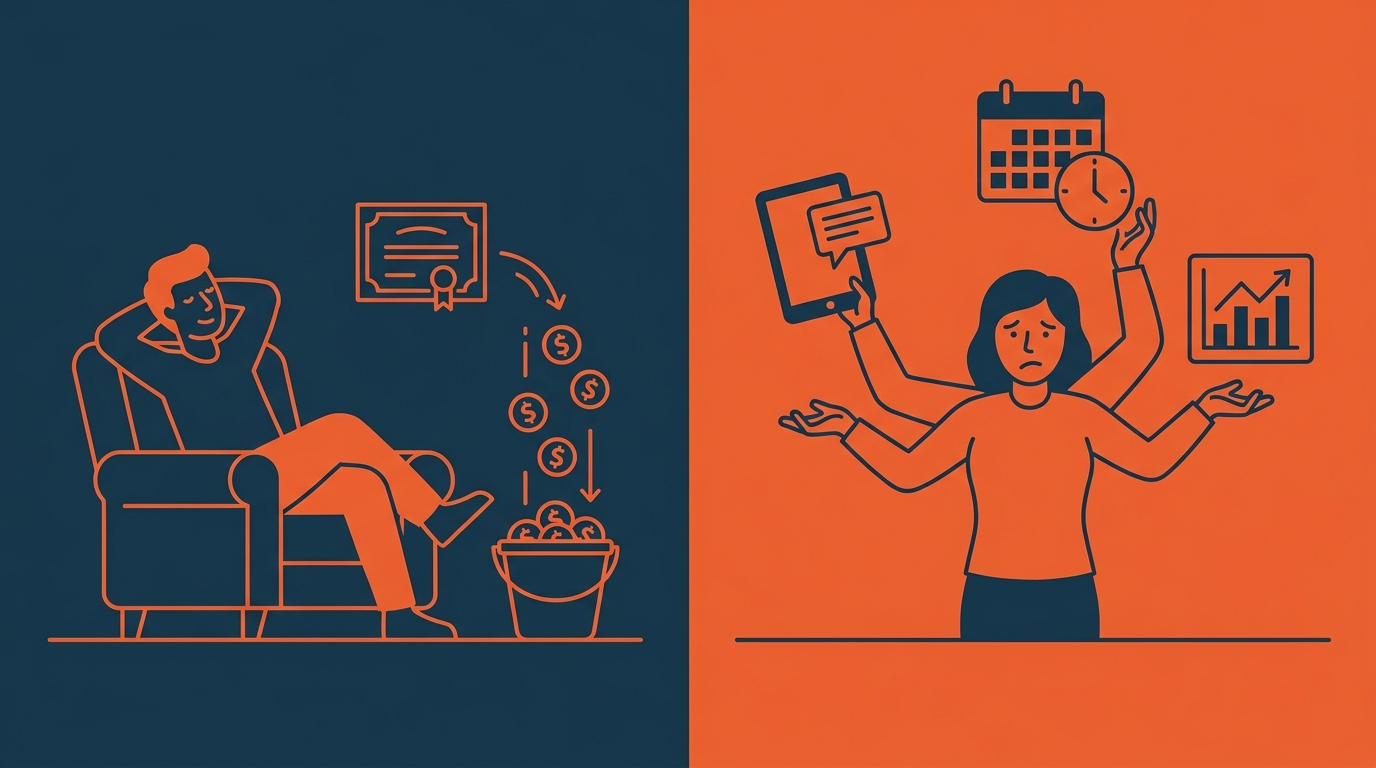
A split comparison of a hands-off REIT investor relaxing versus an active short-term-rental operator juggling guest messages, cleaning, and pricing.
Short-term rentals are not passive. They are a business. Read that twice before you sign anything.
The work list is specific. List on Airbnb, Vrbo, or both. Communicate before, during, and after each stay. Coordinate a turnover after every checkout. Adjust rates weekly or daily against demand, season, and local events. Handle maintenance, respond to reviews, fix the Wi-Fi, replace the lockbox battery, and answer the neighbor who wants to know who keeps parking in front of the mailbox. Do all of that by hand and you are at 10-15 hours a week per property.
Build the systems, which means automated guest messaging, review templates, demand-based pricing software, a cleaning team with a backup, and a named handyman, and the same property runs on 2-5 hours a week. Systems are the difference between operators who add a second unit and operators who quit.
The return is why people accept the workload. In the markets my operators work in, a well-run short-term rental typically produces roughly 2x to 4x the monthly revenue of the same unit leased for a year. That is my own operating range, not a published statistic, and it has to be checked in your zip code. Revenue is not profit: furnishing, utilities, platform fees, cleaning, and higher turnover costs come out of that multiple before you see cash.
Rental arbitrage is the low-capital way in. You lease a unit, get written permission to sublet it as a short-term rental, furnish it, and operate it exactly like an owned unit. Startup cost usually lands between $5,000 and $15,000 depending on market and furniture choices. You skip the down payment and you learn operations without balance-sheet risk. You also build no equity, so treat arbitrage as a cash-flow business and a test, not a retirement plan. If you decide you hate the work, you learned it for $5,000 instead of $50,000.
What the IRS Calls Passive
The tax definition and the operational definition are different, and confusing them costs money.
Rental activity is generally treated as passive even when you are the one doing the work, unless you qualify as a real estate professional. That test has two parts: more than 750 hours per year in real-property trades or businesses in which you materially participate, and more than half of your total personal-services time for the year in real property. Hold a full-time W-2 job and you almost certainly fail both, so your rental income stays passive.
Short-term rentals can fall outside the rental-activity definition entirely. When the average guest stay is 7 days or fewer, the activity is not treated as a rental activity under the passive-loss rules, and if you also materially participate (most operators use the 500-hour test), the income and losses are active. That is the mechanism behind offsetting W-2 wages with early-year depreciation and startup costs.
Long-term rental losses do not get that treatment. They are limited to the $25,000 special allowance, which phases out between $100,000 and $150,000 of modified adjusted gross income, and anything suspended carries forward until you have passive income or sell.
Situation
Tax classification
What losses can offset
Long-term rental, W-2 job
Passive
Passive income; up to $25,000 against ordinary income below $100,000 MAGI
Long-term rental, real estate professional (750+ hours, >50% of work time)
Non-passive
Ordinary income
Short-term rental, average stay 7 days or fewer, 500+ hours participation
Non-passive
Ordinary income including W-2 wages
REIT or crowdfunding distributions
Portfolio or passive depending on the instrument
Generally not W-2 wages
This is educational information, not tax advice. Rules change and your facts matter. Take the table to a CPA who works with rental operators before you file anything based on it.
Pick Your Zone: A Five-Step Process
Work these in order. Skipping step one is how people end up in the wrong zone.
Count your real hours. Track two weeks of actual free time, not aspirational time. Under 1 hour a week points to Zone 1, a few hours a month to Zone 2, 10+ hours a week for the first quarter to Zone 3.
Count deployable capital. Under $10,000 means REITs or crowdfunding; $5,000 to $15,000 puts arbitrage in range. $30,000 to $100,000 opens a financed long-term rental or an owned short-term rental. $50,000 and up makes most syndications (minimums usually start around $50,000) or two simultaneous arbitrage units possible.
Decide how much control you need. If handing every decision to a sponsor keeps you awake, Zone 1 is out no matter how convenient it looks.
Price one market before you commit. Pull long-term rent comps and short-term nightly rates and occupancy for the same zip code. If the short-term numbers do not show at least 2x the long-term revenue after cleaning and furnishing, the extra work is not paid for.
Run the smallest version first. One REIT position of $500 to $2,000 for 90 days, one arbitrage unit for six months, or one managed rental for 12 months. Then scale the model the data supports.
Operators who stall pick from what sounds appealing. Operators who compound pick from constraints, prove the model at one unit, and move across the spectrum as their capital and hours change. A written plan helps here; the SBA's business-plan guide is a reasonable free template for the arbitrage or short-term rental version of this.
If you want a second set of eyes on which zone fits your market and hours, book a complimentary one-on-one diagnostic call. It is free. If you want us to build the plan with you afterward, the $997 action plan is the paid next step, and nobody will push you into it on the call.
Frequently Asked Questions
Is rental income passive income?
For tax purposes, usually yes. Rental activity is generally passive even when you manage it yourself, unless you qualify as a real estate professional or your average guest stay is 7 days or fewer. Operationally it varies: REITs are passive, long-term rentals with a manager take 2-4 hours a month, and short-term rentals are an active business.
How much money do you need to start?
Some crowdfunding platforms open at $10 and REIT shares cost whatever one share costs. Rental arbitrage typically runs $5,000 to $15,000 for deposits and furnishings. A financed long-term rental needs $30,000 to $100,000 for down payment and closing costs, and an owned short-term rental usually starts around $50,000.
What is the most passive way to invest in real estate?
Publicly traded REITs. You buy shares in a brokerage account, collect distributions, and make no operational decisions. The trade-off is zero control and share prices that move with the stock market rather than with your local rental demand.
Are short-term rentals passive income?
No, not operationally, and often not for taxes either. With an average stay of 7 days or fewer plus material participation, the activity falls outside the passive rental rules, so losses can offset ordinary income including W-2 wages. Expect 10-15 hours a week per unit before systems and 2-5 hours after. Confirm your own facts with a CPA.
How do beginners build passive income with real estate?
Start with the model that matches your hours, capital, and control needs rather than the one with the best headline. For most beginners that is a small REIT or crowdfunding position to learn how returns get reported, then one long-term rental or one arbitrage unit. Prove one position works before adding a second.
What is the difference between passive and active income for taxes?
Passive losses generally offset only passive income, with a $25,000 special allowance that phases out between $100,000 and $150,000 MAGI. Active losses offset ordinary income including wages. Real estate professional status (750+ hours and more than half your working time) or a short-term rental with 7-day-or-fewer average stays and material participation are the two common routes from passive to active.
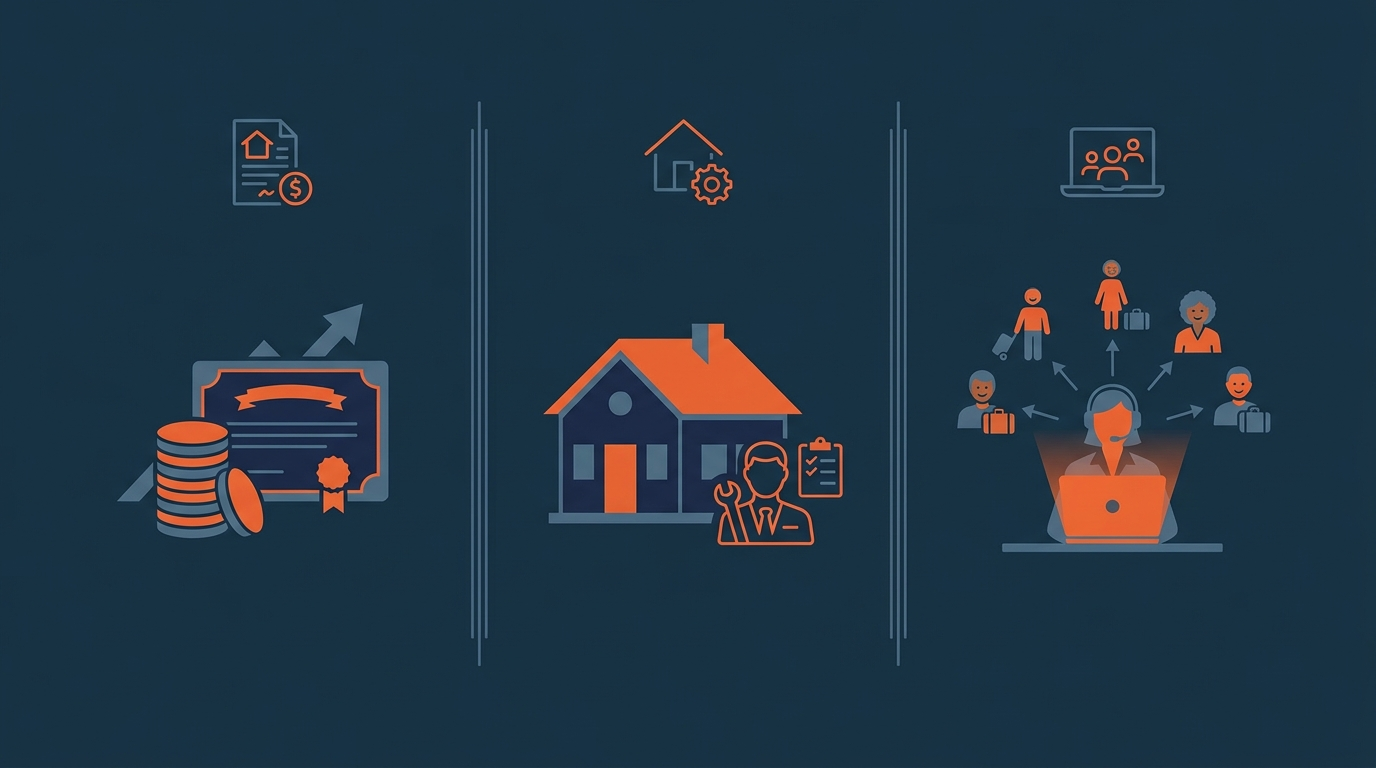
Three labeled columns comparing a truly passive REIT, a mostly passive long-term rental with a property manager, and an active short-term-rental business.