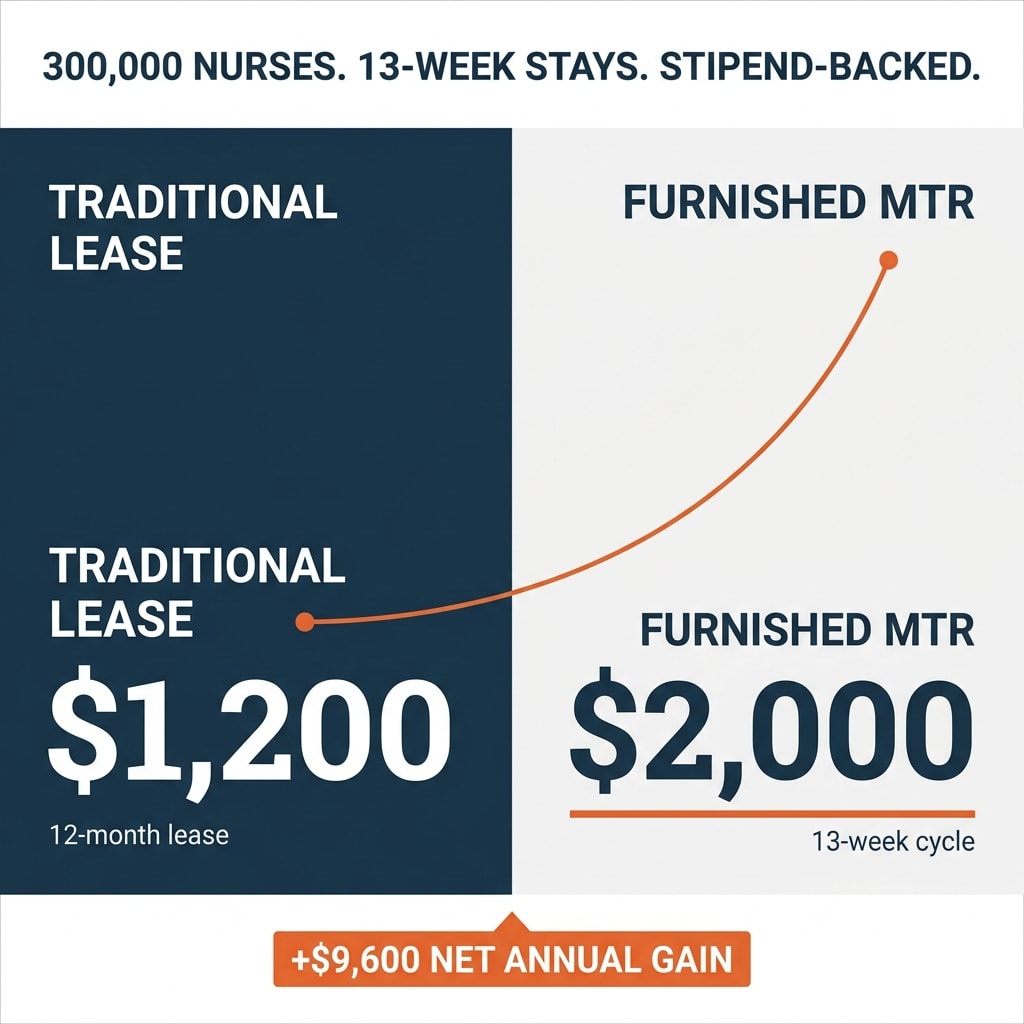
To rent to travel nurses, you furnish a unit near a hospital corridor, price it as one all-in monthly number that fits the local housing stipend, list it where contract travelers actually search, and sign a fixed-term lease that matches the assignment length. Most contracts run about 13 weeks, so you plan four tenant cycles a year and start re-filling the unit the week the current nurse tells you whether they are extending.
Last updated: 2026-09-17
Almost everything written about travel-nurse housing is written for the nurse. This is written for the owner. Your job is not chasing a stipend; it is turning a furnished apartment over four times a year without a gap you did not plan for.
I have spent more than 18 years in real estate, focused on short-term rentals since 2016, and I have trained more than 10,000 operators through CashFlow Diary. The operators who do well with contract housing treat it as an operations problem, not a listing problem. The ones who struggle furnish beautifully, price by feel, and then sit empty for five weeks between contracts.
One note before the numbers: this is educational material, not tax or legal advice. Landlord-tenant rules, lease terms, occupancy taxes, and mid-term rental ordinances vary by city and state. Confirm your local rules with a qualified attorney and a CPA before you sign anything.
How Travel-Nurse Contracts Shape Your Calendar
A travel nurse takes an assignment through a staffing agency. The standard contract is roughly 13 weeks — one quarter. Some crisis contracts run four to eight weeks. Many nurses extend once, occasionally twice, at the same facility.
That single fact drives everything else. Your calendar is not a mystery. It is four known dates a year, each of which you learn about weeks in advance because the nurse finds out about an extension before you do.
Contract housing sits between the two models you already know. A nightly rental means dozens of small decisions a month and seasonal swings you do not control. An annual lease means one decision a year at a rent the long-term market sets. Mid-term gives you monthly rent above the long-term number with turnover you can put on a calendar.
The tenant profile helps too. These are employed professionals on a documented contract, working long shifts, usually alone or with one partner. They are not throwing parties. They also need housing again in three months, in a different city, and they talk to each other. A landlord with a clean record and fast replies gets referred. That is the closest thing to free marketing in this niche.
Demand for contract staff is not a fad, but it is also not evenly spread. NCSBN's 2023 workforce research reported that about 100,000 registered nurses left the workforce during the pandemic and that 610,388 more said they intended to leave by 2027. Staffing gaps like that are what keep agencies placing travelers. Where owners get burned is assuming the pool is infinite. It is not. Demand concentrates around hospitals, trauma centers, and teaching facilities. If your unit is 45 minutes from the nearest hospital, no amount of furnishing fixes that. Insurance-displacement tenants are the other mid-term demand pool worth mapping in the same market; I cover that overlap in insurance ALE versus travel-nurse demand. Wrong location, wrong strategy — and that is the one thing you cannot operate your way out of.
How Agency Housing Stipends Actually Work
Most nurses take one of two paths. Either the agency arranges housing directly, or the nurse takes a housing stipend and finds their own place. Experienced travelers usually take the stipend, because whatever they do not spend on rent, they keep.
Agencies do not publish their housing formulas. In my experience the packages track the federal per diem lodging rates for the assignment county — the rates the General Services Administration publishes for government travel. GSA sets one standard rate for most of the continental United States and individual rates for about 300 non-standard areas, most of them a key city plus its surrounding county. The meals and incidentals portion is separate: the standard continental M&IE total is $68 a day. That number has nothing to do with your rent and should stay out of your pricing math.
So your first pricing input is free and public: look up the lodging rate for your property's county on the GSA per diem tool. It is not a guarantee of what any agency pays, and packages differ by agency and contract. Treat it as a reference point that tells you roughly what a traveler's housing allocation can absorb, then confirm the real budget with the tenant in front of you.
The tax treatment belongs to the nurse, not to you. Stipends are generally tax-free to the traveler only when they maintain a tax home and are working away from it — the rules the IRS lays out for travel expenses and per diem allowances. You do not advise on this. If a prospective tenant asks you whether their stipend is taxable, point them to their agency and their own tax professional. Your rental income is your business and is reported as rental income; talk to your CPA about how furnishings are depreciated.
Two practical consequences for pricing:
The nurse is spending an allocation, not personal savings. Price resistance drops when your number fits inside the allocation.
Anything you make the tenant pay separately — utilities, internet, parking — comes out of the same allocation and makes your unit look more expensive than a competitor quoting one number.
Pricing a Monthly Furnished Stay Against Nightly STR
Quote one all-in monthly number: rent, electric, gas, water, trash, internet. That is what contract travelers compare, and it is the only way your listing reads cleanly next to the one down the street.
Then decide whether monthly is even the right use of the unit.
Question | Points toward mid-term | Points toward nightly STR |
|---|
Drive time to a major hospital | Under 25 minutes | Irrelevant to demand |
Seasonality of your market | Flat demand year-round | Strong peak season premium |
Local ordinance | Nightly rentals restricted, 30+ day stays allowed | Nightly permitted and permitted units are scarce |
Your time budget | You want four tenant events a year | You can staff nightly turns and messaging |
Cash flow preference | Predictable monthly deposits | Higher ceiling, wider swings |
Furnishing budget | One functional package, replaced slowly | Design-forward package, faster wear |
The yield comparison matters more than the frame. Run it with your own numbers before you buy a single piece of furniture. The example below is an illustration with the assumptions shown, not a projection of what your unit will earn.
Line item (illustration: 1BR, mid-cost market) | Annual lease | Furnished mid-term |
|---|
Quoted rent | $1,200/mo, tenant pays utilities | $2,100/mo all-in |
Owner-paid utilities and internet | $0 | -$220/mo |
Cleaning and linen between contracts (4/yr) | ~$0 | -$65/mo averaged |
Furnishing package, amortized over 36 months | $0 | -$110/mo ($4,000 package) |
Assumed occupancy | 96% | 85% (two-week gap per cycle) |
Illustrative net before debt and taxes | ~$1,150/mo | ~$1,450/mo |
Change three inputs — a smaller gap, a higher all-in rent, a cheaper furnishing package — and mid-term pulls ahead. Change them the other way and it loses. The biggest variable is not rent; it is empty weeks between contracts, which is why the re-fill routine below matters more than any pricing trick.
One rule I hold to: do not price above the local lodging anchor and expect a nurse to cover the difference out of pocket. Some will. Most will book the unit that fits.
Furnishing and Utility Standards That Fill a Unit
A travel nurse arrives with two suitcases and starts a 12-hour shift within days. The unit has to work on night one. Function beats styling every time in this niche.
Category | Required | Skip or defer |
|---|
Sleep | Quality queen or king mattress, blackout curtains, extra linens | Designer bedding, headboard upgrades |
Kitchen | Full cookware, knives, dishes for four, coffee maker, microwave | Specialty appliances, open-shelf styling |
Laundry | In-unit washer and dryer, detergent to start | Laundry-room remodels |
Connectivity | Business-grade internet, router placed centrally, posted password | Whole-home smart systems |
Work | Desk, real chair, good lamp | Dual-monitor setups |
Access | Keypad or lockbox entry, clear parking instruction | Full smart-lock ecosystems |
Basics | Iron, drying rack, first-aid kit, basic tools, trash-day note | Decor budget beyond a few pieces |
Blackout curtains are not a nice touch. Night-shift nurses sleep during daylight, and a bright bedroom is the fastest way to a mediocre review. The mattress is the second thing they will mention. Buy one good one instead of two cheap ones.
Utilities stay in your name. You pay them, you build them into the monthly number, and you set a plain-English fair-use line in the lease for electricity in extreme-climate markets. Internet must be yours too, with enough upload speed for video calls and charting. A tenant who has to set up service for a 13-week stay will pick a different listing.
Budget a few thousand dollars for a functional one-bedroom package, buy once, and hold a small annual replacement reserve. Furnishings wear faster than owners expect when four households a year use them.
Listing Channels and the Direct Pipeline
Furnished Finder is aimed at 30-plus-day traveling healthcare stays, and in my experience it is where most contract travelers start looking. Owners set their own rent there. Its listing cost and fee structure change from time to time, so read the current terms on the site before you pay for a listing rather than trusting anyone's summary, including mine. Treat it as your anchor listing: complete profile, real photos of every room, explicit list of what is included, exact drive time to the nearest hospitals.
A nightly platform such as Airbnb works as a secondary channel. You control minimum-stay length and length-of-stay discounts in your own listing settings, so check the current fee and long-stay rules in the platform's help center before you rely on them. The trade-offs are platform fees and a mixed audience — you will field vacation inquiries alongside healthcare ones. I use nightly channels to fill gaps between contracts, not as the main channel.
Beyond platforms, the pipeline that actually compounds is direct:
Agency housing coordinators. Most large staffing agencies have people whose job is helping placed nurses find housing. Call, introduce the unit, ask to be added to their local list, and send them a one-page PDF with photos, the all-in rate, and availability.
Hospital HR and travel-staff offices. Larger facilities keep informal housing lists for incoming contract staff. Ask who maintains it.
City-specific traveler housing groups. Search for travel-nurse housing groups for your metro. Zero fees, more manual work, and useful relationships.
Past tenants. Ask every departing nurse two questions: would you come back, and do you know anyone rotating into this market next quarter?
If you want the platform mechanics in detail, I walk through the listing itself in how to list on Furnished Finder for travel-nurse tenants. Aim to get at least half your future bookings from direct sources. Platform listings are the safety net, not the plan.
Screening and Lease Terms for Contract Tenants
Screening a contract traveler is not the same as screening a 12-month tenant, but you still screen. Ask for the assignment confirmation or agency contact, the facility and shift, the exact start and end dates, the stipend or budget, and how many people plus pets will occupy the unit. Verify the license if you want an extra layer — most state nursing boards publish a public license lookup.
Lease terms that hold up in this model:
Fixed term matching the assignment, not month-to-month. If the contract runs 13 weeks, the lease runs 13 weeks with a stated end date.
Extension clause. Spell out that an extension must be requested in writing by a set date — I use 21 days before the end date — and name the rate for extended months.
Early-termination terms. Assignments do get canceled. Decide in advance: written notice period, what happens to the deposit, and whether you charge a fee. Then apply it the same way to everyone.
All-in utilities with a fair-use cap stated in dollars, so nobody argues in month three.
Occupancy, pet, and guest terms. Contract travelers sometimes bring a partner or a dog. Price it, do not ban it by default.
A security deposit within your state's legal limit, held the way your state requires.
Security deposit rules, notice periods, and termination penalties are regulated differently in every state, and some of what is standard in one market is unenforceable in another. Again: educational, not legal advice. Have a local attorney read your lease once. It is cheap compared to one bad termination.
The Re-Fill Playbook Between Contracts
Empty weeks are the only thing that reliably kills the returns in this model. The fix is a routine that starts long before the current tenant packs. Run this every cycle.
Step 1 — Ask about extension at week six
Halfway through a 13-week contract, ask the nurse directly whether they expect to extend. Most know, or will know within days. A yes saves you a full turnover. A no starts your marketing clock seven weeks early.
Step 2 — Re-list at week seven
Update your listing with the exact available-from date and refresh the photos if anything changed. In my own units, most contract inquiries land four to eight weeks before the start date, so a listing that goes live two weeks before the unit opens is already late. Track your own lead times and set the re-list date from them.
Step 3 — Push the availability date to your direct list
Email or message every agency coordinator, hospital contact, and past tenant with one line: unit type, all-in rate, available date. This costs ten minutes and is where the fastest bookings come from.
Step 4 — Run the turnover in one day
Book the cleaner and any repairs for the day after move-out. Deep clean, launder every linen set, replace consumables, test the internet, check smoke detectors, and photograph the finished unit for your records. A one-day turn keeps your gap at days rather than weeks.
Step 5 — Close the gap or fill it
If the next contract starts more than ten days out, list the gap as a nightly or weekly stay on your secondary channel. If it starts sooner, leave it alone. Chasing a three-night booking before a 13-week tenant arrives is not worth the risk to the unit.
Track two numbers per cycle: days vacant and all-in monthly rate achieved. If days vacant per cycle stays under ten and your rate holds inside the local anchor, the model is working. If vacancy climbs past three weeks a cycle, your problem is either location or marketing lead time, and no rate change fixes it.
If you want a second set of eyes on whether your specific unit and market fit this model, book a complimentary one-on-one diagnostic call and we will run your numbers together before you spend anything on furniture.
Frequently Asked Questions
How long do travel nurses usually rent for?
The standard assignment is about 13 weeks, which is why leases in this niche are written as fixed 13-week terms with a stated end date. Crisis contracts can run four to eight weeks, and a nurse who likes the facility will often extend once. Plan your year around four tenant cycles and treat every extension as upside rather than as your base case.
How do I price a unit for a travel nurse?
Start with the federal per diem lodging rate for your property's county on the GSA tool, which is the closest public proxy for what a traveler's housing allocation can absorb. Quote one all-in monthly number that includes utilities and internet and sits inside that anchor. Then check what comparable furnished units near your hospital corridor are asking, and adjust for drive time, parking, and laundry.
Is a housing stipend taxable to the nurse?
That depends on the traveler's own circumstances, mainly whether they maintain a tax home and are working away from it under IRS travel-expense rules. It is not your call to make and not a question you should answer for a prospective tenant. Point them to their staffing agency and their own tax professional, and keep your own conversation focused on the rent.
Where should I list a travel-nurse rental?
Furnished Finder is my anchor listing because it is aimed at 30-plus-day healthcare stays and lets owners set rent directly; check its current listing terms yourself. Add a nightly platform such as Airbnb, with a 30-day minimum stay, as a secondary or gap-fill channel. The bookings that compound, though, come from agency housing coordinators, hospital staffing offices, and past tenants who refer colleagues.
What if the nurse's assignment gets canceled mid-lease?
It happens, so decide the terms before it does. Write an early-termination clause with a defined written-notice period, a stated consequence for the deposit or a flat fee, and your right to re-list the unit immediately on notice. Check enforceability with a local attorney, because deposit and termination rules differ by state.
Sources