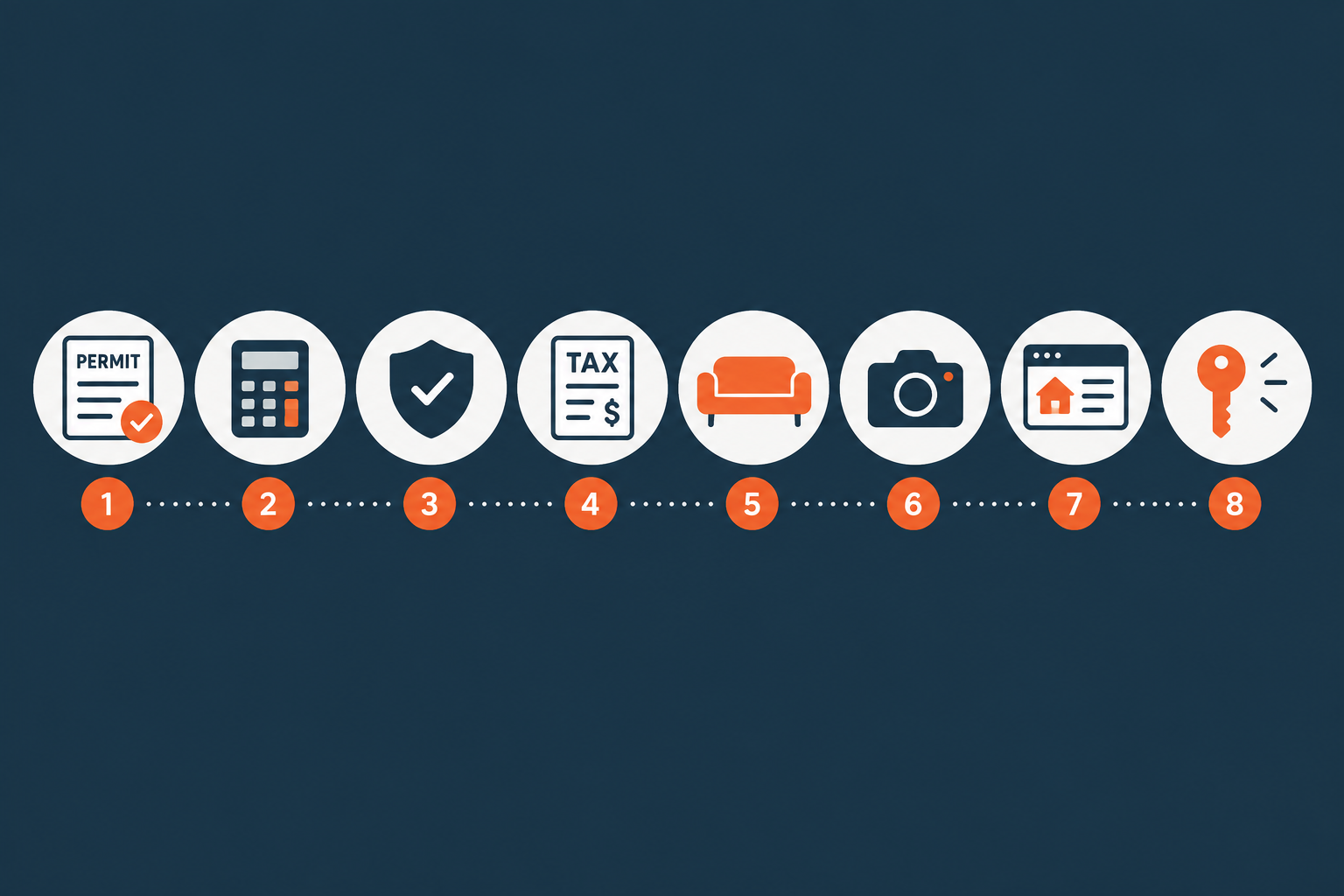
Starting an Airbnb in a property you own or control comes down to eight ordered steps: confirm the property can legally be rented short-term, run the market math, budget the launch, set up the entity and bank account, buy real short-term-rental insurance, settle your tax treatment, furnish and photograph the space, then publish and price the listing. The order matters more than any single step. I have spent 18-plus years in real estate, focused on short-term rentals since 2016, and trained more than 10,000 operators — and the people who lose money almost always bought furniture before they read their city's ordinance.
How to Start an Airbnb: Owner's Path (Eight Steps, Real Numbers)
Eight ordered steps to a first owner-operated Airbnb, with the permit check first and the furniture last. Real cost ranges, real tax treatment, and the failure points at each step.
By J. MasseyJune 24, 2026· 11 min read
Disclosure: This post may contain affiliate links. If you purchase through our links, we may earn a commission at no extra cost to you. We only recommend tools and services J. Massey's team actually uses. Read the affiliate disclosure
Table of Contents
The Eight Steps in Order
Work the list top to bottom. Each step is a gate: if it fails, you stop and fix it before spending on the next one.
Confirm short-term rentals are permitted at that address, and start the permit application.
Run occupancy and nightly-rate comps for your submarket, then pressure-test the monthly math.
Build the launch budget, including a cash reserve, before you buy anything.
Decide on an entity, open a dedicated bank account, and get an EIN if you form one.
Bind short-term-rental insurance that names paying guests, not a standard homeowner policy.
Settle whether you expect to file Schedule E or Schedule C, with a CPA.
Clean, repair, and furnish the space, then hire a photographer.
Publish the listing, set an entry price, turn on automated guest messages, and take the first booking.
Step | Typical elapsed time | What it costs | Failure mode if skipped |
|---|---|---|---|
1. Permit and zoning | 1 day to several months | $0–$1,000 in fees | Fines, forced delisting after you furnished |
2. Market math | 1–2 days | $0–$100 in data tools | Negative margin discovered after closing |
3. Launch budget | 1 day | $0 | No reserve when the water heater fails |
4. Entity and banking | 1–3 weeks | State filing fee | Mixed books, weak deduction records |
5. Insurance | 3–10 days | Annual premium | Personal liability on a guest injury |
6. Tax treatment | 1 CPA meeting | CPA fee | Wrong schedule, amended return |
7. Furnish and photograph | 2–5 weeks | Largest line item | Bad reviews from bad beds and photos |
8. List, price, launch | 1–2 days | $0 upfront | Empty calendar, no review base |
This guide assumes the owner path: you own the property, are buying it, or control a unit you may sublet. Arbitrage and co-hosting run on different economics.
Step 1: Confirm the Property Can Legally Be Rented
Most US cities and counties now require some form of short-term-rental registration, permit, or license, and many require a lodging or transient occupancy tax account on top of it. Requirements differ by jurisdiction and change often, so the only current answer comes from the government site itself.
Do this in one sitting:
Search "[city] short-term rental permit" and "[county] transient occupancy tax," and open only .gov results.
Read the caps: some jurisdictions limit annual rental nights, restrict permits to owner-occupied homes, or cap permits per block.
Check whether the platform collects and remits the lodging tax for your market. Where it does not, you register and remit yourself.
Read the HOA covenants and, if you are a tenant, the lease. A private ban is as binding on you as an ordinance.
Start the application before you buy furniture. Some cities issue online in days; some require inspection and take months.
If the permit answer is no, or the answer is "no new permits," stop. There is no furnishing decision that fixes an illegal listing. This is not legal advice — verify your own jurisdiction with the issuing office or an attorney.
Step 2: Run the Market Math Before You Spend
Use two numbers: median nightly rate for comparable listings in your submarket, and a realistic occupancy assumption — not the peak month, and not a vendor projection. Pull comps by searching your city on the platform with no dates set, which shows active listings and their rates, and cross-check with a market data tool.
The calculation I run before any deal:
Monthly revenue = median nightly rate × realistic occupancy × 30.
Monthly carry = mortgage or rent + utilities + internet + insurance + HOA + supplies + cleaning.
Platform fee. On Airbnb's single-fee structure, the whole service fee comes out of your payout: most hosts pay 15.5%, and the rest typically pay 14% to 16% (Airbnb service fees page, checked September 2026). On the split-fee structure most hosts pay 3% and the guest pays the rest. Model whichever structure your listing is on.
Margin = revenue − carry − platform take − a monthly maintenance set-aside.
Run the same math a second time at 10 points below your occupancy assumption and 10% below your rate assumption. If that version is negative every month, the deal only works in a perfect year, and perfect years are rare.
Demand signals worth more than listing counts: a real tourism or event calendar, business travel, and steady non-leisure demand from hospitals, universities, and insurance-placement or relocation stays. High listing counts alone tell you nothing; occupancy relative to supply does. A submarket with 500 listings holding high occupancy is healthier than one with 200 listings sitting half empty.
Step 3: Budget the Launch, Reserve Included
In the launches I have worked through, most first owner-listings in the US reach guest-ready for $5,000 to $12,000, driven mostly by unit size and starting condition. A furnished unit needing small updates lands under that range; a bare three-bedroom can run past it. Treat the numbers below as planning ranges from operator experience, not quotes.
Line item | Planning range | Notes |
|---|---|---|
Furnishing (beds, seating, kitchen, storage) | $3,000–$10,000+ | 60–70% of the budget; a bare 1BR is usually $5,000–$7,000 |
Mattresses specifically | $400+ per bed | The single most review-sensitive purchase |
Linens, towels, consumables | $300–$800 | Two sets per bed and per guest, plus restock |
Professional photography | $150–$400 | Lowest-cost, highest-return line item |
Short-term-rental insurance | Annual premium, quoted per property | Varies by value, location, and rental frequency |
Cash reserve | 3 months of carry + 1 month of operating costs | Non-negotiable before the first guest |
Platform listing setup | $0 | The fee comes out of payouts, not upfront |
Where first-timers overspend: furniture that photographs as luxury before the unit has proved it can book. Buy functional and durable, upgrade after revenue exists. Where they underspend: mattresses, pillows, towels, and photography — the four things guests physically touch or judge you by before booking.
If your budget only covers the furnishing and not the reserve, you are not funded yet. A failed HVAC unit on a holiday weekend costs money and a refunded stay in the same 48 hours.
Step 4 Through 6: Entity, Insurance, and Tax Treatment
You do not need an LLC to host. Many owners form a single-member LLC anyway, for liability separation from personal assets and cleaner books. The right answer depends on your state's filing and franchise costs, how exposed your other assets are, and your lender's terms. Ask a licensed attorney and CPA about your own facts; nothing here is legal or tax advice.
Three items to complete in this block:
Entity decision, filed with your state if you form one.
EIN from the IRS — free, issued online in minutes — so you can bank without using your Social Security number.
A dedicated checking account and card used only for the rental. Every deduction you will later claim is defended by this account's records.
Insurance is where owners get hurt. Standard homeowner and landlord policies generally exclude commercial short-term-rental activity, which means a guest injury or guest-caused fire can land on you personally. You need either a dedicated short-term-rental policy or an endorsement that explicitly covers paying guests. Platform host-protection programs such as AirCover are a floor, not a policy: they apply only to stays booked on that platform, and their terms list exclusions. Read those terms next to your quote instead of assuming overlap. Ask a licensed broker about liability limits and whether an umbrella policy makes sense for your net worth, and get the coverage bound before the listing goes live.
Tax treatment is the other gap. This is educational information, not tax advice — get a CPA who works with short-term rentals before you file.
Question | Schedule E path | Schedule C path |
|---|---|---|
What it treats the activity as | Rental real estate | A trade or business |
Typical host profile | Cleaning between stays, standard amenities, guest support | Hotel-like services during the stay: daily cleaning, meals, concierge |
Self-employment tax | Generally not applied to the rental income | Generally applies to net profit |
Who usually lands here | Most owner-operators | Service-heavy operations |
Primary references | IRS Publication 527, Topic No. 414 | IRS Publication 527 and Schedule E instructions |
One more provision worth knowing: if you rent a dwelling that is also your personal residence for fewer than 15 days in the tax year, that rental income is generally not reportable (IRS Topic No. 415). Most hosts pass 14 days quickly, so treat it as a narrow exception, not a plan.
Step 7: Furnish, Then Photograph
Furniture is step seven for a reason. By the time you are buying beds, the permit is in motion, the math survived a stress test, the reserve is funded, and the policy is bound.
The guest-ready standard is plain: clean, uncluttered, and functional, with nothing in the space that is irreplaceable to you. Personal photos, heirlooms, and half-empty closets come out.
Every bedroom: supportive mattress, two linen sets, blackout curtains, a lamp and outlets on both sides.
Every bathroom: two towel sets per guest, soap, shampoo, conditioner, hair dryer, non-slip mat.
Kitchen: coffee setup, basic cookware, dishware for the listed guest count, cleaning supplies.
Living area: reliable internet with a posted speed, television, real seating for every listed guest.
Safety: smoke and carbon monoxide detectors, extinguisher, and a posted exit path.
Then hire a photographer who shoots real estate or rentals. Shoot midday with every curtain open and every light on, in landscape orientation, and lead with the strongest room. In the new listings I review with operators, the early one- and two-star reviews name beds, pillows, towels, and cleanliness far more often than decor — spend accordingly.
Step 8: List, Price, Launch, and Avoid the Five Common Losses
Write the title around property type plus the strongest specific draw: "Quiet 2BR two blocks from the medical center" outperforms "Cozy Home." Write the description for a guest holding three other tabs open, and name your differentiator in the first two lines. Check every amenity that truly applies, because search filters run on amenity tags. State check-in and check-out times, pet and smoking policy, and quiet hours in the house rules. Keep the listing accurate — overpromising produces the exact early reviews that bury a new listing.
Price to earn reviews first. Open 10% to 15% under comparable listings for your first five to 10 stays, then move to market once the rating base exists. After that, demand-based pricing tools adjust nightly rates for season, day of week, and local events; set floors and minimum stays yourself rather than trusting defaults. Write and schedule your booking confirmation, check-in instructions, mid-stay check, and check-out messages before you publish, because the first inquiry can arrive within hours.
The five losses I see most:
Furnishing before the permit check — the most expensive mistake available to a new host.
Buying into a submarket on listing counts instead of occupancy.
Launching with no reserve, then financing a repair with a credit card at a bad rate.
Phone photos, which quietly cost bookings for the entire life of the listing.
Filing on the wrong schedule, which turns a good year into an amended return.
Your next action is narrow: open your city's short-term-rental page today and find out whether a permit exists, what it costs, and how long it takes. If you want a second set of eyes on your market, your numbers, and your permit path before you spend, book a complimentary one-on-one diagnostic call and bring your carry costs.
Frequently Asked Questions
How do I start an Airbnb as a beginner?
Work the eight steps in order: confirm local legality and start the permit, run occupancy and rate comps, build a launch budget with a reserve, set up the entity and a dedicated bank account, bind short-term-rental insurance, settle tax treatment with a CPA, furnish and photograph, then publish and price. The first step is the ordinance, not the furniture.
How much does it cost to start an Airbnb?
In my experience with first-time owner launches, guest-ready usually lands between $5,000 and $12,000, with furnishing consuming roughly 60% to 70% of that. An already-furnished unit can cost far less; a bare multi-bedroom house can run well past it. Fund three months of carrying costs plus one month of operating expenses on top of the setup spend.
Do I need a permit or license to run an Airbnb?
In most US cities and counties, yes — a registration or permit, plus a lodging or transient occupancy tax account. Rules vary by jurisdiction and change often, so confirm current requirements on your city and county government sites before you spend anything. HOA covenants and leases can prohibit short-term rentals even where the city allows them.
Do I need an LLC to start an Airbnb?
No. Hosting is possible as a sole proprietor. Many owners still form a single-member LLC for liability separation and cleaner books, and the decision depends on your state's costs, your asset exposure, and your lender's terms. This is not legal advice — ask a licensed attorney about your situation.
Do I file Schedule E or Schedule C for short-term rental income?
Most owner-operators who clean between stays and provide standard amenities report on Schedule E. If you provide hotel-like services during the stay — daily housekeeping, meals, concierge — the activity is generally treated as a business on Schedule C, with self-employment tax on net profit. See IRS Publication 527, and confirm your facts with a CPA; this is educational information, not tax advice.
Related Reading
How to choose your first STR market — the data points behind step two.
STR insurance: what is covered and what is not — the coverage detail behind step five.
STR taxes, the 14-day rule, and deductions — deeper on schedules and deductions.
Building an STR business without owning property — the arbitrage and co-hosting path instead of the owner path.
Sources
IRS — Publication 527, Residential Rental Property — Supports the rental-versus-business distinction and how short-term rental income and expenses are reported.
IRS — Topic No. 414, Rental Income and Expenses — Supports the Schedule E reporting path for rental activity.
IRS — Topic No. 415, Renting Residential and Vacation Property — Supports the fewer-than-15-days personal residence rental provision.
IRS — Instructions for Schedule E (Form 1040) — Supports which activities belong on Schedule E versus a business return.
IRS — Get an Employer Identification Number — Supports that an EIN is free and issued online.
SBA — Register your business — Supports the entity registration and state-filing requirements in step four.
Airbnb Help Center — Service fees — Supports the host-fee model deducted from payouts used in the margin math.
Disclaimer: Educational content only — not financial, legal, or tax advice; results vary.
See our full Earnings Disclaimer and Affiliate Disclosure for complete details. © 2026 West Egg Enterprises, Inc. All rights reserved.