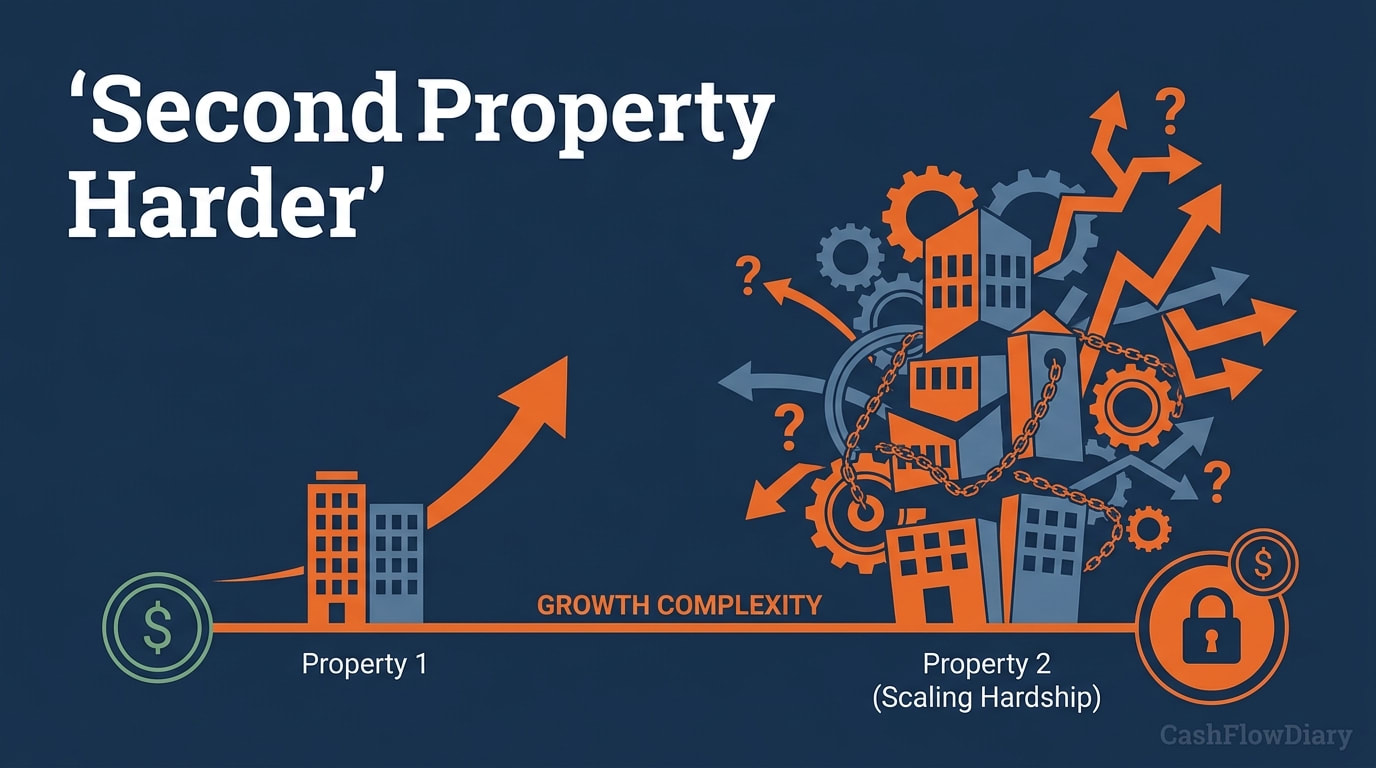
Your second rental property feels harder than the first because you spent your margin on the first one: the cash reserve that absorbed surprises on property one is gone, and property two starts with roughly $0 of buffer instead of the $10,000–$15,000 buffer a first-time buyer typically starts with, in the deals I see. That is a liquidity problem, not a skill problem, and it is the reason most investors stall somewhere between unit one and unit three.
I have been in real estate for 18 years and focused on short-term rentals since 2016, and I have trained more than 10,000 operators. The pattern almost never changes. Property one builds confidence. Property two tests the systems that confidence was hiding.
The Real Reason Your Second Property Feels Different
Your first property worked because you had one thing your second one lacks: margin.
On property one you had time, cash reserves, and the ability to absorb surprises. A water heater failed and you wrote a check. A tenant left early and you covered two weeks of vacancy from savings. By the time property two arrives, that margin has already been deployed covering property one's problems. You start the second deal with less runway than you had at the start of the first.
Property one did not test your systems, because you were the system. You answered the messages, met the cleaner, drove over when the lockbox jammed. At two units those same tasks collide on the same weekend. The work does not double. It doubles and then overlaps.
None of this means you bought a bad deal. It means owning real estate at scale requires capital reserves for every unit, a maintenance buffer per unit, and carrying costs that compound as the portfolio grows. Those requirements show up on unit two whether or not you budgeted for them.
The Cash Flow Trap That Catches Most Investors at Property Two
Here is the arithmetic most investors skip.
Say property one tied up $40,000 in capital: down payment, closing costs, and reserves. Property two needs another $40,000. You have now deployed $80,000 before either property has produced a stabilized year of income. Add one boiler replacement, one vacant month, and one roof repair you did not budget for, and the number climbs past $90,000 while your reserve account reads near zero.
Each additional owned unit also adds a fixed monthly obligation: a mortgage payment, an insurance premium, a property tax escrow, and a reserve account. It adds a lender who wants to see your debt-service coverage ratio before the conversation goes anywhere. IRS Publication 527 spells out how those ownership costs get treated — depreciation, repairs, and capital improvements each follow different rules, which is part of why owners routinely underestimate the real annual cost of a unit.
This table lays out what the capital stack looks like as you add owned units, using the $40,000-per-unit figure above and a $2,500 monthly fixed obligation per unit for mortgage, taxes, and insurance.
Owned units | Capital deployed | Fixed monthly obligation | Reserve needed at 6 months |
|---|
1 | $40,000 | $2,500 | $15,000 |
2 | $80,000 | $5,000 | $30,000 |
3 | $120,000 | $7,500 | $45,000 |
5 | $200,000 | $12,500 | $75,000 |
Read the right-hand column again. To hold five owned units responsibly you need $75,000 sitting idle on top of $200,000 already deployed. That is the wall. It is not motivation. It is math.
The Question Nobody Asks at Property Two
When the squeeze hits, most investors ask one of two questions: should I sell property two, or should I refinance property one? Both keep you inside the same model, and both cost you either equity or time.
The question that actually moves the needle is different: do you need to own a property to earn short-term rental income from it?
You do not. You need control of the unit and permission to host in it. Ownership is one way to get control. A lease with written subletting rights is another, and it costs a fraction as much.
How Rental Arbitrage Solves the Scale Problem
Rental arbitrage means you lease a property from a landlord at a fixed monthly rate and host short-term or mid-term guests at nightly or weekly rates. You keep the spread between what guests pay and what you pay the landlord.
No mortgage. No property tax escrow. No capital reserve for a roof, because the roof is not yours. You are operating a hospitality business inside a lease agreement, which means your entry cost is first and last month's rent plus furnishings instead of a down payment plus closing costs.
Rough entry ranges I see operators hit — illustrative, not survey data — based on furnishing a two-bedroom with used and mid-tier goods:
Ownership: $20,000–$60,000 per unit (down payment, closing, reserves)
Arbitrage: $3,000–$8,000 per unit (first and last month rent plus furnishings)
Five owned units: $150,000–$300,000 in capital
Five arbitrage units: $15,000–$40,000 in capital
At the low end of those ranges you can stand up five arbitrage units for less than the down payment on a second owned property. The trade is real and worth stating plainly: you give up appreciation and depreciation deductions, and you accept lease-renewal risk. In exchange you get speed, and you stop spending reserves you do not have.
The Census Bureau's housing data is useful here for a sanity check on your own market — if rental vacancy in your metro is running high, landlords have a reason to take your call, and that is the market condition arbitrage depends on.
The Numbers: What One Arbitrage Unit Actually Earns
Work a single illustrative unit all the way through. You lease a two-bedroom in a steady mid-size market for $1,800 per month. Comparable furnished units book at $100–$160 per night. At 65% occupancy, about 20 booked nights per month, gross revenue lands between $2,000 and $3,200.
Then subtract. Cleaning runs $90 per turnover and at eight turnovers that is $720, though guests usually cover most of it through a cleaning fee. Platform fees run roughly 3% to the host under Airbnb's split-fee structure, where the guest pays a separate service fee; under host-only pricing the host pays closer to 14% to 16% instead, per Airbnb's published service-fee documentation. Supplies, utilities, and internet on a two-bedroom typically run $250–$350 combined.
Line item | Conservative month | Strong month |
|---|
Gross booking revenue | $2,000 | $3,200 |
Rent to landlord | -$1,800 | -$1,800 |
Platform fees (3%) | -$60 | -$96 |
Utilities, internet, supplies | -$300 | -$350 |
Net cleaning cost after guest fees | -$120 | -$160 |
Net to operator | -$280 | $794 |
That conservative column matters more than the strong one. A single unit at $2,000 gross and $1,800 rent loses money every month. The spread only works when your gross clears rent by roughly 1.6x or better, which is why the lease price you negotiate decides the deal before you buy a single pillow. Three units running at the strong end produce roughly $2,400 per month net with no mortgage application and no debt-service calculation anywhere in the file.
Use demand-based pricing rather than a flat nightly rate, and expect your average daily rate to climb as your review count passes 10 and then 25. The first 90 days are the weakest 90 days you will have.
The First-Unit Process: A 30-Day Checklist
Run this in order. Skipping step three is how operators end up furnishing a unit they are not allowed to host in.
Pick one submarket and pull 15 comparable furnished listings. Record nightly rate, occupancy, and bedroom count. If comps do not clear 1.6x the long-term rent, pick a different submarket.
Build a shortlist of 10 landlords with visible vacancy — listings sitting more than 30 days, small private owners over large management companies.
Propose a managed sublease: guaranteed rent paid on the first, professional cleaning between guests, and written permission for short-term hosting. Get the hosting clause in the lease itself, not in an email.
Confirm local rules before signing. Many cities require registration, and jurisdictions like Texas apply a state hotel occupancy tax to short-term lodging (6% state in Texas, plus local hotel tax). Check registration and tax obligations for your city and state.
Furnish for $3,000–$8,000. Marketplace and IKEA. Functional, clean, and photogenic beats new.
Shoot photos in daylight, list on Airbnb and Furnished Finder the same week, and price 15% below comps until you have five reviews.
Track three numbers weekly: net cash flow per unit, occupancy, and average daily rate. Target your first booking inside 30 days of signing.
If you want a second set of eyes on whether your market and your numbers support this, book a complimentary one-on-one diagnostic call. The call is free. If it makes sense afterward, we build a $997 action plan tailored to your market, your capital, and your available hours.
What to Do This Week
If you are at property one and already dreading property two, stop acquiring for a quarter. Rebuild the reserve to six months of fixed obligations first, then add income through a model that does not consume the reserve.
If you are already at property two and feeling the squeeze, you do not have to sell anything. Arbitrage runs alongside owned property with a separate capital pool and a different risk profile. Keep the owned units, stabilize them, and add cash flow through leases while the equity does its slow work.
Your second rental property feeling impossible is not a signal to quit. It is a signal that the ownership model has capital limits, and you have reached yours. The next unit does not have to come with a mortgage attached.
Frequently Asked Questions
Why does my second rental property feel harder than the first?
Because your reserve is gone. Property one consumed the buffer that let you absorb surprises, so property two starts with near-zero runway while carrying the same maintenance, vacancy, and carrying-cost risk. The work also overlaps instead of queueing neatly, which makes two units feel like four.
How much cash do I actually need to hold two owned rentals?
Using a $2,500 monthly fixed obligation per unit, six months of reserves for two units is about $30,000 on top of the roughly $80,000 already deployed. If your reserve is under three months per unit, one failed system can force a sale at the worst possible time.
Is rental arbitrage legal?
It is legal where the lease permits subletting for short-term stays and where local rules allow short-term rentals. Get the hosting permission written into the lease, register with the city if registration is required, and confirm occupancy or hotel tax obligations before your first booking. Skipping any of those three is where operators get shut down.
How much does one arbitrage unit earn per month?
In the illustrative $1,800-rent example above, net ranges from a $280 monthly loss to about $794 in profit depending on occupancy and rate. The deciding variable is the rent you negotiate: gross revenue needs to clear rent by roughly 1.6x before the spread is worth operating.
Should I sell my second property to relieve the cash squeeze?
Selling under pressure usually converts a temporary liquidity problem into a permanent equity loss, plus transaction costs and possible depreciation recapture. Cut expenses, extend a stay to mid-term, or raise income before you list. Sell only if the unit is structurally negative after 12 months of honest numbers.
Can I run arbitrage and owned rentals at the same time?
Yes, and most operators I work with eventually do. Keep separate bank accounts and separate bookkeeping so a slow month in one model does not quietly drain the other. Owned units build equity slowly, lease-based units produce cash quickly, and the two failure modes are different.
Sources
Related Reading