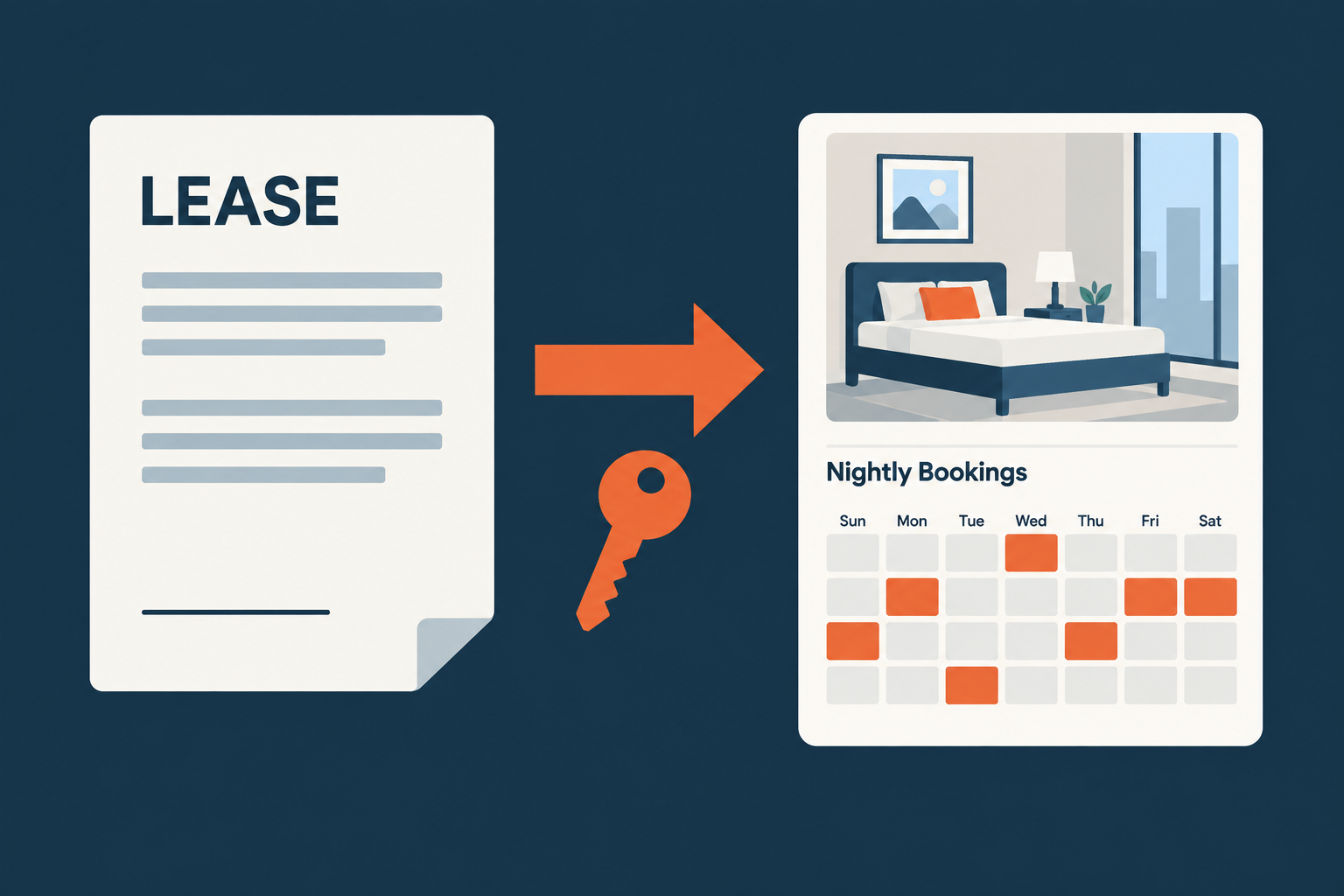
You do not need a mortgage to run short-term rentals. The path without ownership is rental arbitrage: you lease a unit at market rent, get written permission to sub-let it for nightly stays, furnish it, and run it as a hospitality business on the spread between rent and booked revenue. A $5,000/month net target is not a one-unit outcome. It is a unit-count question, and the first unit is a systems build, not a payday.
Last updated: 2026-09-21
I have spent more than 18 years in real estate, focused on short-term rentals since 2016, and I have trained more than 10,000 operators through CashFlow Diary. The operators who fail at arbitrage almost never fail at decorating or listing copy. They fail at the lease, the permit, and the cash cushion. So that is where most of this article sits. This is educational material, not tax, legal, or investment advice — your lease, your city code, and your tax treatment need your own attorney and CPA.
What Rental Arbitrage Is — and What It Is Not
Arbitrage is a lease business. You sign a residential lease, you get a written addendum allowing nightly sub-letting, and you take on the rent obligation for the full term. You own nothing. You build no equity. You get no appreciation, no depreciation deduction on a building you do not hold, and no asset to sell at the end.
What you do get is a lower entry cost and a faster start than purchase. What you also get is a fixed monthly liability that does not care whether you booked. If the unit sits empty in February, rent is still due on the first. That single sentence is the whole risk profile.
Two more things arbitrage is not. It is not passive. You are running cleaning, guest communication, restocking, maintenance calls, and pricing. It is also not automatically legal, and the platform will not make it legal for you. Plenty of leases forbid sub-letting outright, plenty of HOAs and buildings ban stays under 30 days, and plenty of cities require a registration or license tied to the property. Austin defines a short-term rental as a residence rented for fewer than 30 consecutive days and licenses them annually, and as of July 1, 2026 the city says it will ask platforms to remove unlicensed properties from their listings. Nashville moved to a new online short-term rental permit application process on March 11, 2026. Airbnb's own responsible-hosting page tells hosts to read the lease, check with the landlord, and check HOA or co-op rules for any prohibition on sub-letting, and suggests adding a rider to the contract.
Treat "is this permitted here, in this building, under this lease" as a gate you clear before money moves. Not after.
The Unit Economics, Walked to Net
Below is an illustration, not a market forecast and not a promise. The inputs are assumptions I chose to show the shape of the math, not data from any market. Every line is a number you must replace with your own quotes and comps before you sign anything.
Assumptions: one 2-bedroom unit, rent $1,800/month, average nightly rate $150, 65% occupancy across the year, tenant pays utilities, cleaning fee billed to guest at cost, and a 3% host service fee. That 3% is the host side of Airbnb's split-fee structure, which the platform says most home hosts pay; Airbnb is migrating hosts to a single-fee structure, so confirm which fee applies to your listing rather than assuming 3% forever.
Line item | Illustration (monthly) | How to get your own number |
|---|
Gross booked revenue (65% of 30 nights × $150) | $2,925 | Your own comp research and quoted rates |
Host service fee (3% split-fee) | -$88 | Your platform's current fee schedule for your listing |
Rent | -$1,800 | Signed lease |
Utilities, internet, trash | -$260 | Provider quotes for that address |
Cleaning not covered by guest fee (turn gaps, deep cleans) | -$140 | Cleaner's rate card |
Consumables and restock | -$110 | 2-3 months of receipts |
Software (pricing, messaging, locks) | -$45 | Vendor pricing pages |
Insurance (STR-endorsed policy, owner named) | -$95 | Broker quote |
Maintenance and damage reserve | -$150 | 5% of gross, set aside monthly |
Permit, license, and lodging-tax compliance | -$60 | City fee schedule |
Net before income tax | $177 | — |
That is the point of the table. When you walk a single unit all the way to net with every line filled in, the spread is thinner than the pitch decks suggest. Change three assumptions — occupancy to 75%, nightly rate to $175, rent to $1,650 — and the same unit nets several hundred dollars more. Change them the other way and it nets nothing. Arbitrage lives or dies on a spread you do not fully control.
The lines operators forget: the turn-gap cleans nobody bills a guest for, the reserve for a broken dryer, the lodging tax, and the month with a five-night booking and 25 empty nights. Build the sheet with those lines in it or you are not looking at your business.
Why $5K/Month Is a Unit-Count Question
If a mature unit nets a few hundred dollars a month, $5,000/month net is arithmetic: net per unit divided into 5,000. At $400 net, that is roughly a dozen units. At $700, seven or eight. At $1,200 in a high-rate market with high seasonality risk, four or five. I am not going to tell you which number your market produces, because I cannot know it and neither can anyone selling you a course.
The first unit is not an income unit. It is where you build the systems: the cleaner who answers, the message templates, the pricing rules, the restock list, the maintenance bench, the books. Unit two either proves those systems transfer or exposes that unit one was carried by your personal attention. Do not sign leases three through six until unit two runs for 90 days without you improvising.
Scaling multiplies the liability before it multiplies the income. Six leases is six rent obligations in a soft quarter. That is the real shape of the growth curve.
One more scaling note. Your per-unit net improves with count in a few places and worsens in others. Cleaning rates improve when you give one cleaner five units in a radius. Software cost per unit drops. But your management load, your tax complexity, and your exposure to a single landlord dispute all grow. Plan the portfolio around a geography tight enough that one cleaner, one handyman, and one supply run cover it.
The Arbitrage Launch Process
Work these in order. Skipping the first two is the most expensive mistake in this business.
Step 1 — Clear the legal gate in writing
Pull the city or county short-term rental ordinance and read the actual text before you tour a single unit. Answer three questions: does the jurisdiction permit non-owner-occupied nightly rentals, is there a cap or zoning overlay on your target area, and what does registration require. Then check the building — HOA rules, condo docs, or property management policy. If any layer says no, walk. There is no workaround that survives a neighbor complaint.
Step 2 — Build the pro forma before you tour units
Use the table above as a skeleton. Fill it with quoted rent, real comps for nightly rate, and a conservative occupancy figure. Model a low season month at half your assumed occupancy. If the annual picture only works at 80% occupancy, you do not have a business, you have a bet. The SBA's startup-cost guidance is a reasonable frame for separating one-time capital from monthly operating cost.
Step 3 — Set up the business and the money
Choose an entity structure with your CPA and attorney — the IRS publishes plain descriptions of the options. Open a business bank account and a separate card. Keep a reserve equal to at least three months of rent per unit before launch, not after. Carry short-term rental-appropriate insurance and be ready to name the owner as an additional insured.
Step 4 — Approach landlords with full disclosure
Lead with what you are: a tenant running a licensed nightly-rental business in the unit, with insurance, professional cleaning on every turn, and guest screening. Show the pro forma. Offer what a landlord actually wants — on-time rent, a longer term, access for inspection, and a unit that gets cleaned 8 times a month instead of never. Never describe it as "a few guests occasionally." A landlord who finds out later terminates, and they are right to.
Bring a one-page packet: who you are, the insurance you carry, the cleaning cadence, the guest screening you apply, references if you have them, and the term you want. Expect to be told no more often than yes. A landlord pipeline is a numbers exercise — the operators who move fastest are the ones having several of these conversations a week rather than waiting on one.
Step 5 — Get the addendum right before you sign
Verbal permission is not permission. The sub-let and nightly-rental terms belong in a signed addendum. The checklist in the next section is what I look for. If a landlord will not put permission in writing, that is your answer.
Step 6 — Furnish to a payback number, then launch
Set a furnishing budget and divide it by your modeled monthly net to get a payback period in months. If payback runs past 12 months, either the budget or the unit is wrong. Photograph properly, write the listing around who actually travels to that block, and price with rate automation rules you set yourself rather than accepting defaults.
Step 7 — Run it without living in it
Smart lock, cleaner with a checklist and photo confirmation, a maintenance contact who takes calls, saved message templates, and a weekly 30-minute review of rate, occupancy, and reviews. If you are driving to the unit between guests, you have a job, not a system, and it will not survive six units.
Track three numbers from day one: net per unit per month, occupancy, and review score. Net tells you whether the model works. Occupancy tells you whether your pricing is calibrated. Review score tells you whether the unit is scalable or whether you are one bad month from a ranking problem you cannot price your way out of.
The Lease and Addendum Checklist
Take this to your attorney. It is a starting list, not legal advice. If you want the longer version of the pitch and the clause language, I walk through it in the landlord pitch and lease clause script.
Clause | What it must say | Why it matters |
|---|
Written sub-let permission | Owner consents to sub-letting for stays of any length, including nightly | Without it, every booking breaches the lease |
Nightly-rental / commercial use | Explicitly allows transient occupancy and listing on booking platforms | Silence here is later read against you |
Insurance | You carry STR-appropriate liability coverage, owner named as additional insured, proof on renewal | Protects owner and keeps the addendum enforceable |
Inspection access | Owner may inspect on defined notice, at a defined frequency | Buys trust and catches damage early |
Permit cooperation | Owner will sign or provide documents the city requires from the property owner | Some jurisdictions require the owner's signature or proof of ownership |
Term and renewal | Term long enough to recover furnishing capital, with stated renewal terms | Protects payback period |
Exit and termination | Notice period, cure rights, who handles existing bookings, furniture removal | The clause that saves you in a dispute |
Damage and reserve | Deposit amount, damage process, guest-caused damage handling | Avoids fights over guest incidents |
Assignment | Whether you may assign the lease to a buyer of your operation | Determines if the unit has resale value |
Failure Modes, and Who Should Not Do This
Four failures cause most of the arbitrage losses I see, and three of them happen before the first guest checks in.
Lease signed before the permit check. The operator falls for a unit, signs, then learns the city bars non-owner-occupied stays under 30 days. Now there is a 12-month rent obligation and no legal business model. Fix: Step 1, always, in writing.
Seasonality ignored. The pro forma uses a peak-month rate as the annual average. Fix: model your low season separately and hold reserves through it. The Census Bureau's Housing Vacancy Survey gives you national, state, and large-metro rental vacancy rates as a backdrop; your block-level read still has to come from live comps and local rate history.
One-unit cash crunch. Furnishing eats the reserve, then a slow month arrives and rent comes from savings. Fix: three months of rent held per unit, untouched, before launch.
Landlord terminates. Usually because the arrangement was never fully disclosed or the insurance and inspection terms were never honored. Fix: transparency and a signed addendum with exit terms.
Who should not do this: anyone who cannot cover several months of rent per unit from reserves without stress; anyone who needs income within 60 days; anyone unwilling to be on call for guest and maintenance problems in the first year; anyone in a market or building that prohibits nightly rentals and is hoping enforcement stays quiet. If you want appreciation, tax depreciation, and an asset, buy — arbitrage is not a cheaper version of ownership, it is a different business with different risk.
Want an operator to pressure-test your arbitrage plan with you? Start with a complimentary one-on-one diagnostic call and bring your pro forma, your target ordinance, and your draft addendum.
Frequently Asked Questions
Do I need to own property to run short-term rentals?
No. Rental arbitrage lets you operate a nightly rental in a unit you lease, provided the lease, the building rules, and local ordinance all permit sub-letting for short stays and you hold any required registration. You take on the rent obligation and build no equity, so the trade is lower entry cost for ongoing fixed liability.
How many units does $5,000/month net take?
It depends entirely on net per unit in your market, which you must model rather than assume. If a unit nets $400 after every expense line, the arithmetic points to roughly a dozen units; at $700 it is seven or eight. Build your own sheet with rent, platform fees, utilities, cleaning, consumables, insurance, taxes, and a maintenance reserve before you trust any unit count.
How much capital does the first unit need?
Plan for deposits and first month's rent, furnishing and setup, photography, permit and license fees, insurance, and a reserve of at least three months of rent. The SBA's startup-cost worksheet is a reasonable structure for separating one-time from recurring costs. Divide furnishing cost by modeled monthly net to get your payback period.
What has to be in the lease addendum?
At minimum: written owner consent to nightly sub-letting, an insurance clause naming the owner as an additional insured, defined inspection access, cooperation on permit paperwork requiring the owner's signature, a term long enough to recover furnishing capital, and clear exit terms covering notice and existing bookings. Have an attorney draft or review it.
Is arbitrage income taxed differently than rental income?
Tax treatment depends on your structure, your level of service, and how the activity is classified, which is exactly why this needs a CPA rather than an article. IRS Publication 527 covers residential rental income reporting and IRS business-structure guidance covers entity choice. This article is educational, not tax advice.
Sources