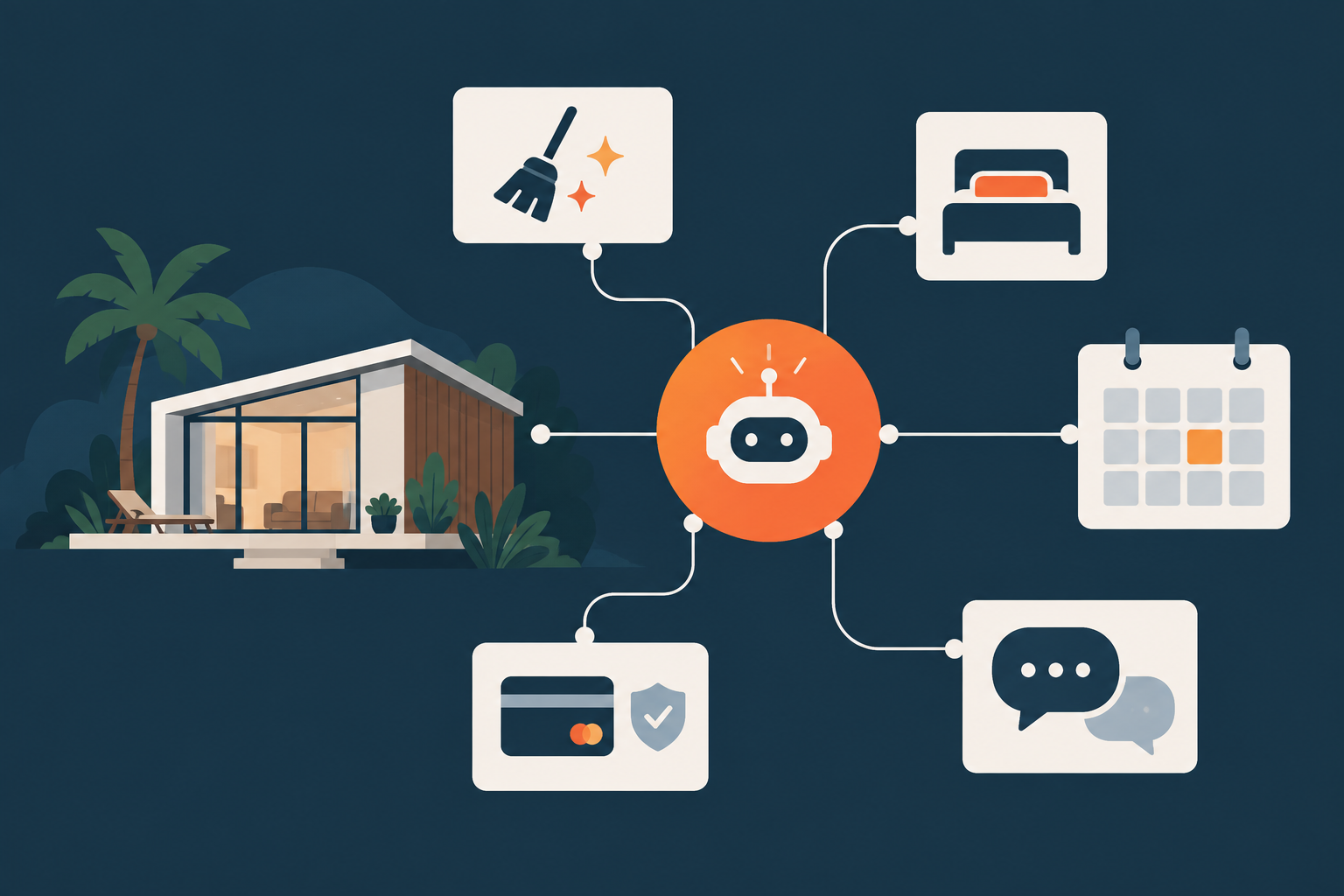
Anthropic's Claude Managed Agents, launched in public beta on April 8, 2026, runs a Claude agent in a hosted environment that can read files, run code, search the web and call your connected tools, billed at model token rates plus $0.08 per session-hour of running time. For a short-term rental operator, four jobs fit it well as of September 2026: drafting guest messages, creating turnover tasks, turning meeting notes into tasks, and drafting review responses, with a human approving anything a guest or vendor will see.
This is an operator guide, because the details are what cost you money.
Some context on why I care. I remember the first time I clicked a mouse. I remember saving data to magnetic tape. I have been in real estate for more than 18 years and focused on short-term rental since 2016, and I have built a list of more than 10,000 short-term rental operators. Most software waves moved the busywork rather than removing it. Hosted agents are the first tool I have used that can take a messy input, like a call transcript or a guest thread, and produce a finished, structured output without me stitching five apps together. That is useful. It is also easy to misuse, so this guide spends as much time on rules and cost caps as on features.
What Is Claude Managed Agents? Plain-English Definition (September 2026)
Anthropic describes Managed Agents as a pre-built, configurable agent setup that runs on its managed infrastructure. In plain terms: instead of you building the loop that calls the model, runs tools and keeps state, Anthropic runs that loop for you on its own servers. You define the agent, and it works through a task step by step.
The official docs organize the product around four pieces:
Agent: the model, the system prompt (your standing instructions), the tools, any MCP servers (connectors to outside software) and skills.
Environment: where the work runs, either an Anthropic-managed cloud sandbox or a sandbox you host yourself.
Session: one running instance of the agent doing one job, such as "draft replies to this morning's guest messages."
Events: the messages passed back and forth, including your instructions, tool results and status updates.
A few facts matter for operators, and each one is confirmed on Anthropic's own pages:
It lives in the Claude Console, not the claude.ai chat app. You need a Claude API key. The Console has a visual builder where you pick a model, write the system prompt, add MCP servers and tools, and then run a test session on the same page while watching the event stream.
It is still a beta. Every request carries a beta header, and Anthropic says behaviors may be refined between releases. Build as if the details will shift.
Credentials sit in vaults. Anthropic's vault feature lets you register a credential for an outside service once and reference it by ID when a session starts. The docs say the agent never sees the secret value; it is swapped in when the agent makes an outbound request.
Data retention has limits. Sessions store conversation history and outputs on Anthropic's side, and the docs state Managed Agents is not currently eligible for Zero Data Retention. Keep guest payment details and ID scans out of it.
The vault does not connect to Airbnb, and nothing will for most hosts, because Airbnb does not offer an open public API to individual hosts. An agent can reach your guest conversations only through software that already has approved access, usually your property management system, and only if that system exposes an API or connector you can authenticate.
What It Costs to Run an Agent on Your Portfolio
Anthropic's pricing page says Managed Agents is billed on two things: tokens (the text the model reads and writes) at normal model rates, and session runtime at $0.08 per session-hour. Runtime is metered to the millisecond and only while the session is actively running, so idle time spent waiting on your approval does not count. Web searches inside a session add $10 per 1,000 searches.
Here are the list prices on the pricing page as of September 25, 2026, for the two models I would consider for STR back-office work:
Cost component | Claude Haiku 4.5 | Claude Sonnet 5 |
|---|
Input tokens, per million | $1.00 | $2.00 |
Output tokens, per million | $5.00 | $10.00 |
Session runtime, per running hour | $0.08 | $0.08 |
Web search, per 1,000 searches | $10.00 | $10.00 |
To make that concrete, below is an illustrative guest-message drafting job. The assumptions are mine, not Anthropic's: each draft reads about 8,000 tokens (your house manual excerpt, the guest thread and the reservation details), writes about 600 tokens, and runs for 2 minutes. At 300 drafts a month, which is roughly what a 10-unit portfolio at 70% occupancy with 3-night average stays might generate at four messages per stay (10 × 30 × 0.70 ÷ 3 = 70 stays; 70 × 4 = 280, rounded up), the math works out like this:
Line item per draft | Haiku 4.5 math | Haiku 4.5 cost | Sonnet 5 math | Sonnet 5 cost |
|---|
Input tokens | 8,000 × $1 ÷ 1,000,000 | $0.0080 | 8,000 × $2 ÷ 1,000,000 | $0.0160 |
Output tokens | 600 × $5 ÷ 1,000,000 | $0.0030 | 600 × $10 ÷ 1,000,000 | $0.0060 |
Runtime | 2 ÷ 60 × $0.08 | $0.0027 | 2 ÷ 60 × $0.08 | $0.0027 |
Total per draft | | $0.0137 | | $0.0247 |
Total for 300 drafts | | about $4.10 | | about $7.40 |
The model bill is rarely your real cost. Your real cost is the hour you spend building it, the review time on every draft, and the damage from one bad message sent unreviewed. A runaway session looping on web searches can cost more than 300 clean drafts, so set budgets.
Which STR Workflows Fit an Agent, and Which Do Not
An agent earns its place when the input is messy, the output has a clear shape, and a person can check the result in under a minute. That describes a lot of STR back-office work. It does not describe pricing decisions, guest disputes or anything involving money moving.
Guest message drafts
The agent reads the guest's message, your house manual and the reservation details, then writes a reply in your voice. You approve and send. This fits because the predictable questions (Wi-Fi, parking, check-in time, early check-in requests) make up most of the volume. Keep the approval step. A draft that promises a 1 p.m. check-in you cannot deliver costs you a review.
Turnover task creation
When a reservation lands or changes, the agent creates the cleaning task in your project tool with the unit, the checkout and next check-in times, the linen count and any notes from the last guest. This fits because the task has a fixed shape and errors are easy to spot. The agent should create tasks. It should not message your cleaner directly until you have run it for a month.
Meeting notes to tasks
This was the demo that got operators excited when the product launched, and it holds up in practice. Paste in a transcript from an owner call, a co-host check-in or a vendor walkthrough, and the agent pulls out each action item with an owner and a due date and files them in your task tool. It fits because a missed action item is the most common way small STR teams drop the ball. Review the list before it files anything.
Review response drafts
The agent reads a new review and drafts a public response that thanks the guest, addresses any specific complaint and stays factual. Five-star reviews are low-risk. Anything three stars or below should get your eyes and probably your rewrite, because a public response is permanent and future guests read it.
What to keep off the agent
Pricing changes. Use a purpose-built demand-based pricing tool and your own judgment.
Refunds, damage claims and security deposits. Money and disputes stay human.
Anything a guest sees without review, at least for the first 30 days.
Emergencies. A leak or lockout at 2 a.m. needs a person on the phone.
Is It Safe? Human-in-the-Loop Rules I Would Not Skip
Anthropic built approval controls into the product, and they map neatly onto STR risk. The docs describe three permission policies for tools the agent can call: always allow (runs with no confirmation), always ask (the session pauses and waits for your approval) and auto (the server evaluates each call and runs it, denies it or pauses for you). Tools that come in through MCP connectors default to always ask. Keep that default.
My rules, in order of importance:
Anything that leaves your business needs a human click. Guest messages, vendor messages, owner emails and public review responses all go through always ask.
Internal writes can run on their own once they have earned it. Creating a task in your own project tool can move to always allow after two weeks without a correction.
One agent, one job. A guest-messaging agent should not also have access to your accounting tool. Narrow access limits the blast radius of a bad instruction or a malicious message.
Treat guest text as untrusted. A guest message is input from a stranger. Anthropic's vault design keeps credentials out of the agent's reach, which matters because of prompt injection, which is text designed to trick the model. Write your system prompt so the agent never follows instructions that appear inside a guest message.
Log every correction. When you edit a draft, note why. Ten notes in, you will know which instruction to add to the system prompt.
The Process: Building Your First STR Agent in Seven Steps
You do not need to be a developer to build the first version in the Console, but you do need an API key, a batch of last month's real guest threads to test on and about two hours. Here is the order I would follow.
Pick the one workflow that costs you the most weekly time. Time it for a week first. If meeting follow-up costs you 90 minutes a week and guest messaging costs you 4 hours, start with messaging.
Write the output format before the prompt. Decide exactly what a finished task or draft looks like: fields, length, tone, what it must never say.
Build the agent in the Console. Choose the model (start with Haiku 4.5 for drafting jobs), write the system prompt, and add only the connectors this one job needs.
Store credentials in a vault, never in the prompt. Connect your task tool or PMS through a vault credential so the agent never handles the raw key.
Set every outward-facing tool to always ask. Leave internal tools on always ask too until the agent has a clean run history.
Run 20 test sessions on real past inputs. Use last month's guest threads or call notes. Grade each output pass or fail, and fix the prompt after each batch of five.
Go live with a budget and a weekly review. Set a per-session spend cap, check the traces every Friday for the first month, and only then consider loosening permissions or scheduling runs.
Anthropic also supports scheduled deployments, which start sessions on a cron schedule you set, such as every weekday at 7 a.m. That is useful for a morning digest of new reviews or an end-of-day turnover check. Add scheduling last, after the agent has proven itself on manual runs.
Cost Control and Failure Modes
The pricing is predictable. The failure modes are where operators lose money and time. Anthropic added a session budget feature that sets a hard dollar ceiling when you create a session. The platform prices what the session consumes at list rates and stops issuing new model requests once the cap is reached. The docs note the request already in progress still finishes, so the final cost can land slightly past the cap. The amount is set in whole US cents, so "50" means 50 cents.
How I would use that:
Cap drafting sessions low. If a normal draft costs 1 to 3 cents, a 25-cent cap gives you room for a long thread and stops a loop early.
Cap research sessions separately. Web searches cost $10 per 1,000, so an agent told to "research local events" can burn through searches quickly. Give it an allowlist of domains and a budget.
Watch runtime, not only tokens. Runtime only counts while running, but a stuck session that keeps working is still billed.
The failure modes I would plan for:
Confident wrong facts. The agent states a check-in time or pet fee from an old house manual. Fix: keep one current source document and point the agent only at that.
Tone drift. Drafts get longer and more formal over time. Fix: include two approved example replies in the system prompt.
Silent connector failure. A credential expires and tasks stop appearing. Fix: check that the week's task count matches the week's reservation count every Friday.
Beta changes. Anthropic can refine behavior between releases. Fix: rerun your 20 test inputs after any release note that touches Managed Agents.
Where This Fits Next to the Rest of Your Stack
Managed Agents is a layer that sits on top of the tools you already run. It does not replace your PMS, your pricing tool or your channel manager, and it cannot reach Airbnb conversations except through software that already has access. If you are still picking those core tools, start with our 2026 roundup of AI tools for STR operators and the STR automation tech stack guide, then come back here once the basics are running.
There is also a limit to how much you should automate. Every host now has the same templates and the same tools, and guests notice when a listing feels generic. Automation is commoditizing STR listings when operators hand off judgment along with the busywork. Use the agent to clear the repetitive work so you have more time for the parts guests remember, like the quick human reply when something goes wrong.
The shift I have seen since early 2025 is real. In my own business, work that used to take a small team two weeks to design, like SOPs, follow-up systems and task routing, can now be drafted and tested in one working session. That makes the operators who document their processes faster than everyone else, because an agent can only follow a process you can describe.
If you want help deciding which workflow in your portfolio should get an agent first, and which should stay manual, book a free one-on-one diagnostic call. If you want a written build order afterward, that is what our $997 action plan covers.
Frequently Asked Questions
Is Claude Managed Agents the same as the Claude chat app?
No. Managed Agents is part of the Claude Platform and is built in the Claude Console with an API key. The claude.ai chat app is a separate product for conversations. You can test an agent visually in the Console before connecting it to anything.
How much does Claude Managed Agents cost for a small STR portfolio?
Anthropic bills model tokens at standard rates plus $0.08 per running session-hour, and web searches at $10 per 1,000. In the illustrative example above, 300 guest-message drafts a month cost about $4.10 on Haiku 4.5 or $7.40 on Sonnet 5. Your build and review time will cost more than the bill.
Can an Anthropic agent log into my Airbnb account?
It should not, and you should not try. Airbnb does not offer an open public API to most individual hosts. An agent can only reach guest conversations through a property management system or other software that already has approved access and exposes a connector you can authenticate.
Is it safe to let an agent reply to guests automatically?
Not at first. Set outward-facing tools to always ask so every guest message waits for your approval. Guest text is untrusted input, so write the system prompt to ignore instructions inside guest messages. Consider auto-send only for narrow, repetitive replies after a clean month.
Do I need to know how to code to build an agent?
Not for the first version. The Console walks you through the model, system prompt, connectors and tools, and it has an inline test runner. You will need someone technical if you want the agent triggered by your PMS or running inside your own software.
What is the first STR workflow I should automate with an agent?
Pick the job that costs you the most time each week and has a clear output shape. For most operators that is guest message drafting or turning call notes into tasks. Avoid pricing, refunds and disputes, which should stay with a person.
Sources
Claude Managed Agents overview — supports the agent, environment, session and events definitions and the Zero Data Retention limit in What Claude Managed Agents Is, in Plain Terms.
Pricing - Claude Platform Docs — supports the $0.08 per session-hour runtime, $10 per 1,000 searches and per-million token rate figures in What It Costs to Run an Agent on Your Portfolio.
Authenticate with vaults — supports the credential vault description in What Claude Managed Agents Is, in Plain Terms and step 4 of The Process.
Permission policies — supports the always allow, always ask and auto policy descriptions in Human-in-the-Loop Rules I Would Not Skip.
Claude Platform release notes — supports the April 8, 2026 public beta launch date and scheduled deployments in What Claude Managed Agents Is, in Plain Terms.
Session budgets — supports the hard spend cap, set in whole US cents, in Cost Control and Failure Modes.
Related Reading