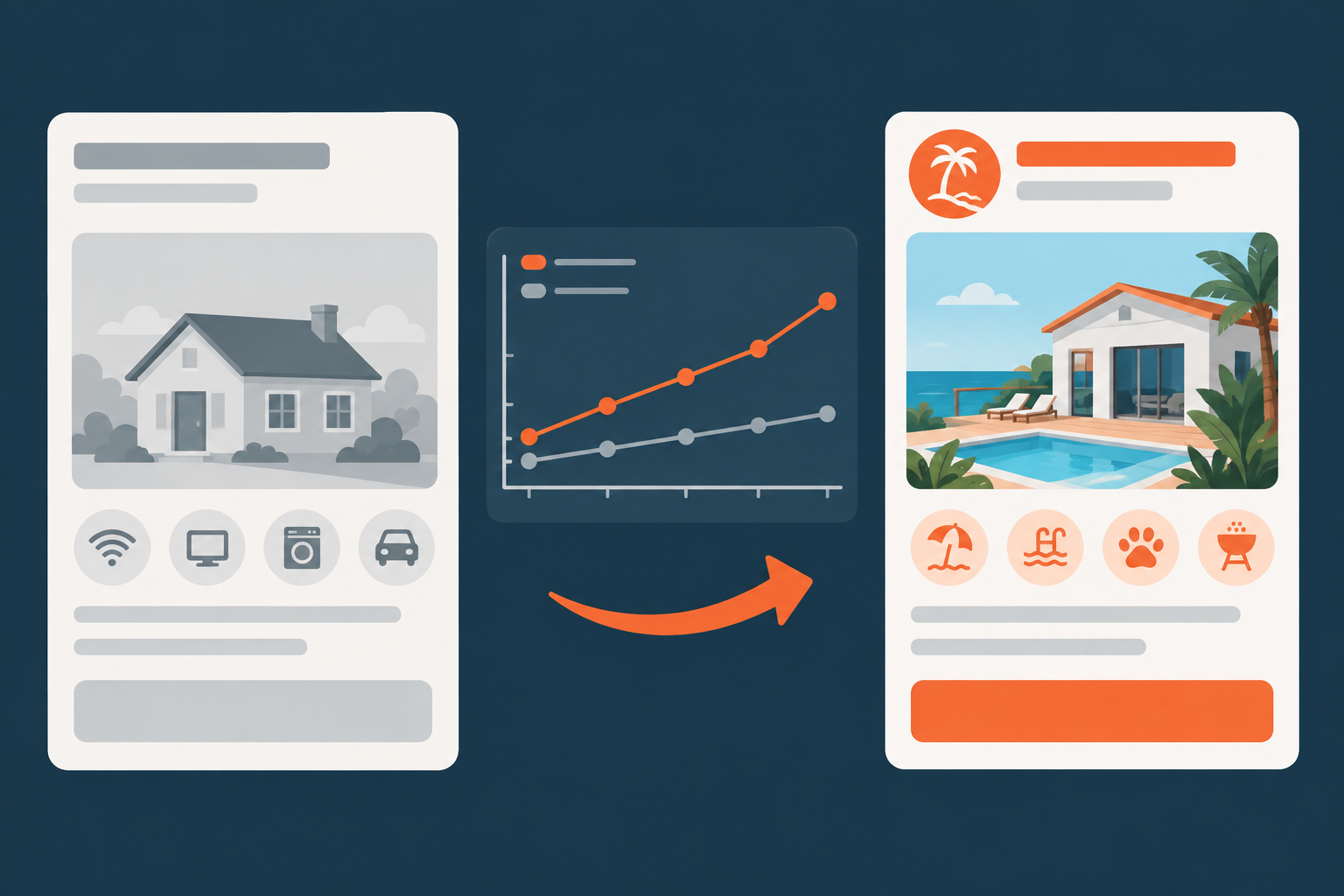
Automation did not flood your market with competitors, but it did erase most of the differences between your listing and theirs. When every operator in a submarket runs the same demand-based pricing tool, sends the same templated messages and lists the same amenity set against the same photo angles, a guest comparing four listings has only one variable left to compare: price. The fix is not less software. The fix is choosing a specific guest segment, fitting one unit to it, and keeping the parts of the guest experience that software cannot copy.
I have been in real estate for more than eighteen years, focused on short-term rentals since 2016, and I have built a list of more than 10,000 short-term rental operators. The pattern is consistent: operators who say their market is saturated almost always have a listing that is interchangeable with nine others within a mile. That is a positioning problem wearing a market-conditions costume.
Underdifferentiation, Not Oversaturation, Is Squeezing Your Rates
Walmart, Target and Nordstrom all sell shirts, often within the same few blocks, and they do not fight each other for the same shopper. Each one picked a customer and built the whole store around that choice: price, layout, staffing, return policy. Nobody walks out of Nordstrom and drives to Walmart for the same purchase.
Most short-term rental listings never make that choice. They are furnished for "everyone," photographed for "everyone," and described with the same list: fast wifi, smart TV, coffee bar, self check-in. When your listing is designed for everyone, the only question a guest can answer is which of the identical options is cheapest that weekend. You lose that contest slowly, one discount at a time, and the software you pay for will keep discounting on your behalf because that is what you told it to do.
The old version of this argument on this site leaned on market-collapse statistics and per-host dollar losses I could not trace to a primary source, so I cut them. You do not need a scary chart to act on this. Pull your own last twelve months: if your average daily rate dropped while your occupancy stayed flat, you are already competing on price.
How Commoditization Actually Happens, Mechanically
Commoditization is not a mood. It is four concrete mechanisms, each of which you can inspect in your own account this week.
Shared pricing inputs. Demand-based pricing tools read from overlapping market data and comparable sets. When your neighbor's tool and your tool watch each other's rates, a single aggressive discount propagates through the block within days. The tools are doing their job. The problem is that every operator handed the same job to the same referee.
Template messaging. Canned check-in sequences and reply macros circulate in every host community and every vendor onboarding flow. Guests who book three different listings in a quarter receive nearly the same eleven messages. Useful operationally, invisible competitively.
Identical merchandising. The same furniture vendors, the same accent wall, the same wide-angle corner shot, the same fourteen-item amenity list. Photos that look like every other listing get compared on price because there is nothing else to compare.
Copied amenity arms races. Hot tub, arcade cabinet, sauna. Each one raises capital cost for all operators and holds its premium for one season, until three neighbors add it and the premium disappears.
Mechanism | What it gives you | What it costs you | Time to lose the advantage |
|---|
Demand-based pricing tool | Faster rate changes, fewer empty gaps | Your rates track the block, including its discounts | Weeks |
Template messaging | Fewer hours on the phone, faster response times | No memorable voice, no segment-specific guidance | Immediate |
Standard staging and photos | Faster launch, acceptable listing quality | No visual reason to pick you over the next listing | One season |
Amenity copying | Short-lived rate bump | Capital spend, upkeep, higher damage exposure | One to two seasons |
Read the columns without flinching. The first two rows are worth keeping. The last two are where operators spend money to become more average.
The Guest Segments Most Operators Never Serve
A segment is not a vibe. It is a group of travelers with a repeatable reason for being in your market, a payer, a length of stay and a short list of things that would make them rebook. Four that are underserved in most metros:
Business and project travel. Weeknight-heavy, booked by an employer or a contractor, sensitive to desk quality, monitor availability, quiet hours and predictable check-in. They care very little about décor.
Medical stays. Patients and caregivers near a hospital or treatment center. They need ground-floor or elevator access, extremely clean linens, a real kitchen, parking near the door, and flexible arrival windows because discharge times move.
Relocation and midterm stays. Thirty to ninety nights, booked by a relocating employee, an insurance carrier or a traveling clinician. They need a full kitchen, laundry in unit, workspace, and a lease-like document rather than a resort experience.
Groups and events. Weddings, reunions, tournaments, conferences. They need beds that actually sleep the advertised count, bathroom ratio, parking count, and a host who answers noise and guest-count questions before booking.
Segment | Typical stay length | Who pays | Three things that win the booking | Main risk |
|---|
Business and project travel | 2–5 nights, weeknights | Employer or contractor | Desk with monitor, quiet rating, invoice-ready receipts | Weekend gaps |
Medical stays | 7–45 nights | Family, sometimes a carrier | Cleaning standard, step-free access, close parking | Cancellations on short notice |
Relocation and midterm | 30–90 nights | Employer, carrier, clinician agency | In-unit laundry, stocked kitchen, written stay agreement | Lower nightly rate, longer vacancy between stays |
Groups and events | 2–4 nights | One organizer | Honest sleeping count, bathroom ratio, parking | Noise complaints, extra wear |
Pick one. Serving two segments at once in a single unit usually means serving neither, because the furnishing and rules decisions conflict. A group listing with a 10 p.m. quiet rule fails both audiences.
Keep the Automation, Stop Outsourcing the Judgment
Automation is operational time savings. It is not positioning. The split that works:
Function | Keep automated | Keep human | Why |
|---|
Rate changes | Yes, with your own floors and minimum stays | Set the floor, the segment calendar and the event overrides yourself | Tools chase occupancy, not your margin or your segment |
Message delivery and timing | Yes | Write the content in your own words, with segment-specific details | Delivery is plumbing; wording is the differentiator |
Cleaning and turnover scheduling | Yes | Inspection standard, cleaner pay, escalation rules | Automation cannot see a stained duvet |
Reviews and follow-up requests | Timing, yes | The ask itself, and any recovery conversation | Recovery is where repeat guests are made |
Listing copy, photos, amenity choices | No | Yours entirely, built for one segment | This is the only lever competitors cannot copy from a dashboard |
Segment choice and pricing floor | No | Yours entirely | Outsourcing this is how you end up average |
Practical version: let software move your rates inside a range you set, and never let it set the range. Keep the automated message schedule and rewrite every template so it reads like a specific host talking to a specific kind of traveler. If you want a deeper look at the pricing side, we cover it in our guide to automated pricing for Airbnb listings.
How to Choose a Segment and Re-Fit One Unit: A Five-Step Process
Do this on one unit, not the portfolio. One unit gives you a clean read and a small loss if you are wrong.
Inventory the demand you already have. Export twelve months of bookings and sort by trip purpose, length of stay, weekday share and who paid. Most operators find one segment already booking them by accident, plus the inquiries they lost. That is your shortlist.
Verify demand outside your own data. Count the local demand generators within fifteen minutes: hospitals, plants, campuses, arenas, corporate parks, courthouses. Call three of them and ask who handles visiting-staff housing. Two returned calls with a real name and a need is enough signal to proceed.
Pick the segment your unit can serve without a renovation. Match the segment table above to what your unit already is. A third-floor walk-up disqualifies most medical stays. A two-bedroom with one bathroom disqualifies groups. Choose the segment with the smallest gap.
Re-fit for the specific stay. Change furnishing, house rules, minimum stay, listing title, photo order, amenity list and message content for that one segment. Budget two to four weeks and treat it as a launch, not a tweak.
Set a ninety-day review with numbers agreed in advance. Write down your target revenue per available night, direct and repeat share, and the review themes you expect. Review at day ninety and either keep going, adjust the offer or revert.
Phase | Weeks | Typical spend | Decision at the end |
|---|
Data and demand check | 1 | Your time only | Segment shortlist of two |
Local verification calls | 1–2 | Your time only | Pick one segment |
Re-fit and relaunch | 2–4 | $600–$3,500, mostly workspace, storage, linens, laundry | Listing live with new positioning |
Measurement window | 12 | Ongoing operating cost | Keep, adjust or revert |
The spend range is an illustration from re-fits I have watched, not a quote. Your number depends on what the unit already has.
Measure the Re-Fit With Three Numbers and One Reading
Occupancy alone will tell you nothing here, because a discount also produces occupancy. Track these instead.
Revenue per available night. Total net revenue divided by all nights the unit was available, including vacant ones. This is the single number that catches both discounting and empty calendars. Compare the ninety days after relaunch to the same ninety days a year earlier, not to last month.
Direct and repeat share. What percentage of nights came from repeat guests, direct bookings or a named referral source such as a relocation coordinator. When you fit a segment properly, this number climbs first, often before rate does. Our write-up on direct booking channel strategy covers how to capture that demand without breaking platform rules.
Length of stay and gap nights. Better fit usually means longer stays and fewer one-night gaps, which lowers cleaning cost per night even if your rate is unchanged.
The reading: review language. Read every review since relaunch and count how many name the thing you built for. "Perfect for my mother's treatment weeks" and "best setup I have had on a six-week project" mean the positioning landed. Reviews that only say "clean and convenient" mean you are still interchangeable.
Metric | Baseline to use | Sign it worked at day 90 | Sign it did not |
|---|
Revenue per available night | Same 90 days last year | Up, with rate flat or up | Up only because you cut rate |
Direct and repeat share | Trailing 12 months | Any measurable increase | Still fully platform-dependent |
Average length of stay | Trailing 12 months | Longer stays, fewer gap nights | Unchanged, more one-nighters |
Review themes | Pre-relaunch reviews | Guests name your segment fit | Generic praise only |
If two of the four move, keep going. If none move in ninety days, the segment choice or the execution was wrong, and the cheapest correction is usually the listing copy and photos rather than more furniture.
Midterm and relocation stays often bring lease-style paperwork and different tax and permit treatment than nightly stays. This article is not tax or legal advice; check your local ordinance and talk to your own CPA and attorney before you change stay lengths. The thresholds are real and specific: Austin defines a short-term rental as a residence rented for less than 30 consecutive days and licenses those properties annually, and Texas hotel occupancy tax does not apply to a guest who stays 30 or more consecutive days without interruption. Both pages are linked below. Your city and state will draw the lines differently.
What This Looks Like When It Works
An operator with a two-bedroom near a regional medical center stops chasing weekend leisure demand. She adds a step-free path from the driveway, a hospital-grade cleaning checklist, a reserved parking spot, a real coffee maker, and a listing title that names the hospital. Minimum stay goes to seven nights. Rate is roughly flat.
What changes over the next two quarters: fewer one-night gaps, four repeat families, two case managers who call her directly, and reviews that read like letters. Her demand-based pricing tool is still running. Her message schedule is still automated. What changed is that she stopped letting software decide who her guest was.
That is the whole play. Keep the tools for the hours they save. Take back positioning, segment choice and guest experience design, because those are the only things left that a competitor cannot copy by subscribing to the same vendor you use.
If you want a second set of eyes on which segment your unit can actually serve, book a complimentary one-on-one diagnostic call and bring your last twelve months of booking data.
Frequently Asked Questions
Should I cancel my pricing tool if it is commoditizing my rates?
No. Cancel the habit of accepting its defaults. Set your own rate floor, minimum stay rules and event-week overrides, and let the tool move rates only inside that range. The time savings are real; the default settings are what make your calendar look like everyone else's.
How do I know whether my market is saturated or my listing is undifferentiated?
Look at the ten listings closest to yours. If you could swap your photos and description with any of them and no guest would notice, the problem is your positioning. Saturation shows up as low occupancy at every price point, including well below your cost. Most operators find their occupancy is fine and only their rate is sliding, which is a differentiation problem.
Can one unit serve two guest segments?
Rarely, and usually at a cost. Furnishing, house rules and minimum stays for business travel conflict with what groups want. If you own several units, give each unit one segment. If you own one, pick the segment with the largest nearby demand generator and the smallest re-fit gap.
How long before a re-fit shows up in revenue?
Plan on ninety days of data before judging it, and longer for midterm and medical stays because those booking cycles are slower. Direct inquiries and review language usually shift first, then length of stay, then rate.
What does the re-fit usually cost?
Most of the spend is workspace, linens, storage, laundry access and new photography rather than a renovation. Operators I work with commonly land in the high hundreds to low thousands per unit, and the ones who need a renovation to serve their chosen segment picked the wrong segment.
Does automation still matter if the real advantage is fit?
Yes, more than before. Once you serve a specific segment, you have more messages, documents and turnover details to manage per stay. Automation buys the hours you then spend on guest experience design. Tools like PriceLabs and Hospitable publish their own pricing and feature pages, so compare their models directly rather than relying on a summary.
Related Reading
Keep reading:
Sources