
Most "best Airbnb course" lists you find in 2026 are affiliate rankings written by people paid on the click, so the honest answer to "which course is best" is that no ranking can tell you — you have to score courses yourself on five things: curriculum depth, instructor proof, support model, refund terms, and total cost including the capital you still need after paying tuition. I have been in real estate for more than 18 years, focused on short-term rentals since 2016, and built a list of over 10,000 short-term rental operators. What follows is the buyer's framework I use when someone asks me whether a program is worth their money, including programs of my own.
The Best Airbnb Courses in 2026: An Operator's Honest Buyer's Guide
Most "best Airbnb course" lists are affiliate rankings dressed as editorial. This is the buyer's checklist an operator would actually use before paying for one.
By J. MasseyJune 22, 2026· 10 min read
Disclosure: This post may contain affiliate links. If you purchase through our links, we may earn a commission at no extra cost to you. We only recommend tools and services J. Massey's team actually uses. Read the affiliate disclosure
Table of Contents
Why Course Rankings Fail Buyers
A ranking article answers a question you never asked: which course pays the writer the most per referral. It cannot answer the question you did ask, which is whether a specific curriculum closes the specific gap between you and your next booked unit.
Three failure modes show up over and over in the operators I talk to:
They bought a course about acquisition when their real problem was that their listing had no visibility and their calendar was empty.
They bought an automation program before they had a single unit producing workflows worth automating.
They spent tuition money that was actually their furnishing budget, and then could not launch the unit the course taught them to launch.
None of those are curriculum failures. They are buying failures. The Federal Trade Commission's endorsement guidance exists precisely because paid recommendations look identical to editorial ones, and its Business Opportunity Rule exists because money-making programs have a long history of overstating results. Read both before you trust any list, including this page.
Nothing here is tax or legal advice. Program terms, refund windows, and prices change; verify everything against the seller's own live page on the day you buy.
The Five Criteria That Predict Value
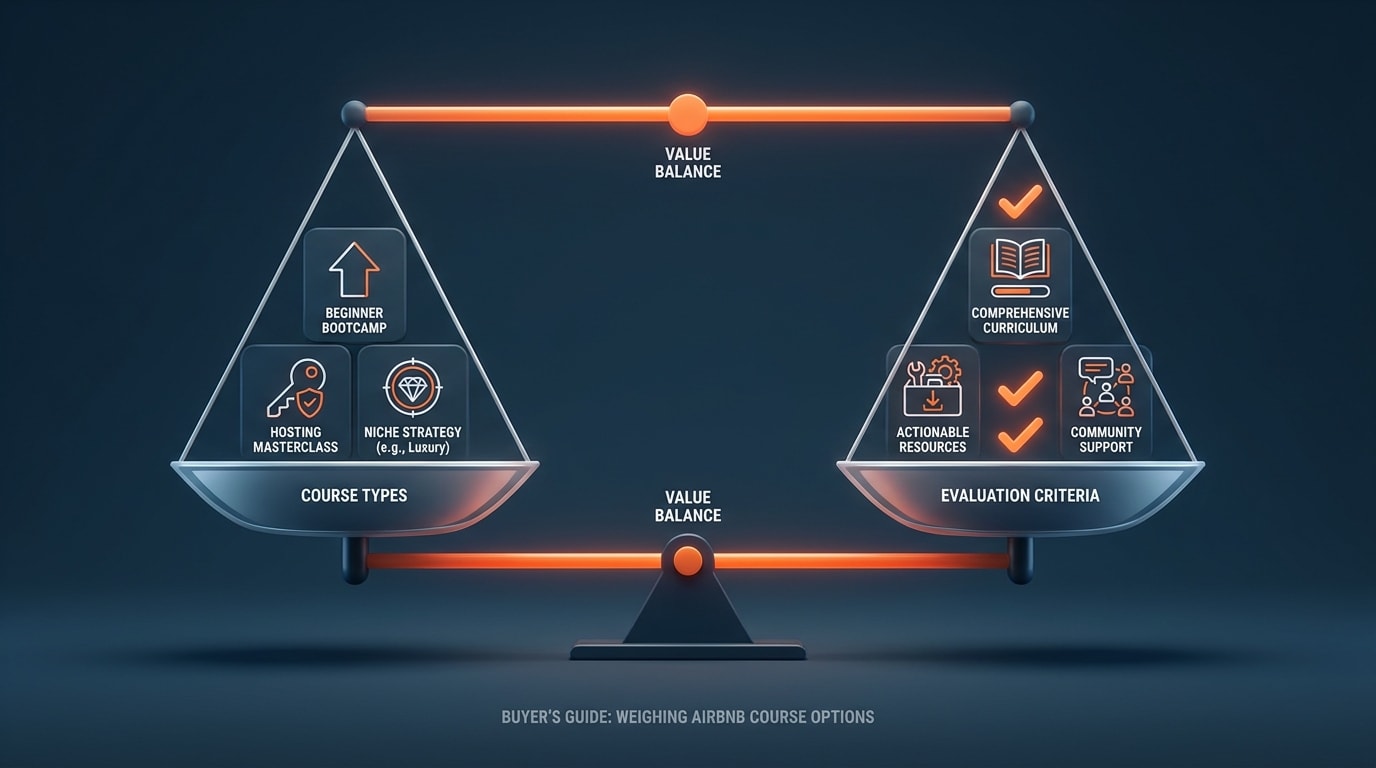
Score every candidate on the same five axes and write the scores down. A course that wins on marketing usually loses on at least two of them.
Criterion | What you are checking | Evidence that satisfies it | Red flag |
|---|---|---|---|
Curriculum depth | Does it teach mechanics or motivation? | A published module list with deliverables: underwriting sheet, lease-negotiation script, cleaning SOP, pricing rules | "Mindset" modules, no syllabus published before purchase |
Instructor proof | Is the teacher operating now, not in 2019? | Live listing URLs, current occupancy screenshots you can cross-check against the listing, named markets | Only student testimonials, no verifiable properties |
Support model | What happens when you are stuck on a Tuesday? | Named response window, live call cadence, who answers (instructor vs. moderator) | "Lifetime access to the community" with no cadence |
Refund terms | Can you exit if the content is recycled? | A written refund window and conditions on the checkout page | Refunds only after "completing all modules and submitting proof of work" |
Total cost | Tuition plus the capital you still need | A stated deposit-plus-furnishing estimate for your market | Any pitch implying tuition alone starts the business |
The fifth line is the one buyers skip. Tuition is rarely the largest number in an STR launch. Deposits, first month's rent or down payment, furnishing, photography, insurance, and permit fees usually dwarf it, and the course does not pay any of them.
How to verify curriculum depth in ten minutes
Ask the seller for the module list in writing. If the syllabus is only available after payment, treat that as the answer. Then check whether each module ends in an artifact you can hold: a filled spreadsheet, a script you can read aloud on a landlord call, a checklist your cleaner can follow. Teaching without artifacts produces confident operators who still cannot underwrite a deal.
How to verify the instructor still operates
Search the platforms for the properties they claim. Airbnb's own responsible-hosting documentation is public, so you can check whether what an instructor teaches matches what the platform currently permits. If a program teaches tactics the platform's help center now prohibits, the content is stale regardless of the sales page's copyright year.
What Airbnb Courses Actually Cost
I am not going to publish a price table, because course prices move constantly, run promotional cycles, and vary by payment plan — and any number I print here will be wrong before you read it. Instead, verify price the same way every time:
Open the seller's own checkout or pricing page, not a review site.
Record the date and the exact figure, including whether it is a one-time price or a payment plan with a higher total.
Find the refund policy on that same page and copy the window and conditions verbatim.
Ask in writing what is not included: coaching calls, software licenses, done-for-you services, upsells presented after enrollment.
Add the capital you still need for the first unit and compare that total against your available cash.
Course categories do differ in structure even when prices move, and structure is what you are buying:
Course type | Structure you are paying for | Fits the operator who | Watch for |
|---|---|---|---|
Platform-basics / marketplace video | Self-paced video library, no live access | Wants orientation before spending real money | Treat as orientation, not training |
Full operator program | Acquisition through operations, plus scheduled coaching | Is building a business and wants an operating system | Whether coaching is with the instructor or a contractor |
Arbitrage-specific | Market research, landlord negotiation, lease structuring | Is starting without buying property | Whether local rules allow subletting for STR |
Automation and systems | Messaging, pricing rules, cleaning and channel workflows | Already runs at least one unit | Buying it before you have operations to systematize |
Tax and entity add-ons | Recordkeeping and structure walkthroughs | Has income and a filing question | Instruction is not advice; confirm with your own CPA |
For tax treatment of rental income and expenses, IRS Publication 527 is the primary document, and it is free. Any paid module on rental taxation should be an interpretation of that publication, not a replacement for it.
How to Decide: A Five-Step Process
Run this in order. It usually saves either the tuition or several wasted months.
Name the bottleneck in one sentence. "I cannot find a landlord who will sign" is a bottleneck. "I want to succeed in STR" is not. Write it down before you look at any sales page.
Check whether free primary sources close it. Platform help centers, your city's ordinance page, and IRS publications answer a surprising share of what operators pay to learn. If your gap is "what does my city allow," no course is the fastest path.
Score two or three candidates on the five criteria. Use the table above. Refuse to score from memory or from a review site; score from the seller's own pages.
Price the whole launch, not the course. Tuition, plus deposits and first payment, plus furnishing, plus insurance and permits, plus a reserve of at least three months of fixed costs. If tuition consumes the reserve, you cannot afford the course yet.
Buy the smallest thing that closes the gap, then execute for 90 days. Most operators need one skill, not a curriculum. Give the purchase a deadline and a measurable outcome — a signed lease, a listing live, occupancy up a stated number of points.
If step one is hard, that itself is the diagnosis: your gap is clarity, not content. That is what a complimentary one-on-one diagnostic call is for — we map where you actually are and what the next move is, and often the honest answer is that a course is not it.
Warning Signs Worth Walking Away From

I have watched these patterns repeat since 2016, across every price tier.
Income screenshots as the primary proof. Revenue screenshots are unverifiable and say nothing about net cash or the market they came from.
Countdown timers that reset. Reload the page in a private window. If the deadline moves, the scarcity is manufactured.
No refund policy on the checkout page. A seller confident in the content publishes the exit terms.
A syllabus that is only a promise. Vague module names and no deliverables usually mean recycled free content.
Coaching that turns out to be a group chat. Ask who answers, in what window, and how many buyers share that person.
A price that assumes zero capital needed. Any program implying tuition alone launches a unit is misrepresenting the business model.
None of these prove fraud. They do predict disappointment reliably enough that I skip the purchase and lose nothing.
What to Do If You Already Bought a Bad One
Sunk cost pulls operators toward finishing a program that is not working. Triage instead.
Situation | Move | Timeline |
|---|---|---|
Inside the stated refund window | Request the refund in writing, citing the published policy | Same day |
Outside the window, content is recycled | Extract the two or three usable artifacts, stop consuming the rest | One weekend |
Content is fine, you are not executing | Drop to one module and one action per week, tied to a booked outcome | 90 days |
Program taught tactics the platform now prohibits | Re-verify each tactic against the platform help center before using it | Before your next listing edit |
You paid with credit and were materially misled | Document the claims and the policy, then ask your card issuer about your options | Within your issuer's dispute window |
Charge-back rights, contract terms, and consumer-protection remedies vary by state and card issuer, and none of this is legal advice. Keep your written record either way, because documentation is the only thing that helps you later.
The Honest Case For and Against Paying
A good program compresses months of expensive mistakes into weeks of guided ones. That is worth real money when you already have capital, a legal market, and a defined gap. The compression is in the operator's reps, not the video quality.
A bad purchase costs more than the price. It costs the four to six months you spend applying a framework built for a different market, a different capital position, or a different regulatory environment. The Small Business Administration's free business-plan guidance will force more useful thinking about your unit economics than most paid modules, and it costs nothing.
My position, after training over 10,000 operators: buy education when it removes a named obstacle you have already hit, and refuse to buy it as a substitute for deciding what to do next.
Frequently Asked Questions
Are Airbnb courses worth it in 2026?
They are worth it when you have already diagnosed a specific gap — landlord negotiation, listing visibility, pricing mechanics, operations — and the curriculum publishes deliverables that close it. They are not worth it when the underlying problem is that you have not decided what to build, or when tuition would consume the capital you need to launch the first unit.
How much should I expect an Airbnb course to cost?
Prices move too often for any article to quote reliably, so verify on the seller's own checkout page and record the figure with the date you saw it. Check whether the number is one-time or a payment plan with a higher total, and add the capital you still need for deposits, furnishing, insurance, and permits before you decide whether it fits.
What is an automated Airbnb course, and when does it help?
It teaches systematizing operations: guest messaging, demand-based pricing rules, cleaning coordination, and channel management. It helps once you have at least one unit running with real workflows to automate. Bought earlier, you are tuning an engine you do not own yet.
How do I check whether an instructor still operates properties?
Ask for live listing links in named markets and cross-check them on the platform yourself. Then compare what the course teaches against the platform's current help documentation; if the tactics conflict with current policy, the material is stale no matter what the sales page says.
Do I need a course to start hosting at all?
No. Many operators start with free primary sources, an honest underwriting model, and one experienced person to ask questions of. Platform help centers, your local ordinance page, and IRS Publication 527 cover more ground than most beginners expect, and paying only after you hit a named obstacle keeps your capital where it earns.
Related Reading

Keep reading before you spend anything:
Short-term rental training: the full landscape — how free, paid, and mentored paths compare.
Airbnb arbitrage: the complete guide — the low-capital entry path and what it actually requires.
Short-term rental investing — underwriting and market selection fundamentals.
How to buy an Airbnb — the ownership path, step by step.
Your next action: write your bottleneck in one sentence, then either find the free primary source that answers it or book a complimentary one-on-one diagnostic call and we will name it together.
Sources
Federal Trade Commission — The FTC's Endorsement Guides: What People Are Asking — sets the disclosure rules that make paid course rankings distinguishable from editorial ones.
Federal Trade Commission — Business Opportunity Rule — the disclosure obligations that apply to money-making programs and earnings claims.
IRS — Publication 527, Residential Rental Property — the primary free reference for rental income and expense treatment that paid tax modules restate.
Airbnb Help Center — Responsible hosting in the United States — the platform's current host obligations and local-rule guidance to check course tactics against.
Federal Trade Commission — Using Credit Cards and Disputing Charges — how billing disputes work if a program materially misrepresented what you bought.
U.S. Small Business Administration — Write your business plan — free planning guidance that covers unit-economics thinking many paid modules charge for.
Disclaimer: Educational content only — not financial, legal, or tax advice; results vary.
See our full Earnings Disclaimer and Affiliate Disclosure for complete details. © 2026 West Egg Enterprises, Inc. All rights reserved.