Short-Term Rental Training: How to Actually Learn the STR Business (and Whether a Course Is Worth It)
Most people buy a short-term rental course hoping it removes the risk. It does not. Here is what training can teach, what only reps teach, and how to judge a program before you pay.
By J. MasseyJune 22, 2026· 10 min read
Share
Disclosure: This post may contain affiliate links. If you purchase through our links, we may earn a commission at no extra cost to you. We only recommend tools and services J. Massey's team actually uses. Read the affiliate disclosure
Short-term rental training is worth paying for when it compresses months of trial and error into a sequence you can run this quarter, and it is a waste when it repackages free videos or is sold by someone who no longer operates properties. The learning itself comes from four sources — free content, paid courses, coaching, and real reps on a real property — and the operators who move fastest use three of them in the right order.
I've spent 18+ years in real estate, focused on short-term rentals since 2016, and trained more than 10,000 operators through CashFlow Diary. The question I get asked most is not "what's the best market." It is "should I buy a course, hire a coach, or just start?" Below is how I answer it, including the test I'd apply before sending anyone money.
The Four Ways People Actually Learn This Business
There are four learning paths. Each one does a specific job, and each one fails when you ask it to do a different job.
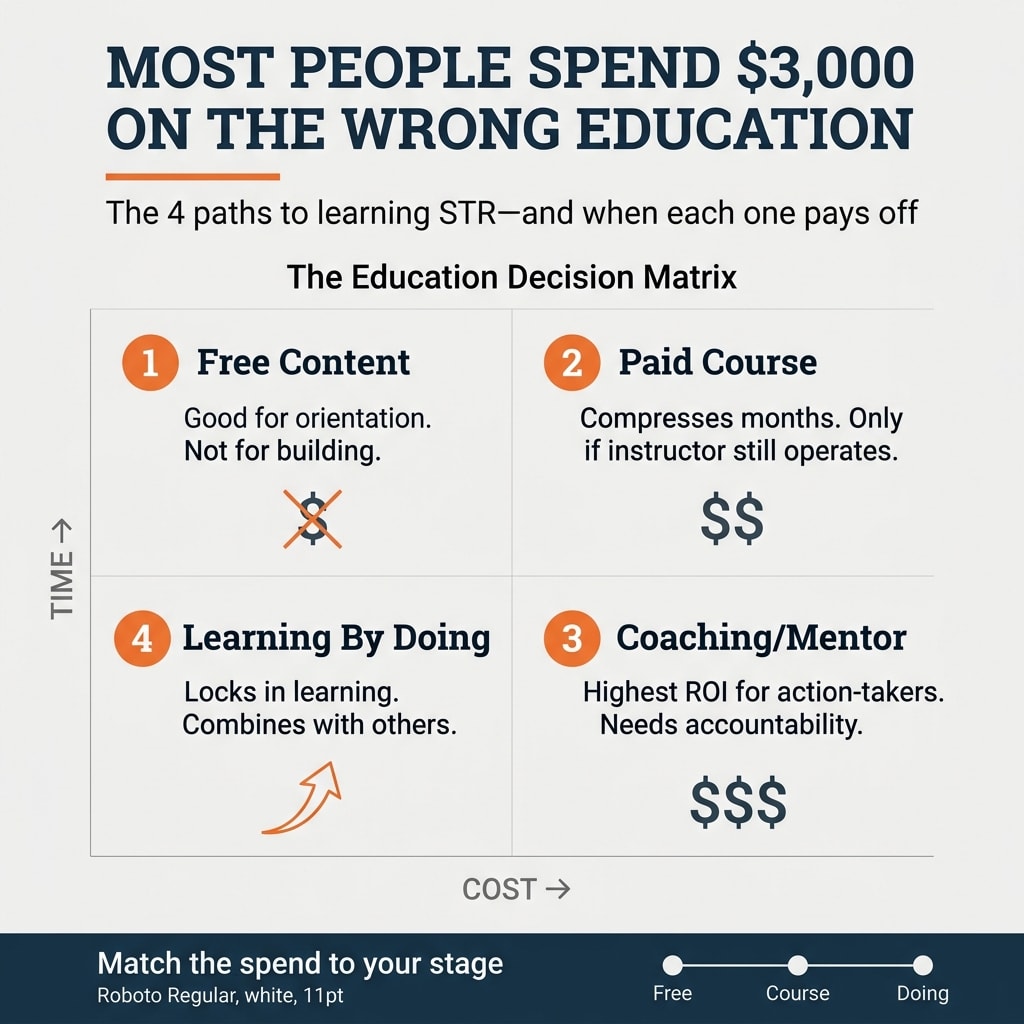
Free content — podcasts, YouTube, host forums, platform help centers. Good for orientation. It teaches vocabulary: ADR, occupancy, break-even, arbitrage, permit. It is scattered by design and nobody sequences it for you, so you can watch 40 videos and still not know what to do Monday morning. Use it to decide whether you want this business at all.
Paid courses — sequence, templates, models. A course's real product is ordering: what to do first, what to ignore, what the failure modes look like. It cannot make you act.
Coaching or mentorship — feedback on your specific deal, your specific market, your specific stuck point. Highest return per dollar for someone who is signing something this quarter. Wasted on someone who is still browsing.
Reps on a live property — the only path that turns knowledge into judgment. You do not understand demand-based pricing until you have watched your occupancy sag because you held rates too high through a slow week. You do not understand guest communication until a guest asks for early check-in while you are rescuing a turnover at another unit.
Path
What it teaches well
Where it fails
Best used
Free content
Vocabulary, market awareness, what the business feels like
No sequence, no accountability, no feedback on your numbers
Deciding whether to pursue STR at all
Paid course
Order of operations, underwriting models, checklists, SOPs
Cannot force implementation; ages fast when not updated
You've named a specific gap you cannot close alone
Coaching
Deal-specific judgment, accountability, live problem solving
Always — start small enough to survive the first one
Most operators who succeed run free content to orient, one structured resource for sequence, then a real deal that forces the learning. The sequence matters more than the method.
Four ways to learn STR: free content, course, coaching, and learning by doing
Be clear about the boundary before you spend anything. A program can transfer process. It cannot transfer reps.
Training transfers well: underwriting math, expense modeling, lease negotiation language, market screening criteria, guest messaging templates, cleaning SOPs, turnover checklists, review response scripts, the questions to ask a city clerk.
Training does not transfer: the nerve to sign, the discipline to answer a 10 p.m. message, the judgment to know when a soft week is seasonality versus a pricing error, the local relationships that get you a plumber on a holiday weekend. Nobody's curriculum contains those. They are earned.
The practical implication: buy the smallest amount of instruction that unblocks the next action, then go take the action. Operators who stack three courses before running a single underwriting model have bought permission to keep delaying.
Is a Short-Term Rental Course Worth It?
Sometimes — and the decision is simpler than the sales pages make it look. A course earns its price when it prevents one bad entry. Overpaying on a lease, choosing a saturated submarket, or launching in a city that requires a permit you cannot get is a five-figure category of mistake in most markets. Instruction that reliably prevents that category of error is cheap. Instruction that restates free videos is expensive at any price.
Two conditions have to be true before I would pay:
The instructor operates today. Not "used to own 40 doors." How many units are they personally responsible for this month? Regulations, platform ranking, and financing all shifted in the last two years. Someone who exited in 2019 is teaching a market that no longer exists.
The content is operational, not motivational. Ask to see one artifact: the underwriting model, the compliance checklist, the guest message sequence. A program that cannot show you a single artifact is selling a feeling.
Two questions expose most programs in about a minute: How many properties do you operate right now? and When was this curriculum last updated? Vague answers to either are your answer.
Spend level
What you should expect for it
Red flag at this price
$0
Vocabulary, market orientation, platform rules from help centers
Treating it as an operating manual
Low hundreds
One narrow skill: a calculator, a template pack, a single-topic workshop
Upsell ladder is the actual product
Low thousands
Full sequence, working models, compliance research method, direct Q&A
Income screenshots instead of artifacts; no update date
High thousands and up
Named operator access, deal review, accountability cadence
You do not yet have a deal to review
Prices in the STR education market move constantly and vary by vendor, so treat that column as ranges to sanity-check against what a seller shows you today, not as quotes. Nothing here is tax or legal advice; verify permit, tax, and licensing questions with your city and your own advisers.
The Six Skill Areas a Real Program Covers
If a curriculum is missing two of these six, it is a topic, not a training program.
Market selection. Screening on demand seasonality, supply growth, event calendars, and the regulatory environment — not on where you happen to live. Choosing wrong here is the one mistake you cannot fix later; every other error has a workaround.
Deal underwriting. Cash-on-cash return, break-even occupancy, full expense modeling (cleaning, restocking, maintenance, software, permits, tax), and a vacancy buffer. The most common reason a new arbitrage operator goes negative by month six is that they modeled the good case and left no cushion for two slow months.
Operations and automation. Message sequences, turnover scheduling, quality control, maintenance escalation. You can run two units out of your head. At three, the operation starts running you.
Pricing. Comp set definition, calendar reading, rule structure, and how to interpret what occupancy and ADR are telling you. Pricing tools are sold per listing per month by most vendors; check the vendor's own pricing page for the current figure. A tool with no operator judgment behind it just guesses faster.
Compliance. Permits, licenses, occupancy caps, taxes, HOA and lease restrictions. This is the most under-taught topic and the one that shuts a listing down overnight. Austin, for example, requires a city license for short-term rentals and publishes its rules and enforcement process directly — that page, not a course, is your source of truth for that city.
Guest experience. Avatar-driven amenities, expectation setting in the listing, problem handling, and repeat bookings. Review scores drive placement, placement drives bookings, and operators who treat this as decoration cannot explain why they sit below market occupancy.
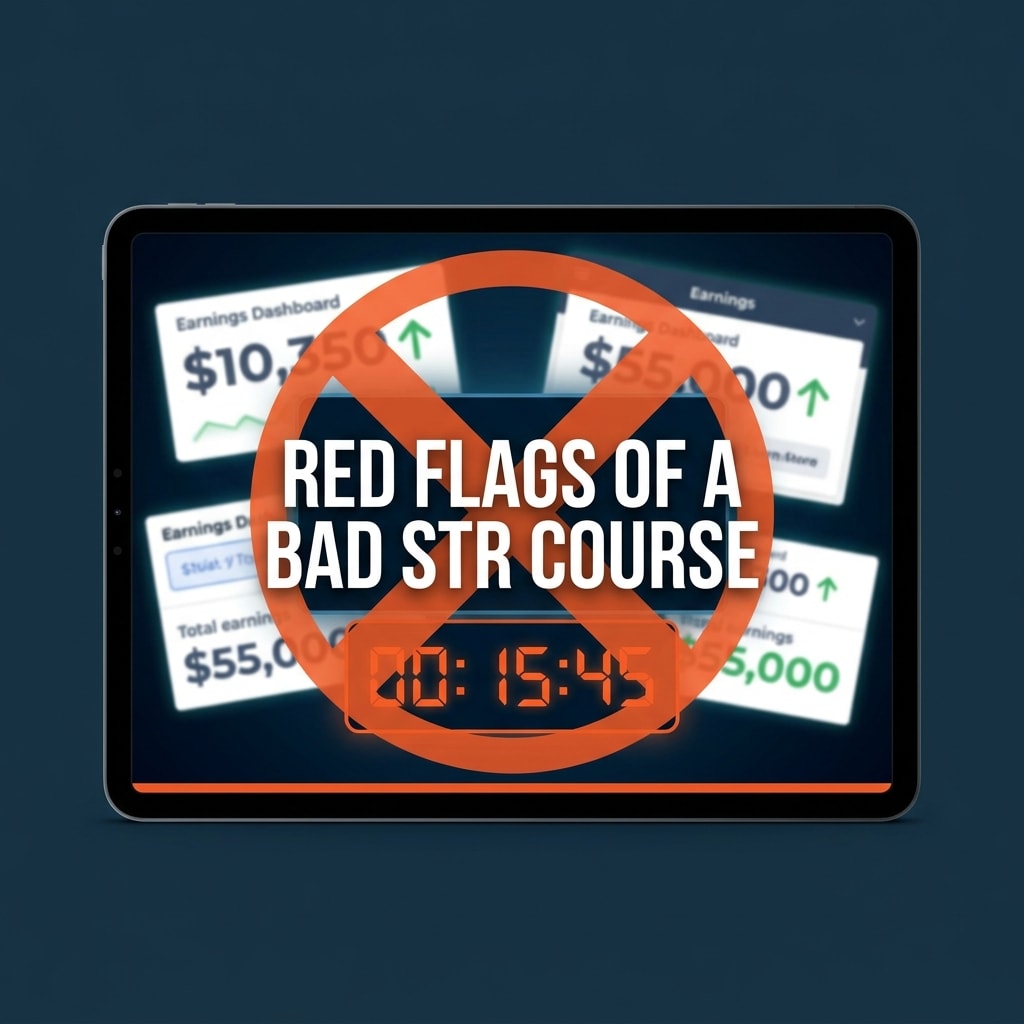
Red flags of a bad STR course: earnings screenshots and false scarcity
Six patterns, and you rarely see just one. Three or more means walk.
Earnings-screenshot marketing, with no expenses, no failures, and no timeline attached. Refusal to state a current operating record. "Nobody else is telling you this" framing — there are no secrets here, only operators who do the boring work and operators who do not. Manufactured scarcity: countdown timers, disappearing seats, price expiring tonight. An upsell ladder where each tier's job is to sell the next tier. And a curriculum with no stated update date, which in this regulatory environment means it is decaying.
Good programs are boring in the sales conversation. They show artifacts, name what they do not cover, and tell you when you are not ready to buy.
How to Decide: A Five-Step Process
Run this in order. It takes an afternoon and usually saves money.
Name the blocker in one sentence. "I cannot underwrite a deal" is a blocker. "I want to feel ready" is not. If you cannot write the sentence, you are not buying training — you are buying reassurance.
Try to close it free for one week. Platform help centers, the IRS rental-income publications, your city's licensing page, and a working spreadsheet cover more than most people expect. Whatever is still unclear after a week is your real gap.
Price the mistake you are trying to avoid. Estimate the cost of getting your next decision wrong — a bad lease, a wrong market, an unpermitted launch. If the training costs a fraction of that exposure and directly addresses it, the math works.
Interview the seller. Units operated today, last curriculum update, one artifact shown before purchase, refund terms in writing, and who answers questions. Any refusal is disqualifying.
Commit to an action date before you pay. Write the date you will submit your first landlord pitch or your first offer. If that date is more than 90 days out, delay the purchase and go do the underwriting instead.
Follow that with a single build, not three. One market, one underwriting model, one deal, one set of SOPs. Breadth after the first property is profitable, not before.
Sequencing: What to Learn in Which Order
Order beats intensity. This is the sequence I hand operators who are starting from zero.
Weeks
Focus
Output you should hold at the end
1–2
Orientation and go/no-go decision
Written reason you want STR income, and a capital number you can survive losing
3–4
Market screening
Two candidate submarkets with demand, supply, and rule notes, plus one eliminated for regulation
5–7
Underwriting and compliance
A working model with break-even occupancy and a vacancy buffer; the licensing requirement confirmed with the city
8–11
Acquisition or lease negotiation
One signed lease or accepted offer, and a landlord pitch you have delivered out loud
12–16
Launch and systems
Listing live, message sequences running, cleaner and maintenance backup named
Starting with arbitrage instead of a purchase has a specific learning advantage: you find out whether you can make a property profitable before you take on the full ownership expense. You are learning against income rather than debt. That is a stage choice, not a permanent strategy.
If you want a second opinion on where you actually are in that table, book a complimentary one-on-one diagnostic call and we will name the gap and the next action.
Frequently Asked Questions
Is a short-term rental course worth it? Sometimes. It is worth it when the instructor still operates properties, the content is operational rather than motivational, and it closes a gap you have already named. It is not worth it when it repeats free content, has no stated update date, or is bought to feel prepared instead of to take a specific next step.
How do I learn the short-term rental business without paying for training? Use primary sources and one live deal. Platform help centers cover listing and host rules, your city's licensing page covers compliance, IRS publications cover rental income reporting, and a spreadsheet you build yourself covers underwriting. That combination gets most people to a first arbitrage deal; what it will not give you is feedback on your specific numbers.
How much should STR training cost? Match spend to the mistake you are avoiding, not to the sticker price. Programs range from free resources through low-thousands sequences to high-thousands access-based coaching, and price does not predict quality. A cheap program from an active operator regularly beats an expensive one from someone who exited years ago.
Do I need a course before starting an Airbnb? No. Plenty of operators start with free material plus a mentor and learn on a first property. A course is a time compressor, not a requirement. If it shortens the gap between deciding and signing, buy it; if it becomes another reason to keep researching, skip it.
What is the fastest way to shorten the learning curve? Get a real property into your hands at the smallest survivable scale, and pair it with someone who will review your numbers. Reps produce judgment faster than any curriculum, and a reviewer stops the reps from becoming expensive.
Your next action: write your blocker in one sentence today, spend one week trying to close it with free primary sources, and only then decide whether anyone deserves your training budget.
Texas Comptroller — Hotel Occupancy Tax — supports the point that short-term stays carry state and local lodging tax obligations operators must model and file.