When Housing Data Contradicts Itself: How Investors Should Read a Peaking Buyer's Market
In spring 2026 sellers outnumbered buyers by a wide margin while mortgage rates spiked. Both were true. Freezing is a framework problem, not an information problem - here is the capital-source framework that fixes it.
By J. MasseyMay 18, 2026· 11 min read
Share
Disclosure: This post may contain affiliate links. If you purchase through our links, we may earn a commission at no extra cost to you. We only recommend tools and services J. Massey's team actually uses. Read the affiliate disclosure
The Buyer's Market Paradox — Marcus Lee Deep Dive · ~20 min
When housing data points in two directions at once — a large surplus of sellers over buyers on one side, a mortgage rate that keeps climbing on the other — the correct read is not "wait for clarity." Both readings can be true in the same week, and the investors who stall are almost never short of information. They are short of capital sources. This piece lays out how to underwrite a contradictory market when your acquisition path does not depend on a bank saying yes.
If you needed groceries, you would not sit in the driveway with the keys in your hand until every traffic light between you and the store turned green. You would drive, using the brakes, the seat belts, the turn signals, and the rules of the road. Most aspiring real estate investors spent 2026 sitting in the kitchen waiting for green lights. What follows is how to drive.
This article is educational and is not tax or legal advice. Confirm your own situation with a CPA and a real estate attorney before you structure anything.
What the Contradictory 2026 Data Actually Said
Through spring 2026, two families of housing headlines ran side by side. One set described a buyer-favorable market: more listings than active buyers, longer days on market, and sellers who had already cut asking prices once. The other set described the opposite pressure on the same buyer: wholesale inflation running hotter than forecast, long Treasury yields grinding up, and mortgage rates refusing to fall on schedule.
The rate side of that story is the part you can still check today. Freddie Mac's Primary Mortgage Market Survey put the 30-year fixed-rate average at 6.95% as of September 17, 2026, up from 6.76% the prior week and 6.26% a year earlier. That is a real, dated, primary number, and it is the one that matters for anyone whose only acquisition path is a conventional bank loan.
The buyer-versus-seller imbalance figures that circulated in May 2026 — a record percentage gap, a December peak, a small April demand uptick — came from a single brokerage's monthly release. I am not restating those specific percentages here as fact, because I could not verify them against a live primary page on the day this article was rewritten. The directional claim survives without them: sellers outnumbered buyers by a wide margin for most of 2026, and that gap was narrowing by late spring. Treat the direction as the signal. Treat any exact percentage you see quoted without a live source as a headline, not as underwriting input.
Most real estate content picks one of those two stories and runs with it. The investor reading the picked story freezes, because the picked story does not match the next news cycle, and that mismatch feels like "I don't have enough information yet."
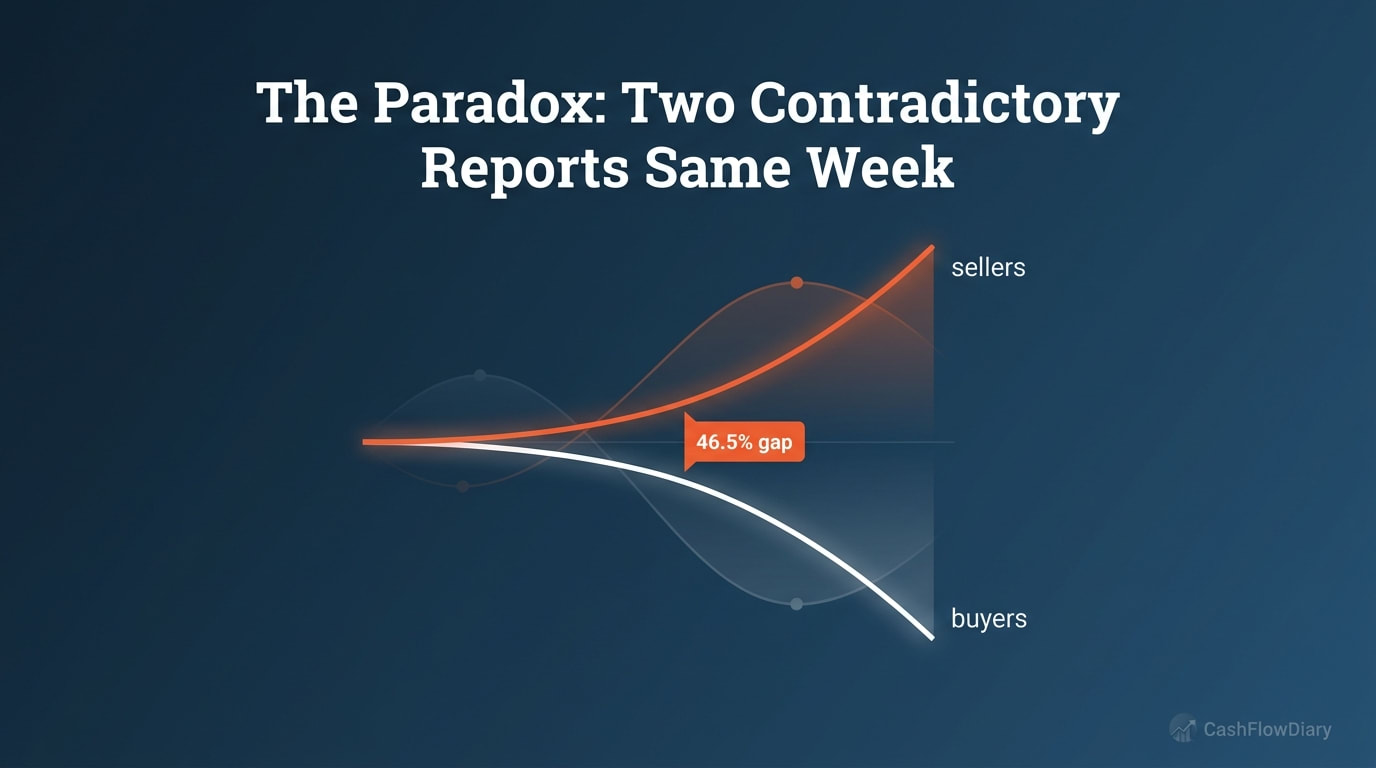
Section 1: The Paradox — two diverging data curves
On the buy side of any transaction you are dealing with fear. On the sell side you are dealing with greed. When people procrastinate on the buy side, it is rarely because they lack data. It is because they believe the outcome will not go their way more than they believe it will.
Here is the mechanical reason the belief breaks down. Most aspiring investors need a bank's money to purchase a property and have no other method for acquiring the property without the bank involved. Borrowing cost through the bank becomes the single variable that controls the entire mental model. Any movement in that one variable triggers paralysis, because the model has no second input.
"When you're on the buy side of any transaction, you are dealing with fear. When you're on the sell side, you are dealing with greed. The reason most investors freeze right now is not the data — it is the absence of a framework for how to read contradictory data."
— J. Massey · CashFlowDiary
The bank is one source of capital. There are several others, and what you do not know about them has cost operators deals for as long as I have been in this business — 18 years across residential, notes, and short-term rentals since 2016, with a list of more than 10,000 operators through Cashflow Diary. The pattern is consistent: single-source buyers stall in mixed markets, multi-source buyers keep closing.
Comparing Capital Options on Control, Speed, Cost, and Constraints
Capital flexibility is the fix. Before you write an offer, know which source is funding it and what that source costs you in control and time.
Capital source
Control over terms
Typical speed to close
Cost profile
Hard constraints
Conventional bank mortgage
Low — the lender sets rate, term, reserves, and DTI
30–45 days
Market rate (30-year fixed averaged 6.95% per Freddie Mac, Sept 17, 2026) plus origination
High — rate, amortization, and balloon timing are negotiated between the two parties
7–21 days when title is clean
Whatever the two parties agree to; often interest-only or partial amortization
Seller must own free and clear or be able to clear existing liens; state disclosure and licensing rules apply
Self-directed retirement plan (solo 401(k) or SDIRA)
Medium — you direct the investment, the plan owns the asset
10–30 days, gated by the custodian
No loan interest if funded in cash; plan pays all costs and receives all income
IRS prohibited-transaction rules; no personal use, no dealing with disqualified persons
Private lender or partner capital
Medium to high — terms are negotiated, but so is the split
7–30 days
Higher rate or an equity share; points common
Securities rules if you are pooling money; relationship and track-record dependent
Two of those deserve detail, because they are written into law and have not moved in years.
A purchase-money mortgage is a mortgage given by the buyer of real property to the seller as part of the purchase transaction, in place of paying the full price in cash. Cornell's Legal Information Institute states the definition plainly. The practical consequence is that rate, repayment schedule, and balloon timing are negotiated between two private parties and can look nothing like a bank product. Land contracts, lease-purchase agreements, and lease-option agreements are all cousins of the same idea.
The second is the self-directed retirement plan. A solo 401(k) or self-directed IRA can hold real estate, notes, and partnership interests. The IRS limit is the prohibited-transaction rule: the plan cannot buy from, sell to, lend to, or provide services to a disqualified person, which includes you as the fiduciary, your spouse, your lineal ascendants and descendants, and entities they control. The plan can buy a property from an unrelated seller and rent it to an unrelated tenant. It cannot buy your house, rent to your child, or pay you for swinging a hammer on a property it owns. Get the structure reviewed by a qualified professional before funds move — a prohibited transaction can disqualify the entire account.
Negotiate for Closing Credits Before Price Cuts or Buy-Downs
Most 2026 advice told buyers to ask for a price reduction or a temporary 2-1 rate buy-down. In a market with more sellers than buyers, the better ask is usually a credit at closing.
Concession
What it solves
Seller resistance
Practical ceiling
Failure mode
Price reduction
Lowers principal and long-run interest
Highest — hits the headline price and the appraisal comp other listings use
Whatever the seller accepts
Seller walks or counters flat; saves little cash at the table
Temporary rate buy-down (2-1 or 3-2-1)
Lowers payment in years one and two only
Medium
Counts against the same interested-party contribution cap
You still qualify at the full note rate; benefit expires
Credit toward closing costs
Cash you need at the table today; can be routed to prepaids or a buy-down
Lowest — headline price is unchanged
Fannie Mae caps financing concessions at 3% above 90% LTV, 6% at 75.01–90%, and 9% at 75% or less for a principal residence or second home, and 2% at all LTVs for investment property
Credit above your actual closing costs is re-treated as a sales concession and cut from the price
That Fannie Mae table is the governing constraint for conventional financing, the caps are calculated on the lower of sales price or appraised value, and the investment-property cap of 2% is the number most investors trip over. Check the equivalent Freddie Mac or FHA limit with your lender for the specific product before you write the number into an offer. Inside the cap, the credit is the more flexible instrument of the three, because you choose where it lands: closing costs, prepaid taxes and insurance, or a buy-down.
One rule about renegotiation. If you are already under contract, a housing chart is not grounds to reopen terms. Renegotiation triggers off due-diligence findings — a roof, a foundation crack, an inspection item — not off a headline. Keep the abundant posture through the inspection period and use the facts you develop.
How to Decide in a Contradictory Market: A Five-Step Process
Section 2: Purchase Money Mortgage — capital sources diagram
Write down the number that actually controls your deal. For most stalled buyers it is cash-to-close, not the rate. Name it before you read another market report.
Pick two capital sources from the table above and qualify them in advance. Confirm the solo 401(k) or SDIRA custodian allows real estate and that checkbook control is set up before, not after, you find a property.
Underwrite the property at today's dated rate, not a forecast. Use the current Freddie Mac survey average as the conventional case and the seller-financed terms you would actually ask for as the alternative case.
Structure the offer around a closing credit inside the applicable contribution cap, and have the lender confirm the cap in writing for your loan type and down payment.
Set a walk-away line before you negotiate, and hold it. With more sellers than buyers, the next property is the negotiating power you have; urgency is what gives it away.
Run that sequence on three properties and the contradictory data stops mattering. You will have two funding paths and a concession structure that works under either reading of the market.
What Abundance Posture Looks Like in Practice
Abundance is not optimism. It is arithmetic about the count of sellers and the count of people who need clean, safe, affordable housing. When sellers outnumber buyers, no single property is required. The investor who can say "then we are not a fit, thank you" gets terms the urgent investor never sees.
In practice it looks like this: you make an offer that works at your numbers, you explain the closing-credit structure in one paragraph so the listing agent can carry it to the seller, and you let silence do the work. If the answer is no, the offer goes to the next address the same week. Operators who buy with a wider capital toolset are not in the rate-driven pullback at all. They are reading the same reports and seeing a different deal.
If you want a second set of eyes on your own capital stack before you write the next offer, book a complimentary one-on-one diagnostic call and bring your last two underwrites with you.
Frequently Asked Questions
Is 2026 a buyer's market or a seller's market? For most of 2026 the national picture was buyer-favorable — more listings than active buyers, and sellers cutting asking prices — while the gap narrowed through spring. Conditions are local, so check active listing counts and days on market in your own submarket rather than applying a national label. The useful reading for an operator is that seller willingness to grant concessions was above normal, which is a structural condition, not a forecast.
Should I buy now or wait for mortgage rates to drop? Waiting assumes you know the direction rates move next. Freddie Mac's survey had the 30-year fixed at 6.95% on September 17, 2026, higher than both the prior week and the prior year, after most early-2026 forecasts called for declines. If your only acquisition path is a conventional mortgage, your timing rides on a variable that has not behaved as predicted. If your path includes purchase-money financing, a retirement-plan purchase, or a closing credit, that variable matters far less.
What is a purchase-money mortgage? It is a mortgage the buyer gives the seller as part of the purchase, in place of paying the full price in cash — the seller finances some or all of the balance. Terms are negotiated privately, so rate, amortization, and balloon date can differ sharply from bank products. State disclosure and licensing rules apply, so have an attorney draft or review the note and security instrument.
Can my retirement account buy a rental property? A self-directed IRA or solo 401(k) can hold real estate, subject to the IRS prohibited-transaction rules. The plan cannot transact with disqualified persons — you, your spouse, your parents and children, and entities they control — which rules out buying your own property, renting to family, or doing your own repair work on a plan-owned asset. All expenses must be paid by the plan and all income must return to it. This is not tax or legal advice; work with your custodian and a tax professional.
How large a seller credit can I actually ask for? For conventional financing, Fannie Mae caps financing concessions at a share of the lower of sales price or appraised value: 3% above 90% LTV, 6% at 75.01–90%, and 9% at 75% or less on a principal residence or second home, and 2% at all LTV ratios on an investment property. A seller-funded rate buy-down counts inside that same cap. Contributions must also be equal to or less than your total closing costs; anything above that is treated as a sales concession and deducted from the sales price. Confirm the exact cap with your lender for your loan program before drafting the offer.