A good cap rate for a short-term rental is one you calculated yourself from twelve months of real expenses, and in most U.S. markets that lands somewhere between 5% and 8% once every operating cost is on the page. The number on a broker's sheet is usually two to four points higher, because the pro forma left out cleaning, supplies, channel fees, management, vacancy, and reserves. Cap rate is a comparison tool. It is not an underwriting tool, and treating it like one is how operators buy a property that cannot pay for itself.
Last updated: 2026-09-17
I have spent more than 18 years in real estate, focused on short-term rentals since 2016, and I have built a list of more than 10,000 short-term rental operators through CashFlow Diary. The single most common reason a deal blows up in month seven is not bad furniture or a bad market. It is that the buyer underwrote a cap rate someone else calculated. This article is educational, not tax, legal, or investment advice — talk to your own CPA and attorney about your situation.
What Is a Cap Rate? (Quick Definition)
A cap rate (capitalization rate) is a property's annual net operating income divided by its purchase price or current market value, shown as a percentage. It measures the yield an asset produces before financing, taxes, or depreciation — the same formula whether the property is a single-family rental, an apartment building, or a short-term rental.
What Cap Rate Actually Measures
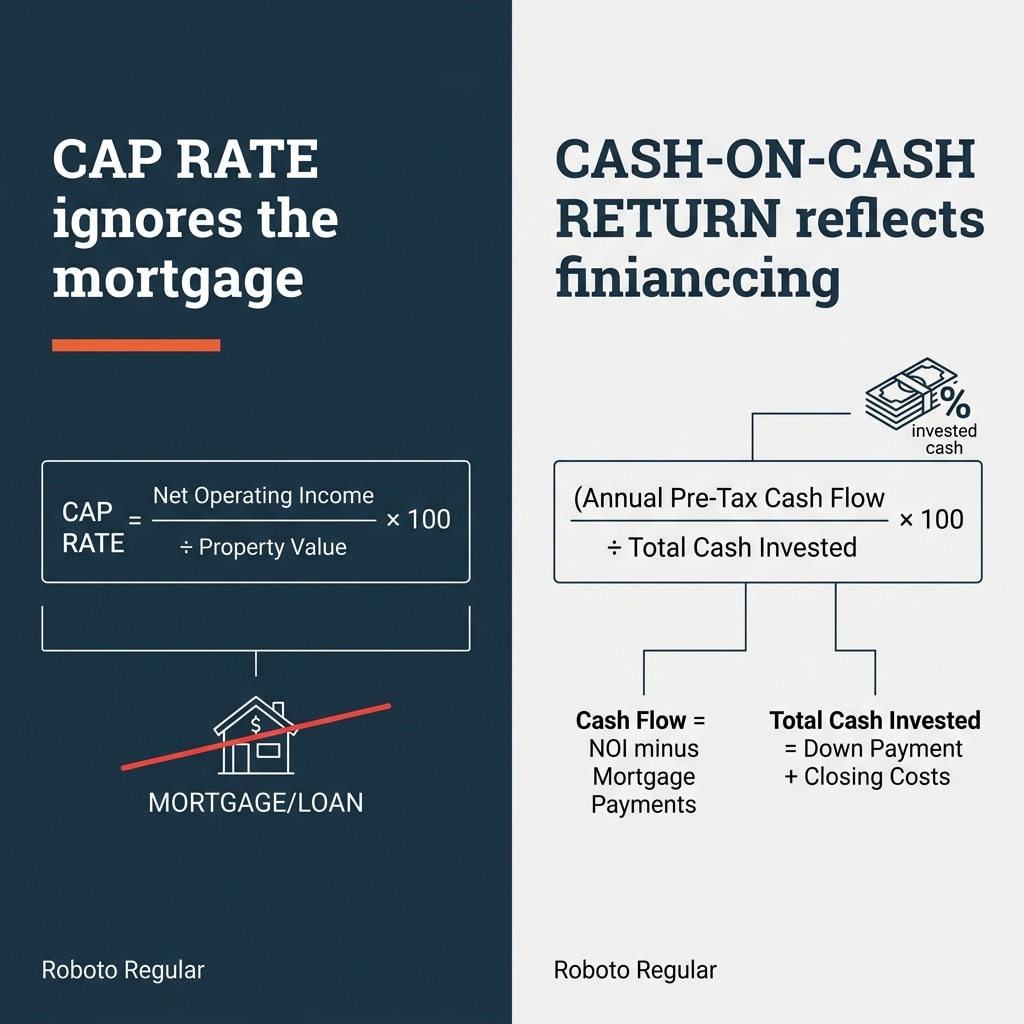
Cap rate is annual net operating income divided by purchase price or current market value.
Cap Rate = Net Operating Income ÷ Purchase Price
Net operating income is gross revenue minus operating expenses. It excludes the mortgage, income taxes, and depreciation. That exclusion is the whole point: cap rate strips out financing so two properties at different prices, with different loans, can be compared on how the asset itself performs.
So a $400,000 house producing $24,000 of true NOI carries a 6% cap rate. The same house producing $36,000 of NOI carries a 9% cap rate. Same building. Same market. The only thing that moved was the expense assumption.
That is the part almost nobody stress-tests. Cap rate has one input you cannot see from the outside — NOI — and whoever controls NOI controls the cap rate. A seller who wants a 9% headline can produce a 9% headline without telling a single lie, just by omitting line items.
Cap rate answers one question well: how does this asset's operating yield compare to other assets at today's prices? It does not answer whether you can make the payment in February. Those are different questions and they need different math.
The Expense Lines STR Pro Formas Leave Out
Long-term rental underwriting is forgiving because the expense set is small and stable: taxes, insurance, maintenance, some vacancy. Short-term rentals run more like a small hospitality business. The expense set is bigger, and most of it scales with bookings rather than with time.
Here is the list I make a seller's pro forma prove or lose. Every missing line inflates NOI, and every inflated dollar of NOI inflates the cap rate.
Expense line | Typical basis | What happens when a pro forma omits it |
|---|
Cleaning and turnover labor | Per stay; often partly offset by a guest-paid cleaning fee | Guest fee gets counted as revenue while the cleaner's invoice disappears |
Consumables and supplies | Per stay: paper, soap, coffee, batteries, linens | Reads as "minor," then shows up as a real per-stay cost on every turn |
Channel and payment fees | Percentage of each booking, set by the platform (Airbnb charges most home hosts a 3% host service fee, and guests 14.1%–16.5% of the booking subtotal) | Gross booking value gets used as if it were deposited cash |
Property management or co-host | Percentage of collected revenue | Assumes you will self-manage forever, including holidays |
Utilities, internet, streaming | Monthly, higher than a tenant-paid rental | Left out entirely on listings converted from long-term use |
Permits, licensing, lodging tax filings | Annual plus filing labor | Ignored until the city sends a notice |
Furnishing and linen replacement reserve | Annual set-aside against guest wear | Treated as a one-time startup cost, never refunded |
Vacancy and seasonality | Reduction to occupied nights, not a line item | Peak-month occupancy applied to all twelve months |
Capital reserve (roof, HVAC, appliances) | Annual set-aside per property | Deferred, then paid for with a credit card at the worst time |
Software, insurance, accounting | Monthly and annual fixed costs | Rounded to zero because each one is small |
Two of those deserve extra attention.
Guest-paid cleaning fees are not profit. They are a pass-through that rarely covers the true cost of a turn once you add laundry, restocking, and the occasional emergency clean. Counting the fee as revenue while excluding the cost is the most common single distortion I see.
Reserves are real expenses. A short-term rental consumes its furniture. Sofas, mattresses, and linens live a few years under guest use, not a decade. If your model has no annual replacement number, your model has a hidden liability with a due date.
When I underwrite, I expect total operating expenses on a professionally managed short-term rental to land in the middle of the revenue line — not the low fraction a long-term rental model would suggest. Self-managing moves that down, but it moves it down by paying yourself in unpaid hours, which is a choice you should make on purpose rather than by accident.
Why the Same House Shows 9% on Paper and 5% in Operation
Below is an illustration, not a market forecast. I chose the assumptions so the arithmetic is checkable. Your numbers will differ.
Stated assumptions: purchase price $400,000. Average daily rate $185. Broker column assumes 75% occupancy for all twelve months and only four expense lines. Operator column assumes 58% occupancy, a 14% co-host fee, blended channel and payment fees of about 4% of gross revenue, and the full expense set. No mortgage in either column, because cap rate ignores financing.
Line | Broker pro forma | Operator underwriting |
|---|
Occupied nights | 274 | 212 |
Room revenue | $50,690 | $39,220 |
Guest-paid cleaning fees collected | $4,110 | $3,180 |
Gross revenue | $54,800 | $42,400 |
Cleaning and laundry cost | $0 | ($4,240) |
Supplies and consumables | $0 | ($1,270) |
Channel and payment fees | $0 | ($1,700) |
Management or co-host | $0 | ($5,940) |
Utilities and internet | ($2,400) | ($3,900) |
Insurance | ($1,800) | ($2,600) |
Property taxes | ($4,200) | ($4,200) |
Repairs and maintenance | ($1,200) | ($2,100) |
Permits, licensing, filings | $0 | ($700) |
Software and accounting | $0 | ($1,150) |
Furnishing replacement reserve | $0 | ($2,000) |
Capital reserve | $0 | ($2,100) |
Net operating income | $45,200 | $10,500 |
Cap rate on $400,000 | 11.3% | 2.6% |
I built the broker column deliberately aggressive to show the mechanism. A milder version of the same edit — peak occupancy carried across the year, plus three missing expense lines — moves the headline several points in the same direction. Nothing in that column is arithmetic fraud. It is a set of assumptions presented as a result.
Three things did the damage. First, occupancy: applying a strong season across the whole year adds phantom nights that carry phantom revenue. Second, the pass-through trap: cleaning fees counted in, cleaning costs counted out. Third, reserves and management set to zero, which is the same as assuming the house never wears out and you never take a week off.
The operator column in this illustration is not a deal. That is the point. When you rebuild the numbers yourself, some properties stop being properties you want.
What a Defensible Cap Rate Range Looks Like
I will give you a range, with the honest caveat that a range calculated on someone else's NOI is worthless.
Under 4%: the asset is priced on appreciation, not operations. Fine if that is your stated thesis and you have the reserves to sit through slow months. Not fine if you need the property to pay you.
4% to 6%: common in higher-priced, supply-constrained markets. Workable, but only if your financing is cheap and your operations are already good.
6% to 8%: where most of my own defensible short-term rental purchases land after full expenses.
Above 9% on your own numbers: verify twice. Either you found something real, or there is a condition, a regulation, or an expense you have not met yet.
Above 9% on someone else's numbers: assume it is 5% until proven otherwise.
Two comparisons matter more than the absolute number. Compare the property to a long-term rental of the same price in the same market. A short-term rental carries more labor, more revenue swing, and real regulatory risk, so it should pay a premium of a couple of points over the long-term alternative on the same house. If it does not, you are taking hospitality risk for landlord returns.
Then compare the cap rate to your borrowing cost. If your loan rate is above the cap rate you calculated, the financed deal is negative before you have paid yourself a dollar. Published rates are the floor your deal has to clear. The Federal Reserve's H.15 release shows current Treasury and short-term rates, and Freddie Mac's Primary Mortgage Market Survey shows where mortgage rates sit this week. Use both, not a rate you remember from last year.
Say the quiet part out loud: if a market only clears these ranges when you assume peak-season occupancy every month, that market is not for you right now, and I would rather you walk than learn it with a down payment.
The Numbers I Underwrite With Instead
Cap rate compares. These four decide. Run all of them on the same NOI you built line by line.
Metric | Formula | What it tells you | My go/no-go line |
|---|
Cash-on-cash return | Annual pre-tax cash flow ÷ total cash invested | Return on the money you actually put in, after debt service | Must beat what you would accept for a passive alternative, or the labor is unpaid |
DSCR | NOI ÷ annual debt service | Whether the property covers its own loan | 1.25 or better on my own numbers; ask any lender for their own written minimum |
Break-even occupancy | Total annual cash obligations ÷ (ADR × 365) | The occupancy you must hit to avoid feeding the property | Below your comps' worst trailing twelve months |
Reserves on hand | Months of fixed costs in cash at closing | Whether a slow quarter is an inconvenience or a crisis | Six months of debt service, taxes, insurance, and utilities |
Break-even occupancy is the one I would keep if I could only keep one. It converts every assumption into a single question a comp set can answer: do properties like this, in this market, actually book that many nights in a bad year? If break-even occupancy is 61% and the honest comp band is 52% to 58%, the deal is done deciding for you.
DSCR matters because it is the lender's view of the same asset, and lenders on debt-service-coverage products underwrite the property rather than your paycheck. If a lender's own math says the property barely covers its loan, that is a data point about the property, not an obstacle to route around with a bigger down payment.
Cash-on-cash keeps you honest about the money at risk. And reserves are what let you make good decisions in a slow quarter instead of desperate ones. Anything you plan to do with tax treatment — depreciation, the material participation rules, the deductibility of specific expenses — belongs in a conversation with your CPA. IRS Publication 527 is the primary reference for residential rental property, and IRS Topic No. 415 covers the personal-use and minimal-rental-use rules that apply when a place is rented for short stays. Those rules are narrower than most operators assume.
Underwriting Checklist: Rebuild the Cap Rate Yourself
Step 1 — Throw out the pro forma's revenue line
Pull trailing twelve-month performance from comparable active listings, matched on bedrooms, capacity, amenity tier, and walkability to whatever drives demand. Use the trailing twelve, not the best twelve weeks. Then take the lower half of the comp band as your base case.
Step 2 — Rebuild expenses from the ten-line list
Fill in every line from the table above with a quoted number where you can get one: an actual cleaner's rate, the real utility history, the current insurance quote, the city's permit fee schedule. Where you cannot get a quote, use a conservative placeholder and mark it as an estimate.
Step 3 — Fund the reserves before you calculate anything
Put an annual furnishing replacement number and a capital reserve number in the model as hard expenses. A model without reserves is not a model. It is a wish.
Step 4 — Calculate NOI, then the cap rate
Now the cap rate means something, because you own every input. Compare it to the long-term rental alternative on the same house and to your borrowing cost.
Step 5 — Run cash-on-cash, DSCR, and break-even occupancy
Add debt service. If DSCR is under 1.25 or break-even occupancy sits above the comp band's weak year, stop. Price the offer down until the math clears, or move on.
Step 6 — Pressure-test the regulation
Confirm the property's legal status in writing: zoning, permit caps, HOA rules, and lodging tax registration. A permit that expires or a cap that closes turns a 7% cap rate into a long-term rental overnight. Check the municipality's own code, not a listing site's summary.
Want a deal underwritten with you line by line, using your comps and your real expense quotes? Book a complimentary one-on-one diagnostic call and bring the pro forma you are worried about.
Frequently Asked Questions
What is a good cap rate for a short-term rental?
On numbers you calculated yourself with every operating expense included, 6% to 8% is a defensible band in most U.S. markets, and 4% to 6% can work in high-priced, supply-constrained areas if your financing is cheap. The more useful test is relative: the short-term rental should out-yield a long-term rental on the same house by roughly two points, and the cap rate should clear your borrowing cost. Any figure above 9% that came from someone else's spreadsheet should be rebuilt before you believe it.
Does cap rate include the mortgage?
No. Cap rate is a pre-financing measure. Net operating income excludes mortgage principal and interest, income taxes, and depreciation, which is exactly why two properties with different loans can be compared with it. It is also why cap rate cannot tell you whether a financed purchase produces cash. For that you need debt service in the math — cash-on-cash return and DSCR.
Why does the same property show a 9% cap rate on a broker sheet and 5% in reality?
Two reasons, usually together. The revenue line uses peak-season occupancy or nightly rate applied across all twelve months, and the expense list omits cleaning, supplies, channel fees, management, permits, and reserves. Since cap rate is NOI divided by price, every omitted expense raises the headline. Rebuild the revenue from trailing twelve-month comps and add every expense line back, and the gap closes.
What should I underwrite with instead of cap rate?
Cash-on-cash return, DSCR, break-even occupancy, and months of reserves on hand. Break-even occupancy is the sharpest of the four because it turns the whole model into one question your comp data can answer: does a property like this book that many nights in a weak year? Use cap rate afterward, as a comparison across candidates at today's prices.
Are guest-paid cleaning fees profit?
No. Treat them as a pass-through against the cost of the turn, which includes laundry, restocking, and the occasional emergency clean. Counting the fee as revenue while leaving the cleaner's invoice out of expenses is the single most common way a pro forma inflates net operating income. This is educational information, not tax advice; how the fee is reported on your return is a question for your CPA.
Sources