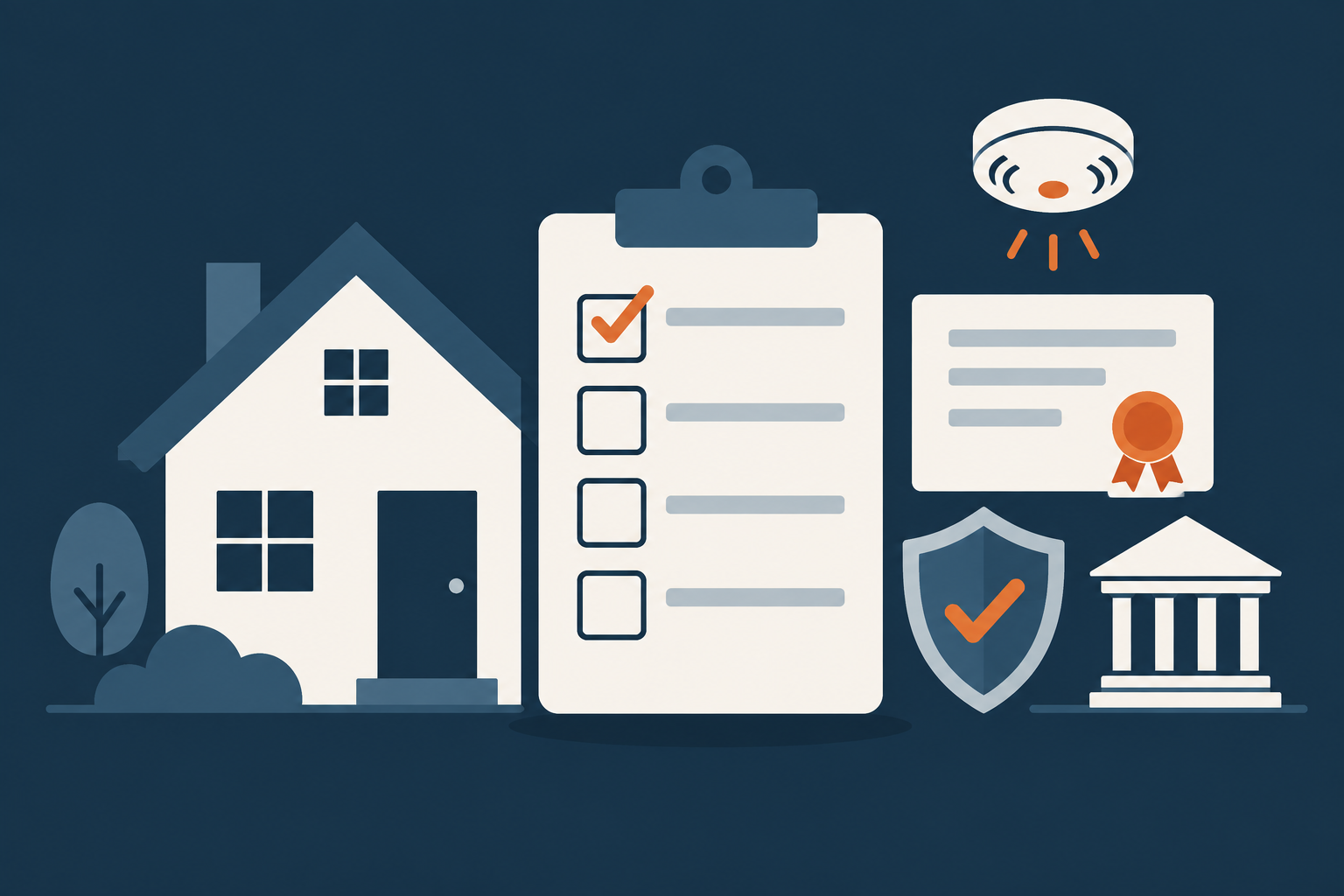
Most U.S. short-term rentals face legal requirements at 4 levels: local zoning and permit or registration rules, state and local occupancy taxes, federal income tax reporting, and safety, insurance and private contract rules such as HOA covenants and leases. In practice that means a permit or registration number where your city requires one, a lodging tax account, correct IRS reporting, working smoke and carbon monoxide alarms, and written proof that your building or HOA allows short stays.
This guide is not legal advice. Short-term rental law is mostly local, it changes often, and two addresses a mile apart can sit under different rules. Use what follows as a map of what to ask, then verify every item with your city or county, your state tax agency, and a licensed attorney or CPA before you take a booking.
I have been in real estate for more than 18 years and focused on short-term rentals since 2016. The operators I see get hurt usually bought or leased a property before confirming it could legally host guests for fewer than 30 nights.
Zoning, Permits and Registration: The First Legal Gate
Zoning decides whether short-term rental use is allowed at an address at all. Permits and registration decide whether you, specifically, are allowed to operate there. Check both before you sign a purchase contract or a lease.
The questions to answer for any address:
Does the zoning district allow rentals of fewer than 30 days, and is there a separate rule for owner-occupied versus whole-home rentals?
Does the city or county require a permit, license or registration number, and must that number appear on your listing?
Is there a cap on the number of permits, a waiting list, or a primary-residence requirement?
Are there occupancy limits, parking rules, quiet hours or a local contact requirement?
What does it cost to apply, how long does approval take, and when does the permit renew?
New York City is the clearest example of how strict local rules can get, and how much of the detail sits in one agency page. The city adopted Local Law 18, the Short-Term Rental Registration Law, on January 9, 2022. It requires hosts to register with the Mayor's Office of Special Enforcement (OSE) and bars booking platforms such as Airbnb and VRBO from processing transactions for unregistered short-term rentals. OSE says enforcement with the platforms began September 5, 2023.
Registration does not make an illegal listing legal. According to OSE, hosts cannot rent an entire apartment or home to visitors for fewer than 30 days, even if they own or live in the building. A short-term rental in a permanent residential building is permitted only if the host stays in the same unit as the guests, with no more than two paying guests at a time. OSE also keeps a Prohibited Buildings list, and rentals of 30 consecutive days or more are exempt from registration.
Most cities are looser than New York, and some are stricter in different ways. The same thing goes wrong everywhere. An operator reads a blog post about "Airbnb-friendly" markets, skips the municipal code, and learns about a primary-residence rule after closing. Read the actual ordinance, then call the planning or permitting office and write down the name of the person you spoke with and the date.
Occupancy and Lodging Taxes
Short-term rental guests usually owe the same lodging taxes that hotel guests pay, and the host is often the one legally required to collect and remit them. These taxes go by many names: hotel occupancy tax, transient occupancy tax, lodging tax, or tourism tax. A single stay can trigger a state tax, a city tax and a county or district tax at once.
Texas publishes one of the plainest statements of the rule. The Texas Comptroller says hotel owners, operators or managers must collect state hotel occupancy tax from guests who rent a room or space costing $15 or more per day, and that the tax covers bed and breakfasts, condominiums, apartments and houses. People leasing their houses must collect it the same way a hotel does. The state rate is 6 percent, and cities, some counties and special districts can add a local hotel tax that the local authority collects.
Here is what one booking looks like under the Texas state rate, with the local tax shown as a placeholder you must replace with your city's actual rate:
Line item (illustrative example) | Amount |
|---|
4 nights at $250 per night | $1,000.00 |
Texas state hotel occupancy tax at 6% | $60.00 |
Local hotel tax at an assumed 7% (replace with your city's rate) | $70.00 |
Total lodging tax due on the stay | $130.00 |
The penalties are where hosts lose money. The Comptroller lists the monthly due date as the 20th day of the month after the rental activity, a $50 penalty on each late report, a 5 percent penalty if tax is paid 1 to 30 days late, and a 10 percent penalty if paid more than 30 days late. Interest starts 61 days after the due date.
The Comptroller also notes that property managers, online travel companies and other third parties may be responsible for collecting the tax. Do not assume the platform covers everything. In many places a platform collects some taxes and not others, so get a written answer from your state and city on which taxes the platform remits for your address and which ones stay on you.
Federal Income Tax Treatment
For the IRS, two numbers matter: how many days you rented the unit at a fair price, and how many days you or your family used it. Those two numbers decide how the income is reported and how much of your expense you can deduct.
IRS Topic 415 lays out the rules. You are treated as using a dwelling unit as a residence if your personal use during the year is more than the greater of 14 days or 10 percent of the days you rent it at a fair rental price. There is also a minimal rental use rule: if you use the unit as a residence and rent it for fewer than 15 days, you do not report the rental income and you do not deduct rental expenses.
The table below shows how the day counts sort a property into three different outcomes:
Situation | Personal-use test | IRS treatment per Topic 415 |
|---|
Used as a residence, rented fewer than 15 days | Not relevant once under 15 rental days | Do not report the rental income; do not deduct rental expenses |
Rented 200 days at fair price, personal use 25 days | 25 is more than the greater of 14 or 20 (10% of 200) | Treated as a residence; split expenses by days, deductions capped at rental income |
Rented 200 days at fair price, personal use 10 days | 10 is less than 20 | Treated as a rental; losses limited by at-risk and passive activity rules |
A day of personal use counts even when someone else is in the unit. Topic 415 includes days used by you or any co-owner, by family members of either (unless it is their main home and they pay a fair rent), by anyone under a home-swap arrangement, and by anyone paying less than a fair rental price. Letting your cousin stay free for a week is a personal-use week.
Two more rules from IRS Publication 527 catch short-term rental operators:
Services change the form. Pub 527 says that if you provide substantial services primarily for the guest's convenience, such as regular cleaning, changing linen or maid service, you report on Schedule C instead of Schedule E, and you may owe self-employment tax. Cleaning between guests is not the same as daily housekeeping during a stay, so ask your CPA where your operation falls.
Depreciation runs on 27.5 years. Pub 527 lists residential rental property on a 27.5-year recovery period under the general system. Illustrative example: a $275,000 building basis (land excluded) works out to about $10,000 a year ($275,000 divided by 27.5), before first-year conventions.
Pub 527 also excludes units in hotels, motels or inns where more than half the units are used on a transient basis from the residential rental property class, and the passive activity rules in Pub 925 have their own tests for rentals with short average stays. This is where I see short-term rental returns go wrong. Hire a CPA who files short-term rental returns every year, not one who mostly handles W-2 households.
Platform Rules and What Airbnb Expects From Hosts
Airbnb, VRBO and Booking.com do not replace local law, and none of them will defend you if your city says the listing is illegal. What they do is add their own layer of rules on top, and they can delist you for breaking them.
Airbnb's Responsible Hosting in the United States article tells hosts to look up local taxes and business license requirements, including hotel or transient occupancy tax, and to check permitting, zoning, safety and health regulations with the authorities that govern property use in their area. The same article covers:
Cameras. Airbnb does not allow security cameras or other recording devices inside a listing, and hosts must fully disclose cameras, recording devices or noise decibel monitors elsewhere on the property.
Parties and neighbors. Disruptive gatherings and other community disturbances are not allowed. Airbnb suggests a written policy on guests inviting visitors, clear quiet hours, and relaying building and parking rules.
Occupancy. Set safe occupancy limits, noting your local government may have guidelines.
Where a city requires a registration number, the platforms increasingly require it on the listing or block the booking, as New York's law directs. Keep your permit number, expiration date and the exact address on file in one place so that listing edits never drift out of line with what the city approved.
Safety Requirements and Insurance
Safety rules come from your local fire and building codes, and many permit programs add an inspection. The minimum Airbnb itself recommends for U.S. hosts is a working smoke alarm and carbon monoxide detector, a working fire extinguisher with required maintenance, a clearly marked fire escape route with a posted map, a first aid kit, and posted local emergency numbers plus a backup contact for you.
Treat those as the minimum. Many ordinances go further with requirements such as alarms in every sleeping room, egress windows in bedrooms, posted maximum occupancy, or pool barriers. Your permit office or fire marshal will give you the list. Get it in writing and keep dated photos of each item installed.
Insurance is a private contract rather than a law, but lenders, HOAs and some cities make it a condition of operating. In the portfolios I work with, the most common gap is a standard homeowners or landlord policy on a property that is actually running as a short-term rental. Ask your agent three direct questions and get the answers in writing:
Does this policy cover short-term rental use of fewer than 30 nights?
What liability limit applies if a guest is injured on the property?
Is loss of rental income covered if the property cannot host after a covered claim?
Platform host protection programs have their own terms and exclusions. They back up your own policy. They do not replace it.
HOA, Lease and Building Restrictions
Private restrictions can block a short-term rental that the city would allow. HOA covenants, condo and co-op bylaws, and residential leases often set minimum stays, ban subletting, or require board approval. Airbnb's own guidance tells hosts to check HOA or co-op regulations for any prohibition on subletting or hosting, and to read their lease and check with their landlord.
What to pull and read before you commit:
The recorded CC&Rs and any amendments, plus the current rules and regulations.
Board meeting minutes from the last 12 to 24 months, which often show a rental restriction on the way before it is adopted.
Your lease, if you are a tenant or running a rental arbitrage model, with written landlord consent for short-term subletting.
Any building list your city keeps, such as New York's Prohibited Buildings list.
If you rent the property rather than own it, public or subsidized housing, rent-controlled units and rent-stabilized units usually carry extra limits. New York's OSE, for example, says tenants in rent-stabilized units are not eligible for short-term rental registration.
Short-Term Rental Compliance Checklist: 10 Steps Before the First Guest
Work through these steps in order for every new property. Each one produces a document you should keep.
Confirm zoning. Get the zoning district and the ordinance section that allows or bans stays under 30 days, and save a copy.
Check private restrictions. Read the CC&Rs, bylaws or lease, and get written approval where needed.
Apply for the permit or registration. Record the permit number, fee, approval date and renewal date.
Register for lodging taxes. Open state and local accounts where required, and write down the rate and filing frequency for each.
Confirm what the platform collects. Get a written answer on which taxes are remitted by the platform and which stay with you.
Set up federal tax tracking. Log rental days and personal-use days separately, and ask your CPA whether you belong on Schedule E or Schedule C.
Install safety equipment. Smoke alarms, carbon monoxide alarms, extinguisher, posted exit map, first aid kit and emergency numbers, with dated photos.
Bind the right insurance. Get written confirmation that short-term rental use is covered, with your liability limit.
Publish the listing correctly. Add the permit number where required, match the approved occupancy, and disclose any exterior cameras or noise monitors.
Calendar every deadline. Tax filing dates, permit renewals and insurance renewal dates go into one shared calendar with reminders 30 days out.
If you want a second set of eyes on a market or a specific property before you commit money, book a complimentary one-on-one diagnostic call. If you decide you want a written plan after that, the action plan is $997.
Frequently Asked Questions
Do I need a permit to run an Airbnb?
It depends on your city and county. Many local governments require a short-term rental permit, license or registration number, and some require it to appear on the listing. Check your municipal code and call the planning or permitting office before you take a booking.
Is short-term rental income taxable if I rent fewer than 15 days?
Under IRS Topic 415, if you use the dwelling unit as a residence and rent it for fewer than 15 days in the year, you do not report the rental income and you do not deduct rental expenses. Once you rent 15 days or more, the income is reportable and the personal-use tests decide how much expense you can deduct.
Does Airbnb collect occupancy taxes for me?
Sometimes, and often only some of them. The Texas Comptroller notes that online travel companies and other third parties may be responsible for collecting hotel tax, but local taxes may still fall on you. Ask your city tax office directly; the platform's tax page is not the final word.
Can I rent out my entire apartment in New York City for a few nights?
Not in a permanent residential building, according to New York City's Office of Special Enforcement. Stays under 30 days are allowed only if the host stays in the same unit, with no more than two paying guests, and the host must register under Local Law 18. Rentals of 30 consecutive days or more are exempt from registration.
What safety equipment does a short-term rental need?
Airbnb's U.S. guidance lists a working smoke alarm, carbon monoxide detector, fire extinguisher, marked fire escape route with a posted map, and a first aid kit. Your local fire and building codes may require more, such as alarms in every sleeping room. Ask your permit office or fire marshal for the local list.
Is this guide legal advice?
No. It is an operator's overview of the requirement categories and the primary sources behind them. Rules are local and change often, so confirm every item with your city or county, your state tax agency, and a licensed attorney or CPA.
Sources
Topic no. 415, Renting residential and vacation property — supports the 14-day or 10 percent personal-use test and the fewer-than-15-days rule figures in Federal Income Tax Treatment.
Publication 527, Residential Rental Property (Including Rental of Vacation Homes) — supports the Schedule C substantial-services rule and the 27.5-year depreciation figure in Federal Income Tax Treatment.
Short-Term Rental Registration and Verification by Booking Services, NYC Office of Special Enforcement — supports the January 9, 2022 adoption date and September 5, 2023 enforcement date in Zoning, Permits and Registration.
Publication 925, Passive Activity and At-Risk Rules — supports the short-average-stay passive activity reference in Federal Income Tax Treatment.
Tips for Hosts, NYC Office of Special Enforcement — supports the host-present, two-guest and 30-day rule figures in Zoning, Permits and Registration.
Hotel Occupancy Tax, Texas Comptroller of Public Accounts — supports the 6 percent state rate, $15 threshold and late-penalty figures in Occupancy and Lodging Taxes.
Responsible hosting in the United States, Airbnb Help Center — supports the camera, party and occupancy guidance in Platform Rules and What Airbnb Expects From Hosts, the safety-equipment list in Safety Requirements and Insurance, and the HOA-check guidance in HOA, Lease and Building Restrictions.
Related Reading