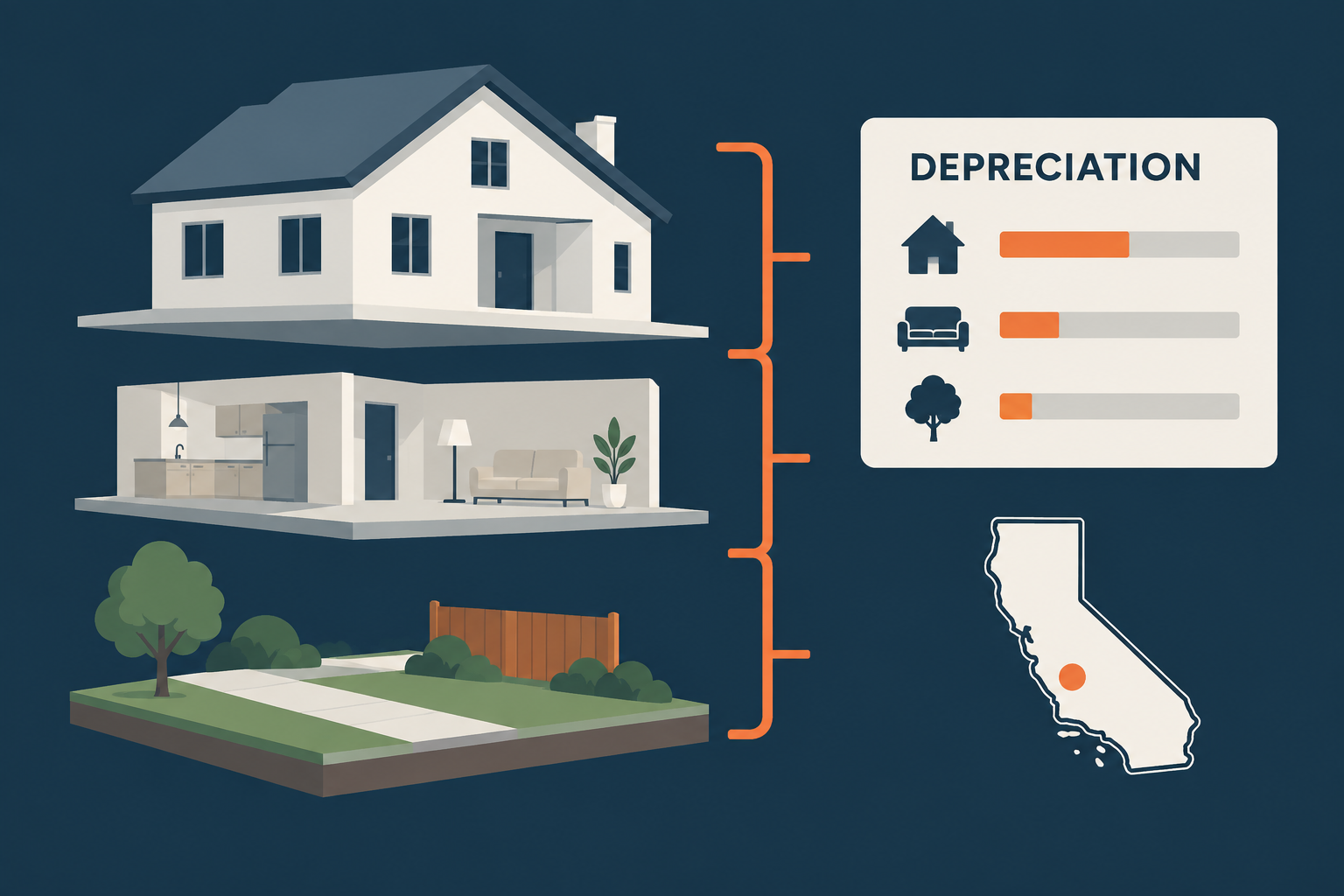
Cost segregation on a California short-term rental typically reclassifies 20% to 30% of a building's depreciable basis out of the 27.5-year or 39-year schedule and into 5-, 7-, and 15-year property, which on a $1,000,000 purchase with an $800,000 building basis means roughly $160,000 to $240,000 of accelerated deductions. Federal bonus depreciation sits at 100% for qualified property acquired after January 19, 2025 and placed in service in 2026, so most of that reclassified amount can be written off in year one on the federal return. California is the catch: the state does not follow federal bonus depreciation, and its IRC Section 179 expensing cap is $25,000, not the far larger federal limit.
That gap is the single most misunderstood part of this strategy. I have watched operators sign a study, claim a large first-year federal deduction, and then get a surprise California bill because their state depreciation schedule looks almost nothing like the federal one. The study still pays. It just pays on two different timelines, and you need both modeled before you wire the fee.
What Cost Segregation Actually Does to an STR Tax Bill
A residential rental building is depreciated over 27.5 years; a property used predominantly for transient stays can land on the 39-year nonresidential schedule. Either way, the default treatment lumps carpet, appliances, cabinetry, landscaping, driveway, and specialty electrical into one long-lived asset. A cost segregation study, done by an engineer who walks the property and prices components, splits those items into their correct recovery classes under the MACRS rules in IRS Publication 946.
The reclassified share is not evenly distributed. Furnished short-term rentals tend to sit at the high end of the range because the unit is stuffed with 5-year personal property: beds, sofas, televisions, kitchen equipment, window coverings, decor. Land improvements — fencing, hardscape, pool equipment, exterior lighting — fall to 15-year property. Land itself is never depreciable, and in California coastal and urban submarkets land can be 30% to 50% of the purchase price, which shrinks the depreciable base before the study even starts.
Here is the arithmetic on a simple $1,000,000 acquisition where land is allocated at 20%, using the 20% to 30% reclassification range as the illustrative bracket:
Item | Amount |
|---|
Purchase price | $1,000,000 |
Land allocation (20%, not depreciable) | $200,000 |
Building basis | $800,000 |
Reclassified to 5/7/15-year at 20% | $160,000 |
Reclassified to 5/7/15-year at 30% | $240,000 |
Federal year-one bonus depreciation at 100% on the 30% case | $240,000 |
California IRC 179 expensing cap for the same year | $25,000 |
Two numbers in that table are doing all the work: the $240,000 federal write-off and the $25,000 California cap. Everything else is setup.
Where California Splits From Federal Law
California conforms to the Internal Revenue Code as of January 1, 2015, with a long list of standing exceptions. The Franchise Tax Board's own Form 3885A instructions say it plainly: California has not conformed to the federal additional first-year depreciation provisions, and for California purposes the maximum IRC Section 179 expense deduction allowed is $25,000. The same instructions note that California does not conform to the federal rule treating real property trade or business rentals as non-passive automatically.
Practical consequences for an operator holding California doors:
You keep two depreciation schedules for the life of the asset. Federal front-loads; California grinds it out over the full recovery period.
Form FTB 3885A exists specifically to report the difference, and you file one per business or activity with a federal/state depreciation gap.
A large federal paper loss can coincide with California taxable income from the same property. Budget for the state payment in the year you take the federal deduction.
The California deferral is not lost, only delayed. Later years carry larger California depreciation than federal, which reverses the gap.
Item | Federal (2026 placed in service) | California |
|---|
Bonus depreciation on qualified 5/7/15-year property | 100% | Not conformed |
IRC Section 179 cap | Federal statutory limit | $25,000 |
Residential rental recovery period | 27.5 years | Generally follows MACRS class life |
Rental real estate automatically non-passive for real property professionals | Yes | Not conformed |
Form used to report the difference | Form 4562 | Form FTB 3885A |
The table is the conversation to have with your CPA before the study, not after. Ask for both columns modeled on your actual property.
The Material Participation Test That Gates Everything
Accelerated depreciation only shelters income you are allowed to offset. Rental activity is passive by default, and passive losses are limited under the rules in IRS Publication 925. A cost segregation study that produces a $240,000 loss does nothing for your W-2 or business income if the loss is trapped as passive and suspended until you sell.
The common path for STR owners runs through the transient-use exception. An activity where the average period of customer use is seven days or less is not a rental activity for passive loss purposes. That does not make the loss non-passive by itself. You still need to materially participate, which in practice means clearing one of the participation tests — most often 500 hours in the activity during the year, or substantially all of the participation, or more than 100 hours with no one else participating more.
Failure modes I see repeatedly:
Average stay drifts above seven days because of 10- and 14-night bookings, and the exception evaporates for that property.
A full-service property manager handles everything, so the owner cannot show more participation than anyone else.
No contemporaneous log. Reconstructed hours from memory do not hold up under examination.
Multiple properties treated as one activity without a proper grouping position.
Track hours weekly in a dated log with task descriptions. If you cannot clearly hit a participation test this year, the study can still make sense — it just becomes a deferral play rather than a current-year offset, and it should be priced that way.
Cost Segregation Study Process: Seven Steps
The work is sequential, and skipping the front end is what produces reports that do not survive review.
Confirm eligibility. Verify placed-in-service date, ownership entity, and whether the property is residential or nonresidential for depreciation purposes under IRS Publication 527.
Model the two-schedule outcome. Have your CPA project federal and California depreciation side by side, plus the state cash tax due in year one.
Test the participation question. Decide whether you can clear a material participation test this year, and document the plan before you spend on the study.
Collect the file. Closing statement, appraisal, land allocation support, construction invoices, renovation records, furnishing receipts, and photos.
Commission an engineering-based study. Require a site visit or documented remote inspection, component-level pricing, and a written methodology section.
File correctly. For a property already in service in a prior year, catching up missed depreciation generally runs through Form 3115 and a change in accounting method rather than amending returns.
Keep the report with the tax file for the full holding period plus recapture years, and update it after any renovation that adds or retires components.
What a Study Costs and When It Pays
Engineering-based studies on single-family and small multifamily STRs are commonly quoted in the low thousands, and pricing scales with square footage, component count, and travel. Rather than repeat a number I cannot source, run the decision this way: ask the provider for a free benefit estimate, then compare the year-one federal deduction times your marginal federal rate against the fee, and subtract the California tax you will owe in the same year because the state ignores bonus depreciation.
Rules of thumb from portfolio work:
Properties under roughly $400,000 of building basis often do not clear the fee once you net the California side.
Heavily furnished units and properties with significant land improvements skew the reclassification share higher, which improves the math.
If you expect to sell inside three years, the depreciation recapture on 5-year property can claw back most of the benefit.
If your marginal rate is dropping next year, taking the deduction this year is worth more.
Sanity-check the whole thing against your operating numbers before you commit. If you want a second set of eyes on the property-level math, book a complimentary one-on-one diagnostic call; if you want the full written plan, our $997 action plan lays out the sequence.
Where Operators Get This Wrong
Four patterns account for most of the damage I see:
Claiming bonus depreciation on the California return. The FTB instructions do not allow it. This is the error that generates notices, interest, and amended returns.
Buying a study without a participation plan. The deduction gets suspended, the operator feels cheated, and the fee was spent a year or two early.
Aggressive land allocation. Pushing land down to 5% of price in a Los Angeles or Bay Area purchase to inflate building basis invites scrutiny. Support the allocation with an appraisal or assessor ratio.
Ignoring the exit. A study taken two years before a sale can hand back most of its benefit at closing — see the recapture math below.
Recapture and the Exit Math
Accelerated depreciation is a timing benefit, not forgiveness. On sale, depreciation taken on 5-, 7-, and 15-year personal property and land improvements is generally recaptured as ordinary income under Section 1245, while depreciation on the building itself is taxed as unrecaptured Section 1250 gain at a maximum 25% rate. The more you front-load, the larger the ordinary-income slice at exit.
That does not argue against studies. It argues for holding period discipline and for using the deferred cash productively. A 1031 exchange can defer the gain, though the personal property component complicates the exchange and needs planning well before closing. If you are buying, improving, and flipping inside 24 months, cost segregation is usually the wrong tool.
Frequently Asked Questions
Does California allow bonus depreciation on a short-term rental?
No. California has not conformed to the federal additional first-year depreciation allowance, and the FTB's Form 3885A instructions state that directly. You claim bonus depreciation on the federal return and depreciate the same components over their normal recovery periods for California. The difference is reported on Form FTB 3885A.
What is the federal bonus depreciation rate for property placed in service in 2026?
Qualified property acquired after January 19, 2025 and placed in service in 2026 is eligible for 100% bonus depreciation. That reversed the old step-down schedule that had been running toward 0%. Confirm your acquisition date, because property acquired before that cutoff can still fall under the phase-down percentages.
How much of a California STR gets reclassified in a study?
Typical engineering studies move 20% to 30% of building basis into 5-, 7-, and 15-year classes. Furnished short-term rentals often land at the upper end because of the volume of 5-year personal property. Coastal California properties can see a lower dollar benefit than the percentage suggests, since a larger share of the purchase price is non-depreciable land.
Can cost segregation losses offset my W-2 income?
Only if the loss is non-passive. For short-term rentals that usually means average stays of seven days or less plus clearing a material participation test, commonly 500 hours in the activity for the year. Without that, the loss is suspended under the passive activity rules and carries forward until you have passive income or sell.
Is it too late to do a study on a property I bought three years ago?
No. Missed depreciation from prior years is generally captured through a change in accounting method on Form 3115, which lets you take the catch-up adjustment in the current year instead of amending old returns. Have your CPA confirm the filing before you commission the study.
What is the California IRC Section 179 limit for rental property?
For California purposes the maximum Section 179 expense deduction is $25,000, well below the federal limit, and it applies to all qualifying assets as a group rather than per asset. Section 179 also has its own eligibility restrictions for property used in rental activity, so treat it as a supplement to cost segregation, not a substitute.
Sources
Related Reading