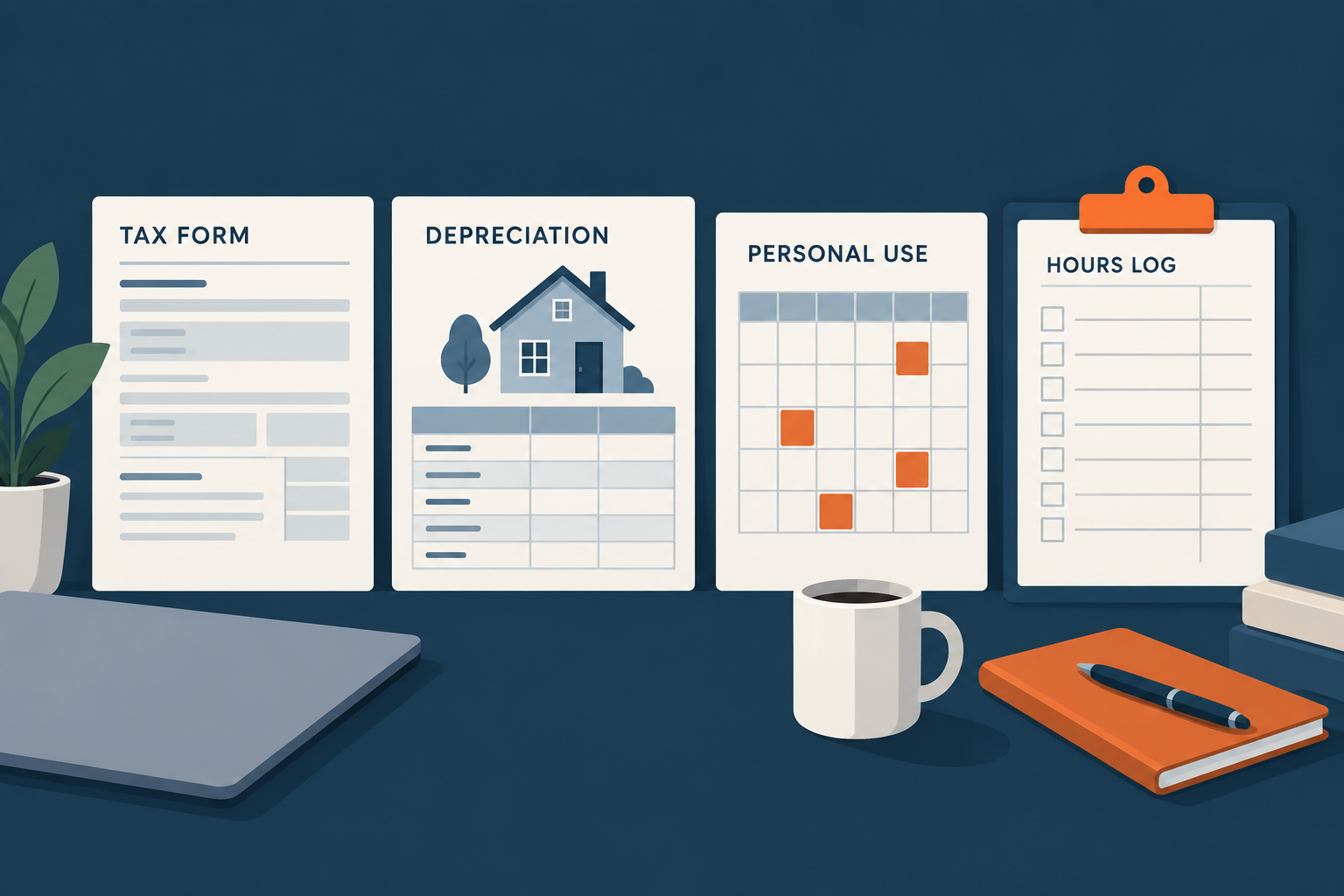
Two numbers decide most short-term rental tax outcomes for the 2026 filing season: 14 days of personal use and a 7-day average guest stay. Clear the first and you keep full rental-expense treatment; clear the second and your rental may sit outside the passive activity rules entirely, which is what lets losses offset other income. Everything else — cleaning supplies, linens, smart locks, cost segregation — is downstream of those two tests.
I have been buying and operating real estate for 18 years, running short-term rentals since 2016, and I have walked something like 10,000 operators through their first year of books. The pattern is always the same. People chase the deduction list and skip the qualification tests that decide whether the list applies to them. This article fixes that order.
One thing up front, and I mean it: this is not tax advice. I am an operator, not a CPA or an attorney. Every rule below is sourced to the IRS's own published pages so you can read the primary text yourself, but a licensed tax professional makes the call on your return.
What Actually Changed Going Into the 2026 Filing Season
Most coverage still in circulation was written when bonus depreciation was scheduled to fall to 40% in 2025 and 20% in 2026. That phase-down was reversed. P.L. 119-21, commonly called the One Big Beautiful Bill Act, reinstated the 100% special depreciation allowance for qualified property acquired and placed in service after January 19, 2025, per IRS Publication 946. Property acquired before January 20, 2025 and placed in service during 2025 stays on the 40% schedule. You can also elect 40% instead of 100% for the first tax year ending after January 19, 2025.
So the panic deadline is gone. The planning question changed shape: it is no longer "buy before the rate drops," it is "does this asset have a recovery period short enough to qualify, and is my activity structured so the deduction is usable this year."
Section 179 limits moved too. For tax years beginning in 2026 the maximum Section 179 expense deduction is $2,560,000, reduced dollar for dollar once Section 179 property placed in service during the year exceeds $4,090,000. For 2025 those figures were $2,500,000 and $4,000,000.
Here is the corrected picture against what most 2025-era articles still claim:
Item | What older articles say | What IRS Pub. 946 says now |
|---|
Bonus depreciation, acquired after Jan 19, 2025 | 40%, dropping to 20% in 2026 | 100% special depreciation allowance |
Bonus depreciation, acquired before Jan 20, 2025 | 40% | 40% for 2025 placements |
Section 179 cap | $1.25M | $2,560,000 for tax years beginning in 2026 |
Section 179 phase-out threshold | $3.13M | $4,090,000 for tax years beginning in 2026 |
If you made a purchase decision in 2025 based on the old phase-down, tell your CPA the acquisition date, not just the invoice date. Acquisition timing is what sorts you into 100% or 40%.
The Personal-Use Test That Decides Your Deductions
IRS Topic 415 states the test plainly. If you use a dwelling unit as a residence, your deductible rental expenses are limited. You are treated as using it as a residence if personal use exceeds the greater of 14 days, or 10% of the total days you rent it to others at a fair rental price.
Read "greater of" carefully, because this is where most host conversations go sideways. The 14-day figure is a floor, not a ceiling. Rent 300 days at fair rental price and your personal-use allowance is 30 days, not 14.
Three illustrative cases, arithmetic shown:
Days rented at fair rental price | 10% of rented days | Personal-use limit (greater of 14 or 10%) | 20 personal days = residence? |
|---|
90 | 9 | 14 | Yes |
200 | 20 | 20 | No, at exactly 20 |
300 | 30 | 30 | No |
A separate rule sits next to this one and gets confused with it constantly. Topic 415 describes minimal rental use: if you use a dwelling unit as a residence and rent it fewer than 15 days in the year, you do not report the rental income and you do not deduct expenses as rental expenses. That is the rule behind every "rent your house during the big event tax-free" post you have seen. It is a different rule from the 14-day personal-use test, and it only helps if the unit is your residence and the rental period stays under 15 days.
Practical habits that hold up under questioning: log every personal night in one calendar, count nights a relative stays even when they paid nothing, keep the platform payout records that prove fair rental price, and never reclassify a personal weekend as a maintenance day without a written work record for that day.
The 7-Day Average Stay Exception to the Passive Activity Rules
This is the mechanic behind the reputation short-term rentals have for offsetting W-2 income, and it is not a loophole — it is a definition in IRS Publication 925.
Pub. 925 says a rental activity is not automatically treated as a rental activity for passive-loss purposes when the average period of customer use is 7 days or less. You compute the average by dividing total days in all rental periods by the number of rentals during the tax year. Land in that bucket and the blanket "rental = passive" rule stops applying, and the question becomes whether you materially participated.
Material participation has defined tests in Pub. 925. Two matter most to owner-operators: you participated in the activity for more than 500 hours during the year, or you participated on a basis that was regular, continuous, and substantial. Pub. 925 also allows a test where the activity is a significant participation activity and your combined participation across all such activities exceeds 500 hours, with each of those activities requiring more than 100 hours.
Worked example, illustrative: 140 total rentals, 420 total rented days. 420 ÷ 140 = 3.0 days average stay. That clears the 7-day threshold. Now the hours question is live, and hours are what people cannot produce when asked. Contemporaneous time logs — date, task, minutes, property — are the difference between a position and a story.
Also note the ownership detail people miss: active participation, a lower standard than material participation, requires at least a 10% interest by value in the activity, and active participation is not material participation. If a co-investor with 5% is telling you they qualify, check the text.
Schedule E or Schedule C: What Tips You Over
Most rental owners file Schedule E. Publication 527 is explicit about when you do not: generally you use Schedule C when you provide substantial services in conjunction with the property, or the rental is part of a trade or business as a real estate dealer.
The examples Pub. 527 gives for substantial services primarily for the tenant's convenience are regular cleaning, changing linen, and maid service. Furnishing heat and light, cleaning public areas, and trash collection do not count. Pub. 527 also warns that Schedule C treatment can bring self-employment tax via Schedule SE.
Where this bites short-term rental operators: mid-stay housekeeping, daily linen service, concierge and guest-experience add-ons. Turnover cleaning between separate guests is routinely handled on Schedule E in practice, while hotel-style in-stay service is the fact pattern Pub. 527 points at Schedule C. The line is fact-specific, self-employment tax is the consequence, and this is exactly the question to hand your CPA in writing rather than guess.
Deductions That Hold Up, and the Ones That Do Not
Topic 415 lists the categories: mortgage interest, real estate taxes, casualty losses, maintenance, utilities, insurance, and depreciation. From the operating side, the deductions that survive scrutiny are the ones tied to a specific booking, a specific asset, or a specific date.
Things that hold up in my books: turnover cleaning invoices matched to booking numbers, consumables restocked per stay, linens, listing and platform fees, property management fees, software the business actually uses, insurance premiums on the rental, repairs with a photo and a paid invoice, and mileage logged per trip with a purpose.
Things that do not: the espresso machine you liked, personal Amazon orders mixed into a business card, a family "discount" paid to a related party, and capital improvements expensed in year one. Publication 527 sets residential rental property depreciation at 27.5 years under MACRS GDS using the straight line method. A kitchen renovation is not a repair because you wrote "repair" on the receipt.
Repairs versus improvements is the single most common misclassification I see. Replacing a failed AC compressor keeps the property in operating condition. Installing new smart thermostats across the unit adds capability. One is deductible now, the other is capitalized and depreciated, and getting it backward either forfeits a deduction or creates a depreciation schedule that will not reconcile.
If you own a property whose component mix suggests cost segregation, hire an engineering-based study. Publication 946 sets the rules for what qualifies for the special depreciation allowance, and assets with recovery periods longer than 20 years do not qualify. A software-only estimate is not a study, and the fee is real money, so run it against the tax you actually expect to owe before you commit.
Year-End Documentation Process
This is the sequence I run every December, in order, and it takes an afternoon when the year was tracked properly and a week when it was not.
Close the calendar. Export every booking with check-in date, check-out date, and nights. Compute total rented days and total rentals, then divide to get average stay. Write the number down.
Reconcile personal use. List every night you, your family, or a relative occupied the unit. Compare against the greater of 14 days or 10% of fair-rental-price days.
Match bank to books. Every rental expense should trace to a business account. Move any personal item out and any business item in, with documentation.
Split repairs from improvements. Flag every line over your capitalization threshold for CPA review rather than deciding yourself.
Assemble the hours log. Date, task, minutes, property. Total it. If it is under 500 hours, say so out loud rather than discovering it in April.
Pull the platform tax forms. Collect 1099-K and equivalent statements from every booking channel, including direct-booking processors.
Hand the package to a CPA who files short-term rentals regularly, with your average-stay number, personal-use count, and hours total on the cover page.
Step 7 is not optional. The purpose of steps 1 through 6 is to give a professional facts to work with instead of a shoebox and a hope.
Where Operators Get This Wrong
Three failure modes account for most of the damage I have watched.
The first is treating average stay as an intention instead of a calculation. If your listing allows 14-night bookings and you take a few, your average can cross 7 days without you noticing. Compute it monthly, not in April.
The second is untracked hours. Material participation under Pub. 925 is measured in hours, and a co-hosted property where a manager handles everything is a hard case to make. Decide early whether you want the position, then operate accordingly.
The third is mixed accounts. There is no defensible way to reconstruct which Amazon order was guest supplies eighteen months later. Separate cards, separate bank, no exceptions.
If you want a second set of eyes on how your specific portfolio is structured before you file, book a complimentary one-on-one diagnostic call. It is free. If we build you a written plan after it, that is $997. Neither one is tax advice, and neither replaces your CPA.
Frequently Asked Questions
Is the personal-use limit always 14 days?
No. IRS Topic 415 sets it at the greater of 14 days or 10% of the days you rent the unit at a fair rental price. At 300 fair-rental days, 10% is 30 days, so 30 is your limit. The 14-day figure only governs when 10% of rented days is smaller than 14.
What is the fewer-than-15-days rule?
Topic 415 describes it as minimal rental use. If you use the dwelling unit as a residence and rent it fewer than 15 days during the year, you do not report that rental income and you do not deduct expenses as rental expenses. It is a separate rule from the personal-use limit and applies to residences, not to dedicated rentals.
How is the 7-day average stay calculated?
Publication 925 says you divide the total number of days in all rental periods by the number of rentals during the tax year. In the illustrative case above, 420 rented days across 140 rentals is a 3.0-day average. An average of 7 days or less means the activity is not automatically treated as a rental activity under the passive activity rules.
How many hours count as material participation?
Publication 925 lists several tests. The one most operators aim at is more than 500 hours of participation in the activity during the year. Another test covers significant participation activities, where activities each exceeding 100 hours combine to more than 500 hours. Contemporaneous logs are the evidence.
What bonus depreciation percentage applies to property placed in service in 2026?
Publication 946 states that P.L. 119-21 reinstated the 100% special depreciation allowance for qualified property acquired and placed in service after January 19, 2025. Property acquired before January 20, 2025 and placed in service in 2025 is limited to 40%. Acquisition date drives which rate applies, so document it.
Do I file Schedule E or Schedule C for my Airbnb?
Publication 527 says Schedule E is the basic form for residential rental income and expenses, and that you generally use Schedule C when you provide substantial services primarily for the tenant's convenience, such as regular cleaning, changing linen, or maid service. Schedule C can bring self-employment tax. Your CPA decides which fits your service model.
Sources
Related Reading