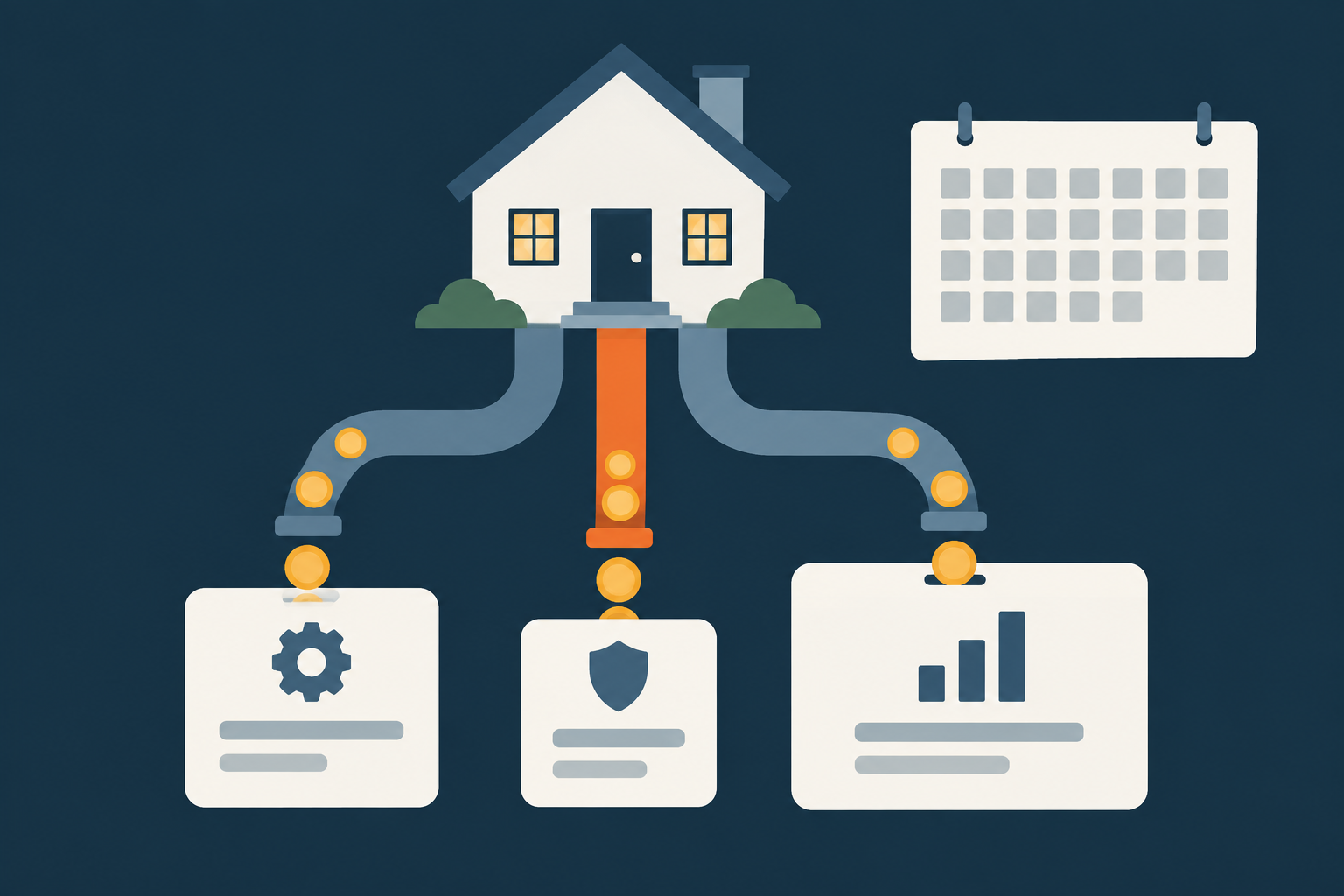
A cash flow system for a short-term rental is six bank accounts, one weekly money review, and a reserve rule that covers at least three slow months. You can install all of it in 90 days: 30 days to separate and map the money, 30 days to build reserves and a forecast, and 30 days to run the routine until it holds. Most owners who feel "busy but broke" have a timing and visibility problem, and a system fixes that before any pricing change does.
I've owned and operated real estate for more than 18 years and have focused on short-term rentals since 2016. The owners who stay calm through a slow January are rarely the ones with the highest nightly rate. They're the ones who know, on any Monday morning, how much cash is committed, how much is spare, and how many weeks of bills the reserves can carry. This blueprint shows how to build that, with the arithmetic laid out so you can swap in your own numbers.
What a Cash Flow System for an STR Actually Is
A cash flow system is a set of rules for where every payout goes, when bills get paid, and how much cash sits in reserve before you take a dime out. It is not an app. Software can help, but a spreadsheet and a business bank account will carry most small portfolios if the rules are clear.
A working system has four parts:
Separation. Rental money lives in its own accounts, never mixed with household spending.
Allocation. Each payout is split by fixed percentages into operating, tax, capital, seasonal, and owner buckets.
Rhythm. You look at the numbers on a set day every week and close the books on a set day every month.
Forecast. You project the next 90 days of revenue against the next 90 days of fixed costs, so a soft month shows up on paper weeks before it shows up in the bank.
The IRS treats the first part as a starting point. Publication 583 tells new business owners that one of the first things to do is open a business checking account and keep it separate from personal checking. For a rental owner, that separation is also what makes a Schedule E or a lender's review painless instead of a weekend of digging through statements.
Why STR Cash Flow Breaks
Short-term rentals fail on cash timing long before they fail on profit. Here are the failure modes I see most often in the portfolios I work with.
Payouts lag bookings. Airbnb's help center says that for most stays of 27 nights or less, the payout is initiated by the end of the business day after the guest's scheduled check-in. Then the money still has to travel: ACH direct deposit typically takes 3 business days and a bank account transfer 3 to 5 business days. A booking made in March for a July stay is not March cash. Airbnb also notes that a payout can be reviewed and delayed up to 45 days after check-in. If your mortgage draft assumes that money is there, one review can bounce a payment.
Revenue is seasonal, bills are not. The mortgage, insurance, internet, and software subscriptions cost the same in February as they do in July. A property that clears $1,000 a month in peak season can lose more than that in the off-season, as the waterfall below shows.
Capital expenses arrive in lumps. A water heater, a sofa that a guest destroyed, a roof patch. None of these show up on a monthly budget unless you've been funding a reserve for them.
Taxes surprise people. IRS Publication 527 explains that a cash-basis owner reports rental income in the year it's received, and that advance rent counts as income in the year you receive it, no matter what period it covers. A December payout for a January stay lands in December's tax year. Owners who spend payouts as they arrive often find the tax bill in April with no cash earmarked for it.
Nobody is watching weekly. When the only review happens at tax time, small leaks run for months. A cleaner who bills an extra hour per turn, a pricing tool that left a peak weekend $60 under market, a subscription for a tool you stopped using. Each is small. Together they decide whether a property pays you or you pay it.
The Monthly Cash Flow Waterfall for One STR
The fastest way to see why reserves matter is to run the same property through a strong month and a weak month side by side.
Illustrative example: one two-bedroom STR with the same fixed costs in both months. Peak month is 20 booked nights at $220 plus 5 cleaning fees at $120. Slow month is 10 booked nights at $190 plus 5 cleaning fees at $120. The platform fee assumption is 3% of gross, and the capital reserve is funded at 5% of gross.
Line item | Peak month | Slow month |
|---|
Nightly revenue | $4,400 | $1,900 |
Cleaning fees collected | $600 | $600 |
Gross booking revenue | $5,000 | $2,500 |
Platform fee (3%) | -$150 | -$75 |
Net payouts received | $4,850 | $2,425 |
Cleaning (5 turns at $120) | -$600 | -$600 |
Supplies and consumables | -$150 | -$150 |
Utilities and internet | -$350 | -$350 |
Pricing and management software | -$80 | -$80 |
Repairs and maintenance | -$150 | -$150 |
STR insurance | -$150 | -$150 |
Net operating income | $3,370 | $945 |
Mortgage payment with escrow | -$2,100 | -$2,100 |
Cash flow before reserves | $1,270 | -$1,155 |
Capital reserve (5% of gross) | -$250 | -$125 |
Cash left for tax set-aside and owner pay | $1,020 | -$1,280 |
Operating expenses total $1,480 in both months ($600 + $150 + $350 + $80 + $150 + $150). The peak month leaves $1,020. The slow month needs $1,280 from somewhere. If a market has three slow months like that, the property needs $3,840 in a seasonal reserve (3 × $1,280) just to stay even, before any owner pay.
This is the moment many owners miss. They see $1,020 in July, spend it, and then borrow on a credit card in January. Over the full year the property can still come out ahead. The cash just wasn't in the account when the January bills came due. To run your own version of this table, plug your numbers into the rental property cash flow calculator and compare your best and worst months.
The Account Structure and Reserve Rules
Once you can see the waterfall, the account structure follows from it. Each account has one job and a target balance, so you always know whether it is full, short, or over-funded.
Using the illustrative property above, fixed monthly costs are $2,680 (utilities $350 + software $80 + insurance $150 + mortgage $2,100). The table below turns that into targets.
Account | What goes in | What comes out | Target balance (illustrative) |
|---|
Income | Every platform and direct-booking payout | Weekly sweep to the other accounts | Near $0 after each sweep |
Operating | Enough to cover the month's bills | Cleaning, supplies, utilities, software, insurance, mortgage | 2 months of fixed costs: $5,360 |
Tax set-aside | A fixed percentage of each sweep, set with your CPA | Estimated tax payments | Your CPA's estimate for the quarter |
Capital reserve | 5% of gross booking revenue | Replacements and repairs over $500 | $5,000 per property, about 20 months if every month funds $250, longer with $125 slow months |
Seasonal reserve | Surplus from peak months | Covers slow-month shortfalls | 3 slow months: $3,840 |
Owner pay | What remains after the others are full | Your distribution | No target; this is the reward |
The SBA's guidance on managing business finances points out that you need a business bank account no matter which payment methods you accept, and it describes the balance sheet as the snapshot that helps you project cash flow. Six accounts sounds like a lot until you realize many business banks let you open sub-accounts quickly, often at no cost. The structure is what keeps you from spending tax money on a new hot tub.
Two rules hold the structure together. First, owner pay is funded last, only when the operating and seasonal accounts are at target. Second, when you tap a reserve, you rebuild it before owner pay resumes.
The 90-Day Process: Steps to Install Your Cash Flow System
Here is the order I recommend. Each step builds on the one before, so resist the urge to skip to pricing tools before the money is separated.
Days 1-7: Open the accounts. Open two business checking accounts, one for income and one for operating, plus savings sub-accounts for tax, capital, seasonal, and owner pay. Point every platform payout and direct-booking processor to the income account.
Days 8-14: Pull 12 months of history. Export payout reports from each platform and 12 months of bank and card statements. Tag every transaction to a category that matches Schedule E lines so your bookkeeping and your tax return use the same labels.
Days 15-21: Build your waterfall. Create the peak-month and slow-month table above with your real numbers. Identify how many slow months your market has and calculate your seasonal reserve target.
Days 22-30: Set allocation percentages. Decide what percentage of each payout goes to tax (with your CPA), capital (start at 5% of gross), and seasonal reserve. Write the rules on one page.
Days 31-45: Start the weekly sweep. Pick one day a week. Move money from income into each account by percentage, then pay bills from operating only. Log the balances in a simple tracker.
Days 46-60: Build a 90-day forecast. List every confirmed booking for the next 90 days by expected payout date, not booking date, and subtract the fixed costs due in the same window. Flag any week where operating drops below one month of fixed costs.
Days 61-75: Run your first full monthly close. Reconcile every account to the bank statement, compare actual expenses to the waterfall, and write down the two largest variances and why they happened.
Days 76-85: Fix the leaks you found. Renegotiate or rebid the largest vendor cost, cancel unused subscriptions, and review your pricing floor and minimum-stay settings for the next slow season.
Days 86-90: Review and set the next quarter. Check each reserve against its target, decide whether owner pay can start or increase, and schedule the next 90-day review on your calendar.
By day 90 you should be able to answer three questions in under five minutes: how much cash is free today, how many months the reserves can carry the property, and which expense grew fastest last month. If you can't, repeat steps 5 through 7 for another month before adding anything new.
Pricing and Expense Controls That Protect the Margin
A system protects the margin you have. Pricing and expense habits decide how big that margin gets.
Use demand-based pricing with a floor. Rates that move with local demand, events, and lead time usually beat a flat rate. The mistake is letting a tool drop the rate below what the slow-month waterfall can survive. Set a minimum nightly rate based on your numbers: in the example above, the $190 slow-month rate does not cover fixed costs on its own, which is exactly the gap the seasonal reserve is sized to fill. Set the floor so each booked night at least covers its per-stay costs. Our guide to automated pricing on Airbnb walks through floors, minimum stays, and gap-night rules.
Watch the fee model. Platform fees come straight off the top line. Check which fee structure your listings use and put the real rate in your waterfall, because a small percentage change on gross revenue shows up in every month of the year.
Track expenses per turn, not just per month. Cleaning, laundry, and consumables scale with stays. Divide each month's total by the number of turns. If cost per turn climbs while turns stay flat, you have a vendor or supply problem to fix.
Separate repairs from capital. Routine repairs come out of operating. Anything over a set dollar amount, such as $500, comes out of the capital reserve. This keeps a single replacement from wrecking a month's numbers and keeps your records cleaner for your tax preparer.
Keep records you can defend. IRS Publication 583 explains that the general period of limitations for assessing additional tax is 3 years, and longer in some cases. Store receipts and payout reports by month in the same folder structure every time. For the tax side of this, see our breakdown of STR tax deductions.
Why Focus Beats Spreading Across Markets
The common advice is to diversify across as many markets as possible. For small operators, I think that advice often hurts cash flow before it helps it.
Every new market adds a new cleaner, a new handyman, a new set of local rules, a new seasonality curve, and a new tax registration. Each one is another waterfall to model and another set of reserves to fund. In the portfolios I work with, the owners who scaled cleanly usually went deep in one or two markets first, learned the demand calendar well enough to price it confidently, and built vendor relationships that cut response times.
Focus does carry risk. A local regulation change or a single bad season hits harder when everything sits in one place. I'd rather earn the right to expand by proving the system in one market first: reserves at target, a clean monthly close, and a forecast you trust. Then the second market starts with a process that already works.
If you want a second set of eyes on your numbers before you expand, book a complimentary one-on-one diagnostic call. We'll look at your waterfall, your reserves, and where cash is leaking. If you want a full written plan after that, the $997 action plan builds it out property by property.
Frequently Asked Questions
How many bank accounts does an STR owner need?
Six works well for most owners: income, operating, tax set-aside, capital reserve, seasonal reserve, and owner pay. The point is that each account has one job and a target balance. If six feels like too many at first, start with income, operating, and one reserve account, then split the reserve once the habit sticks.
How big should my seasonal reserve be?
Take your average slow-month shortfall after debt service and the capital reserve, then multiply by the number of slow months in your market. In the illustrative example, that's $1,280 times 3 months, or $3,840. Recalculate it every quarter as your rates and costs change.
When does Airbnb actually pay hosts?
Airbnb's help center says that for most stays of 27 nights or less, it initiates the payout by the end of the business day after the guest's scheduled check-in. Transfer time then depends on the method, such as about 3 business days for ACH. Some hosts are on different schedules, and payouts can be held for review, so build your forecast on payout dates, not booking dates.
How much should I set aside for taxes?
That depends on your tax bracket, how your rental is classified, and your deductions, so set the percentage with your CPA. What matters for cash flow is that the money moves to a separate account on every weekly sweep. IRS Publication 527 notes that advance rent is income in the year you receive it, which is why year-end payouts deserve extra attention.
Do I need special software to run this system?
No. A business bank with free sub-accounts and a spreadsheet will run the whole system for one to three properties. Software helps once you have more properties or more booking channels, but it can't fix unclear allocation rules. Get the rules working by hand first.
How long before I see results?
You will likely feel the difference within the first month of weekly sweeps because they finally know what's spare. The reserves take longer to fill. In the example, the capital reserve needs about 20 months at $250 a month, and closer to two years once slow months fund only $125. Plan on about a year to fill the operating and seasonal reserves and about two years for capital.
Sources
Related Reading