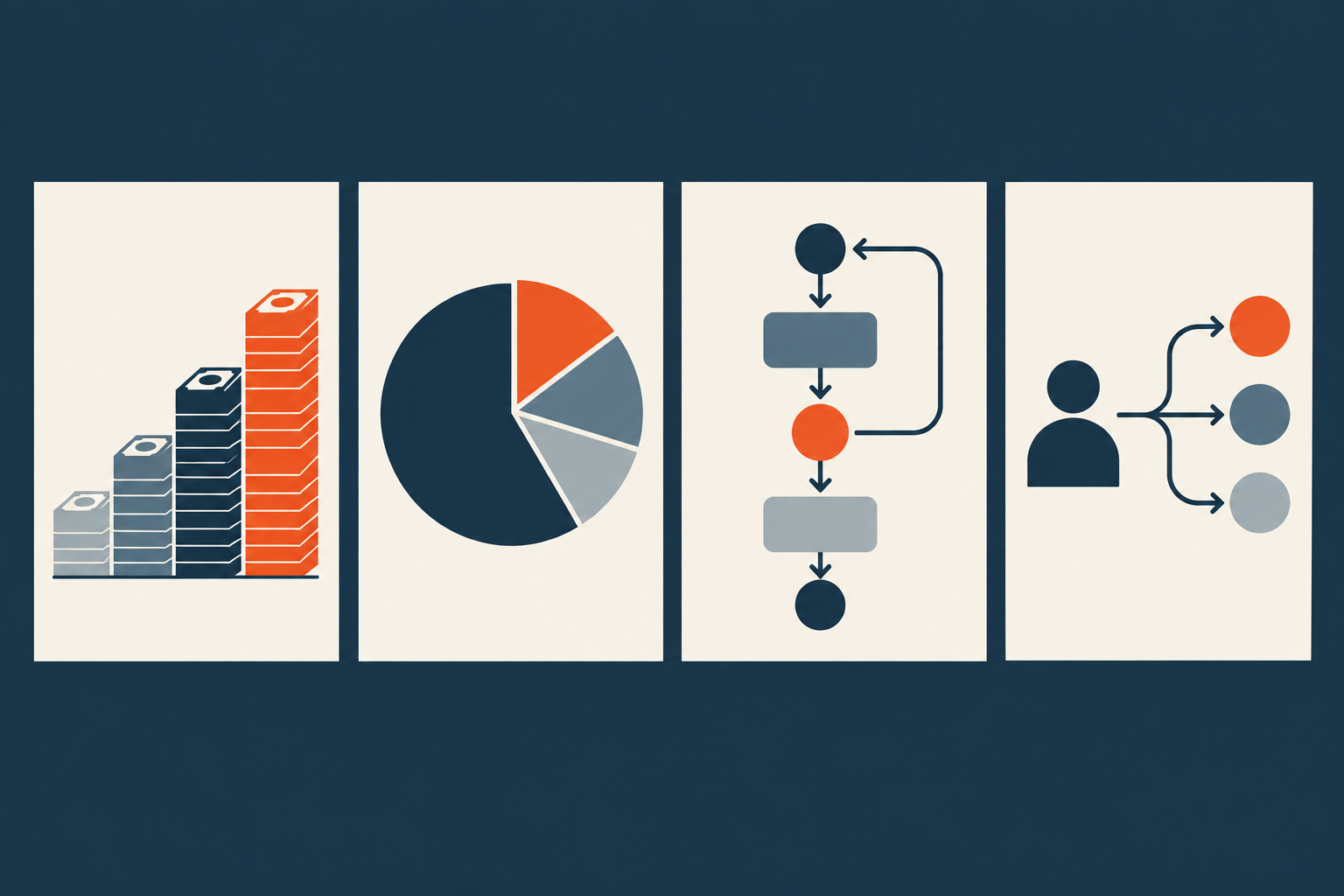
Future-proofing a small business is not a mindset exercise. It is the work of closing four measurable exposures: how many weeks of operating expense your cash covers, how much of your revenue depends on one customer or one channel, whether the work is written down well enough to survive a person leaving, and how many decisions still route through the owner. Each one can be counted this week, and each one can be moved within a quarter.
I have spent 18-plus years buying, operating, and financing real estate, with short-term rentals as the core of the portfolio since 2016, and I have built a list of more than 10,000 short-term rental operators through Cashflow Diary. The businesses that came apart rarely died of a single bad month. They died because a single customer left, a single platform changed its rules, or a single person quit and took the only copy of the process with them. This article is education, not tax or legal advice; run structure and deduction questions past your own CPA and attorney.
The Four Exposures, Scored in One Sitting
Before you fix anything, score where you stand. Give each exposure a rating of red, yellow, or green using a number you can actually pull from your bank account, your sales report, and your calendar. No estimates from memory.
Exposure | Metric to pull | Red | Yellow | Green |
|---|
Cash reserve depth | Unrestricted cash ÷ average monthly operating expense, in weeks | Under 4 weeks | 4–12 weeks | 13+ weeks |
Revenue concentration | Largest customer's share of trailing 12-month revenue | Over 35% | 15–35% | Under 15% |
Channel concentration | Largest booking or sales channel's share of revenue | Over 70% | 40–70% | Under 40% |
Documented systems | Share of recurring tasks with a written procedure someone else has run | Under 25% | 25–70% | Over 70% |
Owner dependence | Decisions per week that cannot be made without the owner | 20+ | 6–19 | 5 or fewer |
Most owners who run this carefully come back with two reds. That is normal and it is fixable. The point of scoring is to stop spreading effort evenly across four problems when one of them is the thing that would actually end the business.
The Federal Reserve Banks' 2026 Report on Employer Firms, drawn from the 2025 Small Business Credit Survey, found that rising costs of goods, services, or wages was the most common financial challenge firms reported in the prior 12 months, that more than four in 10 firms reported tariff-related cost increases, and that 77% of firms reported one or both of those cost challenges. Cost shocks arrive whether or not your reserve is ready. In the same survey, the most common reason firms applied for financing was to meet operating expenses (56% of applicants) — borrowing to plug a hole is the expensive version of a reserve.
Exposure One: Cash Reserve Depth in Weeks
Count reserves in weeks of operating expense, not in dollars. A $40,000 balance means something different for a business with $9,000 of monthly fixed cost than for one with $32,000. Weeks is the unit that tells you how long you can keep the lights on while you fix whatever broke.
Calculate it in three moves. Add your true monthly operating expense: rent or debt service, payroll and contractors, insurance, software, utilities, and the recurring maintenance you keep pretending is occasional. Divide your unrestricted cash — not deposits held for guests, not sales tax you owe, not a credit line — by that number. Multiply by 4.3 to convert months to weeks.
Monthly operating expense | Cash on hand | Weeks covered | Reading |
|---|
$9,000 | $7,500 | 3.6 | Red — one slow month ends the business |
$9,000 | $27,000 | 12.9 | Yellow — survives a quarter, not a re-tenanting |
$18,000 | $54,000 | 12.9 | Yellow — same weeks, larger dollar loss per week |
$18,000 | $108,000 | 25.8 | Green — can absorb a channel suspension |
$32,000 | $40,000 | 5.4 | Red — large business, thin runway |
These rows are illustrative examples, not survey results. Build the same table with your own two numbers and the reading falls out.
The target depends on how volatile your revenue is. A seasonal short-term rental portfolio with a four-month shoulder season needs deeper cover than a business on annual contracts. My working rule for rental operations: enough unrestricted cash to carry every fixed cost through the longest historical gap between strong months, plus one full turnover cost per unit. For one property that might be 13 weeks; for a seasonal mountain market it is closer to 26.
Fund it in a separate account at a separate institution, and move a fixed percentage of every deposit on the day it lands rather than sweeping what is left at month end. What is left at month end is always zero. The SBA's guidance on managing business finances covers the mechanics of separating business cash from personal cash, which is the precondition for any of this being countable.
Exposure Two: Revenue Concentration by Customer and Channel
Concentration is the exposure owners most often mistake for success. One client paying 60% of your revenue feels like stability right up to the renewal email. Two numbers matter: the largest customer's share of trailing twelve-month revenue, and the largest channel's share.
Channel concentration hits rental operators hardest. If one booking platform produces 85% of your nights, that platform's policy change, algorithm shift, or account suspension is a business-ending event you do not control. I treat any channel above 70% as an active project, not a background worry. Direct bookings, a second listing platform, and repeat-guest relationships each reduce the number of parties who can switch you off. The mechanics of splitting demand across platforms are covered in our breakdown of Airbnb, Vrbo, and direct booking channel strategy.
Concentration can also sit in a segment you have never sized. The same Fed survey found about one in five firms had international customers in 2024, and those firms were more likely to expect that revenue to fall (40%) than rise (16%) the following year. Name your equivalent segment and size it before it moves.
Three moves reduce concentration without gutting revenue:
Set a ceiling. Decide the maximum share any one customer or channel may hold — 30% is a common line — and treat crossing it as a trigger to sell into a different segment, not as a reason to celebrate.
Grow the denominator. It is easier to add a second and third revenue source than to fire your biggest customer. Concentration falls as total revenue rises.
Own the relationship. Collect guest and customer contact details, with consent, into a list you control. A booking platform owns its demand; your email list is yours.
Exposure Three: Documented Systems That Survive a Departure
The test for this exposure is blunt. Pick your most important recurring process. Hand the written version to someone who has never done it and leave the room. If the work gets done to standard, the system exists. If your phone rings, it does not.
Documentation fails for predictable reasons: the procedure lives in someone's head, the written version describes intent rather than steps, or there is no named owner to update it when the tool changes. Write procedures as the person doing the work would need them — trigger, steps in order, the exact tool and login path, the standard of done, and who to escalate to.
Start with the processes where a mistake costs the most money or the most trust: turnover and quality checks, guest or customer communication windows, payment collection and refunds, maintenance triage, and month-end bookkeeping. The IRS recordkeeping guidance for small businesses is a reasonable outside anchor for what your financial records need to contain and how long to keep them.
One practice separates a documented business from a decorated binder: every procedure gets run by someone other than its author within 30 days of being written, and the author is not allowed to answer questions during the run. Gaps show up immediately. Fix them in the document, not in a text thread. Our post on why your systems are the reason you cannot take time off walks through what that looks like when it is working.
Exposure Four: Owner Dependence and the Decision Bottleneck
Owner dependence is measurable. For one week, log every decision that came to you and mark each one as (a) clearly yours — capital, hiring, pricing policy, legal exposure — or (b) a decision someone else could have made with a rule, a budget, and a boundary. Count category (b). That count is your bottleneck score.
Most of category (b) collapses under three fixes: a spending authority (anyone may approve maintenance under a set dollar amount without asking), a decision rule (if a guest reports X, do Y, notify me after), and a standing answer to the question that keeps coming back. Write the rule the first time you answer the question. The second time, point at the rule.
Decision type | Who should own it | Authority to grant | What comes back to the owner |
|---|
Maintenance under a set threshold | Operations lead or manager | Spend without pre-approval, log after | Weekly spend summary |
Guest service recovery | Front-line team | Refund or credit up to a fixed amount | Anything above the cap |
Nightly rate adjustments | Revenue rule or pricing tool | Move inside a set floor and ceiling | Changes to the floor or ceiling |
Hiring a contractor | Manager | Choose from an approved vendor list | New vendor onboarding |
New debt or a new lease | Owner | None delegated | The decision itself |
Owner dependence and documentation are the same problem seen from two sides: people cannot decide without you because the standard was never written down. Our pieces on hiring a team so you can fire yourself and how to stop being the chief everything officer start from the same place: define the outcome, define the boundary, then stop approving things inside the boundary.
How to Decide: A Four-Step Process
Four exposures, limited hours. This sequence picks the order for you.
Score all four this week using the table at the top. Pull the numbers from the bank, the sales report, and a one-week decision log — not from memory.
Rank by time-to-failure, not by discomfort. Ask how long the business survives if that exposure breaks tomorrow. A three-week reserve fails faster than a 60% customer, so cash goes first even though documentation feels more productive.
Work one exposure for 90 days with one number attached: weeks of reserve, largest-channel share, share of processes run by someone else, or decisions per week that need you.
Re-score at day 90 and move to the next red. Keep the finished exposure alive with a single recurring check on the calendar, or it drifts back inside two quarters.
Running all four at once is how owners end up with four half-built projects and the same risk profile they started with. Sequence beats intensity here. If you want a second set of eyes on which exposure is actually closest to breaking, book a complimentary one-on-one diagnostic call and we will score it with you.
What This Looks Like at Scale
The context is worth holding. The SBA Office of Advocacy counts 34,752,434 small businesses in the United States, employing 45.9% of American workers. Nearly all of them face the same four exposures with fewer resources than a large firm has to absorb a shock, which is exactly why sequencing matters more than ambition.
A business that clears all four — a quarter's worth of operating expense in unrestricted cash, no customer or channel over about a third of revenue, procedures a stranger can run, and an owner who makes five decisions a week instead of thirty — is not immune to a downturn. It is solvent through one. That is the whole goal: keep the business alive long enough to buy the assets and take the contracts that only become available when weaker operators are forced to sell.
Pick the red with the shortest time-to-failure and give it 90 days. Then re-score.
Keep Reading
Frequently Asked Questions
How much cash reserve does a small business actually need?
Measure it in weeks of operating expense rather than dollars. A steady business on recurring contracts can function near 13 weeks of unrestricted cash; a seasonal operation with a long shoulder season should target enough to carry every fixed cost through its longest historical gap between strong months, which often lands closer to 26 weeks. Exclude money that is not yours to spend — held deposits, sales tax, and untapped credit lines — because a credit line can be reduced exactly when revenue drops.
What counts as dangerous revenue concentration?
A single customer above roughly 35% of trailing twelve-month revenue, or a single sales or booking channel above roughly 70%, is the point where someone else's decision can end your business. Track both numbers monthly. The faster fix is usually growing other revenue rather than cutting the large account, since concentration falls as the denominator rises.
How do I document systems without stopping the business for a month?
Document while you work instead of scheduling a documentation project. Record yourself doing the task once, write the steps from the recording, then have someone else run it from the written version within 30 days while you stay out of the room. Start with the five processes where a mistake costs the most money or the most trust, and add one new procedure a week after that.
How do I know if I am the bottleneck in my own company?
Log every decision that reaches you for one week and mark which ones actually required you — capital, hiring, pricing policy, legal exposure — versus those that could have been made with a spending limit, a written rule, and a clear boundary. If more than about five decisions a week fall in the second group, you are the constraint. Convert each recurring question into a written rule the first time you answer it.
Is any of this tax or legal advice?
No. Everything here is operational guidance on reserves, concentration, documentation, and delegation. Entity structure, deductions, employment classification, and contract terms are decisions for your CPA and your attorney, working from your specific facts and your state's rules.
Sources