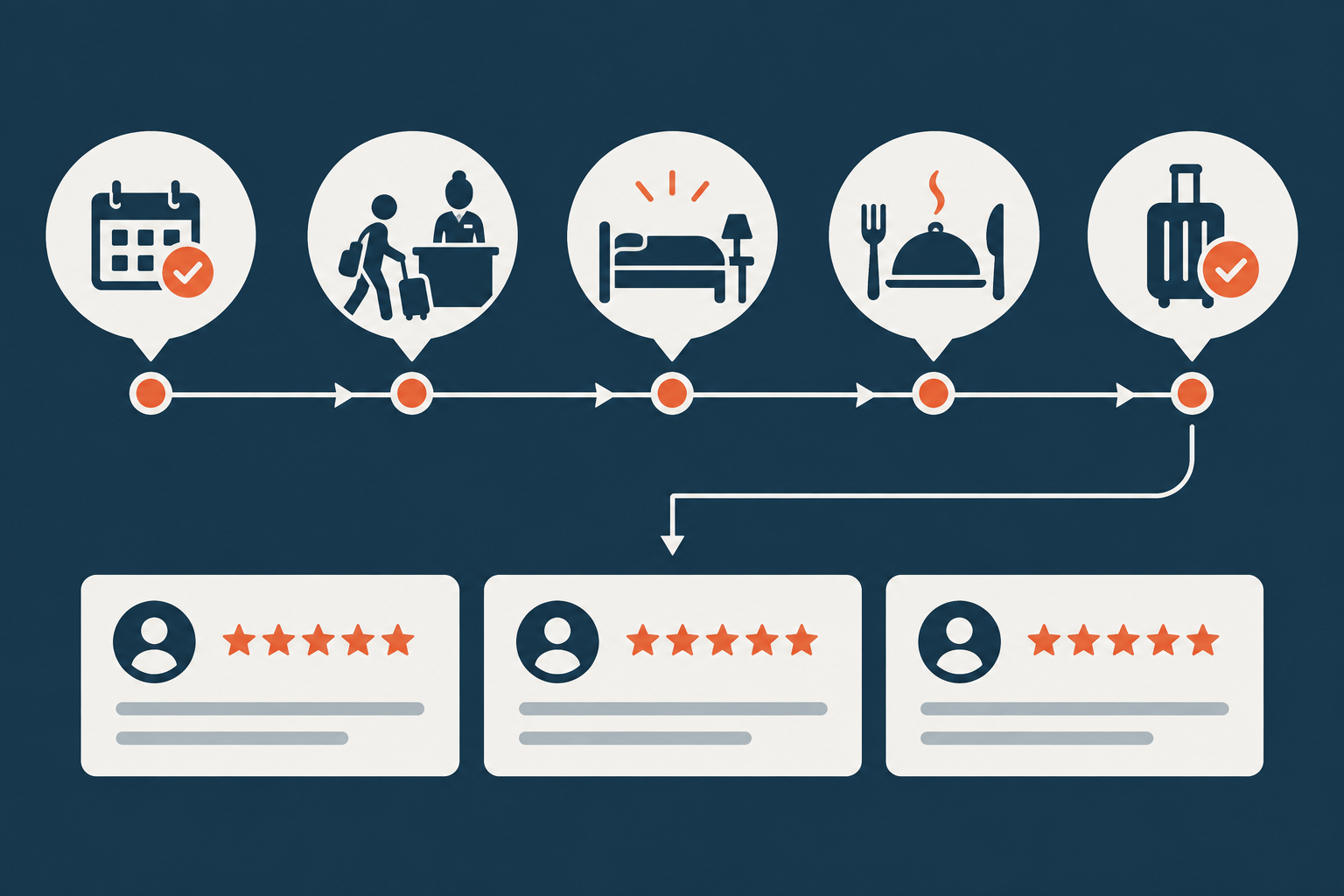
Your first ten five-star reviews are not luck, and they are not charm — they are the output of a system you build before the first guest books: a listing that promises only what the property delivers, a controlled arrival window, a fixed message schedule, a recovery script for the stay that goes sideways, and one compliant review request sent at the right hour. Get those five parts right and ten reviews take about six to ten weeks on a normal calendar.
I've spent 18+ years in real estate, focused on short-term rentals since 2016, and trained more than 10,000 operators through CashFlowDiary. The hosts who stall at three or four reviews almost never have a property problem. They have a promise problem, a timing problem, or no plan for the night the water heater quits.
Why the First Ten Reviews Carry So Much Weight
Airbnb shows an overall rating and category ratings on a listing once it has enough reviews, and guests filter and compare on that number. Early on, the math is brutal: a single four-star review inside your first five reviews drags the average further than ten four-stars will once you have a hundred. One 3-star stay in your first five pulls a perfect listing to roughly 4.6 — close to the range where guests start reading reviews instead of booking.
Reviews so far | Average after one 5★ | Average after one 4★ | Average after one 3★ |
|---|
0 (first review) | 5.00 | 4.00 | 3.00 |
4 at 5.00 | 5.00 | 4.80 | 4.60 |
9 at 5.00 | 5.00 | 4.90 | 4.80 |
24 at 5.00 | 5.00 | 4.96 | 4.92 |
49 at 5.00 | 5.00 | 4.98 | 4.96 |
Two operating conclusions follow. First, protect the first five stays like they are the whole business — screen dates, block back-to-back same-day turns, and be available by phone. Second, do not chase volume before the system works. Ten clean reviews beat thirty mixed ones, because rating recovery is slow arithmetic.
Airbnb also gives both sides a 14-day window to submit a review after checkout, and reviews publish once both parties submit or the window closes. That window is your whole operating clock: you cannot fix a review after it posts, and you cannot ask for one after day 14.
Expectation Setting Starts in the Listing
Most four-star reviews are written by guests who got exactly what you delivered and something different from what they expected. The listing is where you close that gap.
Rewrite the listing against this filter: every sentence either describes something a guest can verify in the first 30 minutes, or it gets cut.
Name the three things that are objectively imperfect. Street noise on weekends, a steep staircase, one bathroom for six beds, parking that is street-only. Guests who read a disclosed flaw and book anyway do not review you for it.
Photograph the actual room dimensions. Wide-angle photos that make a 9×10 bedroom read as a suite produce arrival-day disappointment you cannot recover from.
Put the check-in mechanics in the listing description, not only the post-booking message. Self check-in after 4 p.m., lockbox code at 2 p.m., no early bag drop.
State the amenity limits in plain numbers. Wi-Fi speed you have actually tested, how many towels, whether the "workspace" is a desk or a kitchen table.
Delete superlatives. "Stunning," "luxury," and "brand new" raise the bar you then have to clear. Describe instead: "2021 renovation, quartz counters, blackout blinds in both bedrooms."
Airbnb's own host-preparation guidance points the same direction: accurate descriptions and photos, clear house rules, and a working check-in process are treated as baseline hosting standards, not extras.
The Arrival Window Decides the Review
In my properties and in the ones I review with students, the first 30 minutes inside the door predicts the star rating better than anything else that happens during the stay. A guest who gets in smoothly and finds the place cleaner than expected has already decided to leave five stars; the rest of the stay only has to avoid breaking that.
Build the arrival window as a checklist, and run it before every one of your first ten stays:
Verify the code yourself, the morning of arrival. Smart-lock battery and code-sync failures are the single most common cause of an 11 p.m. emergency.
Do a walk-in inspection after the cleaner leaves, not a photo review. Check hot water, toilet flush, Wi-Fi connection on your own phone, and the bed you would sleep in.
Set one visible anchor. A short handwritten note plus a small consumable is enough. Hospitality reads as attention, not expense.
Leave a printed one-pager on the counter: Wi-Fi name and password, trash day, thermostat instructions, your phone number, checkout time.
Stay reachable for the first two hours after the stated check-in time. Not automated — reachable.
Arrival failure | Guest impact | Prevention cost | Typical rating hit |
|---|
Lock code does not work | Locked out, often at night | $0 — morning code test | −1 to −2 stars |
Missed cleaning detail (hair, trash) | Cleanliness category tanks | One walk-in inspection | −1 star, cleanliness sub-rating |
No hot water / HVAC off | Stay-ruining, refund risk | 5-minute systems check | −2 stars plus refund |
Wi-Fi down | Work trip ruined | Speed test on your phone | −1 star, accuracy sub-rating |
No checkout/trash instructions | Confused guest, bad handoff | Printed one-pager | −0.5 star, communication |
The Message Timing Schedule
Guests rate communication on responsiveness and clarity, not volume. Five messages per stay is the pattern that has worked across my portfolio: enough to feel hosted, few enough to feel private. Send them from your own account during your first ten stays — automate later, once you know what guests actually ask.
Touchpoint | Timing | Purpose | Length |
|---|
Booking confirmation | Within 1 hour of booking | Confirm dates, set check-in expectations, ask trip purpose | 4–5 sentences |
Pre-arrival details | 24–48 hours before check-in | Address, code, parking, arrival logistics | Short, scannable |
Arrival check | 2–3 hours after check-in | "Did you get in okay? Anything missing?" | 2 sentences |
Mid-stay check (stays of 3+ nights) | Morning of day 2 | Surface problems while they are still fixable | 2 sentences |
Checkout reminder | Evening before departure | Checkout time, trash, keys | 3 sentences |
The arrival check is the message that earns the money. It is your only reliable chance to convert a silent problem into a fixed problem. A guest who tells you on night one that there are no extra towels gets towels and writes a five-star review; the same guest who says nothing writes a four-star review about towels ten days later.
One rule on the mid-stay check: ask about the property, never about the review. "Anything the place is missing?" is a service question. "Are you happy so far?" invites a verdict you cannot control yet.
The Recovery Playbook When a Stay Goes Wrong
Something breaks eventually. A well-handled failure often produces a better review than a flawless stay, because the guest now has a story about you instead of a story about a condo. Run this triage in order:
Acknowledge inside 15 minutes, in writing, on the Airbnb message thread. Keep the record on-platform — if the case ever goes to Airbnb support or the Resolution Center, the thread is your evidence.
Classify the failure using the table below. The class determines what you spend, not how upset the guest sounds.
Fix or substitute the same day. Emergency vendor, replacement appliance, a bought-and-delivered item, or a paid hotel night for a habitability failure.
Make the remedy proportional and offer it once. Partial refund for lost nights, a fee refund for an inconvenience, a small credit for a minor gap. Do not escalate offers in a bidding pattern.
Confirm in writing when it is resolved, and ask one closing question: "Is there anything else before you check out?"
Debrief after checkout. Log the root cause, change the vendor, the checklist, or the listing copy so the same failure cannot repeat.
Failure class | Examples | Same-day action | Money response |
|---|
Habitability | No water, no heat/AC in extreme weather, no access | Relocate or repair immediately | Refund affected nights; cover relocation |
Core amenity | Wi-Fi, kitchen, washer, hot tub down | Vendor same day or documented substitute | Refund the fee tied to the amenity |
Cleanliness | Missed bathroom, previous-guest items, linens | Re-clean within hours; deliver fresh linens | Refund the cleaning fee |
Accuracy gap | Listing says two beds, one is a futon | Explain, offer alternate dates or exit | Partial refund or full refund with release |
Comfort/preference | Firm mattress, street noise, decor | Supply what you can (fan, mattress pad) | Usually none; supply instead |
Never trade money for a rating. Airbnb's review policy prohibits using incentives, threats, or refunds to influence what a guest writes, and coercion or review manipulation can get a listing removed. Refund because the guest lost something real, document why, and let the review land where it lands. This is an operating guideline, not tax or legal advice — check your own lease, insurance, and local rules before promising remedies in writing.
How and When to Ask for the Review
Both you and the guest have 14 days after checkout to write a review, and Airbnb publishes reviews once both are submitted or the window ends. That gives you a narrow, high-yield sequence:
Submit your review of the guest the same day they check out. Honest and brief. Airbnb prompts both sides to review after checkout, so getting yours in early clears your half of the clock and stops you from writing a reactive review after you read theirs.
Send one thank-you message 1–2 hours after checkout, while the trip still feels good. Ask for honest feedback, not for stars.
Use compliant language only: "Thanks for taking good care of the place. If you have a moment, an honest review helps other travelers and helps us improve." No stars requested, no gift, no discount, no trade.
Send one reminder on day 6 or 7 if no review has posted — one, and never after that.
Stop at day 14. The window closes, the review posts or it doesn't, and you move on to the next stay.
Reply publicly to every review you receive, including the good ones. Short, specific, no defensiveness. Future guests read your replies as evidence of how you handle problems.
What not to do, because it puts the listing at risk: asking for five stars specifically, offering anything of value in exchange, asking a guest to change or remove a review, or messaging after the window to complain. Airbnb treats incentivized and coerced reviews as policy violations.
The 8-Week Path to Ten Reviews
Reviews come from completed stays, so the only levers are booking pace and consistency. The schedule below is an illustration, not a forecast: at an average 3-night stay and moderate early occupancy, ten completed stays inside 8 weeks is what one unit can reach in a normal market. Your own pace depends on your calendar, price, and market demand.
Week | Focus | Target completed stays |
|---|
0 | Listing rewrite, photos, printed one-pager, vendor list | 0 |
1–2 | First two bookings hosted personally; run arrival checklist | 2 |
3–4 | Fix whatever the first guests flagged; keep 5-message cadence | 4–5 |
5–6 | Add a mid-stay check for 3+ night stays; review sub-ratings | 7 |
7–8 | Audit category ratings; close the weakest one | 10 |
Watch the sub-ratings, not just the overall number: cleanliness, accuracy, check-in, communication, location, and value are scored separately, and the weak one tells you exactly which part of this system is broken. Cleanliness says fire or retrain the cleaner. Accuracy says your listing is over-promising. Check-in says your arrival window is not being run.
If you want a second set of eyes on your listing copy and your first-ten plan before you take bookings, book a complimentary one-on-one diagnostic call and bring the live listing URL plus your message templates.
Frequently Asked Questions
How long do guests have to leave an Airbnb review?
Guests and hosts each have 14 days after checkout to submit a review. Reviews publish when both sides have submitted, or when the 14-day window closes. Once a review you wrote is published you can't edit it, though Airbnb's review policy lets you remove your own review within 30 days of publication. Plan your thank-you message and single reminder inside that window.
Should I review the guest first, or wait to see what they write?
Review the guest the same day they check out. Airbnb prompts both sides after checkout, so submitting early gets your half done while the stay is fresh and keeps you from writing a reactive review after reading theirs. Keep it factual: arrival, communication, condition at checkout.
Can I offer a discount or gift in exchange for a five-star review?
No. Airbnb's review policy prohibits incentivizing, coercing, or trading anything of value for reviews, and violations can lead to review removal or listing suspension. Ask for an honest review, with nothing attached to it.
What do I do about a four-star review that says nothing was wrong?
Reply publicly, briefly, and without arguing, then look at the sub-ratings to find the gap between promise and delivery. Usually it's accuracy or value, and the fix is listing copy or one missing amenity, not a bigger gift basket. One four-star review inside ten stays is survivable; a pattern is a system defect.
Do I need to drop my price to collect early reviews?
A modest early discount buys booking pace, which is the only real constraint on review count, but it is a temporary tactic with a fixed end date, not a positioning strategy. Decide the discount and the number of stays before you list, then return to market pricing once you hold ten reviews.
How many messages per stay is too many?
Five scheduled touchpoints — booking, pre-arrival, arrival check, mid-stay for longer stays, and checkout reminder — plus fast replies to anything the guest starts. More than that reads as surveillance, and guests mention it in reviews.
Related Reading
Sources