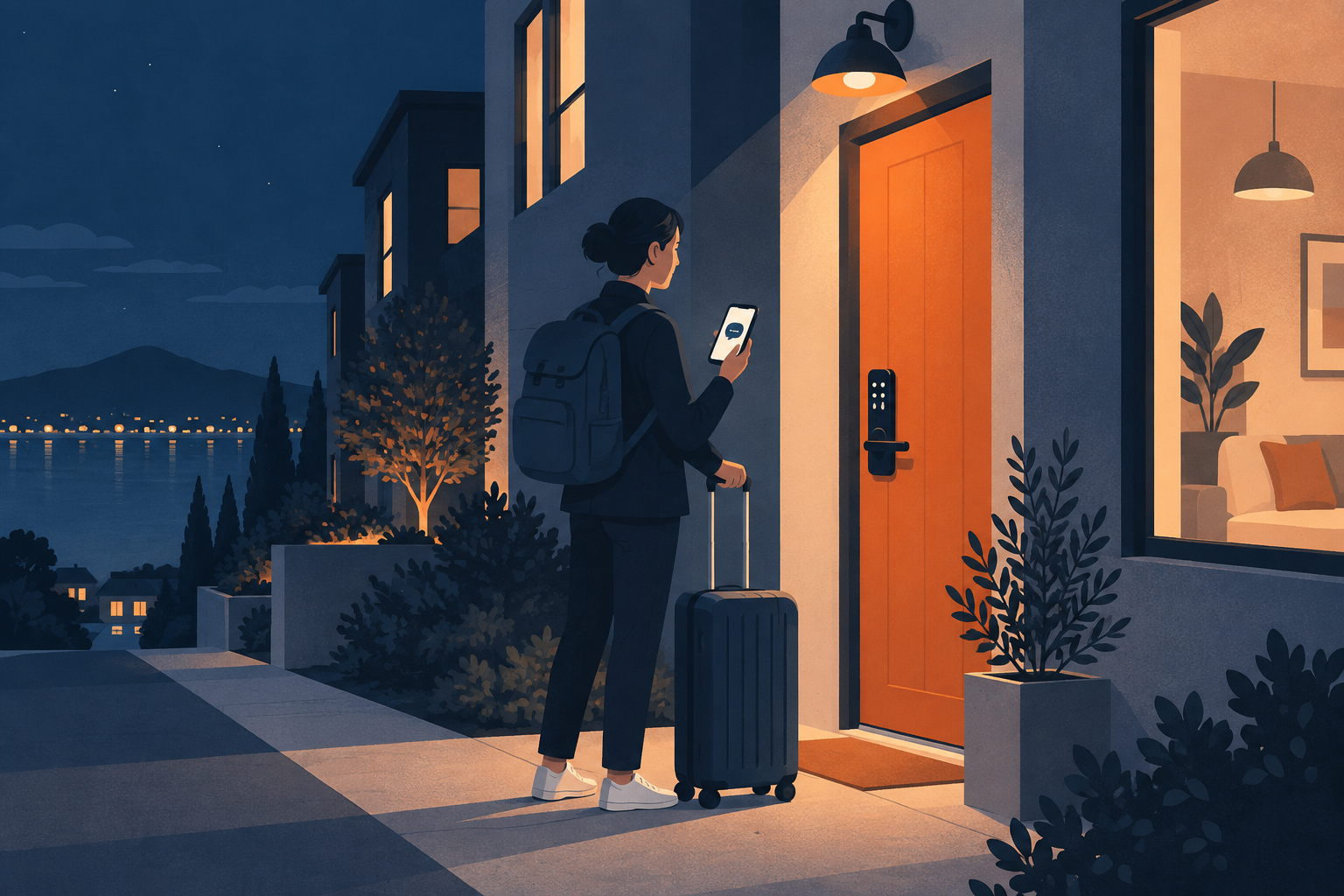
Short-term rental guest satisfaction comes down to three things you control: what the guest expects before they book, how easy the first 30 minutes after arrival are, and how fast and how well you respond when something breaks. Most low scores aren't caused by a bad property. They come from a gap between what the listing promised and what the guest found, made worse by a slow or defensive reply. Close those three gaps and your ratings, repeat bookings, and pricing power follow.
Last updated: 2026-09-24
Where Guest Satisfaction Is Actually Won and Lost
Guests don't rate your property in one moment. They rate a chain of moments, and the weakest link sets the score.
Airbnb asks guests to rate a stay across six categories: cleanliness, accuracy, check-in, communication, location, and value. The overall rating is its own separate score, not an average of the other six (Airbnb: Ratings for homes). That detail matters. A guest can give you fives on cleanliness and location and still leave a four overall because check-in took 40 minutes and a text went unanswered.
Map those categories to the stay and you get a clear picture of where the work sits:
Stay stage | Rating category it feeds | What the guest is judging | The failure you control |
|---|
Browsing and booking | Accuracy, value | "Is this what I think it is?" | Flattering photos, vague house rules, hidden limits |
Pre-arrival | Communication, check-in | "Do I know exactly what to do?" | Late or buried access details |
Arrival | Check-in, cleanliness | "Can I get in and relax?" | Hard-to-find entry, lock problems, a missed turnover detail |
In-stay | Communication, accuracy | "Will someone help if I need it?" | Slow replies, broken amenities, no backup plan |
Checkout and after | Value, overall | "Was it worth it?" | Long checkout chore lists, a dispute left unresolved |
Notice what isn't on this list: décor, welcome baskets, and fancy amenities. Those help, and the in-unit must-haves guide covers what belongs in the unit. But the three tips below are about operations, because operations is where most operators lose points they already paid for.
Tip 1: Set Expectations Before the Booking, Not After
The cheapest bad review to prevent is the one that starts with "the listing didn't mention."
Accuracy is the category operators underrate most. Guests measure your place against your listing, not against a hotel. If the listing oversells, a perfectly good property scores badly.
Write the listing for the guest who will complain
Every listing has a few facts that are awkward to put in writing. Put them in writing anyway. The usual suspects:
Stairs. Say how many flights and whether there's an elevator. A guest with a bad knee or three suitcases will judge you on this.
Parking. Say where, how many cars, and whether it's street parking that fills up at night.
Noise. Name the bar two doors down, the train line, or the early garbage pickup.
Sleeping arrangements. Say what each bed actually is. A sofa bed listed as "sleeps 6" invites a value complaint.
Wi-Fi. Post a real speed test, not "fast Wi-Fi." Remote workers check.
Shared or limited spaces. Locked owner's closet, shared laundry, a hot tub with seasonal hours.
Airbnb's own guest support is built around this. AirCover for guests steps in with rebooking or a refund when a listing is significantly different from what was advertised and the host can't resolve it, with examples like fewer bedrooms than listed or a major advertised amenity missing (Airbnb: AirCover for guests). An accurate listing protects the review and the payout.
Refresh photos when the property changes
Photos drift out of date quietly. A replaced sofa, a removed grill, a new neighbor's fence blocking "the view." Airbnb's accuracy rating asks guests whether the place was represented with up-to-date photos and info and whether everything was in good working condition (Airbnb: Ratings for homes). Put a photo review on the calendar every time you replace furniture or change a room, and at least once a year even if nothing changed.
Use the booking confirmation to reset expectations
The message right after booking is your second chance to set expectations. Restate the two or three facts most likely to surprise this guest: stairs, parking, quiet hours, and check-in time. Short and specific beats long and friendly. The exact wording is already built out in the guest communication templates, so there's no need to reinvent it here. The point is the habit: every booking gets a "here's what to know" message within an hour.
⚡ The math operators skip: one inaccurate line in a listing can cost more than the discount you'd have had to offer to make it honest. If the parking situation is bad, price the night slightly lower and say so. A slightly cheaper five-star stay beats a full-price four-star.
Tip 2: Remove Arrival Friction in the First 30 Minutes
Guests forgive a lot after they're inside with their bags down. They forgive very little before.
Arrival is when guests are most tired, most stressed, and least patient. They may have been traveling all day. They're in an unfamiliar street, often at night, sometimes with kids. The check-in rating asks one question, and it's a blunt one: was it easy? (Airbnb: Ratings for homes)
Run a cold arrival test
Have someone who has never visited the property arrive using only the instructions you send guests. Not your cleaner, not your spouse. A friend who has never been there. Ask them to do it after dark if most of your guests arrive in the evening. Then ask them:
Where did you hesitate?
Which door did you try first?
Did the photos match what you saw?
How long from parking to inside with bags?
What did you look for in the first ten minutes and not find?
Every hesitation is a future text message, and every text message at 10 p.m. is a risk to your check-in score. Fix the instructions, then run the test again.
Build redundancy into access
The worst arrival failure is a guest who can't get in. Smart locks are standard, and they fail in predictable ways: dead batteries, lost Wi-Fi, a code that didn't sync. The fix is a backup, not a better lock.
A lockbox with a physical key, with its code sent separately.
A battery-level alert you actually watch, plus a battery swap on every turnover schedule.
A local person who can be on site within 30 minutes during arrival windows.
If a guest is standing outside and can't get in, your only acceptable outcome is getting them in fast. Everything else is recovery, covered in Tip 3.
Make the first ten minutes obvious
Once inside, guests hunt for the same things: Wi-Fi, thermostat, the light switches, towels, and how the TV works. Put the Wi-Fi name and password where they'll see it on arrival. Leave the heating or cooling at a comfortable setting before they arrive. Turn on one light so nobody walks into a dark room.
The goal is removing the small moments of confusion that make a guest feel uncared for. If your turnover checklist doesn't include "arrival state" items like lights, thermostat, and a clear surface for bags, add them. The SOP blueprint shows how to write that into a standard your cleaners can follow.
💡 Key reframe: the check-in score measures how much thinking you forced a tired person to do, and the lock is only one part of that.
Tip 3: Respond Fast and Recover Well When Something Breaks
Something will break. The review reflects how you handled it far more than the fact that it happened.
Every operator eventually has a water heater fail, a Wi-Fi outage, a leak, or a noisy neighbor. Guests know this. What they judge is whether you noticed, whether you owned it, and whether you made it right. Airbnb's communication rating asks directly whether the host responded to messages promptly (Airbnb: Ratings for homes).
Set a response standard and staff it
Decide your response times before the problem happens, then make sure a real person can meet them. A reasonable operator standard looks like this:
Issue severity | Examples | First reply target | Resolution target |
|---|
Can't access or unsafe | Locked out, no heat in winter, leak, smoke or CO alarm | Minutes, by phone if possible | Person on site or relocation plan within the hour |
Stay-impacting | No hot water, Wi-Fi down for a remote worker, broken AC in summer | Within 15 minutes | Fixed or compensated same day |
Annoyance | Missing towels, confusing TV, small appliance fault | Within an hour | Fixed within the day or next morning |
Question | Local tips, checkout time, parking | Within a few hours during waking hours | Answered in the same message |
These are targets you set for your own business, not platform rules. The point is to decide them in advance so a 9 p.m. message doesn't become a judgment call. If you can't cover the top two rows at night, you need a co-host, a virtual assistant, or a local backup before you need more bookings.
Life-safety equipment belongs in the top row. The U.S. Fire Administration recommends testing smoke alarms monthly and replacing the whole alarm every 10 years (USFA: Smoke alarms). A chirping alarm at 2 a.m. is both a safety issue and a guaranteed communication test, so put battery and function checks on the turnover schedule.
Use a service recovery ladder
When something goes wrong, work through the same four moves every time:
Acknowledge fast. "I'm sorry, I'm on it. I'll update you in 15 minutes." Don't wait until you have the fix to reply.
Own it without excuses. Skip the story about the plumber who didn't show. The guest doesn't need your problem. They need theirs solved.
Fix or offer a real alternative. A technician, a replacement item, a different unit, or a clear timeline.
Compensate in proportion. Match the gesture to the inconvenience, and offer it before the guest asks.
Proportion is where operators go wrong in both directions. A missing hair dryer doesn't need a refund. A night without heat in January does. A useful rule: compensate for the part of the stay that was actually affected. If one night of four had no hot water, a partial refund tied to that night reads as fair. A generic "10% off your next stay" reads as a coupon.
Know what happens if you don't fix it
If a serious issue comes up, Airbnb tells guests to document it, contact the host within 72 hours of discovery, and contact Airbnb if the host is unresponsive or can't resolve it (Airbnb: AirCover for guests). In practice, a slow host turns a fixable problem into a platform case, which is worse for the review and for the payout. Fast acknowledgment keeps the conversation between you and the guest.
Close the loop before checkout
After the fix, follow up once: "Is everything working now? Anything else I can do?" Then, near checkout, acknowledge it again briefly. Guests write reviews after the stay ends, and both parties have 14 days to submit (Airbnb: Reviews for homes). The last thing they remember should be your follow-up, not the broken water heater.
How to Measure Satisfaction Before the Reviews Arrive
A review is a lagging signal. By the time a four-star shows up, the problem has usually happened more than once.
Airbnb shows individual category ratings and private notes to the host, not to the public (Airbnb: Reviews for homes). That private data is the most useful satisfaction feedback you have, and many operators never read it systematically.
Track these monthly for each property:
Category averages. Which of the six categories is lowest? That's your next project.
Private note themes. Copy every private note into a sheet and tag the theme: access, cleaning, noise, accuracy, communication.
Message volume per stay. A rising count of "how do I..." messages usually means instructions are unclear.
Issue log. Every maintenance or guest issue, with date, severity, first-reply time, and resolution time.
Repeat and direct booking rate. Returning guests are the clearest satisfaction signal you can measure.
Review this once a month. If the same theme shows up twice, it's a system problem, not a bad guest. If you're still building your first reviews on a new listing, start with the first 10 five-star reviews guide, which covers the early-stage launch work this article skips.
If you want a second set of eyes on where your guest experience is leaking points, book a complimentary one-on-one diagnostic call and bring your category ratings and private notes.
Mistakes That Quietly Lower Scores
Most satisfaction problems come from habits that feel reasonable to the operator and feel careless to the guest.
Long checkout chore lists. Asking guests to strip beds, start the dishwasher, take out trash, and sweep while also charging a cleaning fee hurts the value score.
Arguing in the message thread. Even when you're right, a defensive reply colors the review. Solve first, discuss policy later if at all.
Automating everything. Scheduled messages are useful. A scheduled message sent to a guest who just reported a leak is not.
Hiding house rules. Rules guests discover after arrival feel like traps. Put them in the listing and the booking confirmation.
One-person coverage. If you're the only one who can respond, a dinner out or a flight becomes a satisfaction risk.
Fixing the complaint, not the cause. Refunding the Wi-Fi complaint without replacing the router means you'll refund it again.
Treating low scores as bad luck. Two similar complaints in a month is a pattern. Act on it.
Frequently Asked Questions
What is the fastest way to increase STR customer satisfaction?
Fix arrival. Run a cold arrival test with someone who has never been to the property, remove every hesitation point, and add a backup way to get in. Check-in problems hit the guest at their most tired and set the tone for the whole stay.
How quickly should I respond to guest messages?
Decide your own standard by severity. For lockouts and safety issues, respond within minutes. For stay-impacting problems like no hot water, aim for about 15 minutes. For simple questions, a few hours during waking hours is fine. Airbnb's communication rating asks whether you responded promptly, so the standard should be something you can actually staff.
Should I refund a guest when something breaks?
Compensate in proportion to the part of the stay that was affected, and offer it before they ask. A small fault doesn't call for a refund. A night without heat or hot water usually does. The fix and a fast, honest reply matter more than the size of the gesture.
Do amenities matter more than service for guest satisfaction?
Amenities set a baseline, but most rating categories are about accuracy, check-in, communication, and cleanliness, which are operations. A well-equipped unit with a confusing arrival and slow replies will still lose points.
How do I find out why my ratings dropped?
Read your category ratings and private notes, which Airbnb shows to hosts but not the public. Tag each note by theme, compare against your issue log, and look for anything that shows up twice. That's your cause.
Sources