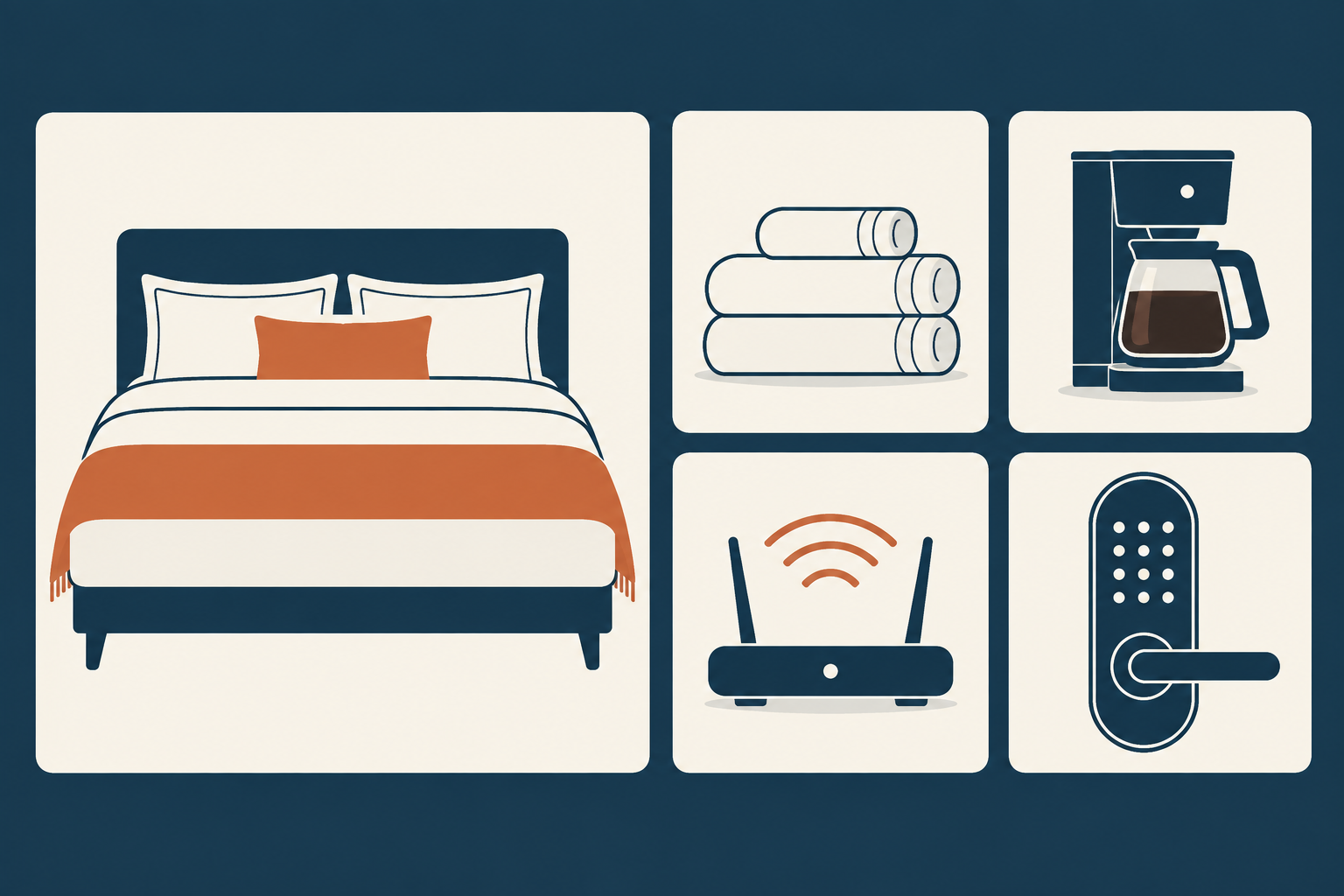
Five-star reviews are mostly a setup problem, not a charm problem. Guests rate a stay on categories Airbnb names for them — cleanliness, accuracy, check-in, communication, location, and value — and most of those categories are decided by what is physically in the unit before the first guest ever arrives. This is the room-by-room amenity checklist I use when I set up or rescue a short-term rental: what belongs in each room, what order to buy it in, what to pull out, and how a missing item shows up in your written reviews weeks later. I have been in real estate 18+ years, focused on short-term rentals since 2016, and have built a list of more than 10,000 short-term rental operators; the pattern below repeats in every market I have worked.
STR Amenity Must-Haves for Five-Star Reviews: The 2026 Setup Checklist
Five-star reviews are a setup problem before they are a hospitality problem. Here is the room-by-room amenity checklist, the spend order, and the items that quietly cost you the fifth star.
· 11 min read
Disclosure: This post may contain affiliate links. If you purchase through our links, we may earn a commission at no extra cost to you. We only recommend tools and services J. Massey's team actually uses. Read the affiliate disclosure
Table of Contents
What "Five Stars" Actually Measures
Think category by category before you buy anything. Guests are rating the overall stay plus specific dimensions — cleanliness, accuracy, check-in, communication, location, and value — and each one traces back to something physical or functional in the unit. Cleanliness, in review terms, means the absence of mold, pests, and the accumulated dust and pet dander that guests can smell on arrival (the EPA's indoor air quality guidance covers exactly this list of triggers). Accuracy means the listing photos and description match what the guest finds, and that everything shown is in good working condition. That single word — working — is where most four-star reviews come from. A hair dryer that is present but dead, a burner that clicks and never lights, a TV remote with dead batteries: each of those is an accuracy hit, not a hospitality failure.
Search visibility follows the same logic even without a public formula to point to: platforms rank listings using signals tied to the listing, the trip, and guest behavior, and it is also why FTC advertising rules — advertising must be truthful and non-deceptive, with evidence behind the claims — apply to a listing description the same way they apply to an ad. You do not control the ranking algorithm. You control whether your unit has the items guests filter for and whether those items function on arrival. Treat amenities as two jobs at once: they get you into filtered search results, and they protect the rating that keeps you there.
One honest caveat before the checklist. Several numbers circulate in host circles — a fixed percentage of extra revenue for badge status, a minimum megabit figure that "guests expect," survey results attributed to a market-data vendor. I have not been able to source those to a live primary page, so they are not in this article. Build against guest-facing categories and your own review text instead of against unverifiable statistics.
Spend Order: What to Buy First, Second, and Later
Most new operators overspend on decor and underspend on sleep, water pressure, and internet. The order below is how I sequence a first unit. Costs are ranges from my own recent setups in US markets; price your own market before committing, because furniture and appliance pricing moves.
Priority | Category | What it buys you | Typical first-unit spend | Buy before first guest? |
|---|---|---|---|---|
1 | Sleep system (mattress, protector, pillows, two sheet sets per bed) | Protects the single complaint you cannot fix with an apology | $600–$1,200 per bedroom | Yes |
2 | Cleaning setup and cleaner pay | Protects the cleanliness category the platform defines for guests | Ongoing, per turnover | Yes |
3 | Internet and keyless access | Removes the two most common arrival failures | $60–$200 hardware, monthly service | Yes |
4 | Kitchen working set (pans, knives, coffee, storage) | Makes "fully equipped" true instead of aspirational | $250–$500 | Yes |
5 | Bath linens and refillable toiletries | Turns bathrooms from adequate to remembered | $200–$400 | Yes |
6 | Light control and safety (blackout window covering, alarms, first-aid) | Prevents sleep complaints and safety flags | $150–$400 | Yes |
7 | Comfort layer (luggage racks, full-length mirror, fan, extra blankets) | Small items that appear by name in five-star reviews | $150–$300 | Within 10 stays |
8 | Guest-experience extras (snack basket, local guide, games, patio upgrade) | Differentiation once the basics are proven | Optional | After 10 stays |
The rule I hold to: nothing in rows 7 and 8 gets bought while anything in rows 1 through 6 is missing. Operators who invert that order end up with a beautiful unit and a 4.6 rating.
The Room-by-Room Amenity Checklist
Walk the unit in the order a guest does: door, kitchen, bathroom, bedroom, then everything small. Here is the working table I hand to clients, with the review category each group protects.
Room | Baseline items | Review category at risk | Common miss |
|---|---|---|---|
Entry and access | Keypad or lockbox entry, exterior light, marked parking, posted house rules | Check-in | Instructions that assume an app the guest cannot install |
Kitchen | Non-stick pan, one stainless pan, sheet pan, knife that cuts, cutting board, pot with lid, colander, coffee setup, basic seasonings, dish soap, trash bags | Accuracy, value | Worn pans still listed as "fully equipped kitchen" |
Bathroom | Four towels per guest (bath, hand, face), bath mat, working hair dryer, refillable shampoo/conditioner/body wash, toilet paper reserve, plunger, squeegee or clean shower surface | Cleanliness | Travel-size toiletries that run out mid-stay |
Bedroom | Supportive mattress, waterproof protector, two pillows per guest plus one firmness option, two sheet sets, blackout window covering, extra blanket, bedside outlet and USB, luggage rack, full-length mirror | Overall, value | Light leak at 6 a.m. in a city unit |
Living and work | Seating for max occupancy, table with a real chair for laptop work, lamp per seating zone, TV with logged-in streaming, fan or noise machine | Value | Only a kitchen counter to work from |
Laundry and storage | Detergent, drying rack, iron or steamer, hangers, closet or bench storage | Accuracy | Hangers counted in the photos but eight of them |
Safety and compliance | Smoke alarms and carbon monoxide alarms tested and dated, fire extinguisher, first-aid kit, posted emergency contacts | Overall, safety flags | Alarms installed years ago and never tested |
A few specifics that matter more than brand names. On mattresses, buy against criteria, not logos: medium-firm support, a warranty that survives rental use, a washable waterproof protector, and a construction you can replace in one market within a week. Any brand that meets those is fine; no brand that fails them is worth a premium. On towels, pick one color family you can bleach-replace forever, and skip white in pet-friendly units. On cookware, replace the pan when the coating dulls — that is a consumable, not an asset.
Test alarms on a schedule rather than at random. The US Fire Administration's guidance for homes is to test alarms monthly and replace units at the manufacturer's stated end of life; NFPA publishes placement guidance by level and sleeping area. Put the test on the same recurring task as your deep clean so it actually happens. This is operational guidance, not legal advice — your city or county may impose its own rental inspection requirements.
Connectivity and Access: The Two Failures Guests Never Forgive
Internet and entry cause the reviews that take months to average out, because a guest who cannot get in the door or get online writes about it while the frustration is fresh.
For internet, measure instead of quoting a number. Run a speed test at the far corner of the unit, on the same band a guest would use, with the TV streaming. If a video call holds steady and a stream does not buffer while someone else is working, the connection is serviceable for the stay you are selling; if it does not, the fix is usually router placement, a mesh node, or a plan change in that order. Publish what you measured in the listing rather than a marketing adjective, and list the speed on the welcome card. Remote-work guests do read it, and accuracy is a rating category.
For access, keyless entry with a code you set per reservation removes the handoff entirely. Keep a physical backup key in a lockbox and tell your co-host or cleaner where it is, because batteries die on Friday nights. Write check-in instructions that work without any app: code, door, elevator, parking, in that order, with a photo of the door.
What to Remove From the Unit
Subtraction raises ratings faster than addition in most units I audit.
Decorative objects that only add dusting time. Every knick-knack is a surface your cleaner must choose between on a tight turnover.
Furniture with gaps and skirts that collect debris. If a cleaner cannot see under it in three seconds, it will hold crumbs until a guest finds them.
White towels and light rugs in pet-friendly units. You cannot hold a cleanliness standard on textiles you cannot restore.
Broken or "mostly working" items. A dead hair dryer scores worse than no hair dryer, because the listing promised it.
Personal storage and locked closets. They read as someone else's house, and they invite accuracy complaints.
Multi-step check-in that depends on a specific app, a phone call, or your availability.
Extra furniture that shrinks walking space. Open rooms photograph better, clean faster, and feel more expensive.
How Missing Items Show Up in Your Reviews
Amenity gaps rarely appear as one-star anger. They appear as a four-star review with a polite sentence, and that sentence is your work order.
Review sentence | Real cause | Fix |
|---|---|---|
"Everything was great, but the bed was a bit firm/soft." | Single-firmness pillow and mattress choice | Add a second pillow option per bed before changing the mattress |
"Would have been five stars but there was no hair dryer." | Item absent or dead | Restock and add to turnover checklist |
"Wifi was spotty for work calls." | Router placement or plan | Measure at the work surface, add mesh node, then consider plan |
"Kitchen was a little basic." | Worn pans, dull knife, no seasonings | Replace consumables; photograph the drawer contents in the listing |
"Check-in was a little confusing." | App-dependent or multi-step entry | Rewrite as code, door, parking, with photos |
"Cleaning could have been better." | Turnover time too short or too much clutter | Remove surfaces before paying for more hours |
Track the language, not the star number. Five reviews mentioning the same noun is a purchase decision. One review mentioning a preference is a preference.
How to Decide: A Four-Step Process
Stay in your own unit for one night before you list it, and again after your tenth booking. Sleep, shower, cook a meal, and work for two hours at whatever surface you expect guests to use. Write down every friction point as you hit it, not afterward.
Score the checklist above room by room and mark each line present-and-working, present-but-failing, or absent. Present-but-failing items get fixed first, because they cost you the accuracy category you already promised.
Buy strictly in spend order. Fund rows 1 through 6 completely before anything in rows 7 and 8, and cap your first-unit budget in writing so decor does not eat the sleep system.
Read your last twenty reviews with a highlighter every month and count repeated nouns. Buy against the count; put the rest of the list on a wishlist with a date, and re-test your alarms in the same session.
Know / Do / Track
KNOW: Guests rate named categories, and most of those categories are decided by physical items and whether they function — not by how warm your messages are.
DO: Audit one room a night this week against the table above. Order the present-but-failing items first, then the absent items in spend order, and write the restock into your turnover checklist so the same gap cannot recur.
TRACK: Repeated nouns in your written reviews, alarm test dates, and a measured speed test at the work surface each quarter. If you want a second set of eyes on the room-by-room audit and the spend order for your specific unit, book a complimentary one-on-one diagnostic call and bring your last twenty reviews.
Keep Reading
Frequently Asked Questions
What amenities do short-term rental guests actually expect in 2026?
The baseline that keeps ratings high is a supportive bed with two sheet sets and blackout window covering, four towels per guest with a working hair dryer and refillable toiletries, a kitchen whose pans and knives still work, internet you have measured at the work surface, keyless entry with a physical backup, and tested smoke and carbon monoxide alarms. Everything beyond that list is differentiation, and differentiation only pays once the baseline is true.
How much should I budget for amenities on a first unit?
Plan roughly $600–$1,200 per bedroom for the sleep system and another $750–$1,600 for kitchen, bath, light control, and safety in a one- to two-bedroom unit, based on my own 2026 US setups. Get a written quote for your own market before you commit, because appliance and furniture pricing changes by season and region.
Does a faster internet plan really change my reviews?
The plan matters less than the measured result at the spot a guest will work from. Test with the TV streaming, fix router placement or add a mesh node first, then change plans if the connection still cannot hold a video call. Publish what you measured instead of calling it "high-speed," because accuracy is one of the categories guests rate.
What should I remove from my listing to raise my rating?
Start with anything broken, anything that only adds dusting time, light-colored textiles in pet-friendly units, personal storage, and check-in steps that need a specific app. Removing clutter gives your cleaner the time to hit the cleanliness standard the platform describes to guests, which is usually cheaper than buying more cleaning hours.
How do I know which missing amenity is costing me the fifth star?
Count nouns in your written reviews. One mention is a guest preference; three to five mentions of the same item across a month is a purchase order. Pair that count with your own overnight stay in the unit, and you will find the gap without guessing.
Sources
U.S. Fire Administration — Smoke alarms — Supports the alarm testing and replacement schedule recommended for the safety line of the checklist.
NFPA — Smoke alarms — Supports placement guidance for alarms by level and sleeping area.
EPA — Care for Your Air: A Guide to Indoor Air Quality — Supports the dust, pet dander, and ventilation points behind the cleanliness and textile recommendations.
EPA — Mold Cleanup in Your Home — Supports the mold and moisture standard behind the cleanliness category referenced above.
FTC — Advertising FAQ's: A Guide for Small Business — Supports the rule that advertising, including a rental listing description, must be truthful and non-deceptive.
Disclaimer: Educational content only — not financial, legal, or tax advice; results vary.
See our full Earnings Disclaimer and Affiliate Disclosure for complete details. © 2026 West Egg Enterprises, Inc. All rights reserved.