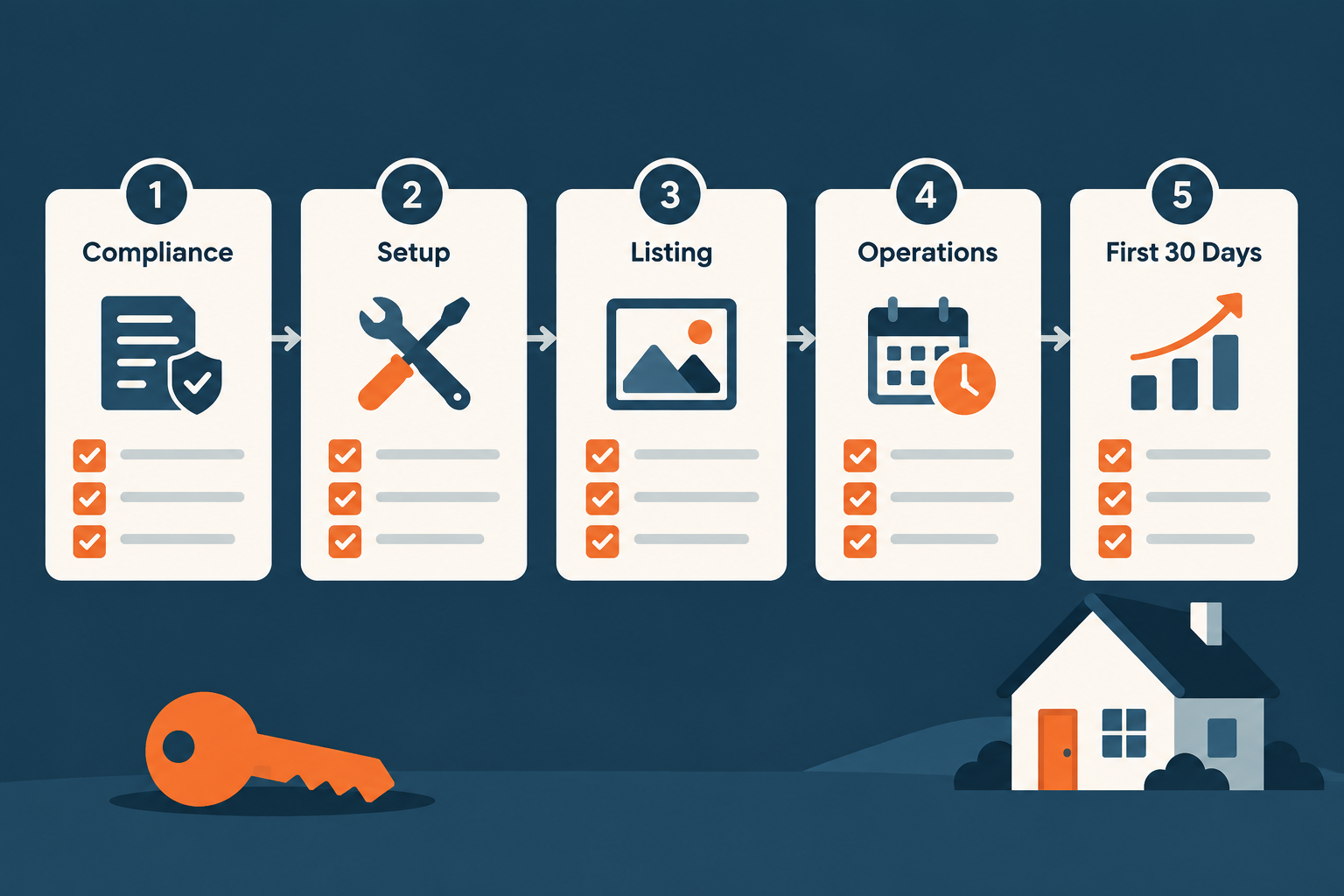
Launching a short-term rental takes about 47 discrete tasks, and they fall into five phases: legal and compliance (8 steps), property setup (14 steps), listing creation (9 steps), operations setup (13 steps), and the first 30 days live (3 steps). Do them in that order. Operators who furnish before they check the permit rules, or publish before they have a cleaner under contract, pay for the reversal later in refunds, fines, and one-star reviews that follow the listing for a year.
Last updated: 2026-09-19
The order matters more than the count. Compliance decides whether you have a business at all. Property setup decides your nightly rate ceiling. The listing decides who books. Operations decide whether the first twenty guests leave five stars. The first 30 days decide how fast the platform algorithm trusts you. Skip a phase and the cost shows up two phases later, when fixing it is expensive.
The Five-Phase Launch Sequence at a Glance
Phase | Steps | What it decides | Do not start until |
|---|
1. Legal and compliance | 8 | Whether you can legally rent at all | Before you spend a dollar on furniture |
2. Property setup | 14 | Your nightly rate ceiling and review scores | Permit path is confirmed in writing |
3. Listing creation | 9 | Who books and who self-selects out | Photos are shot and edited |
4. Operations setup | 13 | Whether guests 1 through 20 leave five stars | Listing draft exists, not yet published |
5. First 30 days live | 3 | Review velocity and search placement | Cleaner, backup cleaner, and vendors are named |
Phases overlap in practice. Ordering furniture while your permit application sits with the city is fine. Publishing a listing before you have a cleaner is not.
Launch Checklist: The 47 Steps by Phase
Step 1 — Clear Legal and Compliance (checklist items 1–8)
This phase is unglamorous and it is the one that ends launches. Work it first.
1. Confirm your address is in a zone that permits short-term rental, and confirm whether your city caps permits or limits them to owner-occupied properties. Many cities publish the rules and the application on one page, as Nashville does.
2. Apply for the local STR permit, license, or registration and keep the confirmation number.
3. Register with the taxing authority that collects transient occupancy or lodging tax. City and county registration are often separate. Portland, for example, requires lodging businesses to register with its Revenue Division within the first 15 days of starting business.
4. Get written HOA approval, or read the CC&Rs and confirm there is no rental restriction. If you are renting the unit, get landlord permission in the lease, in writing, signed.
5. Choose and form your ownership structure. The SBA's business-structure guide lays out the liability and tax tradeoffs between sole proprietorship, LLC, and corporation.
6. Open a dedicated business bank account and get an EIN. Every dollar in and out of the property runs through that account, starting with the first furniture purchase.
7. Buy a short-term rental policy. Ask your carrier in writing whether nightly rental to paying guests is covered under your current policy, and at what liability limit per occurrence, before you accept a booking. Airbnb's own hosting guidance tells hosts to work with their agent on required limits and coverage, and says its damage protection and liability insurance do not replace homeowner's or renter's insurance, and that not all policies cover guest-caused damage.
8. Have one call with a CPA who has STR clients. Ask about depreciation, personal-use limits, and what records they want from month one. IRS Topic 415 sets the line: you are treated as using the place as a residence if your personal use exceeds the greater of 14 days or 10% of the days you rent it at fair rental price, and there is a separate rule that if you use it as a residence and rent it fewer than 15 days in the year, you report no rental income and deduct no rental expenses. Those thresholds change what you can deduct, so get them straight before you book a single night. For who else belongs on that call, see who to talk to before buying short-term rentals. This is educational, not tax or legal advice.
Failure mode here: assuming platform coverage replaces insurance. Airbnb states plainly that its host damage protection and host liability insurance are basic coverage and do not take the place of your own policy.
Step 2 — Property Setup (checklist items 9–22)
Furnish to your market tier, not to your taste.
9. Decide your tier: budget, mid-market, or premium, based on what the top ten listings within a mile actually charge and show.
10. Set and hold a furnishing budget by room before you shop.
11. Buy beds first. Mattress quality shows up in reviews more than anything else in the unit.
12. Furnish for the guest count your listing will advertise, including real seating and real dining places for that number.
13. Stock the kitchen to cook a full meal: pans, sharp knife, colander, coffee setup that a stranger can operate at 6 a.m.
14. Buy three sets of linens and towels per bed and bath, so a turnover never waits on laundry.
15. Install smoke alarms inside each bedroom, outside each sleeping area, and on every level, following NFPA's smoke alarm guidance, and test them. Add carbon monoxide alarms to the placement your local code and the alarm manufacturer specify, since that requirement varies by state.
16. Mount a fire extinguisher in the kitchen, stock a first aid kit, and post exit information.
17. Add a smart lock with unique guest codes, plus a documented backup entry method.
18. Add exterior lighting and clear, photographed parking and access instructions.
19. Fix every deferred maintenance item now: slow drain, sticking door, loose handrail, dead bulb.
20. Add the internet connection guests expect and test speed in the furthest bedroom.
21. Write the house manual: wifi, trash day, appliance quirks, checkout steps, local recommendations.
22. Hire a photographer who shoots real estate or hospitality. Stage, shoot in daylight, and get 25 to 35 usable images. The photos are the storefront; phone snapshots cost you more in lost bookings than the shoot costs.
Failure mode here: buying a full house of furniture before Phase 1 clears. If the permit comes back denied, the furniture is a loss and the lease is still yours.
Step 3 — Listing Creation (checklist items 23–31)
23. Write a title that names the property type, the standout feature, and the location a guest would search.
24. Write the first two lines of the description to pre-qualify: who this place is for and who it is not for.
25. State plainly what is not there. No air conditioning, stairs only, street parking, thin walls. The guest who books anyway will not complain about it.
26. List every amenity accurately and completely. Airbnb says its algorithm weighs listing content, amenities, ratings, and host-guest communication when it orders search results, so a half-filled amenity list works against you.
27. Write house rules that are specific and neutral in tone. Quiet hours, guest count limit, pets, events, smoking.
28. Set the cancellation policy, minimum stay, and check-in window you can actually staff.
29. Set launch pricing below your target rate to pull the first bookings and reviews, and put an end date on that discount. Airbnb says listings priced below comparable listings with similar capacity and amenities tend to rank higher in search, so an intro rate buys placement as well as reviews.
30. Set cleaning, pet, and extra-guest fees, and confirm how the platform collects and remits lodging tax in your jurisdiction, since Airbnb collects it automatically in some places and not others.
31. Read Airbnb's responsible-hosting guidance for your country and fix anything in the listing that conflicts with it before you publish.
Failure mode here: writing a listing that sells to everyone. A listing that pleases everyone attracts the guest who wanted something else, and that guest writes the three-star review.
Step 4 — Operations Setup (checklist items 32–44)
This is the phase most new operators skip. It is the phase that protects your review average.
32. Hire a cleaner and agree on rate, turnover window, and what happens on a same-day turn.
33. Hire a backup cleaner before you need one. The first cancellation always lands on a Friday.
34. Write the turnover checklist room by room, with photo proof required at the end of each clean.
35. Set a linens and towels process: who washes, where spares live, when items get retired.
36. Build the consumables restock list with par levels: paper goods, soap, coffee, batteries, light bulbs.
37. Decide who buys restock and how they get reimbursed.
38. Choose your property management software and connect the calendar to every platform you list on.
39. Set up rate automation rules, with a floor price you will not go below and minimum-stay rules for weekends and holidays.
40. Write messaging templates for booking confirmation, pre-arrival, check-in, mid-stay check, checkout, and post-stay review request.
41. Line up a handyman, a plumber, and an HVAC contact, and ask each one their after-hours policy before you need it.
42. Decide your damage process: deposit or platform coverage, what you document, who inspects.
43. Set up bookkeeping so revenue and expenses land in categories your CPA asked for, monthly.
44. Do a full guest walkthrough yourself. Arrive with the guest code, make coffee, shower, sleep there one night. You will find four problems no checklist catches.
Failure mode here: one cleaner, no backup, no checklist. Two turnovers go wrong, two reviews mention hair in the shower, and your average sits at 4.6 for six months.
Step 5 — First 30 Days Live (checklist items 45–47)
45. Publish on every platform you plan to use on the same day, and keep calendars synced from the first booking. Airbnb only is a single point of failure.
46. Chase review velocity. Ask every guest for a review through your post-stay template, and hold launch pricing until you have roughly ten reviews. Then raise rates in small increments and watch booking pace, not opinions.
47. Keep a defect log for 30 days. Every guest question, complaint, and small breakage goes in it. Weekly, fix the top three items and update the listing or house manual so that question stops arriving.
Two more habits pay off in that window. Answer every inquiry fast during the first month. Airbnb counts host-guest communication among the quality signals in search, and the early guest pool is small enough that one ignored message is a lost week. And re-shoot the one photo guests keep asking about. If three guests in a row ask where the second bathroom is, the photo set is not doing its job.
At day 30, review three numbers: occupancy versus the comparable listings you chose in Step 2, average nightly rate versus your target, and review average. If occupancy is high and rate is low, you are underpriced. If occupancy is low and reviews are strong, the problem is your photos or your title, not your price.
One more note on order. Phase 4 is where I push back hardest on new operators. Everyone wants to publish the day the couch arrives. Publishing without a named cleaner, a named backup, and a written turnover checklist means your first guests are the test run, and their reviews are permanent. A week of operations setup before publishing is the cheapest insurance in the whole sequence.
Startup Cost Illustration, Not a Market Quote
The figures below are an illustration I use for planning conversations, not market data and not a quote. Assumptions: a furnished two-bedroom, two-bath unit in a mid-market US city, mid-market tier, no renovation needed, owner does the listing work, single permit jurisdiction. Your numbers will differ by city, unit size, and tier. Price everything locally before you commit.
Line item | Illustrative range | Notes on the assumption |
|---|
Permit, registration, tax accounts | $100 – $900 | Varies widely by city; some charge annual renewal |
Entity formation and bank setup | $100 – $800 | State filing fee plus optional registered agent |
STR insurance, first year | $1,200 – $3,000 | Quoted, not estimated; depends on limits and location |
Furnishing a 2BR/2BA, mid-market | $12,000 – $22,000 | Beds, seating, dining, kitchen, decor, three linen sets |
Safety and access hardware | $300 – $900 | Alarms, extinguisher, smart lock, exterior lighting |
Photography | $300 – $900 | Real estate or hospitality photographer, 25–35 images |
Software, first year | $300 – $1,200 | Management platform plus rate automation |
Operating reserve | 3 months of fixed costs | Mortgage or rent, utilities, insurance, software |
Two rules I hold to on cost. Quote insurance rather than guessing it, because the spread between carriers on the same unit is large. And fund the reserve before the last furniture purchase, because the first slow month arrives before the first strong one.
Who This Launch Sequence Is Not For
If you have not confirmed that short-term rental is permitted at your address, this checklist is premature. Finish Step 1 before anything else. If you are renting the unit and your lease prohibits subletting or transient occupancy, stop; getting caught costs you the lease and the furniture. If your plan depends on a single vendor projection of revenue you have not checked against real booked rates in your market, you do not have a plan yet, you have a hope. And if you want passive income with no operations layer, understand that Phase 4 is the business. Nightly rental is hospitality work, staffed or outsourced, every week.
I have spent more than 18 years in real estate and have worked on short-term rentals since 2016, and I have built a list of more than 10,000 short-term rental operators through CashFlow Diary. The launches that go badly almost never fail on the property. They fail on an unread ordinance, an insurance policy that excluded the use, or a cleaning bench of exactly one person.
Want an operator to pressure-test your launch plan with you? Start with a complimentary one-on-one diagnostic call and walk your address, your permit path, and your first 30 days through with someone who has done it.
Frequently Asked Questions
How long does it take to launch a short-term rental?
Plan on four to ten weeks from acquisition to first guest, and let the permit timeline set the schedule. Compliance can take a week in a light-touch city or several months where permits are capped or need an inspection. Furnishing usually runs two to four weeks around furniture delivery, and listing plus operations setup takes about a week of focused work once photos are in hand.
Do I really need short-term rental insurance if the platform offers host protection?
Yes, treat platform coverage as a supplement, not a policy. A standard homeowner policy is typically written for owner-occupied use and often excludes business or commercial activity, which nightly rental is. Ask your carrier in writing whether renting to paying guests is covered and at what liability limit, and get the answer before your first booking.
What happens if I skip the permit and just list the property?
You risk fines, forced delisting, and back taxes on collected stays, and in some cities the penalty compounds daily. Cities that cap permits also tend to enforce through platform data and neighbor complaints. Registration and lodging tax registration are usually separate filings, so confirm both with the city and county before you publish.
Should I launch below market price?
Yes, for a defined window. Price under your target rate until you have roughly ten reviews, then raise in small increments and watch booking pace week over week. Airbnb names ratings, reviews, and how often guests book among the factors that lift a listing in search, so a cheap first month buys both. Put an end date on the discount so it does not become your rate.
How many steps can I safely do out of order?
Property setup and listing drafting can run in parallel with a pending permit, but do not spend on furniture before the permit path is confirmed, and do not publish before a cleaner and a backup cleaner are named. Those two gates prevent the two most expensive launch mistakes I see.
Sources