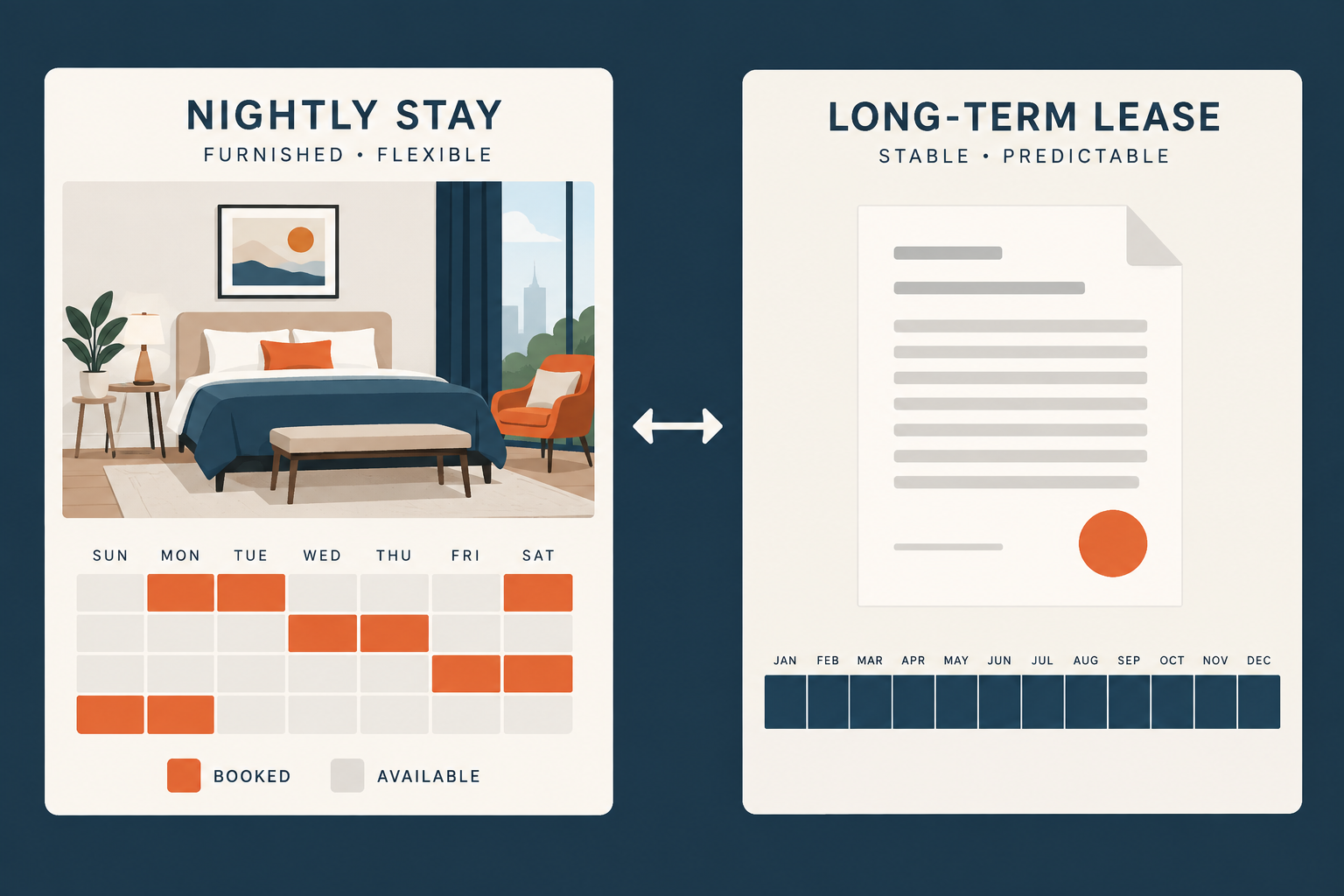
Short-term rental versus long-term rental is not a contest one model wins everywhere. STR usually produces higher gross revenue on the same unit, but it also carries cleaning, supplies, utilities, furnishing replacement, platform fees, higher management rates, higher vacancy, and higher insurance. Long-term rental produces less revenue and far fewer expense lines. The right answer comes from comparing net operating income per hour of your attention on one specific property in one specific market — not from a "2-3x revenue" headline.
Last updated: 2026-09-19
I have spent more than 18 years in real estate, focused on short-term rentals since 2016, and I have built a list of more than 10,000 short-term rental operators through CashFlow Diary. The single most expensive mistake I watch new investors make is buying a property because someone told them short-term rentals earn two to three times the long-term rent. That figure is about gross revenue on the top line. Nobody spends gross revenue. Below is how I walk the same property through both models to a net number, and how I decide when long-term rental is the better call.
This article is educational. It is not investment, tax, or legal advice. Rent, occupancy, and regulation vary by address, so verify your own market with primary data before you commit capital.
Why Comparing Gross Revenue Is the Wrong Frame
A "2-3x" claim compares the wrong two numbers. A long-term lease at $2,000 a month is close to $24,000 of gross rent with a short list of costs behind it: taxes, insurance, maintenance, a management fee of roughly 8-10% if you use a manager, and vacancy between tenants. The same unit furnished might book $55,000 gross. That looks like a landslide until you write down what short-term operation actually consumes.
Short-term rentals add expense lines that simply do not exist on a lease. Turnover cleaning on every stay. Consumables and linen replacement. Utilities and internet, which the guest never pays. A furnishing reserve, because sofas, mattresses, and cookware wear out on a three-to-five-year cycle rather than a fifteen-year one. Platform service fees, which Airbnb documents in its own help center: under the older split-fee structure most hosts pay about 3% of the booking subtotal and the guest pays roughly 14-16%, while under the single fee structure the host pays 15% with a $6 minimum. Airbnb states the split-fee structure is being phased out, so budget the 15% number, not the 3% one. Short-term management, when you hire it, gets quoted to my students at 18-25% of revenue rather than the 8-10% a long-term manager charges. Those management figures are quotes I see in the field, not a published statistic — collect your own.
Then there is vacancy. A signed twelve-month lease sells 100% of the calendar unless the tenant leaves early. The Census Bureau put the national rental vacancy rate at 7.3% in the second quarter of 2026, ranging from 5.3% in the West to 9.5% in the South, with principal cities at 8.0%. A short-term rental prices that exposure nightly instead of annually, and the unsold nights are not a rounding error — they are the difference between a strong year and a break-even one. Insurance is the last line: a furnished, commercially occupied unit does not price like an owner-occupied or tenant-occupied home, and many carriers require a specific short-term rental endorsement.
Side-by-Side: What Each Model Actually Carries
Factor | Short-term rental | Long-term rental |
|---|
Gross revenue per unit | Higher in most urban and leisure markets | Lower, fixed by lease |
Expense lines | Cleaning, supplies, utilities, internet, furnishing reserve, platform fees, permits, higher insurance | Taxes, insurance, maintenance, vacancy, one management fee |
Management rate quoted | 18-25% of revenue | 8-10% of rent |
Revenue predictability | Varies by season, event calendar, and competitor supply | Fixed for the lease term |
Vacancy exposure | Nightly; unsold nights disappear | Between tenancies only |
Owner hours per month | 4-15 even with a manager | Under 1 in a normal month |
Up-front capital beyond purchase | Furnishing and setup, often $15K-$40K | Make-ready and paint |
Regulation risk | High; permit caps and zoning change by city | Low; landlord-tenant law is stable |
Default risk shape | Many small stays, chargebacks, damage claims | One tenant; a default can mean months of eviction |
Financing treatment | Harder; appraisals and DSCR math differ | Standard; lender comfort is high |
Exit | Sells to investors on income, or retail with furniture | Sells to retail buyers or investors on cap rate |
I use this table as a filter, not a scorecard. If three or more rows on the STR side describe something you are unwilling to own — the hours, the capital, the regulation risk — stop there and run the property as a long-term rental.
A Worked Net-to-Net Illustration
The numbers below are an illustration with assumptions stated as assumptions. They are not a projection for your property, and I am not claiming these results. Change the inputs to your own address and your own quotes.
Assumptions: a three-bedroom single-family home in a mid-size metro. Market long-term rent of $2,100 a month, verified against HUD Fair Market Rents and American Community Survey gross rent for that county. Short-term average daily rate of $185 with 62% annual occupancy. Owner uses a short-term manager at 20% and a long-term manager at 9%. Platform fee set at Airbnb's 15% single host fee. Long-term vacancy allowance set at one half-month of rent between tenancies. Furnishing reserve set at $4,000 a year against a $28,000 setup on a seven-year replacement cycle. Taxes, insurance base, and mortgage are held identical across both columns and excluded, since they do not change the comparison.
Line item | Short-term rental | Long-term rental |
|---|
Gross revenue | $41,865 | $25,200 |
Vacancy / unsold nights | Already in occupancy | ($1,050) |
Platform fees (15%) | ($6,280) | $0 |
Cleaning (net of guest fees) | ($3,100) | $0 |
Supplies, linens, consumables | ($2,400) | $0 |
Utilities and internet | ($4,200) | $0 |
Furnishing reserve | ($4,000) | $0 |
Management | ($8,373) | ($2,268) |
Insurance premium above LTR | ($1,100) | $0 |
Permits, licenses, filings | ($600) | $0 |
Repairs and maintenance | ($2,600) | ($1,800) |
Net before debt, taxes, base insurance | $9,212 | $20,082 |
Gross revenue was 66% higher and net was less than half. That is not an argument against short-term rentals. It is an argument against buying on gross. In this illustration the fix is specific — raise ADR or occupancy, self-manage the guest side, or cut the utility load — and each of those fixes costs either capital or your hours. Now run the same sheet with ADR at $240 and occupancy at 70%, and short-term net clears long-term net — about $21,900 against $20,100 on the same assumption set. The model does not decide. The inputs decide.
Workload, Bandwidth, and the Cost of Your Hours
A long-term rental is an asset. A short-term rental is a small hospitality business that happens to own real estate. Even with a full-service manager, you still approve pricing strategy, replace furniture, handle escalations, read reviews, and decide on amenity upgrades. Budget 4-15 owner hours a month per property with a manager, and 20-40 without one. A long-term rental in a normal year takes under an hour a month.
Put a dollar figure on your own time before you compare. If the short-term net advantage on a property is $6,000 a year and it costs you 120 hours, you are earning $50 an hour for work that is on call. Some operators will take that trade happily because they are building an operating business with resale value. Others should not. If your bandwidth is already committed — a demanding job, young kids, another business mid-build — long-term rental is the better answer, and choosing it is not a failure of nerve.
Risk Profile: Four Risks That Behave Differently
Demand volatility. Short-term revenue moves with travel demand, local event calendars, and competitor supply. A new 80-unit building or a wave of new listings in your submarket can reset your rate in a single season. Lease income does not move until renewal.
Regulation risk. This is the risk most investors underweight. Cities regulate short-term rentals by permit type, zoning district, owner-occupancy requirement, and unit caps, and those rules change. Metro Nashville, for example, requires a Codes Department permit before a property is listed, renews permits annually, publishes separate permit types, and caps any guest stay at thirty consecutive days. Read the actual ordinance for your address before you buy, not a forum post, and confirm whether permits are transferable at sale. Long-term rental regulation changes too, but it changes slowly and rarely bans the use.
Tenant and guest default. A long-term rental concentrates risk in one tenant: a default can mean months of lost rent plus an eviction process. A short-term rental spreads revenue across dozens of stays, so a single bad guest costs a few nights plus a damage claim. Different shape, not less risk.
Seasonality. A market with a four-month season needs those four months to carry twelve months of fixed cost. Test whether the property survives a season that arrives late or short, because that is the year that takes properties back.
Financing, Appraisal, and Why DSCR Treatment Differs
Financing is where the two models separate hardest. A long-term rental appraisal leans on comparable sales and market rent, and lenders generally credit a share of documented lease income toward qualifying. Short-term rental income is treated with more caution: it is variable, often documented only by platform statements rather than a signed lease, and many appraisers will fill the rent schedule with long-term market rent even when the property operates nightly.
That flows straight into debt-service coverage. A DSCR loan sizes the loan from property income divided by debt service. If the lender uses long-term market rent for a property you intend to run nightly, your qualifying income is the lease number, not the nightly number, and the loan shrinks. Some lenders will underwrite short-term income using platform statements or a market data report, usually with a haircut and often at a higher rate and larger reserve requirement. Ask three questions before you write an offer: which income source you will be underwritten on, what reserve months are required, and whether the appraisal will include a short-term rent schedule. Get those answers in writing. Financing terms and tax treatment vary by lender and by taxpayer — this is educational, not tax or legal advice, and the IRS rules on residential rental income and expense are worth reading alongside your own advisor's guidance.
The Middle Option: Mid-Term and 30-Plus-Day Furnished Rentals
Mid-term rental — furnished, typically 30 days or longer — sits between the two models, and it deserves a real look instead of a footnote. You keep the furnished premium over a bare lease. You cut turnover cleaning to roughly one per tenancy, drop supplies and linen burn sharply, and reduce owner hours to a handful per month. Many cities that cap or ban stays under 30 days leave 30-plus-day furnished rentals alone, which converts a regulatory dead zone into a workable strategy.
The trade is demand depth. Mid-term demand comes from traveling medical staff, relocations, insurance placements, and project-based contractors, and it is thinner and more seasonal than either nightly travel or annual leases. Some submarkets have almost none of it. Mid-term also lands in the middle on financing: still furnished and still not a twelve-month lease, but a signed 60- or 90-day agreement documents better than a stack of nightly bookings.
My rule: if the short-term numbers are marginal and the ordinance is hostile or unsettled, price the mid-term case before you default to a bare long-term lease. It often nets closer to short-term than to long-term while carrying long-term's workload.
The Weighted Scoring Test: Four Steps for One Property
Score one address, not a strategy. Rate each factor 1-5 for how strongly it favors short-term, multiply by the weight, and add. Nine factors, 100 points of weight. Score under 60 and I run it long-term. 60-74 is the mid-term zone. Above 75, short-term earns the extra work.
Step 1 — Score the market and property inputs
Factor | Weight | Score 1-5 for STR fit | Weighted |
|---|
Verified ADR and occupancy vs. market rent | 20 | | |
Regulatory clarity and permit transferability | 18 | | |
Your available hours per month | 15 | | |
Financing path and reserve capacity | 12 | | |
Property fit: layout, parking, amenity set | 10 | | |
Demand depth outside peak season | 8 | | |
Setup capital available beyond purchase | 7 | | |
Local cleaning and maintenance labor supply | 5 | | |
Hold horizon and planned exit buyer | 5 | | |
Step 2 — Build the two net columns
Run the worked sheet above twice with your own quotes: real cleaner pricing, real insurance quotes, real utility history, real manager rate. Use HUD Fair Market Rents and Census gross rent data for the long-term column so the baseline is not a guess.
Step 3 — Divide net by your hours
Compute net dollars per owner hour for each model. A short-term case that wins on net but loses badly per hour is a job you are buying, not an investment. Decide with that number visible.
Step 4 — Stress the downside
Cut occupancy 15 points, raise cleaning 20%, and assume the permit regime tightens next year. If the property still services debt, the case holds. If it does not, either the price is wrong or the model is wrong.
When Long-Term Rental Is Simply the Better Answer
I will say this plainly, because most comparison articles will not. Choose the lease if any of these is true: your market's verified ADR and occupancy do not clear long-term rent by a meaningful net margin; the ordinance caps permits, requires owner occupancy you cannot provide, or is under active revision; you do not have setup capital on top of your down payment and reserves; you cannot give the property consistent monthly attention or afford a manager at 18-25%; the property is a standard unit in a residential pocket with no amenity story; or your hold plan is fifteen-plus years of quiet cash flow. A long-term rental that you own calmly for a decade beats a short-term rental you abandon in month nine.
Want an operator to pressure-test your launch plan with you? Start with a complimentary one-on-one diagnostic call and bring both net columns for one specific property.
Frequently Asked Questions
Do short-term rentals really earn two to three times long-term rent?
Sometimes on gross revenue, rarely on net. Once cleaning, supplies, utilities, furnishing reserve, platform fees, higher management, unsold nights, and higher insurance are subtracted, the gap narrows sharply and can invert. Compare net operating income on the same property, using your own vendor quotes, before you accept any multiple.
What occupancy rate do I need for short-term to beat a lease?
There is no universal number, because it depends on your ADR relative to market rent and on your expense load. Build both net columns, then solve for the occupancy at which short-term net equals long-term net. That break-even figure is the number to track monthly, and it is specific to your property.
Is short-term rental income harder to finance?
Generally, yes. Appraisals often carry a long-term market rent schedule, and many lenders size DSCR loans on that lease figure rather than nightly income. Some lenders will underwrite platform statements with a haircut, usually at a higher rate with larger reserves. Confirm the income source, appraisal type, and reserve requirement in writing before you make an offer.
Where does mid-term rental fit?
Mid-term, meaning furnished stays of 30 days or more, keeps most of the furnished premium while cutting turnover cost and owner hours, and it often sits outside short-term ordinances. The constraint is demand depth: verify that traveling professionals, relocations, or insurance placements actually exist in your submarket before you commit.
How many hours a month should I expect to spend on a short-term rental?
Plan on 4-15 owner hours a month per property with a manager and 20-40 without one, versus under an hour for a typical long-term rental. Price your own time into the comparison. If the net advantage divided by your hours looks like a low hourly wage, the lease is the better trade.
Sources