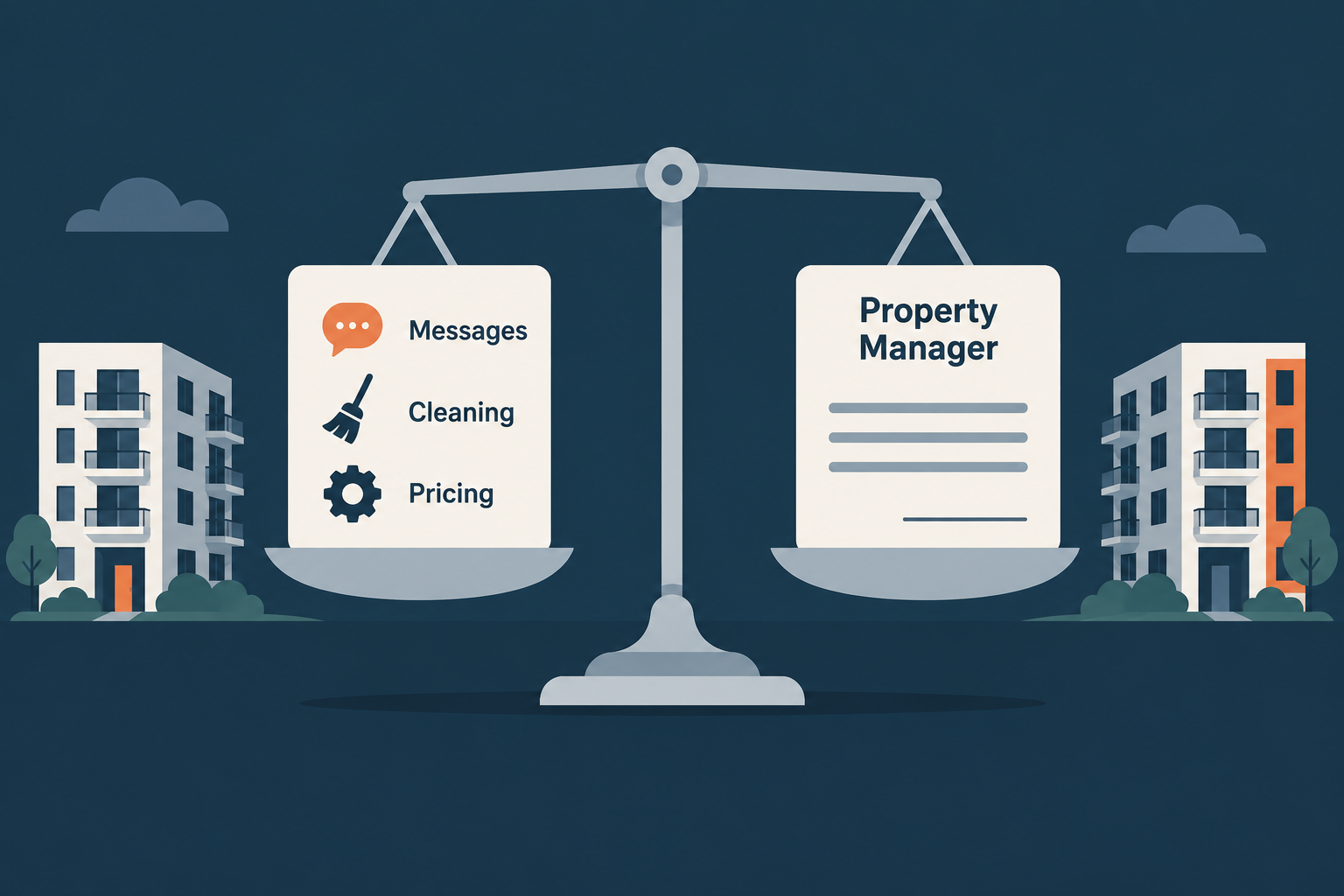
Hire out when the fee you pay is smaller than the value of the hours you get back, or when the property sits in a market you cannot drive to; self-manage when you are still learning the operation, your units are close, and your vendor bench is strong. That is the whole decision. Everything below is how you run the numbers yourself instead of taking someone's word for a percentage.
Last updated: 2026-09-19
Most operators ask the wrong question first. They ask "can I afford a manager?" The better question is "what is an hour of my time worth, and is guest messaging the best use of it?" Answer that, and the fee stops being a cost you resent and becomes a price you either accept or decline on purpose.
What the Management Job Actually Is
Before you price it, list it. Short-term rental management is seven separate jobs wearing one title:
Guest messaging. Pre-booking questions, check-in instructions, mid-stay problems, late checkout requests. Airbnb counts a reply inside 24 hours toward your response rate, and that rate feeds Superhost status and search placement, so this is not a job you can batch once a week.
Pricing and calendar. Rate setting, minimum stays, gap nights, event weekends, seasonal floors. Rate automation software helps, but someone has to set the strategy and check the output.
Turnovers. Cleaner scheduling, quality checks, same-day flips, linen rotation, damage reporting.
Maintenance. HVAC, plumbing, lock batteries, appliances, and the 11 p.m. call that decides whether you get a 5-star review or a refund request.
Restocking. Consumables, paper goods, coffee, batteries, light bulbs.
Compliance filings. Permit renewals, occupancy or lodging tax returns, HOA paperwork, insurance certificates.
Reviews and reputation. Review responses, guest disputes, resolution center claims.
Two of those seven quietly decide your margin. Pricing sets the top line; turnovers set the review average, and the review average feeds back into the top line six months later. Everything else is maintenance of the machine. When you decide what to hand off, start by asking who is better at those two than you are.
A manager who only does the first three and hands the rest back is not full-service. Get the list above written into the agreement, line by line, before you sign anything.
Run the 30-Day Time Audit First
You cannot price your time from memory, so track it for 30 days before you price a manager's fee.
For 30 days, log every minute spent on the seven categories above. Use your phone's timer or a note in your calendar. Record the task, the minutes, and whether it interrupted something else. The interruptions matter more than the totals — 20 minutes at 9 p.m. on a Friday costs more than 20 minutes on a Tuesday morning.
At the end of 30 days you have three numbers:
Total hours. Your real monthly load, not your estimate.
Interrupt count. How many times the operation pulled you out of something else.
Your hourly value. What you would earn, or save, with those hours back. If you have a consulting rate, use it. If your best alternative is acquiring the next property, estimate the profit that deal adds and divide by the hours it needs.
One more column is worth logging: which tasks you resent. Resentment predicts sloppiness. The operator who hates restocking will run out of coffee pods, get a 4-star review for "not fully stocked," and lose more revenue than the shopping trip was worth. Hand off the tasks you avoid before you hand off the tasks you merely dislike.
If you have no better use for the hours and no plans to add units, self-management is defensible. Be honest about that. For most operators past two or three units, it stops being true fast.
The Fee Math: A Worked Break-Even Illustration
Full-service short-term rental management is usually quoted as a percentage of gross booking revenue, and that percentage varies by market, unit count, and what is included. I am not going to assert a national average as fact. Instead, run your own numbers against the same structure.
Here is an illustration. Assumptions, stated plainly: gross annual revenue of $48,000 on one unit; a management fee of 20% of gross; your logged time at 6 hours per week, or 312 hours per year. The manager is assumed to keep revenue flat. None of these figures are a forecast for your property.
Line item | Self-managed | Manager at 20% of gross |
|---|
Gross revenue (assumed) | $48,000 | $48,000 |
Management fee | $0 | $9,600 |
Your hours per year | 312 | ~40 (oversight and reporting) |
Cash after fee | $48,000 | $38,400 |
Break-even value of your hour | — | $9,600 ÷ 272 saved hours = $35.29 |
Read the last line carefully. In this illustration, hiring out pays if your hour is worth more than about $35. If your hour is worth $100, you are buying back 272 hours for the equivalent of $35 each. If your hour is worth $20 and you like the work, keep it.
Run the same table at 15%, 20%, and 25%, and at your real revenue rather than the illustration's $48,000. The break-even hourly value moves with both inputs, which is why a single "market rate" tells you almost nothing about your own decision.
Two adjustments make the math honest. First, a manager who raises occupancy or nightly rate changes the top line, so ask for evidence before you credit them with it. Second, self-management is not free — software, your own supply runs, and mileage all cost money. Put your real numbers in the table above and rerun it.
This is educational, not tax or legal advice. Management fees are generally treated as a rental expense, but how that lands on your return depends on your facts, so confirm treatment with your own tax professional.
When Self-Management Wins, and When Hiring Out Does
Both answers are correct in different seasons of the same portfolio. Here is how to tell which season you are in.
Keep it in-house
Keep the work in-house when at least three of these are true:
You are in your first or second year and still learning what breaks, when, and why.
You own one or two units within a 30-minute drive.
You have a cleaner, a handyman, and an HVAC contact who answer your calls.
Your calendar has room for interruptions without damaging your main income.
You are not trying to add units in the next 12 months.
The learning argument is the strongest one. The operator who has personally handled a broken water heater at midnight can tell in one phone call whether a manager knows the job. Skip that year and you will be buying a service you cannot evaluate.
Hand it off
Hire a manager when the numbers or the geography make the decision for you:
Your hourly value clears the break-even figure you calculated above.
The property is in a market you do not live in, and your backup plan is a text message to a cleaner you have never met.
You want to add units faster than your own hours allow.
You are building a portfolio that can be sold or financed as a business rather than a job you own. Buyers pay more for an operation that runs without you.
Compliance in your city is heavy enough that missing a filing costs real money.
I have spent 18-plus years in real estate, focused on short-term rentals since 2016, and built a list of more than 10,000 short-term rental operators through CashFlow Diary. The pattern I see most: people hire too late, after the operation has already cost them a deal, a relationship, or their weekends for a year.
The Hybrid Middle Most Operators Miss
The choice is not binary. Three middles work well.
Co-hosting. On Airbnb you can add a co-host with either full access or limited access to the calendar and messaging, without handing over ownership of the account. Co-hosts are often paid a lower percentage than full-service managers because the scope is narrower. Check what permissions your platform grants and what stays your responsibility.
Keep pricing, outsource the rest. Pricing is the highest-dollar decision in the operation and the easiest to keep. Many operators hold rate strategy, then buy turnovers, maintenance dispatch, and guest messaging.
Outsource turnovers only. A cleaning company with its own scheduling, inspection, and restocking removes the single biggest source of same-day emergencies while you keep everything else.
Function | Self-managed | Co-host / hybrid | Full-service manager |
|---|
Guest messaging | You, all hours | Co-host handles, you set tone | Manager, with a stated response window |
Pricing | You | Usually you | Manager, on their system |
Turnovers | You schedule | Split | Manager's vendor bench |
After-hours maintenance | You | Case by case | Manager, up to an approved dollar limit |
Compliance filings | You | You | Confirm in writing — often still you |
Typical cost basis | Software plus your hours | Lower percentage, narrow scope | Percentage of gross revenue |
Best fit | 1-2 nearby units, learning years | 2-4 units, one weak spot | Remote markets, growth, sellable asset |
The hybrid fails in one predictable way: nobody owns the gap. If your co-host handles messaging and your cleaner handles turnovers, write down who tells a guest the unit will be 90 minutes late. Name the owner of each handoff point in writing, or the guest becomes the one who discovers the gap.
One test settles the hybrid question: if you handed off only the tasks that wake you up at night, would the rest of the job fit in three hours a week? If yes, buy the hybrid. If no, you are shopping for full-service and should price it that way.
How to Vet a Manager: The Checklist
Ask these in one call, in this order, and take notes. A manager who cannot answer four of them is not running a business you want inside your revenue.
Step 1 — Size and fit
How many units do you manage right now, and how many are in my price tier? A manager who excels with $500-a-night beach houses may be mediocre with $150-a-night city apartments. Different guests, different problems.
Step 2 — Performance against the market
What is your portfolio occupancy, and what is the market occupancy for comparable units? Ask for the data source. Beating the market by a little, consistently, is a real answer. "We keep everyone booked" is not.
Step 3 — Pricing approach
What tool do you use, who reviews the output, and how often do you adjust minimum stays? You want a named tool plus a human review cadence.
Step 4 — Maintenance authorization threshold
What dollar amount can you approve without calling me, and what happens above it? Get the number in the contract. Unstated thresholds are where owner relationships die.
Step 5 — Owner communication SLA
How fast do you respond to me, not just to guests? What does the monthly statement show, and does it break out fees, refunds, and damage claims?
Step 6 — Two owners like me
Give me two owners with units like mine, including one who left. The exit reference tells you more than the happy one.
Step 7 — Money handling
Who receives the platform payout, and when does my share land? Ask whether bookings pay into their account or yours, what the payout date is, and who holds the security deposit or damage claim proceeds. Money that touches their account first is normal in this business, but the timing and reporting need to be written down.
Step 8 — Contract terms and exit
What is the term, the notice period, and what happens to future bookings if I leave? Who owns the listing, the reviews, and the guest history? If the answer is "we do," walk.
The Handoff Checklist If You Switch
Switching managers, or moving from self-management to a manager, is where revenue leaks, so work this list in order before the transfer date arrives.
Export your guest history, review record, and 24 months of financials.
Document existing bookings, rates, and any promises made to guests in writing.
Decide who honors pre-transfer bookings at pre-transfer rates and put it in the agreement.
Transfer smart lock codes, alarm codes, and Wi-Fi credentials, then rotate them.
Hand over vendor contacts and tell each vendor who now authorizes work.
Move utilities, permits, insurance certificates, and tax filing responsibility explicitly.
Photograph the unit and inventory the supplies on transfer day.
Keep your own platform account ownership and payout method under your control.
Agree in writing on how owner statements will be delivered and by what date each month.
Set a 30-day and 90-day review against the occupancy and revenue baseline you recorded.
If a manager resists any item on that list, that is information, not an obstacle. The good ones have done a handoff before and have their own version of this checklist.
Before you sign either way, pressure-test the plan with someone who has run the operation. Want an operator to do that with you? Start with a complimentary one-on-one diagnostic call.
For the wider question of who to consult before you buy, see who to talk to before buying short-term rentals.
Frequently Asked Questions
How much do short-term rental managers charge?
Fees are quoted as a percentage of gross booking revenue, and the percentage moves with market, unit count, and scope. Ask three managers in your market for a written scope and fee, then run the break-even table in this article with your own revenue and hourly value. Treat any single national figure you see online as a starting point for questions, not a rate you should accept.
Is a co-host the same as a property manager?
No. A co-host is granted defined permissions on your listing — messaging, calendar, or pricing — while you keep the account and most of the risk. A full-service manager takes the whole operation, usually for a higher percentage. Co-hosting fits an operator with one weak spot, not one who wants the job gone.
Should I self-manage the first property and hire out later?
That is the sequence I recommend for most new operators, with one condition: set the trigger in advance. Write down the hour count or the unit count that makes you hire, then act on it. Operators who leave the trigger undefined self-manage for years past the point where it pays.
How many hours a week does self-managing one unit take?
Do not use anyone else's number, including mine. Log 30 days of your own time across messaging, pricing, turnovers, maintenance, restocking, and filings. The total plus the interruption count is your real answer, and it is the input the fee math needs.
Are management fees deductible?
Management fees are generally treated as an expense of the rental activity, but the treatment on your return depends on your specific facts, including how the property is classified. This is educational, not tax advice — confirm with your own tax professional before filing. And before you sign, settle the exit terms: notice period, who honors existing bookings, and who owns the listing, the reviews, and the guest data.
Sources