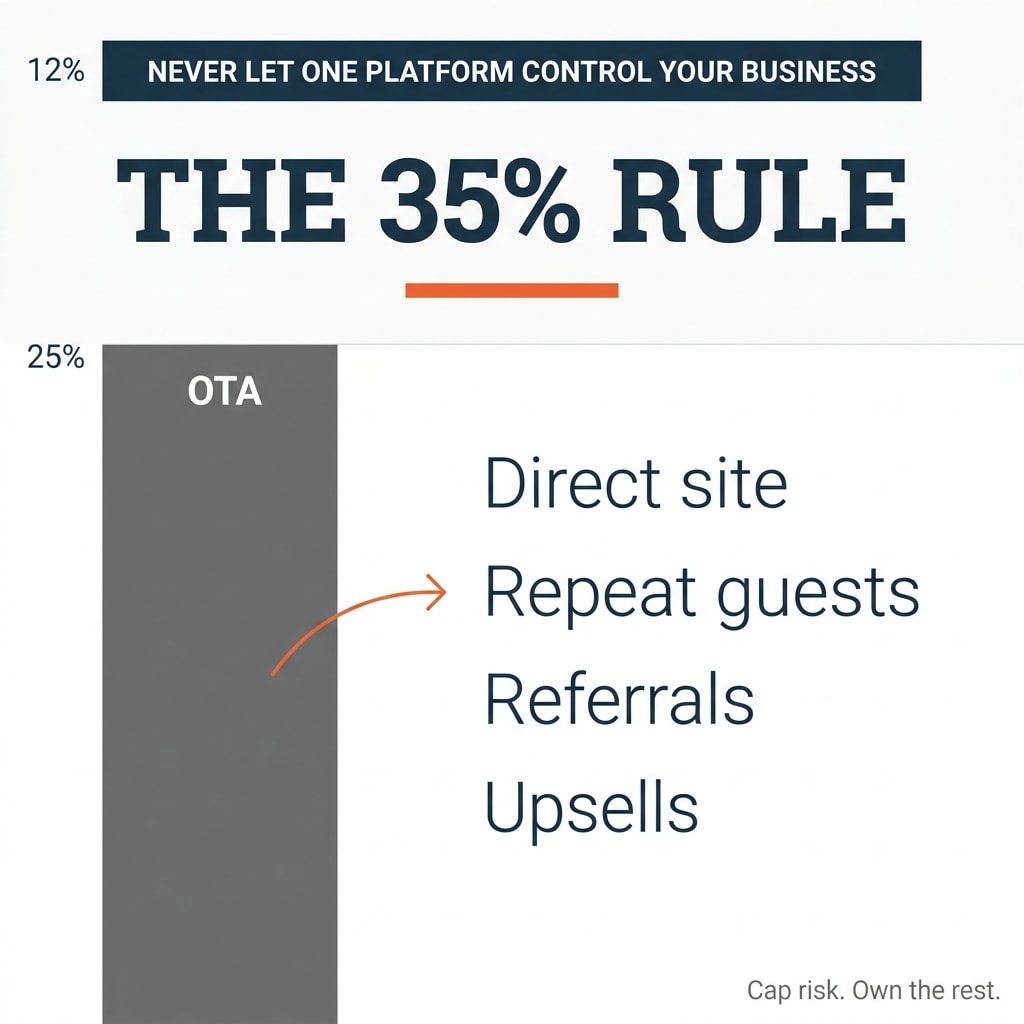
No single online travel agency should supply more than about 35% of your short-term rental revenue. The other 65% belongs on channels you control: repeat guests, referrals, your own booking site, and add-ons sold off-platform. That number is a risk threshold, not a growth target — at 35% you keep the reach a platform gives you while surviving a suspension, a fee change, or a ranking shift without a hole in the month's cash flow.
Last updated: 2026-09-18
I have spent more than 18 years in real estate, worked almost entirely in short-term rentals since 2016, and built a list of more than 10,000 short-term rental operators through CashFlow Diary. Channel concentration is the risk almost nobody measures. Operators track occupancy weekly and average daily rate monthly, then discover during an account review that one platform carries every dollar they earn. The measurement takes twenty minutes. The rebuild, once the concentration is already at 90% or 100%, takes a year or more.
This is written for operators running roughly 2 to 15 units. Nothing here is tax or legal advice; talk to your own CPA and attorney about your structure and your contracts.
What the 35% Rule Actually Says
The rule is one sentence: no single booking channel — any online travel agency, or OTA — gets more than 35% of trailing-twelve-month revenue. Everything below is about reading your OTA revenue mix from the payout reports and fixing it when Airbnb dependence is the number staring back at you.
It is a concentration limit borrowed from how lenders look at tenant risk in commercial real estate. A building where one tenant pays 80% of the rent underwrites worse than an identical building with five tenants, even at the same total rent, because the downside is a cliff rather than a dip. Your booking channels work the same way. At 35%, losing a platform costs you a quarter you can plan around. At 100%, losing a platform is the business.
Three things the rule does not say:
It does not say quit the platforms. Airbnb, Vrbo, and Booking.com are the cheapest new-guest acquisition in lodging. Paying a commission for a guest you could not have reached is a fair trade.
It does not say cut listings to force the ratio. Pulling inventory to improve a percentage while total revenue falls is arithmetic, not progress. You grow the denominator on owned channels instead.
It does not say 35% is a magic number. It is a threshold that keeps meaningful platform reach on the table while capping single-point-of-failure risk. If you want 25%, run 25%.
Why Concentration Is a Cash-Flow Problem, Not a Philosophy Problem
Platform risk is documented in the platforms' own policies, which is where to read it rather than in anyone's opinion piece.
Airbnb's Host Cancellation Policy for homes, effective October 9, 2023, sets out what happens when a host cancels a confirmed reservation: a fee with a $50 minimum, calculated as 10% of the reservation amount more than 30 days out, 25% between 30 days and 48 hours out, and 50% of the nights not stayed inside 48 hours or after check-in. Those fees are withheld from the next payout. The policy also states that hosts who cancel confirmed bookings without a valid reason may have a listing or account suspended or removed and may lose Superhost status.
Read that as an operator, not as a reader. The penalty arrives as a deduction from money you have already booked, and the worst case is the account itself. If that account is 100% of revenue, a maintenance failure that forces two cancellations in one month becomes a fee, a ranking hit, and a possible account action against your only income stream at the same time.
The second pressure is regulatory, and it also changed the math. The FTC's Rule on Unfair or Deceptive Fees, 16 CFR Part 464, published at 90 FR 2166 on January 10, 2025, defines "covered good or service" to include short-term lodging — hotels, motels, inns, short-term rentals, and vacation rentals — and requires total price disclosure that is clear and conspicuous, with the disclosure unavoidable in interactive electronic media. Guests now compare all-in totals. Cleaning fees and mandatory add-ons have to show up in the number a guest sees, so the platform's total is the number you compete on, and every commission inside that total is visible pressure on your rate.
The third pressure is the one you cannot read in any policy: search ranking. Platforms adjust placement and fee structures on their own schedule, and Airbnb's own fee page states that it reserves the right to change service fees at any time. You get no notice and no vote. That is acceptable for a channel supplying a third of revenue. It is not acceptable for a channel supplying all of it.
What Each Channel Costs, As of September 2026
Here is what the live platform documentation says today. Verify before you price — these change.
Channel | Who pays the fee | What the documentation says (Sept 2026) | Practical read |
|---|
Airbnb, split-fee structure | Split host/guest | Most hosts pay 3% (4% in Brazil and Mexico); guests pay 14.1%–16.5% of the booking subtotal | Being phased out; Airbnb says it disappears once hosts are migrated |
Airbnb, single-fee structure | Host only | Most hosts pay 15.5%; remaining hosts typically 14%–16%; 16% in Brazil and Mexico | Mandatory for hotels, serviced apartments, and hosts using property management software |
Vrbo | Host | Two host payment models: an annual subscription, or pay-per-booking commission plus card processing. Rates are quoted in your host dashboard, not on a fixed public schedule | Subscription wins above a revenue crossover; commission wins below it |
Booking.com | Host | Commission per stay, set by market and listing type | Highest headline commission of the three in most US markets |
Your direct site | You | Payment processing plus your booking software subscription | Processing is a small percentage; software is a fixed monthly cost |
Repeat guest, booked direct | Nobody | No acquisition cost | The highest-margin booking you will ever take |
Two notes on that table. First, Airbnb's single-fee structure is not optional once you connect property management software — if you run a channel manager, you are on the host-only fee. Second, the difference between a 3% split fee and a 15.5% single fee is not a rate change you absorb quietly; on $120,000 of platform revenue the 12.5-point gap works out to about $15,000 a year in that illustration, which is the entire budget for a direct-booking stack several times over.
The fee is not the argument against platforms. The fee is the argument against paying it twice for the same guest. A commission on a first-time guest who found you through search is acquisition spend. The same commission on a guest who stayed last October, remembers your name, and only rebooked through the app because you never gave them another path is a leak you created.
How to Measure Your Channel Concentration
Do this with a spreadsheet and your payout reports. Trailing twelve months, gross revenue net of platform fees, grouped by where the booking originated.
Step | What to pull | What you are looking for |
|---|
Pull payouts | 12 months of payout statements per platform | Actual deposited revenue, not gross booking value |
Tag direct revenue | Bookings taken on your site, by phone, or by email | Include repeat and referral stays booked outside a platform |
Add off-platform income | Early check-in, late checkout, add-on packages, mid-term extensions | Revenue that never touched a commission |
Divide | Each channel ÷ total revenue | Any single channel above 35% is your exposure |
Repeat monthly | Same four rows, same day each month | Direction matters more than the single reading |
Read the result against this triage table before you decide what to do:
Largest single channel | Risk position | What to do first |
|---|
Over 85% | One policy action from zero revenue | Contact capture on every stay, starting with the next check-in |
60%–85% | Survivable but thin | Contact capture plus a return-guest offer to everyone in the last 24 months |
36%–59% | Working position | Stand up or finish the direct-booking site; add referral incentives |
25%–35% | At target | Hold. Grow owned channels with total revenue, not by cutting listings |
Under 25% | Possibly under-distributed | Check whether you are turning down reach you could profitably buy |
Most operators who run this for the first time find one of two surprises: either a platform they thought was minor is carrying 20% of revenue, or the "direct" bucket they were proud of turns out to be three bookings from one repeat family.
The Five-Step Process to Get Under the 35% Line
Order matters here. Every step below depends on the one before it, and the most common failure is building the website first and then having nobody to send to it.
Capture guest contact information on every stay. The platforms restrict contact sharing during booking, so the stay itself is the window: a WiFi splash page, a welcome card with a QR code to a guest guide that asks for an email, a digital guidebook with opt-in. Log every guest, every stay, in one place. Our guest spreadsheet marketing system is the low-tech version of this and it works.
Earn the second booking. A post-checkout email with a specific return offer and a direct path to book. The guest already trusts you, so you are not paying for trust twice. Use tight message discipline here — our guest communication templates cover the sequences that get replies.
Add a referral loop. A credit for the referring guest and a credit for the new guest. No platform required, no algorithm involved, and the cost per booking is whatever you decided to give away.
Stand up the direct-booking site. Mobile-first, real-time availability synced to your channels, card processing, a stated cancellation policy, and reviews on the page. Booking software in this category includes Lodgify, OwnerRez, Hostfully, Guesty, and Hostaway; compare a flat per-listing monthly fee against any revenue-share model using your own last twelve months of booking revenue before you sign.
Sell what the platforms do not. Early check-in, late checkout, mid-stay cleans, stocked-fridge packages, local partnerships. Off-platform revenue per booking raises the owned side of the ratio without adding a single night of occupancy.
If you want a second read on your own channel mix before you start rebuilding it, book a complimentary one-on-one diagnostic call and we will look at your trailing-twelve-month split, your fee structure, and which of the five steps is actually your constraint.
What a Realistic Rebalance Timeline Looks Like
Nobody moves from 95% platform to 65% owned in a quarter. Here is the shape of the work, assuming 4 to 8 units and 200 to 400 stays a year. Percentages below describe the owned share of revenue, and they assume total revenue holds flat or grows.
Window | Work | Owned share of revenue | Failure mode to watch |
|---|
Months 1–3 | Contact capture live on every stay; baseline concentration measured | 5%–10% | Capture rate under 30% because the ask is buried in a guidebook nobody opens |
Months 4–6 | Return-guest offers to the last 24 months of stays; referral credit launched | 10%–20% | Sending offers to a list with no tagging, so the message fits nobody |
Months 7–12 | Direct-booking site live and synced; upsells priced and listed | 20%–35% | Calendar sync errors causing a double booking, which costs more than the fees saved |
Months 13–18 | Repeat and referral bookings compound; platform mix held, not cut | 35%–50% | Cutting platform inventory too early and losing total revenue |
Months 19–24 | Direct becomes the default path for past guests | 50%–65% | Letting the guest database go stale with no contact for a year |
Two hard rules for that period. Do not cut platform listings to make the ratio look better; grow the owned side while platform revenue stays where it is. And measure monthly, because concentration drifts back up quietly every time a platform has a strong season.
One more note on bookkeeping: if your books do not separate platform revenue from direct revenue at the deposit level, you cannot run this measurement at all, and no amount of estimating fixes it. Our guide to what to track in an STR financial model covers the account structure that makes the monthly read take minutes.
What Changes Once You Are Under 35%
The obvious change is fee savings, and it is the least interesting one.
The more useful changes are operational. You set your own cancellation terms on direct bookings instead of inheriting a platform's. You hold payment timing rather than waiting on a payout schedule that can stretch on higher-value reservations. You keep the guest relationship, so a marketing message about a shoulder-season gap reaches people who have already stayed with you rather than strangers. You stop pricing against the platform's all-in total for every single booking, because some of your nights are sold on a page where you control the whole number.
There is also a valuation argument if you ever sell or refinance an operating business rather than the real estate. A book of repeat guests and an owned booking channel transfers. A ranking position on someone else's platform does not.
And the risk you started with shrinks to a manageable size. A suspension becomes a bad month instead of a closed business. That is the whole point of the cap.
Frequently Asked Questions
What is the 35% rule for short-term rental channel mix?
No single online travel agency should supply more than about 35% of your trailing-twelve-month revenue. It is a concentration limit, borrowed from how lenders view tenant concentration in commercial real estate: at 35% you keep the reach a platform provides while a suspension or fee change costs you a planned-for quarter instead of the whole business.
How do I calculate my channel concentration?
Pull twelve months of payout statements from every platform, tag every booking taken on your own site or by phone or email as direct, add off-platform income such as early check-in and add-on packages, then divide each channel by total revenue. Run the same four rows on the same day each month so you can see direction, not just a single reading.
Should I stop listing on Airbnb to get more direct bookings?
No. Platforms remain the cheapest source of first-time guests in lodging, and pulling inventory to improve a percentage while total revenue falls is not progress. Grow the owned side of the ratio — repeat guests, referrals, your own site, off-platform add-ons — and hold platform revenue where it is.
What does Airbnb charge hosts as of September 2026?
Airbnb's service fee page documents two structures. Under the split fee, most hosts pay 3% (4% in Brazil and Mexico) and guests pay 14.1% to 16.5% of the booking subtotal. Under the single fee, which is mandatory for hotels, serviced apartments, and hosts using property management software, most hosts pay 15.5%, with remaining hosts typically at 14% to 16%. Airbnb states it may change service fees at any time, so check the page before you price.
How long does it take to get a single platform under 35%?
For most operators at 4 to 8 units, 12 to 24 months of consistent work: contact capture first, then return-guest offers and referrals, then the direct-booking site, then off-platform add-ons. Anyone promising the shift in one season is describing a listing cut, not a rebuild. This is general operator education, not tax or legal advice.
Related Reading
Your next action is the measurement, not the website. Pull twelve months of payouts this week, tag each deposit by channel, and write down your largest single-channel percentage. That one number tells you which of the five steps you start on Monday.
Sources
Airbnb Help Center — Airbnb service fees — source for the split-fee (3% host, 14.1%–16.5% guest) and single-fee (15.5%, 14%–16% range) structures, the Brazil and Mexico rates, the phase-out of the split fee, and Airbnb's stated right to change fees at any time.
Airbnb Help Center — Host Cancellation Policy for homes — source for the $50 minimum cancellation fee, the 10%/25%/50% tiers, withholding from future payouts, and possible listing or account suspension or removal.
eCFR — 16 CFR Part 464, Rule on Unfair or Deceptive Fees — source for short-term and vacation rentals being covered services and for the clear, conspicuous, unavoidable total-price disclosure requirement (90 FR 2166, January 10, 2025).
Vrbo Help Center — What fees does Vrbo charge — Vrbo's own help page for host payment models (annual subscription versus pay-per-booking commission plus card processing); current rates are shown to each host in the dashboard.
IRS Publication 527, Residential Rental Property — primary reference for how rental income and operating expenses, including platform commissions, are treated.
IRS Tax Topic 415, Renting Residential and Vacation Property — primary reference behind the note that reporting depends on personal-use and rental-day counts, which is a question for your own CPA.