Turn Your Guest Spreadsheet Into a Marketing System (Without Breaking Airbnb's Rules)
Your past-guest data is an unused asset. Here is how to capture emails at touchpoints you control, structure them, and run five sequences without breaking platform rules.
By J. MasseyJuly 22, 2026· 11 min read
Share
Disclosure: This post may contain affiliate links. If you purchase through our links, we may earn a commission at no extra cost to you. We only recommend tools and services J. Massey's team actually uses. Read the affiliate disclosure
Your guest spreadsheet becomes a marketing system the moment you stop treating platform message threads as a contact list and start collecting email addresses at touchpoints you own: your own booking site, your digital guidebook, a wifi login page, a post-checkout follow-up. You store consent with the record, then run five simple email sequences against it. None of it breaks Airbnb's rules, because none of it uses platform-supplied contact details for marketing.
Last updated: 2026-09-18
I run diagnostic calls with short-term rental operators most weeks. The same pattern shows up again and again: three years of stays, a few hundred reservations, and no way to bring a single past guest back without paying a platform for the introduction a second time. The data is scattered across an Airbnb inbox, a property management dashboard, and a spreadsheet nobody has opened since 2023.
I have spent 18+ years in real estate, focused on short-term rentals since 2016, and trained more than 10,000 operators through CashFlow Diary. The operators who build repeat business are rarely the ones with the best photos. They are the ones who own a permissioned list and mail it on a schedule.
This is educational content for operators, not legal or tax advice. Email law and platform policy both change, and your jurisdiction matters. Read the primary sources linked at the end and get your own counsel before you send.
The asset you already own and are not using
Every reservation carries the same raw material: a name, stay dates, nights, party size, an origin city, a total spend, and the channel it came through. That is enough to segment a list and personalize a message. Most operators never move it anywhere useful.
The cost of ignoring it is arithmetic. Airbnb publishes two fee structures for home hosts. Under the split fee, most hosts pay 3% and guests pay a service fee of 14.1% to 16.5% of the booking subtotal. Under the single fee, which Airbnb says is mandatory for most hosts and is replacing the split fee, most hosts pay 15.5% and the rest typically pay 14% to 16%. Every repeat stay you win directly is a stay you do not pay that fee on. You also skip the ranking lottery, the promotion discounts, and the race to the bottom on nightly rate.
You do not need a large list to begin. Ten permissioned email addresses and two working sequences beat a thousand contacts sitting in a dead file. The system compounds because past guests are the cheapest audience you will ever talk to — they have already slept in the bed and know whether they liked it.
One more thing the spreadsheet gives you that a platform dashboard will not: the shape of your demand. Sort a year of stays by origin city and you usually find two or three metros producing most of your bookings. Sort by party size and you learn whether you are selling a couple's weekend or a family reunion. Those two sorts change what you write in every email below, and they take ten minutes.
Name the failure mode first: the data is not missing, it is unstructured and unpermissioned. Fix those two things in order.
A guest spreadsheet transforming into an automated email-marketing engine
Airbnb's Off-Platform and Fee Transparency Policy is the document to read, not the forum thread someone quoted at you. Read the named prohibitions literally. It bans asking or encouraging users to move current, future, or repeat bookings off Airbnb. It bans including links that take people off the platform in listings or messages. It bans offering or soliciting discounts to book off Airbnb. And it bans asking guests for, or using, contact or identity information in ways unrelated to their stay. The masked address Airbnb issues for a reservation (the one ending in @guest.airbnb.com) exists for stay logistics. It is not a marketing list.
Airbnb does not ban you from running a direct booking business. It bans using its channel, its messaging, and its supplied contact data as the acquisition engine for one. Other channels publish their own versions of this policy; read the terms of every channel you list on before you build anything on top of them, because they differ and they change.
That distinction is the whole article. You are not banned from emailing past guests. You are banned from harvesting them.
Action
Allowed?
Why
Emailing the @guest.airbnb.com alias with an offer
No
Platform-provided contact data used for marketing
Asking in platform messaging for a personal email to join your list
No
Solicitation inside the booking channel
Pointing a confirmed guest to your own guidebook page that collects an email for wifi and check-in details
Yes
Guest-initiated opt-in on a surface you control
Collecting an email at checkout on your own booking site
Yes
Your transaction, your customer record
Emailing a past guest who opted in on your site, with an unsubscribe link
Yes
Permissioned list plus CAN-SPAM compliance
Copying guest names and details out of the platform into an ad audience
No
Platform data reused for marketing targeting
Including a printed card in the unit inviting guests to join your local-guide list
Yes, with care
Offline invitation, guest chooses to opt in
When you are unsure, apply one test: did the guest hand me this address on a page I own, in exchange for something they wanted? If yes, you have a contact. If no, you have platform data.
The capture points you control
Four surfaces produce permissioned addresses. Build the first two before you think about the rest.
Your own booking site. The cleanest record in the business. The guest pays you, so you hold the email, the billing name, and the stay dates without asking a platform for anything. Add a clearly labeled marketing opt-in checkbox at checkout — separate from the reservation terms — and store what they ticked.
Your digital guidebook and check-in flow. Guests want the wifi password, the door code, the parking rules, and the three restaurants that are actually good. Put that behind a short form on your own domain: "Enter your email and I will send your check-in details and my neighborhood guide." The value is immediate and the guest starts the exchange.
A wifi login page. Tools that sit in front of your network ask for a name and email before granting access. Every guest in the party passes through it, not only the person who booked, which is why this is the highest-volume capture point most operators have. Disclose on the page what you will send and include the opt-in language.
A gated local guide on your website. A seasonal activity list or neighborhood map, offered on your site and your social accounts, collects people who have not stayed yet. That is a different segment with different messaging, and it keeps the list growing in the off-season.
Skip anything that asks a guest for their address inside a platform's messaging thread, including a "leave me your email for the guide" line in your welcome message. It is the one shortcut that reliably costs people their listing.
One rule across all four: no pre-ticked boxes, no bundling marketing consent into a rental agreement, and a plain statement of what you will send. Sloppy consent is worse than no consent, because it teaches you to mail people who never asked.
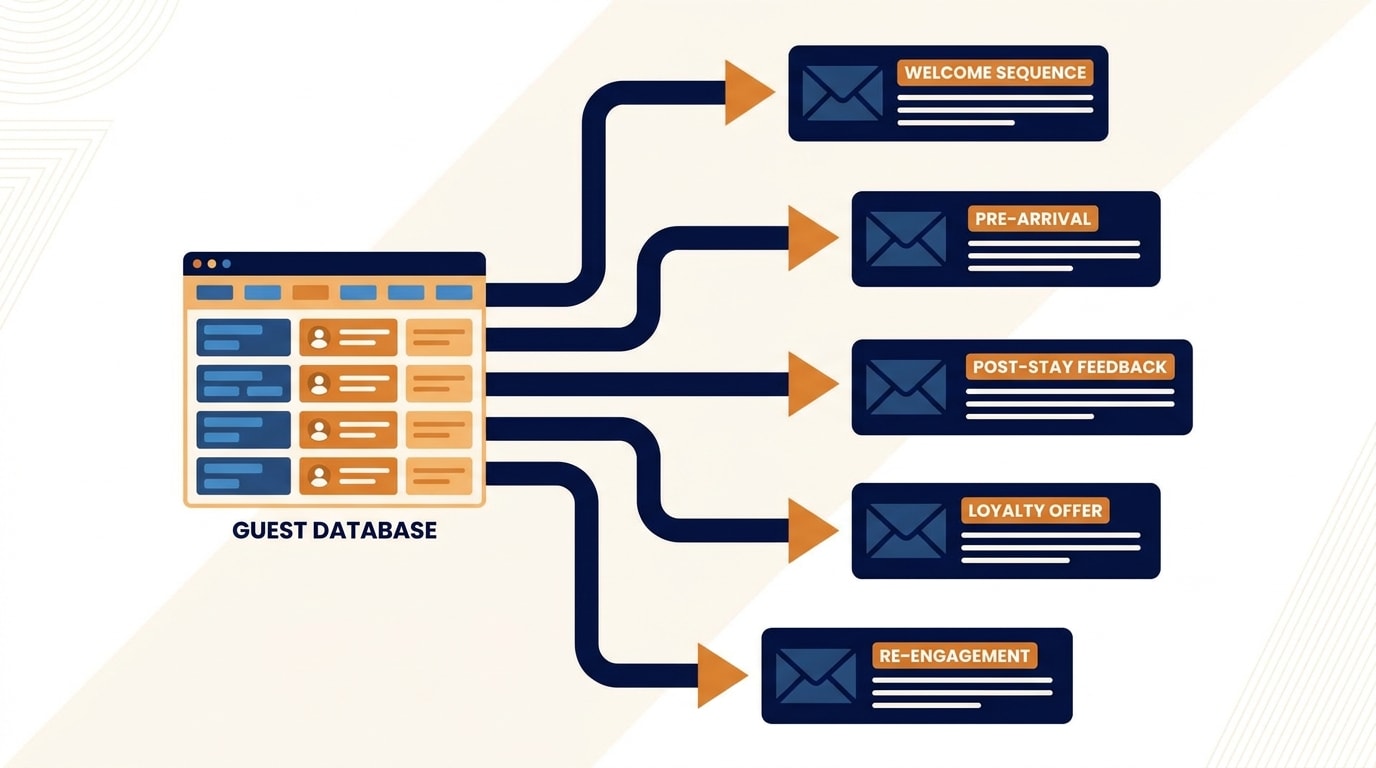
A structured guest database branching into five automated email sequences
A list without fields is noise. These are the columns that let you segment, personalize, and prove consent. A spreadsheet is fine until roughly 100 contacts or the first time you want automated sends; then move to an email platform or a small customer record system.
Field
Example
What it lets you do
First / last name
Tanya Mitchell
Personalize the greeting
Email
tanya@example.com
The asset itself
Consent source
Wifi login page, Unit 2
Prove how you got it
Consent date
2026-03-12
Prove when you got it
Check-in / check-out
2026-03-10 / 2026-03-14
Trigger post-stay and anniversary sends
Nights
4
Spot short-break vs long-stay guests
Party size
5
Match them to the right unit
Origin city
Sacramento, CA
Drive-market offers and seasonal timing
Total spend
$1,840
Rank who deserves the best offer
Booking channel
Airbnb / Vrbo / direct
Measure your direct-booking share
Segment tag
stayed / prospect / lapsed
Decide which sequence they enter
Unsubscribe status
active / opted out
Honor opt-outs permanently
The consent source and consent date columns are the two most operators skip and the two that matter most. If a guest ever asks how you got their address, or a regulator asks, the answer has to be specific: "You entered it on the wifi login page for Unit 2 on March 12, 2026."
Two segments are enough to start: people who have stayed, and people who have not. Add lapsed guests at the twelve-month mark and you have three.
The five-sequence playbook
Write these once. Trigger them off dates already in your database. Automate the first two and send the rest by hand until the volume justifies otherwise.
Step 1 — Welcome and confirmation
Fires when someone opts in or books direct. One email, sent immediately, containing the thing they asked for: check-in details, the wifi code, the local guide. Set expectations in a single line — "I send a short note a few times a year about the area and open dates" — and include the unsubscribe link from the very first send. This email earns the open rates that carry the rest of the list.
Step 2 — In-stay note
Fires on day two of the stay. Short, useful, no selling. One local recommendation, the number to text if something breaks, and a reminder of checkout time. This is the email that prevents bad reviews, because it gives an unhappy guest somewhere to complain before they complain in public. Keep it under 120 words.
Step 3 — Post-checkout review request and direct rebook
Fires 24 hours after checkout. Thank them, ask for the review, and give one reason and one link to book direct next time. Do not bury the rebook offer at the bottom — put it as the second paragraph with a specific hook, such as your direct rate for repeat guests or the ability to hold a longer checkout. If they booked through a platform, keep the review request and the booking offer plainly separate so you are not steering an active reservation off platform.
Step 4 — Seasonal offer
Fires two to three times a year, timed to your demand pattern rather than the calendar. Lead with the place, not the property: the festival weekend, the first snow, the shoulder season when the town is empty and the rates are soft. One offer, one date range, one link. Segment by origin city if you have a drive market — the people four hours away behave differently from the people who fly in.
Step 5 — Win-back
Fires at 11 to 13 months since checkout with no return stay. Reference the specific stay: the unit, the season, the reason people come back. Make the offer concrete, and make it expire. If a contact ignores three win-back attempts across a year, stop mailing them and mark the record dormant. A small list that opens is worth more than a large one that does not.
Keep the whole set in one document with the trigger, the timing, the subject line, and the body for each step. When you add a second unit or hand the work to a co-host, that document is the system. Without it, the sequences live in your head and stop the week you get busy.
Priority order matters. Steps 1 and 3 produce the fastest return because they fire on events that already happen. Steps 4 and 5 are where the repeat revenue actually lands, and they only work if Steps 1 through 3 built the habit of opening your email.
One operator using AI to run guest marketing across many rental units
Once the address is yours, email law applies. In the United States that is CAN-SPAM, enforced by the FTC. It covers all commercial email, down to a single note to former customers announcing something new, and it makes no exception for business-to-business mail.
Accurate From, Reply-To, and routing information. Subject lines that match the content. Identification of the message as an ad. A valid physical postal address in every email — a street address, a registered post office box, or a private mailbox you rent. A clear opt-out mechanism that works for at least 30 days after sending, and opt-out requests honored within 10 business days. You cannot charge a fee or require anything beyond an email address and an opt-out preference to process it. You stay responsible even if you hire someone else to send for you; the FTC says you cannot contract that liability away. Each separate violating email carries a penalty of up to $53,088, so this is not the corner to cut.
CAN-SPAM does not require prior opt-in. Platform policy and basic trust still do, which is why the capture points above matter more than the statute.
If you host guests from the EU, the GDPR gives them rights over their data: the right to be informed about the processing, the right of access to the record, the right to erasure, and the right to object to processing for marketing. California residents have parallel rights under the CCPA to know, delete, and opt out of the sale or sharing of their data. Practically, this means one thing for a small operator: keep a clean consent column, act on access and deletion requests quickly and in writing, and never buy or swap lists. This is educational, not legal advice — if a meaningful share of your guests are European, pay an attorney for an hour.
Quarterly hygiene keeps the whole system alive. Remove hard bounces, re-apply opt-outs across every tool, update segment tags from the last quarter's stays, and confirm the unsubscribe link still works in your template. Fifteen minutes, four times a year.
If you want a second set of eyes on which capture points fit your units and which two sequences to build first, book a complimentary one-on-one diagnostic call and bring your last twelve months of stay data.
Frequently Asked Questions
Can I email my Airbnb guests marketing offers? Not using the contact information Airbnb gives you. The masked alias issued for a reservation is for stay logistics, and Airbnb's Off-Platform and Fee Transparency Policy prohibits asking guests for, or using, contact or identity information in ways unrelated to their stay. You can email a past guest who gave you their real address on your own booking site, guidebook page, or wifi login page, as long as your message follows CAN-SPAM.
Is a wifi login capture page against the rules? No, when it runs on your own infrastructure inside your property and the guest chooses to enter their email in exchange for network access. What crosses the line is soliciting contact details through platform messaging or using platform-supplied data for marketing. Disclose on the page what you will send and log the consent date and source.
How many contacts do I need before this is worth doing? Ten. The point of starting small is that you debug the capture form, the consent column, and the first two sequences while mistakes are cheap. Operators who wait until they have a large list usually end up with a large list and no working system.
What do I do with guests who never open anything? Give them three chances across a year, then stop. Dormant contacts drag down your sending reputation and inflate the price of your email tool. Mark the record dormant rather than deleting it, so you keep the stay history for planning even after you stop mailing.
Do I need a physical address in every email? Yes. CAN-SPAM requires a valid physical postal address in every commercial message. The FTC says that can be your current street address, a post office box registered with the U.S. Postal Service, or a private mailbox registered with a commercial mail receiving agency. Most operators use a rented box rather than publishing a home address.
Sources
Airbnb Off-Platform and Fee Transparency Policy — the named prohibitions on moving bookings off platform, off-platform links, and using contact or identity information unrelated to a stay.
Airbnb service fees — the 3% split-fee host rate, the 14.1%–16.5% guest service fee, and the 15.5% single-fee host rate quoted in the cost section.
FTC CAN-SPAM Act: A Compliance Guide for Business — the requirements, the physical-address options, the 30-day opt-out mechanism, the 10-business-day honoring window, and the $53,088 per-email penalty.