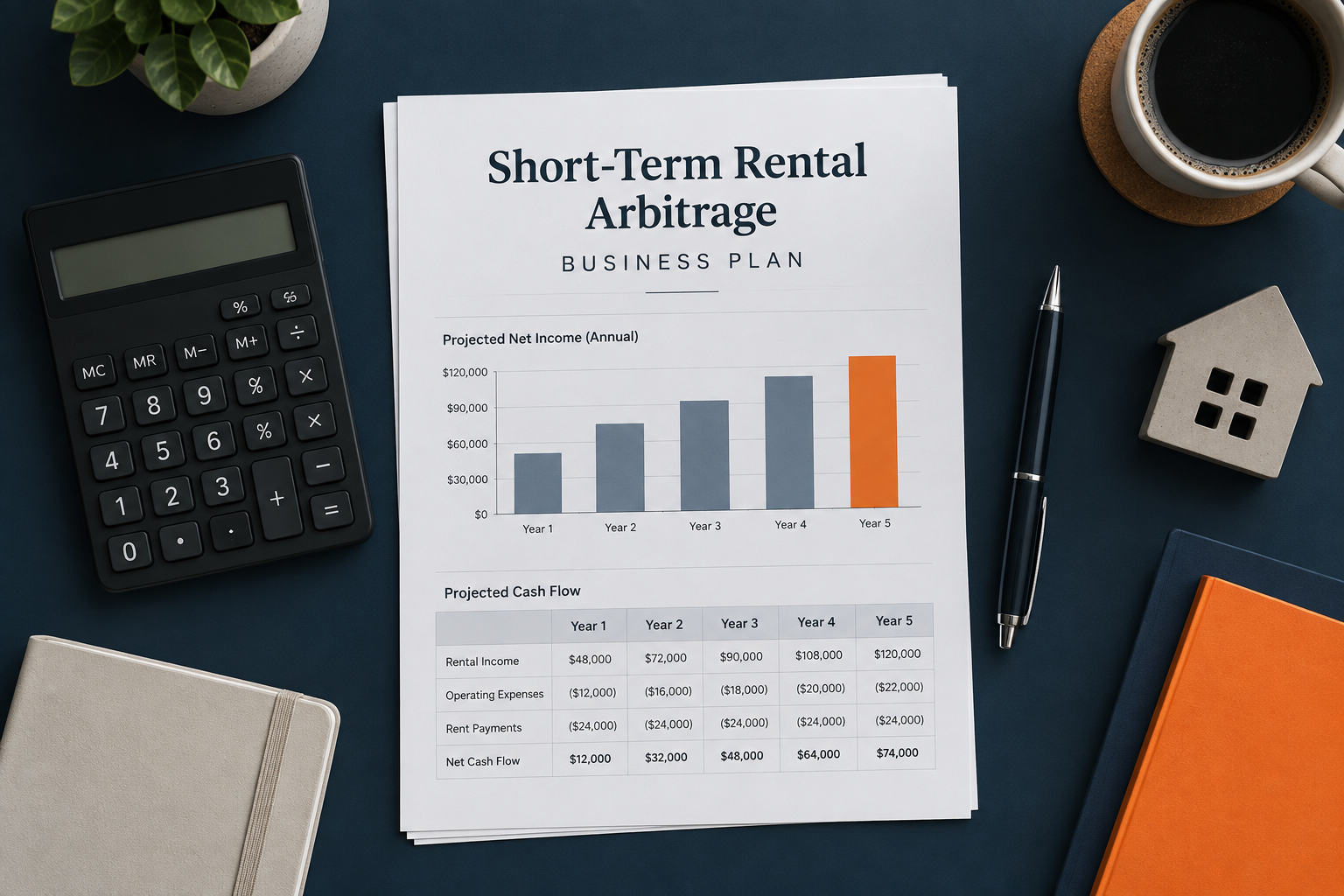
A rental arbitrage business plan is an underwriting document, not a pitch deck. It has one job: prove, in numbers, that one leased unit can pay its own rent, its own operating costs, its own reserves, and still leave a margin — before you sign anything. That means unit economics per unit, break-even occupancy, a startup and furnishing budget, a reserve target, written landlord consent, the insurance you carry, and a risk page that names what kills the deal. Write those seven things and you have a plan a landlord will actually read.
Last updated: 2026-09-17
I have spent more than 18 years in real estate, focused on short-term rentals since 2016, and trained over 10,000 operators through CashFlow Diary. The plans that get a yes from a property owner are short and specific. The plans that get a no read like ambition. This article walks the sections in the order I want you to build them, and it is educational only — not tax or legal advice.
What a Rental Arbitrage Business Plan Actually Is
Rental arbitrage means you lease a property, furnish it, and rent it out in short or mid-term stays with the owner's written permission. You control the revenue. The owner keeps the asset and the asset-level risk. That structure only works if two parties agree on paper, so your plan has two audiences: the landlord who must approve the sublease use, and you, the person who signs a 12-month obligation.
Start with the failure mode. Most first-time operators write a plan that describes the model and skips the arithmetic. They sign a lease at $1,800, expect $4,000 in bookings, and discover that cleaning, utilities, platform fees, software, insurance, and a single water-heater weekend leave them at zero. The fix is boring: build the plan around one unit's monthly P&L, and refuse to sign until that P&L survives a bad month.
Keep the document to five to eight pages. The U.S. Small Business Administration describes two formats: a traditional plan that runs dozens of pages, and a lean startup plan that is "typically only one page" and can take about an hour to write. A single leased unit sits between the two. My own standard is five to eight pages, because you need room for the numbers and the lease language and nothing else. Anything longer is usually padding hiding a thin revenue assumption.
One rule before you write a word: arbitrage without written landlord consent is a lease violation. Not a gray area. Subletting or commercial use without permission is grounds for eviction, forfeited deposit, and a denied insurance claim. If you cannot get it in writing, you do not have a business — you have exposure.
Unit Economics: The One Table That Decides the Deal
Your plan lives or dies on a single-unit monthly statement. Build it in this order, with your own quoted numbers, not averages you read somewhere. Ask your cleaner for a per-turn price. Ask the landlord which utilities are included. Read the platform's fee page.
Here is the format I use. The figures below are an illustration for a $1,800/month two-bedroom, not a promise, and every assumption is shown so you can replace it with your own quotes.
Line item | Illustration | Where your number comes from |
|---|
Gross booking revenue | $4,200 | Your own comp set: nightly rate × nights booked |
Platform service fee | -$651 | Airbnb single-fee structure: most hosts pay 15.5% of the booking subtotal, and Airbnb makes that structure mandatory for hosts who use property management software |
Lease payment | -$1,800 | The signed lease |
Utilities and internet | -$260 | Landlord quote or prior tenant's bills |
Cleaning (10 turns) | -$950 | Cleaner's written per-turn price |
Consumables and restock | -$120 | Receipts from month one |
Software (PMS + rate automation) | -$110 | Vendor pricing pages |
Short-term rental insurance | -$95 | Broker quote for your unit |
Maintenance and repairs | -$150 | Your own history, or 3–4% of gross |
Reserve contribution | -$420 | 10% of gross revenue, moved to a separate account |
Net to operator | -$356 | What is left after everything, before income tax |
Two things to notice. The gap between gross bookings and what you keep is mostly rent, cleaning, and the platform fee — and at these assumptions the unit loses money. Check the fee line first. If you run property management software, Airbnb requires the single-fee structure, so the fee on a $4,200 month is roughly $651, not the 3% split-fee number many arbitrage guides still quote. That single line is the difference between a plan that pencils and one that does not. At minus $356 a month the answer is to negotiate rent down, add a mid-term stay strategy that cuts cleaning turns, or walk.
Set aside income tax separately from net. Rental and short-term stay income is taxable, and if you are running this as a business you may owe quarterly estimated tax. The IRS publications on residential rental property and estimated taxes are the primary references; a CPA prices your situation. Again — educational, not tax advice.
Break-Even Occupancy and the Reserve Math
Break-even occupancy is the number a landlord and a partner both understand: the share of nights you must sell to cover fixed and variable costs. Compute it once and put it on page one.
The math: divide monthly fixed costs by your contribution per booked night. Contribution per night is your average nightly rate minus the variable cost of selling that night (platform fee, the cleaning cost spread across the average stay length, consumables).
Using the illustration above: fixed costs of $2,415 a month (lease $1,800, utilities $260, software $110, insurance $95, maintenance $150). At a $200 average nightly rate, the variable cost of selling a night is about $31 platform fee, about $45 of cleaning spread across a two-night average stay, and about $6 of consumables — a contribution of roughly $118 per booked night. That gives 20.5 booked nights, or about 68% occupancy, before a single dollar of reserve or owner draw. A unit that needs 68% occupancy in a market that averages 60% is not a deal.
Break-even occupancy | What it tells you | My decision |
|---|
Under 45% | Rent is well below what the unit can earn | Sign, and ask for a longer term |
45–60% | Workable with real reserves and off-season pricing | Sign if the market's trailing occupancy clears it by 15 points |
60–70% | One soft quarter from losses | Renegotiate rent or utilities before signing |
Over 70% | The lease is priced for a tenant, not an operator | Walk |
Reserves are the second half of this section. I want two separate buckets named in the plan: an operating reserve of three months of fixed costs — in the illustration, about $7,200 — funded before you take any owner draw, and a replacement reserve of 10% of gross revenue for mattresses, sofas, appliances, and the repaint. Write the target dollar figure and the funding schedule. A plan that shows a reserve schedule reads like an operator. A plan that shows only upside reads like a gamble.
Startup Capital and the Furnishing Budget
Your capital page answers one question: how much cash goes out before the first payout lands? Airbnb releases a host payout after the guest checks in, then the money takes another 30 minutes to seven business days to arrive depending on your payout method. So the furniture, the deposit, and the first month of rent all leave your account before any revenue arrives. Plan for six to eight weeks of spend with no income.
Line the budget up like this, with quotes attached:
Security deposit and first month's rent — the lease tells you exactly.
Furnishing and setup, itemized room by room. Beds, mattresses, seating, table, storage, linens for three full sets, kitchen build-out.
Listing photography. Hire a professional. Photos are the only part of your listing that competes before anyone reads a word.
Licensing, permits, and any city short-term rental registration fee.
First month of software and the insurance binder.
A cash buffer equal to two months of lease payments. This is not the reserve; this is runway.
Furnishing is where budgets die, so give it its own sub-budget with a per-room cap and buy in this order: sleep, kitchen, seating, everything else. Guests forgive a plain living room. They do not forgive a bad mattress or a kitchen with two forks. Buy the mattress, the pillows, the blackout curtains, and the cookware new. Buy the dresser, side tables, and decor used.
The honest comparison with ownership is about which risks you hold, not which is cheaper in the abstract. Leasing keeps the roof, the water heater, the tax bill, and the resale market on the owner's side of the ledger. Ownership gives you appreciation and control but hands you every large-ticket surprise. Arbitrage is the model I recommend when you want to learn operations before taking balance-sheet exposure. If you already hold capital and systems, ownership often prices better long term.
The Landlord Conversation and Written Sublease Permission
The landlord section is the part most templates skip, and it is the part that decides whether any of your math matters. Lead with the owner's problem: vacancy, turnover cost, unpaid rent, and 2 a.m. phone calls. Pull your own market's vacancy and days-on-market figures from local listing data, then argue the simple case: one accountable operator paying on time beats a rotating tenant list.
What I hand a property owner is a two-page packet: the one-unit P&L above, my insurance certificate, my maintenance and inspection cadence, my guest screening and house rules, my references, and the exact lease language I am asking for. Never lead with the word "Airbnb." Lead with the use case — corporate stays, relocating professionals, traveling medical staff, insurance-displaced families — and the term length that goes with it.
Then get it in writing. The plan should quote the four clauses you are asking the landlord to sign, and the packet should include a redline of the lease showing them:
Written permission for short-term or mid-term subletting and commercial use, naming the platforms.
Named-insured or additional-insured status for the owner on your short-term rental policy.
Who handles what maintenance, with dollar thresholds and response times.
An exit clause: notice period, furniture removal, and condition standards at hand-back.
If the owner says yes verbally and refuses to amend the lease, treat that as a no. Verbal consent disappears the moment the building changes managers or the property goes up for sale, and an insurer will decline a claim on an unpermitted commercial use. Also confirm the property's own rules — an HOA or building policy can ban stays under 30 days even when the owner is willing.
Insurance, Taxes, and the Risk Page
Standard renters or landlord policies do not cover paid guest stays. You need a short-term rental or commercial liability policy that names the activity, and you should read what platform protections actually cover. Airbnb documents its host damage protection and host liability program in AirCover for Hosts; read the exclusions yourself and treat it as a backstop behind your own policy, never as the policy. Put the carrier's coverage limits — not the platform's — in your plan. This is educational, not insurance or legal advice.
The risk page names each failure mode, the trigger, and your response. Keep it to one page:
Risk | Trigger to watch | My mitigation |
|---|
Regulation change | City council agenda, registration or permit notices, platform removal emails | Verify rules before signing; keep a mid-term (30+ night) fallback that sits outside most short-term rules |
Lease violation claim | Manager complaint, ownership change, neighbor report | Written sublease permission on file; owner listed on the insurance certificate |
Demand drop | Trailing 60-day occupancy falls 10+ points | Extend minimum stays, shift to monthly rates, pause new units |
Cleaner failure | One missed or late turn | Second cleaner under contract from day one |
Large repair | Any single item over $500 | Replacement reserve at 10% of gross; maintenance split written into the lease |
Exit | Lease end or persistent negative months | 30–60 day wind-down: relist furniture or move it to the next unit |
Cities do enforce. New York City's Office of Special Enforcement runs registration and enforcement for short-term rentals, and Austin publishes its own licensing and enforcement rules. Read the actual city page for your market before you sign, then check it again at renewal. Fines and permit costs vary widely by jurisdiction, so quote your own city's published schedule in the plan rather than a national range.
Plan-Writing Playbook: Six Steps to a Signable Document
Step 1 — Confirm the market is legal for your use
Pull your city's short-term rental page and read the registration, primary-residence, and minimum-stay rules. If the rules require the host to live in the unit, arbitrage is off the table there. Write the rule and the source link into the plan.
Step 2 — Build the one-unit P&L with quoted numbers
Get a cleaning quote, a utility estimate, an insurance quote, and platform fee pages in writing. Fill in the unit-economics table. No placeholder averages.
Step 3 — Compute break-even occupancy and compare it to the market
Divide fixed costs by contribution per booked night. Compare to your market's trailing 12-month occupancy. If your break-even is within 15 points of the market average, renegotiate or move on.
Step 4 — Write the capital and reserve schedule
List every dollar out before the first payout, plus two months of lease runway. State the operating reserve target in dollars and the month you expect to reach it.
Step 5 — Assemble the landlord packet and the lease redline
Two pages plus the insurance certificate and the four clauses. Bring the redline to the first meeting so the ask is concrete.
Step 6 — Write the risk page and set your review date
One page, six risks, each with a trigger and a response. Put a calendar reminder to re-read the plan against actuals at day 90.
If you want an operator to pressure-test the plan before you sign a lease, book a complimentary one-on-one diagnostic call and we will walk your market, your break-even number, and your landlord ask line by line.
Frequently Asked Questions
Do I need a business plan for rental arbitrage if I am not raising money?
Yes, because the plan is what proves the lease is worth signing. Most operators fund the first unit themselves, so no lender ever reads it. The document still does the work: it forces you to price cleaning, utilities, insurance, and reserves before you commit to twelve months of rent, and it becomes the packet you hand a landlord.
Can I run rental arbitrage without telling my landlord?
No. Subletting or commercial use without written permission is a lease violation, and it can cost you the lease, the deposit, and any insurance claim you file. Get an amendment or an addendum signed that names short-term or mid-term guest stays. Verbal approval is not enough, and a building or HOA rule can override a willing owner.
What break-even occupancy is safe?
I want break-even under 60%, with the market's trailing occupancy clearing it by at least 15 points. Above 70%, the lease is priced for a long-term tenant and the unit has no room for a soft quarter. Compute it as monthly fixed costs divided by contribution per booked night, and recheck it whenever rent or cleaning prices change.
How much should I hold in reserves?
Two buckets. An operating reserve of three months of fixed costs, funded before you take any draw, and a replacement reserve of about 10% of gross revenue for furniture, appliances, and repairs. Name both dollar targets in the plan. Reserves are what turn one bad month into an inconvenience instead of a default.
What insurance does a rental arbitrage plan need to show?
A short-term rental or commercial liability policy that names paid guest stays, with the property owner added as an additional insured where the carrier allows it. Platform protection programs sit behind that policy, not in place of it. Put the coverage limits and the certificate in the landlord packet. This is educational, not legal or insurance advice — confirm terms with your broker.
Sources