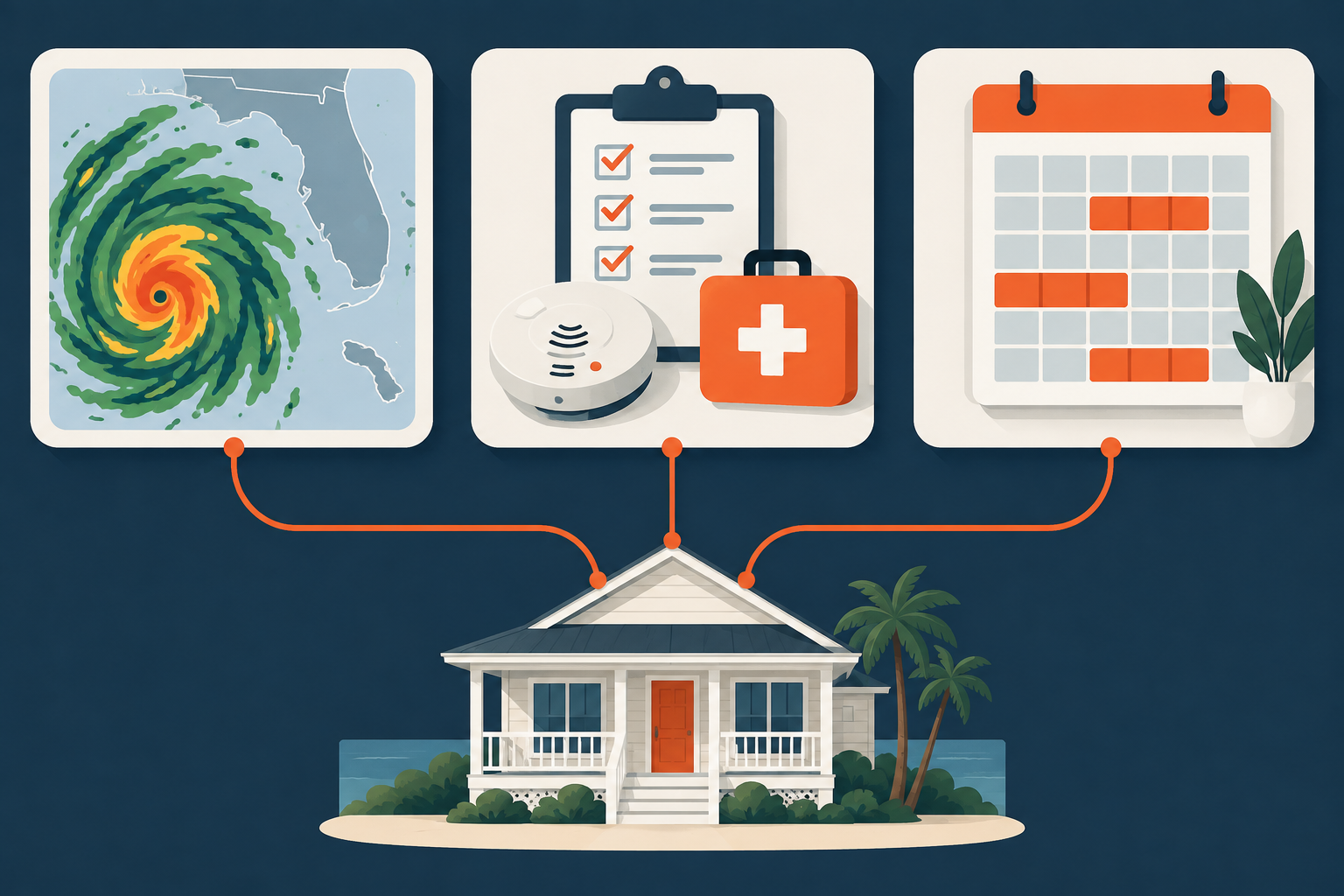
You can prepare an STR for disaster-displacement stays with 3 systems built on general AI assistants and free public data: a market-risk and demand monitor, a property-readiness file, and a revenue mix that accepts 30+ day furnished stays. Setting all 3 up takes most operators one focused weekend plus under 30 minutes a week to maintain, and none of it requires buying a special "disaster AI" product.
I'll admit something first. When I was introduced to AI, I thought it was another shiny tech distraction. "Why complicate things?" I said. "Manual research works fine." Then I watched a chat assistant summarize a year of federal disaster declarations for my county in about ten minutes, a job that used to eat an afternoon.
An earlier version of this article described 3 "AI tools" with product-style names and promised premium rates. Those were not real products, and the rate claim had no data behind it. This rewrite replaces them with what I actually recommend after 18+ years in real estate and STR work since 2016: 3 systems you build yourself, with the public data and caveats spelled out. If you want the market side (who pays for displaced families and why), read the sister piece on the disaster housing opportunity.
Why Most Operators Miss Displacement Demand
When a hurricane, wildfire, or flood hits a market, the same pattern repeats:
Manual research takes weeks while displaced families sign leases elsewhere.
Paperwork (insurance certificates, W-9s, safety documentation) is missing when an adjuster or housing coordinator asks for it.
The listing only accepts 2-5 night stays, so a family needing 60 nights never sees it.
Pricing rules built for vacation weekends either scare off long stays or look like gouging.
None of those are AI problems. They are preparation problems. AI assistants help because they compress the research and document drafting from days into an hour, which means you do the work before the storm instead of during it.
The operators who get these bookings are not faster during the emergency. They finished the boring setup months earlier.
System 1: Market-Risk and Demand Monitoring
The first system answers one question: what disasters are realistic in my market, and when would displacement demand show up?
You do not need a paid scanner for this. Three free public sources cover most of it:
OpenFEMA disaster declarations data (fema.gov/openfema). It lists every federal declaration by state, county, incident type, and date. Download the county rows for your market and ask an AI assistant to summarize incident types by month.
FEMA National Risk Index (hazards.fema.gov/nri). It scores counties and census tracts by natural hazard risk, so you can see whether your exposure is mostly hurricane, riverine flood, wildfire, or winter storm.
The National Hurricane Center and National Weather Service. Atlantic hurricane season runs June 1 to November 30 each year, per the National Weather Service. During that window, check the tropical outlook weekly.
Here is how I use an AI assistant on top of those. Paste the declaration export into the chat and ask: "Group these declarations by incident type and month. Which months had the most declarations in the last 20 years?" Then ask for a one-page watch plan. The assistant is doing summarization, not forecasting. Treat any "prediction" it offers as a guess, and check its counts against the raw file before you trust them.
What this system produces:
A 12-month risk calendar for your county.
A weekly 10-minute check during your peak-risk months.
A short list of the neighboring counties your guests would likely be displaced from, since displaced families often relocate 20-60 minutes away from damaged neighborhoods (an assumption to test locally, not a published figure).
Failure mode: operators build the calendar once and never look at it again. Put the weekly check on your actual calendar.
System 2: Property Readiness and Documentation
The second system makes the property bookable by an insurance adjuster, a housing placement company, or a family with a claim number on the first phone call.
Start with safety. The U.S. Fire Administration recommends smoke alarms inside and outside each sleeping area and on every level, tested monthly, with 9-volt batteries replaced at least once a year and the whole alarm replaced every 10 years. Dual-sensor alarms start at about $24 on USFA's own price guide. Add a carbon monoxide alarm near sleeping areas if you have gas appliances or an attached garage, and a fire extinguisher in the kitchen.
Then build the documentation folder. I keep one shared folder per property with:
Current insurance declarations page showing coverage for rental use.
W-9 and business entity details, since placement companies pay businesses.
Photos of every room dated this quarter, plus a floor plan with bed counts.
Local permit or registration number, if your city requires one.
A one-page property sheet: address, bedrooms, beds, accessibility, pet policy, parking, and distance to schools and grocery.
An AI assistant earns its keep here by drafting the property sheet from your listing text, turning your photos into a room-by-room inventory, and building a maintenance reminder list with dates. Ready.gov publishes home and business preparedness checklists that make a good starting prompt for the property's own emergency plan.
Failure mode: an expired insurance page. Adjusters and placement companies ask for current documents, and a stale one stalls the booking.
System 3: A Revenue Mix That Accepts Displacement Stays
The third system is the one the old version of this article got wrong. The same property can serve vacation guests, traveling professionals, and displaced families, but the money for displaced families comes through specific channels.
Get the payment flow right first:
Insurance Additional Living Expense (ALE). When a homeowner's policy includes loss-of-use coverage, the insurer pays for temporary housing. Payment may go to the policyholder or directly to a housing placement company, depending on the carrier.
FEMA rental assistance pays eligible survivors, not hosts. You do not contract with FEMA by listing on a platform. The survivor rents from you like any other tenant.
SBA disaster loans help homeowners, renters, and businesses in declared areas repair damage. They are a reason displaced owners may stay longer while repairs are financed, not a payment you receive.
So the operator's job is to accept 30+ day furnished stays at a fair monthly rate, list where displaced families and placement coordinators look, and invoice cleanly.
The comparison below is an illustrative example for a 2-bedroom unit, not market data. Plug in your own numbers.
Scenario (illustrative) | Math | Monthly gross | Turnovers |
|---|
Nightly STR, 60% occupied at $150 | 30 × 0.60 × $150 | $2,700 | about 6 |
Furnished 30-day stay at $3,000 flat | 1 × $3,000 | $3,000 | 1 |
Difference | $3,000 − $2,700 | $300 | 5 fewer |
The point is not that displacement stays pay more. Sometimes they pay less than a peak vacation month. The point is fewer turnovers, lower cleaning cost, and a filled calendar in a period when leisure travel to a damaged area drops.
Ask your AI assistant to model your own version: your ADR, occupancy, cleaning fee, and platform fee versus a flat monthly rate. Then decide the floor rate you would accept for a 30, 60, or 90-day stay. For taxes, IRS Publication 527 covers how residential rental income and expenses are reported, and stays of 30+ days can change local lodging tax treatment. Confirm with your CPA and city.
The Setup Process: Building All 3 Systems in One Weekend
This is the order I recommend. Each step assumes a general AI assistant (any major chat assistant works) and a shared folder.
Pull your county's disaster declaration history from OpenFEMA and ask the assistant to group it by incident type and month.
Look up your county and census tract in the FEMA National Risk Index and note the top 3 hazards.
Build a 12-month risk calendar and set a weekly 10-minute check during peak months (June 1 to November 30 for Atlantic hurricane markets).
Walk the property with the USFA smoke alarm guidance in hand: alarms in and outside sleeping areas, every level, test monthly, and note manufacture dates.
Assemble the documentation folder: insurance declarations page, W-9, dated photos, floor plan, permit number, and property sheet.
Have the assistant draft a one-page property sheet from your listing, then correct every fact by hand.
Model a 30-day, 60-day, and 90-day rate against your nightly numbers and write down your floor.
Turn on monthly stays in your listing settings and set a monthly discount that still clears your floor.
Write a price-gouging rule for your business: no rate increases after a declaration beyond what your state allows.
Put a quarterly reminder on your calendar to refresh photos, insurance, and alarm checks.
The table below shows the maintenance rhythm once setup is done.
System | Main public input | Review cadence | Time per review |
|---|
Market-risk monitor | OpenFEMA, National Risk Index, NHC outlook | Weekly in peak months | 10 minutes |
Property readiness | USFA alarm guidance, insurance page | Monthly alarm test, quarterly file refresh | 30 minutes |
Revenue mix | Your ADR, occupancy, and floor rate | Monthly | 20 minutes |
Add those up: 10 minutes a week, plus roughly 50 minutes of monthly work (30 for the property check, 20 for the revenue review), which lands near 25 minutes a week, or about 1.5 hours a month, in peak season.
Price Gouging and Ethics in Declared Emergencies
Many states have price-gouging laws that activate when a governor or the President declares an emergency. They typically cap increases on essential goods and services, and lodging is often included. The caps, durations, and definitions vary by state, so read your own state attorney general's guidance before a season starts, not during one.
My rules for operators:
Do not raise rates after a declaration. Set displacement pricing in advance and keep it.
Turn off automated demand-based pricing surges for your market while a declaration is active, or cap them manually.
Put the monthly rate in writing and do not change it mid-stay.
Describe the property accurately. The FTC's business guidance on truthful advertising applies to your listing the same way it applies to any business.
Displaced families remember who treated them fairly. So do adjusters who place dozens of families a season. The reputation you build in one bad week will do more for your business than a surge rate ever could.
Where AI Helps and Where It Does Not
After using these systems, I get the appeal. Automation is not about replacing judgment. It is about having better information faster.
AI assistants are good at:
Summarizing long government data exports.
Drafting property sheets, inventories, and emails to placement coordinators.
Running rate comparisons you describe in plain English.
Building checklists and reminder schedules.
They are bad at:
Knowing current law in your city or state.
Forecasting a specific storm or wildfire.
Verifying insurance coverage or tax treatment.
Getting facts right without a source. Check every number an assistant gives you against the original file.
If you want help deciding whether displacement stays fit your market and portfolio, book a complimentary one-on-one diagnostic call. It is free. If we find a fit, the $997 action plan maps the setup to your specific properties.
Talk soon,
J. Massey
Frequently Asked Questions
Are there real AI tools built specifically for disaster-displacement STR bookings?
Not in the way the earlier version of this article implied. What works is a general AI assistant applied to free public data like OpenFEMA declarations and the FEMA National Risk Index. Be skeptical of any product claiming to predict disasters or guarantee premium rates.
Does FEMA pay STR hosts directly for housing displaced families?
No. FEMA rental assistance is paid to eligible survivors, who then rent housing like any other tenant. Hosts get paid by the guest, by an insurance carrier through ALE, or by a housing placement company working for the carrier.
How long do disaster-displacement stays usually last?
It depends on the damage and the repair timeline. Many placements run 30 days or longer, which is why accepting monthly stays is part of System 3. Model 30, 60, and 90-day rates so you are ready for any of them.
Can I raise my rates after a disaster declaration?
Be very careful. Many states have price-gouging laws that apply to lodging during declared emergencies, with caps and penalties that vary by state. Set your displacement pricing before hurricane or wildfire season and do not raise it after a declaration.
What safety equipment do I need before accepting displacement stays?
At minimum, follow USFA guidance: smoke alarms inside and outside each sleeping area and on every level, tested monthly, and replaced every 10 years. Add carbon monoxide alarms where you have fuel-burning appliances, and a kitchen fire extinguisher. Check your local code for anything stricter.
Do 30+ day stays change my taxes?
They can. Many cities and states exempt stays of 30 days or more from lodging tax, and the rental may be reported differently than a short-stay property. IRS Publication 527 covers residential rental reporting, but confirm your situation with a CPA.
Sources
Related Reading