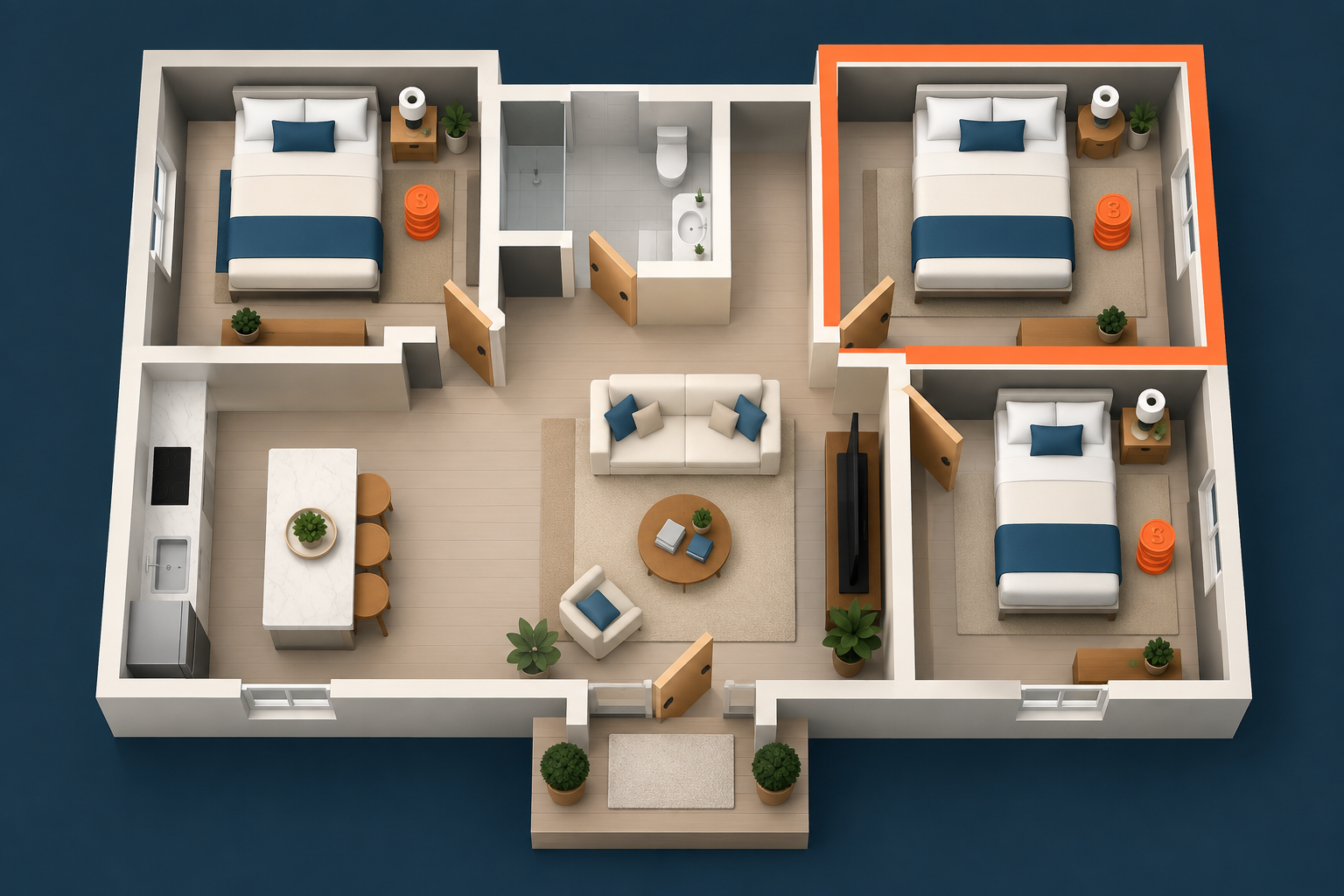
Most hosts run their rentals like real estate charities because they never set a per-bedroom revenue target. The benchmark I use at Cashflow Diary is $800 net profit per bedroom per month, so a 3-bedroom property should clear $2,400 net a month, and if yours doesn't, you need to know exactly why.
That $800 figure is our operator benchmark, not an industry statistic. It's a target I've used since I moved my own real estate business toward short-term rentals in 2016, and it's the number we test properties against when we work with operators. Some markets beat it. Some can't reach it. The point is to have a number at all.
I see it over and over. A host asks "How much can this property make?" as if the answer comes from a lottery drawing. That's hope-and-pray thinking, and the bank account usually shows it.
Last updated: September 2026
Why a Per-Bedroom Target Beats "How Much Can This House Make?"
Real operators think per bedroom. They know what each sleeping space needs to generate to hit their numbers.
Optimists think per property. They assume a house will make more than an apartment because it's bigger. Size doesn't pay the bills. Bedrooms are what guests book, what sets the occupancy limit, and what your cleaning, linen and supply costs scale with. When you divide profit by bedrooms, you can compare a 2-bedroom condo to a 5-bedroom house on the same scale.
A per-bedroom target does three jobs:
It gives you a pass/fail test before you sign a lease or make an offer.
It shows you which of your existing units are pulling their weight and which are subsidized by the others.
It turns "we're doing pretty good" into a gap you can measure in dollars.
Currency Is Not Competency
Making money for eight years on one property doesn't mean you understand the business, especially when it comes to scale. A lot of hosts started when interest rates were low and the platforms were spending heavily to bring guests to every listing. Good timing and a good location can carry one property for a long time.
The test is simple: can you repeat your results across several properties in different markets? If you can't explain your numbers per bedroom, you probably can't repeat them either.
The $800-per-Bedroom Math, Worked for 1 to 5 Bedrooms
Start with a 3-bedroom, because it's the example that makes people push back.
Target: $800 net per bedroom per month
Monthly net: $800 × 3 = $2,400
Required gross at a 30% profit margin: $2,400 ÷ 0.30 = $8,000 per month
Annual: $8,000 × 12 = $96,000 gross, and $2,400 × 12 = $28,800 net
Most people's first reaction is "that's impossible." My response is that this reaction is usually why they're stuck. The benchmark exposes how much you've been leaving on the table while telling yourself things are fine.
The table below runs the same formula (net ÷ 0.30 margin) for properties from one to five bedrooms, with monthly gross rounded to the nearest dollar (annual figures use the unrounded monthly amount).
Bedrooms | Monthly net target | Monthly gross needed (30% margin) | Annual gross | Annual net |
|---|
1 | $800 | $2,667 | $32,000 | $9,600 |
2 | $1,600 | $5,333 | $64,000 | $19,200 |
3 | $2,400 | $8,000 | $96,000 | $28,800 |
4 | $3,200 | $10,667 | $128,000 | $38,400 |
5 | $4,000 | $13,333 | $160,000 | $48,000 |
The 30% margin is an assumption, and your margin drives the gross you need more than anything else. Here is how the required gross moves for the same 3-bedroom, $2,400-net target when your margin is higher or lower.
Profit margin | Monthly gross needed (3BR, $2,400 net) | Annual gross needed | Change vs. 30% margin |
|---|
20% | $12,000 | $144,000 | +$4,000 per month |
25% | $9,600 | $115,200 | +$1,600 per month |
30% | $8,000 | $96,000 | Baseline |
35% | $6,857 | $82,286 | −$1,143 per month |
Read that second table carefully. Going from a 20% margin to a 30% margin drops the gross you need by $4,000 a month. That's why cutting waste and platform costs can matter as much as raising rates.
To turn monthly gross into a nightly rate, divide by booked nights. As an illustration only: if a 3-bedroom books 21 nights in a 30-day month (70% occupancy), $8,000 ÷ 21 works out to about $381 per night, including the cleaning fees you collect. At 24 booked nights it's about $333. Plug in your own occupancy, not someone else's.
Net here means what's left after every operating cost: rent or mortgage, utilities, cleaning, supplies, platform fees, software, repairs, insurance and lodging taxes you owe. IRS Publication 527 lists the kinds of rental expenses you track, and it's a good checklist for making sure your "net" isn't flattering you. If you provide hotel-style services, the same publication explains why your income may belong on Schedule C instead of Schedule E, so run the tax side past your CPA.
Three Operating Gaps That Keep Hosts Below Target
Most hosts who miss the $800 mark aren't missing it because of the house. They're missing it because of how the house is run. These are the three gaps I see most often.
Gap 1: Slow, Generic Guest Messaging
If an inquiry sits for hours, the guest keeps shopping. Airbnb measures this directly. Your response rate is the share of new inquiries and reservation requests you answered within 24 hours over the past 30 days, and letting a request expire counts against you. To earn Superhost status, you need to respond to 90% of new messages and accept or decline new requests within 24 hours.
Twenty-four hours is the minimum Airbnb will accept. In my own properties, fast answers have made the difference on higher-value bookings, because the guest who gets a clear, specific reply first tends to stop looking. Set up saved replies and scheduled messages for the questions you answer every week, then write the first line yourself so it doesn't read like a form letter. Response time is a revenue number. Track it like one.
Gap 2: No Marketing System Outside the Platform
Most hosts have no CRM, no plan for repeat guests, no referral system and no path to direct bookings. They depend entirely on the platform, and they pay for it. Airbnb's help center says most hosts on the split-fee structure pay a 3% host service fee, while most hosts on the single-fee structure see 15.5% deducted from their payout. Those fees are part of your cost structure whether you think about them or not.
The operators who hit their per-bedroom targets have a deliberate way to bring past guests back and to generate referrals. Everyone else has hope and the search algorithm.
Gap 3: No Guest Contact List
The platform gives you contact details for the person who booked, inside its messaging system. That's it. If six people stayed, you know one of them.
Build a list you own. Collect name, email and phone number from guests who opt in, through your house manual, a guest Wi-Fi login page, or a welcome form. Tell people what you'll send them and follow your platform's rules and privacy laws. Some operators offer a free basic Wi-Fi tier and a faster paid tier, which makes the sign-up page earn its keep. A list of past guests is the cheapest marketing asset you'll ever have.
Pick One Guest and Build the Listing Around Them
Your listing tells a story, and most hosts try to make it a romantic comedy and a horror film at the same time.
They write descriptions aimed at business travelers, families, couples and groups all at once. They post generic photos that could be anyone's property anywhere. The result is that nobody thinks the place is for them.
Pick a lane and commit. If you want families with young kids, put a stroller, a pack-and-play and a high chair in your first five photos. If it isn't in the photos, it doesn't exist in the guest's mind. Many guests never read the description closely.
When a family sees that gear, they think "this place is for us" and they stop shopping. You've removed their decision fatigue, which is what lets you hold a premium rate. Build the stay your target guest believes was designed for them, and price it that way.
Pricing tools help once the positioning is right. Airbnb's Smart Pricing adjusts your nightly price based on demand within the minimum and maximum you set, so set those limits from your per-bedroom math, not from a guess. A tool can't fix a listing that's trying to please everyone.
Past Guests, Direct Bookings and the Cleaning Fee
Everyone assumes the fastest path to $800 per bedroom is a pricing trick or a renovation. In my experience it's usually sitting in your list of past guests.
Email Every Past Guest
Send a note to everyone who's stayed with you. Ask for referrals and give them a reason to book direct next time, such as a returning-guest rate or a free late checkout. Past guests already know and trust the property. Every direct booking avoids the platform's service fee on that stay, and that margin goes straight into your per-bedroom number.
Most hosts don't do this because they're afraid of bothering people who paid them money and had a good stay. That's poverty thinking dressed up as politeness.
Stop Treating Cleaning as Cost Recovery
Many hosts set the cleaning fee at exactly what the cleaner costs. Say your turnover costs $75 and you charge $75, you break even on every stay. Price it at $125 to $175 and you add $50 to $100 per booking, assuming your market will bear it. Check competing listings with the same bedroom count before you move it.
Price the fee on the value of a clean, well-stocked home, not only on what you pay the cleaner. Guests who want a premium stay understand premium pricing. Guests who shop only on price tend to complain regardless. Choose your customer and price for them.
When $800 per Bedroom Isn't Realistic
Two things can put the target out of reach in a given market.
Regulation
Local rules that cap nights, limit permits, or add heavy operating requirements can shrink the number of bookable nights. Check your city and county code before you underwrite, and assume rules can change after you buy or sign a lease.
Extreme Seasons
Desert summers and northern winters can cut a market's demand window to a few good months a year. Your 12-month average has to carry those empty months.
The Pivot: Longer Stays
When either happens, shift to stays of a month or longer. Extended stays are the original version of this business, and in my own portfolio they've often produced better net per bedroom than a half-empty short-term calendar, thanks to fewer turnovers and lower cleaning and supply costs. The catch is marketing. Traveling nurses, relocating families and insurance placements find housing differently than vacationers, and most hosts haven't built that skill because platform traffic spoiled them. Run the same per-bedroom math on a monthly rate before you decide.
Steps to Set Your Own Per-Bedroom Target
Use this process for every property you own or are considering. Do it with real numbers from your books, not your listing dashboard.
Pull 12 months of actuals. Export gross revenue, including cleaning fees you collected, and every operating expense for the last 12 months. If a property is newer, use what you have and flag it.
Calculate your real net. Subtract every cost, including platform fees, supplies, repairs, software and lodging taxes. Use the IRS Publication 527 expense categories as a checklist.
Divide by bedrooms and by 12. Annual net ÷ bedrooms ÷ 12 gives you your current net per bedroom per month. Write it down next to the $800 benchmark.
Find your margin. Divide annual net by annual gross. Compare it with the sensitivity table above to see how much gross you'd need at your margin.
Set your target. Start with $800 net per bedroom per month and adjust for your market's regulation and seasonality. Write the monthly and annual gross it requires.
Convert to a nightly rate. Divide monthly gross needed by the nights you realistically book. Use that to set your minimum and maximum prices.
Pick the biggest gap. Choose one fix this month: response time, guest list, target guest, past-guest email, or cleaning fee. Don't try all five at once.
Review every quarter. Recalculate net per bedroom each quarter. If a property stays well under target for two quarters, decide whether to reposition it, move it to longer stays, or exit.
If you'd like a second set of eyes on your numbers, book a complimentary one-on-one diagnostic call. The diagnostic is free. If it makes sense afterward, we can build a written $997 action plan for your specific properties.
What's your current per-bedroom number, and what's the main reason you're below $800? Do the math before you answer.
Frequently Asked Questions
Is $800 net per bedroom per month an industry standard?
No. It's Cashflow Diary's own operator benchmark, a target we use to test properties. It isn't a published industry statistic. Some markets beat it, and some can't reach it because of regulation or seasonality.
How much gross revenue does a 3-bedroom need to hit $800 per bedroom?
At a 30% profit margin, a 3-bedroom needs $8,000 in monthly gross to net $2,400. That's $96,000 gross and $28,800 net per year. At a 25% margin the gross rises to $9,600 a month.
Should cleaning fees count toward my per-bedroom revenue?
Yes, count them as gross revenue and count your cleaning costs as expenses. What matters is the net left after both. Keeping them in the same books shows whether your cleaning fee makes or loses money.
How fast do I need to reply to Airbnb guests?
Airbnb's response rate counts inquiries and requests you answer within 24 hours, and Superhost status requires responding to 90% of new messages within 24 hours. Treat that as the minimum. Faster, specific replies keep guests from continuing to shop.
What if my market can't support $800 per bedroom?
Run the numbers on stays of a month or longer before you give up on the property. Fewer turnovers usually mean lower cleaning and supply costs. If the property still can't come close after two quarters, consider repositioning it or exiting.
Does Smart Pricing replace a revenue target?
No. Airbnb's Smart Pricing adjusts your nightly price with demand, but only within the minimum and maximum you set. Your per-bedroom target tells you where those limits belong.
Sources
Related Reading