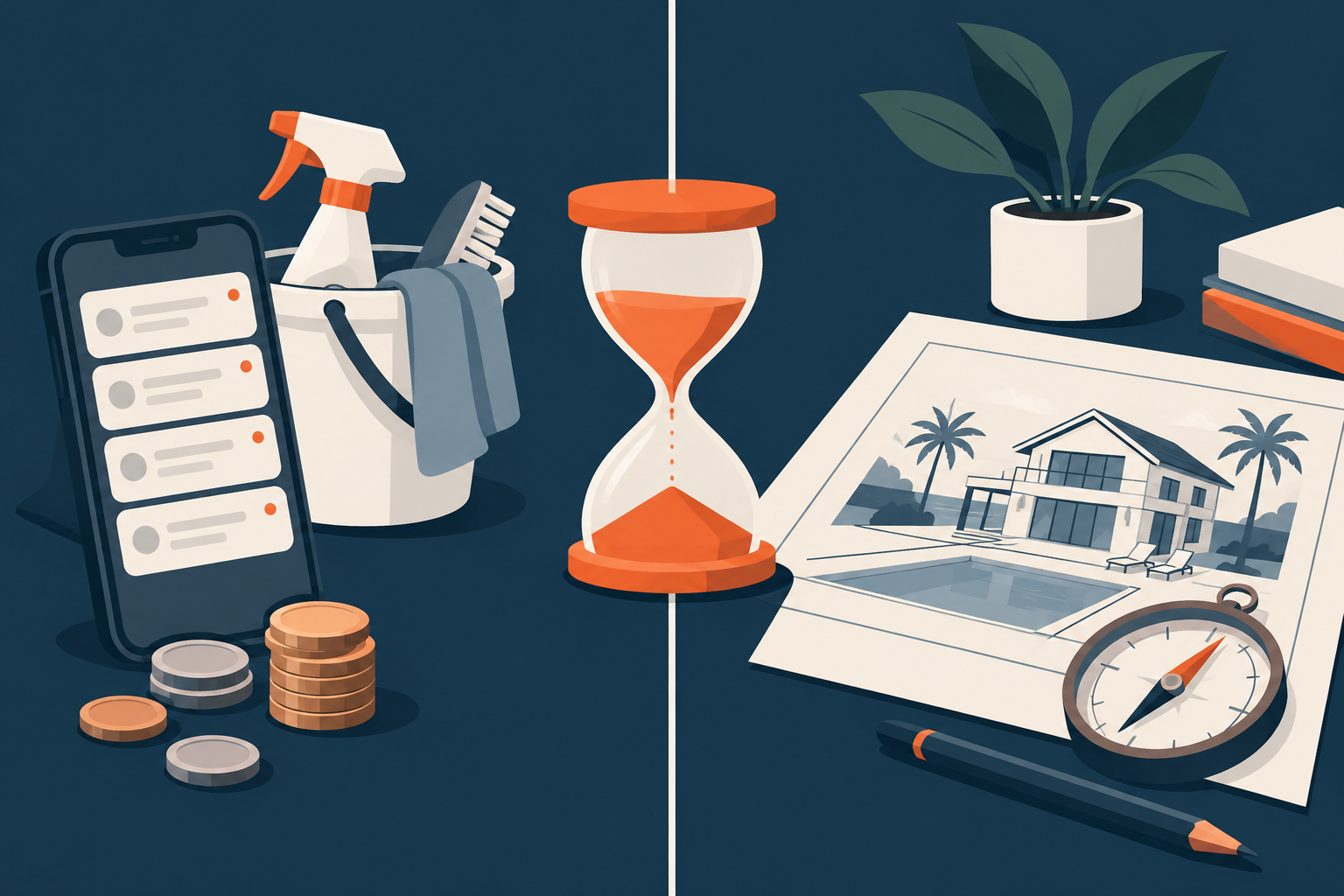
You're doing $2/hour work because you have never put a price on your own hour, so a guest text about towels feels as urgent as a pricing decision worth thousands. By my rough math, checking messages 47 times a day at about 2 minutes a check cost me around 94 minutes daily, roughly 47 hours a month, while the illustrative pricing math below puts an hour of rate work above $200.
That gap is the whole article. Below is how I price an hour, which short-term rental tasks land on which side of the line, and the 3-bucket sort I use to hand off everything that doesn't need me.
The Night I Figured Out What My Business Hired Me To Do
Let me tell you about the moment I realized I was failing at the job my STR business had hired me to do.
It was 11:47 PM and I was sitting in my car outside a property. I was texting a guest who couldn't figure out the smart lock while trying to remember whether this was the house with the finicky AC unit or the one where the neighbors complain about noise after 10 PM. My phone kept buzzing with messages from two other properties, and I had that sinking feeling that I was forgetting something.
Here is what the business had actually hired me to do: keep the properties filled with happy guests who pay good rates and leave 5-star reviews, while I focus on growth instead of daily fires.
Here is what I was doing instead: checking messages 47 times a day across 3 platforms and making the same decisions over and over.
The problem wasn't that I was bad at property management. The problem was that my brain was doing work that should have been written down, templated, or handed to someone else. I was the most expensive person in the business, and I was spending most of my day on the cheapest work in it.
Most operators I've trained live in the same pattern:
Mental load. Every guest message triggers a small spike of anxiety because the history lives in your head, not on paper.
Context switching. You jump between properties and lose the thread each time.
Decision fatigue. By the time a real pricing or investment decision shows up, you've already spent your good judgment on lockbox codes.
Vacation anxiety. You can't take time off because "what if something happens?"
It's a pricing problem. You haven't decided what your hour is worth, so you can't tell which tasks are beneath it.
How to Price Your Hour Before You Sort Anything
You need two numbers: what your hour costs and what your hour can earn. The first sets your floor for delegation. The second tells you where to spend the time you free up.
Step one: your floor rate. Pick the annual amount you want the business to pay you for your time, separate from the return on your capital. Divide it by the hours you actually work. For this example, say you want $60,000 a year for your labor and you work 25 hours a week on the portfolio. That's 25 × 52 = 1,300 hours a year, and $60,000 ÷ 1,300 = about $46 an hour. Any task you could hand off for less than $46 an hour, with no drop in quality, is costing you money every time you do it yourself.
Step two: your strategic rate. This is what an hour of decision-making produces. Here is an illustrative example from the kind of portfolio I ran early on: 3 properties at 70% occupancy. That's 3 × 365 × 0.70 = about 767 booked nights a year. If a few focused sessions reviewing comps, event calendars, and minimum-stay rules lift your average nightly rate by $10, that's 767 × $10 = $7,670 a year. If that work takes 30 hours spread over the year, it earned $7,670 ÷ 30 = about $256 an hour.
Step three: your $2/hour trap. Now price the stuff you do on autopilot. You notice the toilet paper is low at one property and drive to the store instead of adding it to a scheduled delivery. The round trip takes 90 minutes and saves maybe a $3 delivery fee. That's $3 ÷ 1.5 hours = $2 an hour. Or take my own message habit, using a rough estimate: 47 checks a day at about 2 minutes each is 94 minutes a day, which is 94 × 30 = 2,820 minutes, or 47 hours a month. If most of those checks produced nothing new, that time earned close to zero.
Here is the same arithmetic side by side, so you can swap in your own numbers:
Activity (illustrative) | Hours | Dollar result | Effective hourly value |
|---|
Supply run to save a delivery fee | 1.5 | $3 saved | $2 |
Checking messages with nothing new (per month) | 47 | about $0 | about $0 |
Your floor rate ($60,000 ÷ 1,300 hours) | 1,300 per year | $60,000 | $46 |
Rate review across 3 properties (per year) | 30 | $7,670 added | $256 |
The point isn't the exact figures. The point is that once the table exists, you stop arguing with yourself about whether to hand off the supply run. The math already made the call.
Which STR Tasks Are $2/Hour and Which Are $200/Hour
Most STR tasks fall into three groups. Some are pure repetition, the same message or the same adjustment every time. Some need a person but not you, as long as that person has the right instructions. A small number need your judgment because the downside of getting them wrong is large or the decision is hard to undo.
This table sorts the tasks I see most often by bucket and by rough value of your time spent on them:
Task | Bucket | Your time's value on this task |
|---|
Booking confirmations with property details | Automate | About $2/hour or less |
Check-in instructions 24 hours before arrival | Automate | About $2/hour or less |
Check-out reminders and review requests | Automate | About $2/hour or less |
Routine rate adjustments by demand | Automate | Low once rules are set |
Early check-in requests | Template | Below your $46 floor |
Noise complaints | Template | Below your $46 floor |
Maintenance triage and vendor scheduling | Template | Below your $46 floor |
Local recommendations for guests | Template | Below your $46 floor |
Pricing for special events | Strategic | $200+/hour |
Major guest disputes and damage claims | Strategic | $200+/hour |
Property improvement spending | Strategic | $200+/hour |
New markets, new doors, partnerships | Strategic | $200+/hour |
Notice that routine pricing sits in Automate while event pricing sits in Strategic. The same category of work can live in two buckets. Setting the rules for your demand-based pricing tool is strategic. Letting the tool apply those rules every night is not.
The 3-Bucket System: Automate, Template, Strategic
I call the full setup the Cognitive Operating System v6. That's just my name for it. It's a set of habits and documents, not software. The center of it is the 3-bucket sort.
Bucket 1: Automate. These are tasks where the right answer is the same every time. Booking confirmations, check-in instructions sent 24 hours before arrival, check-out reminders, post-stay review requests, and basic rate adjustments based on demand. Your channel manager or messaging tool can send these on a schedule. You write them once, test them once, and review them each quarter.
Bucket 2: Template. These are common situations that need a human but follow a pattern. Early check-in requests get a decision tree. Noise complaints get apology, solution, follow-up. Maintenance issues get assess, temporary fix, schedule repair. Local-area questions get a curated recommendation list. Cleaning concerns get immediate response, resolution, and a defined compensation range. Once each has a written path, a virtual assistant, co-host, or cleaner-lead can run it without calling you. This is the delegate bucket.
Bucket 3: Strategic. These are decisions where your judgment is the product. Major guest disputes, pricing for special events or unusual circumstances, property improvement investments, new market opportunities, and partnership negotiations. You keep these.
The goal: you only touch Bucket 3. Everything else runs without your constant input.
A few conditions decide whether a task can move out of your hands. It must happen often enough to be worth documenting, generally at least a few times a month. The right answer must be describable in writing. And the cost of a wrong answer must be small and reversible. A Wi-Fi question passes all three tests, so it leaves your plate. A $1,200 damage claim fails the third, so it stays with you.
When you hand Bucket 2 work to people, how you engage them matters. The IRS looks at behavioral control, financial control, and the relationship between the parties to decide whether a worker is an independent contractor or an employee. If you dictate hours, tools, and methods for a full-time assistant, read that guidance before you assume a 1099 is correct.
The Property Context Card That Makes Delegation Possible
You can't delegate what only exists in your head. The fix is a one-page context card for each property. When a guest messages, whoever answers pulls the card instead of calling you. Great property managers don't treat every situation as new. They keep guest histories, remember which property has which quirk, and plan around seasonal patterns. The card does that for you.
Build each card with four sections:
Property quirks. Wi-Fi password, known issues, booster locations. Thermostat quirks and seasonal limits, such as "this AC struggles when it hits 85 degrees." Hot water recovery time. Neighbor noise sensitivity and contact info.
Guest patterns. Peak seasons and typical stay lengths. Common requests like early check-in and late checkout. Frequent issues with the fix that worked. Repeat guests and their preferences, such as "this guest always books last-minute and needs early check-in."
Maintenance notes. Preventive schedule for HVAC, plumbing, and deep cleans. Vendor contacts for the plumber, electrician, cleaner, and landscaper. Warranty dates. After-hours emergency contacts and backup plans.
Revenue notes. Best rate periods and local events. Upsell options. Cost reduction ideas for utilities and supplies. What guests mention in 5-star reviews.
Start with your most difficult property. It will produce the longest card and the biggest drop in interruptions.
To keep cards current, use voice memos. Record notes while you walk a property after a turnover and have someone transcribe them into the card weekly. That one habit turns what you learn into something your team can use instead of something you forget by Friday.
The 30-Day Delegation Playbook
This is the order I'd follow if I were starting over with 3 properties and no help. Each week has one job.
Week 1, capture. Write down your 7 most common guest interactions word for word. Create a context card for each property. Log every task you do for 5 working days with the minutes it took.
Week 1, price. Run the hourly math from earlier with your own income target and hours. Mark every logged task as above or below your floor rate.
Week 2, sort. Put every logged task into Automate, Template, or Strategic. If a task is below your floor rate and repeats, it cannot stay with you.
Week 2, automate. Set up scheduled messages for confirmations, check-in instructions, check-out reminders, and review requests. Send a test booking through each one.
Week 3, template. Write a decision tree for each of your 7 common scenarios. Include what the helper is allowed to spend or refund without asking, in dollars.
Week 3, hand off. Give Bucket 2 to one person, whether a VA, a co-host, or your lead cleaner. Share the context cards and templates, and set one daily check-in time instead of constant pings.
Week 4, review. Read every message thread your helper handled. Fix the templates that produced a follow-up question. Track how many times you were interrupted compared with Week 1.
Week 4, reinvest. Block 2 hours a week on your calendar for Bucket 3 work only: rate reviews, improvement budgets, and your next acquisition.
Keep a record of what you pay each helper. IRS Publication 527 says you can deduct the ordinary and necessary expenses of managing, conserving, or maintaining rental property, and clean records make that easier to support at tax time.
Step 8 is where the $200/hour shows up. Freeing time does nothing if the time goes back into checking messages.
Where Delegation Goes Wrong
I've watched a lot of operators try this and slide back into doing everything themselves. The failure modes repeat.
Handing off before writing it down. If your helper has to ask you how to handle an early check-in, you haven't delegated, you've added a middle step. Write the template first.
No spending limit. Helpers freeze or overspend when they don't know what they can approve. Give a dollar number for refunds, supplies, and vendor call-outs.
Keeping the phone notifications on. If every guest message still lights up your phone, you will answer it. Route guest messages to your helper and review a summary once a day.
Automating something that isn't stable yet. If your check-in process changes every month, a scheduled message will send wrong instructions. Stabilize the process, then automate it.
Treating response metrics as optional. Delegation cannot cost you response time. Airbnb's Superhost criteria include a response rate of at least 90%, and a slow handoff shows up there fast. Check your response rate weekly for the first month after you hand off messaging.
Delegating compliance. Local registration, occupancy taxes, and house rules stay in Bucket 3. Airbnb's own responsible hosting guidance tells hosts to review local laws before listing. That's your job, not your VA's.
The shift is simple to describe and hard to stick with. You move from "I need to remember everything" to "the card remembers everything," and from "I have to handle this" to "the template handles this." Your job becomes what it should have been all along: growing a profitable STR portfolio, not managing daily chaos.
If you want a second set of eyes on where your hours are going, book a complimentary one-on-one diagnostic call. The diagnostic is free. If it makes sense after that, we can build a $997 action plan for your specific portfolio.
Frequently Asked Questions
How do I calculate what my hour is worth as an STR operator?
Divide the annual amount you want the business to pay for your labor by the hours you work in a year. At $60,000 and 25 hours a week, that's $60,000 ÷ 1,300 hours, about $46 an hour. Anything you can hand off below that rate without losing quality should leave your plate.
What are the three buckets in the 3-bucket system?
Automate, Template, and Strategic. Automate covers repeat messages and routine rate rules. Template covers common situations a trained helper can run from a written path, and Strategic covers the judgment calls you keep.
Which STR tasks should I delegate first?
Start with guest messaging that follows a pattern, such as early check-in requests, Wi-Fi questions, and local recommendations. These repeat often, are easy to write down, and a wrong answer is cheap to fix. Keep damage claims and event pricing for yourself.
Is the Cognitive Operating System v6 a software product?
No. It's the name I use for my own set of habits and documents: context cards, the 3-bucket sort, decision trees, and voice-memo capture. You can build it with a shared document and the messaging tools you already use.
Should my virtual assistant be a contractor or an employee?
It depends on how much control you have over how, when, and where the work gets done. The IRS weighs behavioral control, financial control, and the relationship between the parties. Read the IRS guidance or ask your tax professional before you decide.
How long does it take to hand off daily operations?
The playbook above takes about 30 days for a small portfolio: one week each to capture, sort, template, and review. Expect to spend extra time in Week 4 reading your helper's message threads. The time savings usually show up once the templates stop producing follow-up questions.
Sources
Related Reading