
Airbnb's own Privacy Policy gives the platform the right to process your host data to develop and improve its AI, and the page live on airbnb.com today is dated February 5, 2026. The opt-out is real and takes about ten seconds to flip. My read after operating short-term rentals since 2016 and training more than 10,000 operators: flipping it is the wrong move. The data you would withhold is the same data the ranking system uses to decide whose listing a guest sees first, and the actual risk in this story was never the training corpus — it is that most operators still have exactly one way to reach a customer.
Airbnb Now Trains AI on Your Host Data: Why Opting Out Is the Wrong Move
Airbnb's February 2026 privacy update gave the platform the right to train AI on host data. The opt-out exists, but using it removes you from the pool the ranking system rewards. Here is the operator read, plus the off-platform defense.
By J. MasseyMay 20, 2026· 12 min read
Disclosure: This post may contain affiliate links. If you purchase through our links, we may earn a commission at no extra cost to you. We only recommend tools and services J. Massey's team actually uses. Read the affiliate disclosure
Table of Contents
What the Policy Actually Says
I pulled the live policy on September 21, 2026 rather than trusting the secondhand coverage. Here is what Airbnb's Help Center page for the Privacy Policy (last updated February 5, 2026) states in its own words.
Section 4, the opening of "How we use personal information we collect," says the uses described in that section include "using AI technologies that we develop and improve using your personal information." Section 4.2, "Develop and Improve the Airbnb Platform," lists the specific purposes: "perform analytics, debug, and conduct research, develop and improve our AI, develop and improve our products and services, and provide customer service training."
Section 9 points to the control: "if you do not want Airbnb to use your personal information to develop and improve AI models that power certain features on Airbnb, you can set your preferences." Section 11 describes the safeguards, including "de-identifying your personal information prior to developing and improving a model by removing references to your name and other identifying information," encryption, pseudonymization, and restricted internal access.
The companion help page, "AI-powered features on Airbnb," names the features those models drive: search, personalization, customer support (including the AI assistant), host and guest communications, and platform performance research. It also spells out the opt-out path on desktop: Menu, then Account settings, then Privacy, then under Data privacy click "Help improve AI-powered features" to turn data sharing off. A checkmark means it is on.
That is the whole factual basis. Three things I am deliberately not telling you, because I could not confirm them on a primary page today: the size of the review corpus feeding these models, the identity or mandate of any recent executive hire on Airbnb's newsroom, and any figure for what AI-driven matching is supposedly worth per listing. Coverage in spring 2026 carried all three. None of it loads as a first-party statement now, so it does not belong in your decision.
What does belong: the policy language is broad, it is already in force, and the opt-out governs model training — not whether Airbnb collects and uses your operating data to rank you. Those are two different faucets, and only one of them has a handle.
Airbnb Is a Channel, Not Your Business

Most operators panic at policy changes because they have quietly let the platform become the business. I have watched this cycle repeat through Smart Pricing, through the pandemic-era cancellation rewrites, through three rounds of fee restructuring, and now through the AI shift. The reaction is the same every time: read the change as an attack, do something defensive, miss the part that actually moves money.
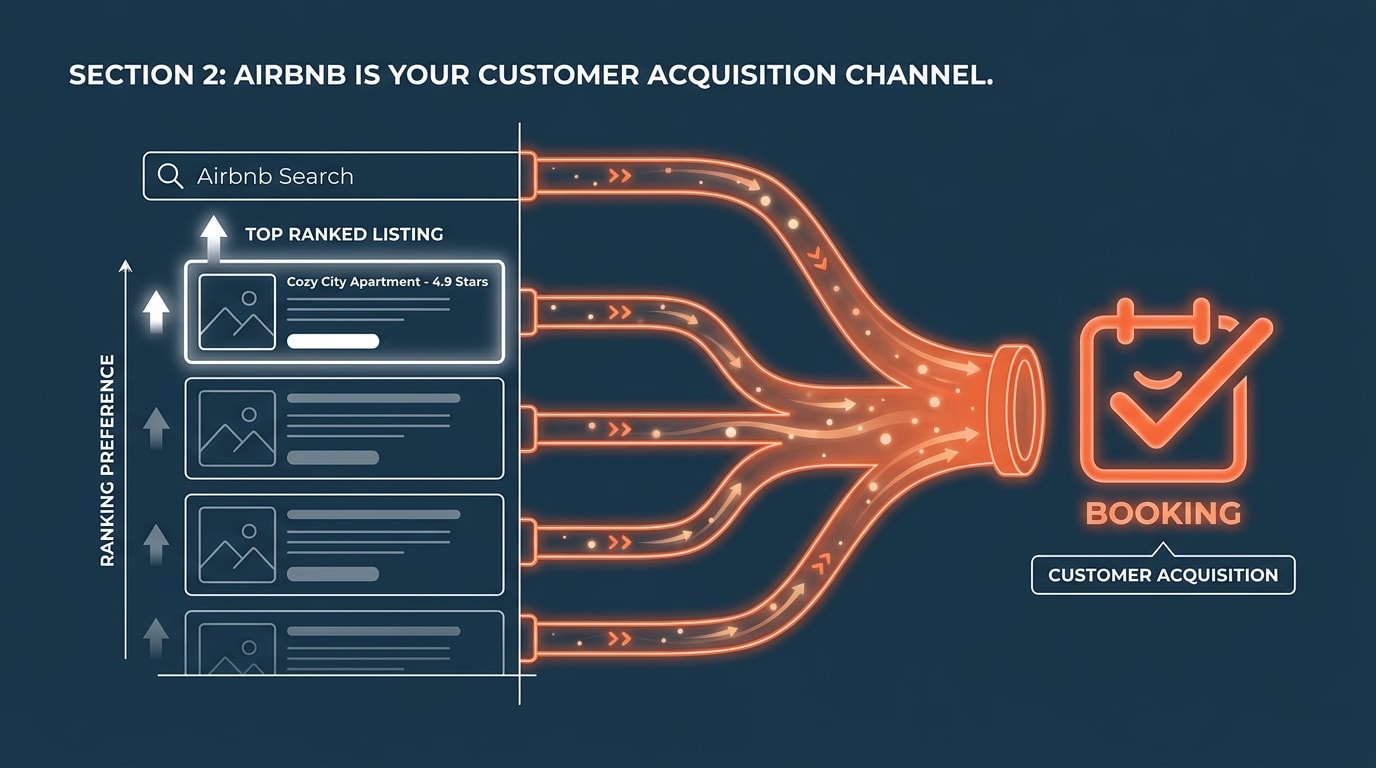
Airbnb is a search engine with a checkout button. Search engines award and withhold visibility according to what they are optimizing for. If you believe Airbnb is your business, training its models on your data feels like theft of an asset. If you understand Airbnb is one customer acquisition channel, the data is the entrance fee for a storefront in the mall — and the real question is what percentage of your annual revenue should depend on any single mall.
"Airbnb is not your business. They're just your customer acquisition."
— J. Massey · CashFlowDiary
That framing changes the decision. You stop asking "how do I protect my data" and start asking "how much of my cash flow is hostage to a ranking system I do not control." For most of the operators I work with, the honest answer in 2026 is somewhere between 80 and 100 percent of bookings. That is the exposure worth fixing this quarter. The privacy toggle is a footnote next to it.
The Three Operator Signals That Move Ranking
Airbnb's own "How search results work" page is specific about what the algorithm weighs, and the AI features sit on top of the same inputs. Read that page before you spend a dollar on tooling. Three of the named factors are inside an operator's direct control.
Response speed. The page states that for listings that are not instantly bookable, the algorithm considers how quickly hosts respond to guest inquiries and how often hosts reject requests to book — and that instantly bookable listings may rank higher because responses are automatic. It also says the algorithm considers Superhost criteria including host responsiveness. Treat replies as a system, not as effort. Templated replies for your top twenty inquiry types, loaded into whatever property management tool you already run, plus instant book turned on for the date ranges you can actually service.
Price against comparable inventory. Airbnb says the algorithm considers total price and how that price compares with other listings in the area for the given dates, and that listings priced below comparable listings with similar capacity and amenities tend to rank higher. This is the signal operators misread most often. It is not "be cheap." It is "know your floor." If you cannot state your true monthly operating cost and your minimum acceptable nightly rate from memory, a pricing tool will happily discount you into a loss while your ranking improves.
Photo and amenity completeness. The same page credits high-quality photos and videos, a full description, and sought-after amenities — it names a crib, hot tub, step-free entrance, and pet-friendly as examples — with improving visibility in searches filtered for those features. My rule from managing units since 2016: if you do not show it, guests assume you do not have it. The pack-and-play, the high chair, the desk with a real chair, the espresso maker. Photograph them individually, tag the amenity in the listing, and you appear in filtered searches you were previously invisible to.
Software handles the first two. The third is judgment, and it is where an owner-operator still beats a portfolio manager running 400 units off a template.
Opting Out: What You Keep, What You Give Up
Here is the tradeoff laid out plainly. This is my operator read of the consequences, not a claim about Airbnb's intentions.
Consideration | Leave data sharing ON (default) | Turn data sharing OFF |
|---|---|---|
Model training on your data | Your pricing, messaging and booking patterns help train the models behind search, personalization and support | Excluded from training for those features |
Ranking inputs | Unchanged — the policy's AI opt-out is separate from how your listing data is used to rank you | Also unchanged; opting out is not a ranking penalty Airbnb publishes |
Personalized and AI-assisted features | Full access as shipped | Features still function; your data stops feeding their improvement |
Named privacy safeguards | De-identification, encryption, pseudonymization, restricted access, per policy Section 11 | Not applicable to training, since training is excluded |
Practical upside | You stay in the pool the platform is optimizing around | A cleaner data-minimization posture if that matters to your counsel |
Practical cost | Data you cannot claw back later | Time spent on a control that does not reduce your real dependency risk |
Who this suits | Operators whose priority is bookings and visibility | Operators with a specific legal, brand or client-data reason to minimize |
Two lines matter more than the rest. First, Airbnb does not publish a ranking penalty for opting out, and I will not invent one — but Airbnb states plainly that it uses these models to improve matching, and the operators whose data feeds that loop are the ones whose behavior the system learns to reward. Second, nothing about the toggle reduces your channel concentration. If you flip it and stop there, you have changed nothing about the risk that actually shows up in a bad quarter.
This is not legal advice. If your business handles guest data under a corporate contract or a jurisdiction with specific consent rules, ask your attorney before you set this preference either way.
How to Decide: A Five-Step Process
Work through these in order. It takes an afternoon.
Read the two primary pages yourself — the Privacy Policy and "AI-powered features on Airbnb" — and write down which sections apply to you. Fifteen minutes. Do not decide from a summary, including this one.
Calculate your channel concentration. Pull last twelve months of revenue by source: Airbnb, Vrbo, Booking.com, direct, repeat guests. Express Airbnb as a percentage of total. Above 70 percent, your diversification work outranks your privacy work.
Set the toggle deliberately. Default to leaving data sharing on unless you have a named legal, contractual or client-confidentiality reason to turn it off. Log the date and reason either way so a future you knows what happened.
Fix the three ranking signals you control. Reply automation live within a week, a written nightly rate floor per property, and one photo per marketable amenity. These pay whether or not the AI story develops further.
Build one off-platform channel to a measurable milestone this quarter — most operators should pick the past-guest email list, because it is free, it is yours, and it converts. Set the milestone as a number of contacts and one send, not as "set up a newsletter."
Nobody finishes step five in a weekend. Finishing step two in an hour is what makes the rest obvious.
Building Demand You Own
Off-platform demand is the only defense that keeps working regardless of what any platform changes. Build it in order of effort-to-payback, not in order of excitement. The figures below are my planning estimates from operator builds, not vendor promises — price any tool on its own live pricing page before you commit, and expect quotes to change.
Build step | Effort | Time to first result | What it protects against | Recurring cost shape |
|---|---|---|---|---|
Export and organize past-guest contacts | Low — one afternoon | Days | Total dependence on platform inbox | Free to low; email tools price per contact tier |
Monthly email to past guests and inquiries | Low — 2 hours/month | 1–3 months | Empty shoulder-season dates | Per-contact monthly fee |
List on Vrbo and Booking.com with a channel manager | Medium — 1–2 weeks | 4–8 weeks | One algorithm deciding your occupancy | Per-listing monthly, or commission per booking |
Direct booking site with real-time calendar and payments | Medium-high — 3–6 weeks | 2–4 months | Platform commission and ranking risk | Monthly subscription plus card processing |
Machine-readable data on your own site (schema for lodging, price, amenities, FAQs) | Medium — 1 week of dev | 1–2 quarters | Being invisible to AI assistants that book on a guest's behalf | One-time build, small maintenance |
Local repeat-demand relationships (relocation, insurance housing, film, medical) | High — ongoing | 1–2 quarters | Seasonality and leisure-travel softness | Time, not software |
That last row produces the bookings nobody can take from you. The schema row is the one operators skip and should not: guests are increasingly starting with an assistant rather than a search box, and an assistant can only recommend what it can parse. Clean, structured, accurate lodging data on your own domain is the 2026 version of being listed in the phone book.
For a longer walk through the channel mix, I have written about reducing Airbnb dependency and about running Airbnb, Vrbo and direct booking as one strategy.
Where Operators Get This Wrong
Four failure modes I see repeatedly when a platform policy lands.
Treating the toggle as the work. Flipping a privacy setting produces a feeling of control and zero change in cash flow. If the only thing you do this month is visit a settings page, you have spent your attention on the cheapest available action.
Discounting to chase the price signal. The algorithm rewards prices below comparable inventory. Your lender does not. Set the floor first, then let a pricing tool work above it.
Buying software before writing the number. Reply automation and pricing tools both assume you know your operating cost per night. Most operators who tell me their tool "isn't working" have never calculated it.
Building a direct site with no demand behind it. A booking page with no email list and no local relationships is a brochure. Sequence it: contacts, sends, then the site.
If you want a second set of eyes on your own channel concentration and which build step to take first, book a complimentary one-on-one diagnostic call and bring your trailing twelve months by source.
Frequently Asked Questions
Does Airbnb use host data to train AI?
Yes. Section 4.2 of Airbnb's Privacy Policy, live on airbnb.com and last updated February 5, 2026, states that Airbnb processes personal information to "develop and improve our AI," and the opening of Section 4 says the described uses include "using AI technologies that we develop and improve using your personal information." Airbnb's "AI-powered features on Airbnb" page lists the features those models support, including search, personalization, customer support and communications.
Can hosts opt out of Airbnb AI training, and where is the setting?
Yes. Airbnb's help page directs desktop users to Menu, then Account settings, then Privacy, then under Data privacy click "Help improve AI-powered features" to turn data sharing off; a checkmark means it is on. Instructions for the iOS app, Android app and mobile browser are on the same page. Opting out applies to model training, not to Airbnb's broader use of your data described elsewhere in the policy.
Will opting out hurt my search ranking?
Airbnb does not publish any ranking penalty for turning off AI data sharing, and I will not claim one exists. What Airbnb does publish, on its "How search results work" page, is that ranking weighs listing quality, popularity, price against comparable listings, location, host responsiveness and cancellations. Those factors are where your visibility is won or lost, and the privacy toggle does not change them.
What does Airbnb say it does to protect data used for training?
Section 11 of the Privacy Policy describes de-identifying personal information before developing or improving a model by removing names and other identifying information, plus encryption, pseudonymization, other privacy-enhancing techniques, and access restricted to a limited number of authorized individuals under confidentiality obligations.
If the platform's matching keeps improving, is a direct booking site still worth building?
It is worth more, not less. Better matching raises the value of the listing that wins and lowers the value of everyone else's, and the tiebreakers increasingly run through data you do not own. An email list of past guests, listings on a second and third platform, and structured, accurate data on your own domain are the assets that keep producing reservations when a ranking change goes against you.
Is any of this tax or legal advice?
No. This is an operator's read of publicly posted platform policy. For consent obligations, corporate housing contracts or jurisdiction-specific privacy duties, ask a qualified attorney about your situation.
Related Reading

Keep reading:
How to Reduce Airbnb Dependency — the channel-diversification sequence in more detail.
Airbnb, Vrbo and Direct Booking Channel Strategy — how to run multiple channels without double bookings.
AI Tools for STR Operators in 2026 — where automation actually pays in a small portfolio.
Automated Pricing for Airbnb — setting a rate floor before you hand pricing to software.
Sources
Airbnb — Privacy Policy (last updated February 5, 2026) — Sections 4, 4.2, 9 and 11: the AI training language, the pointer to the opt-out, and the stated safeguards.
Airbnb — AI-powered features on Airbnb — the list of AI-driven features and the exact desktop and app path for turning off "Help improve AI-powered features."
Airbnb — How search results work — the published ranking factors: quality, popularity, price versus comparable listings, location, media and amenities, responsiveness and cancellations.
Airbnb — Reviews for homes — how listing and host ratings are calculated, which feeds the quality factor in search.
Airbnb — Privacy legal terms hub — the index of regional privacy supplements that may apply on top of the main policy.
Disclaimer: Educational content only — not financial, legal, or tax advice; results vary.
See our full Earnings Disclaimer and Affiliate Disclosure for complete details. © 2026 West Egg Enterprises, Inc. All rights reserved.