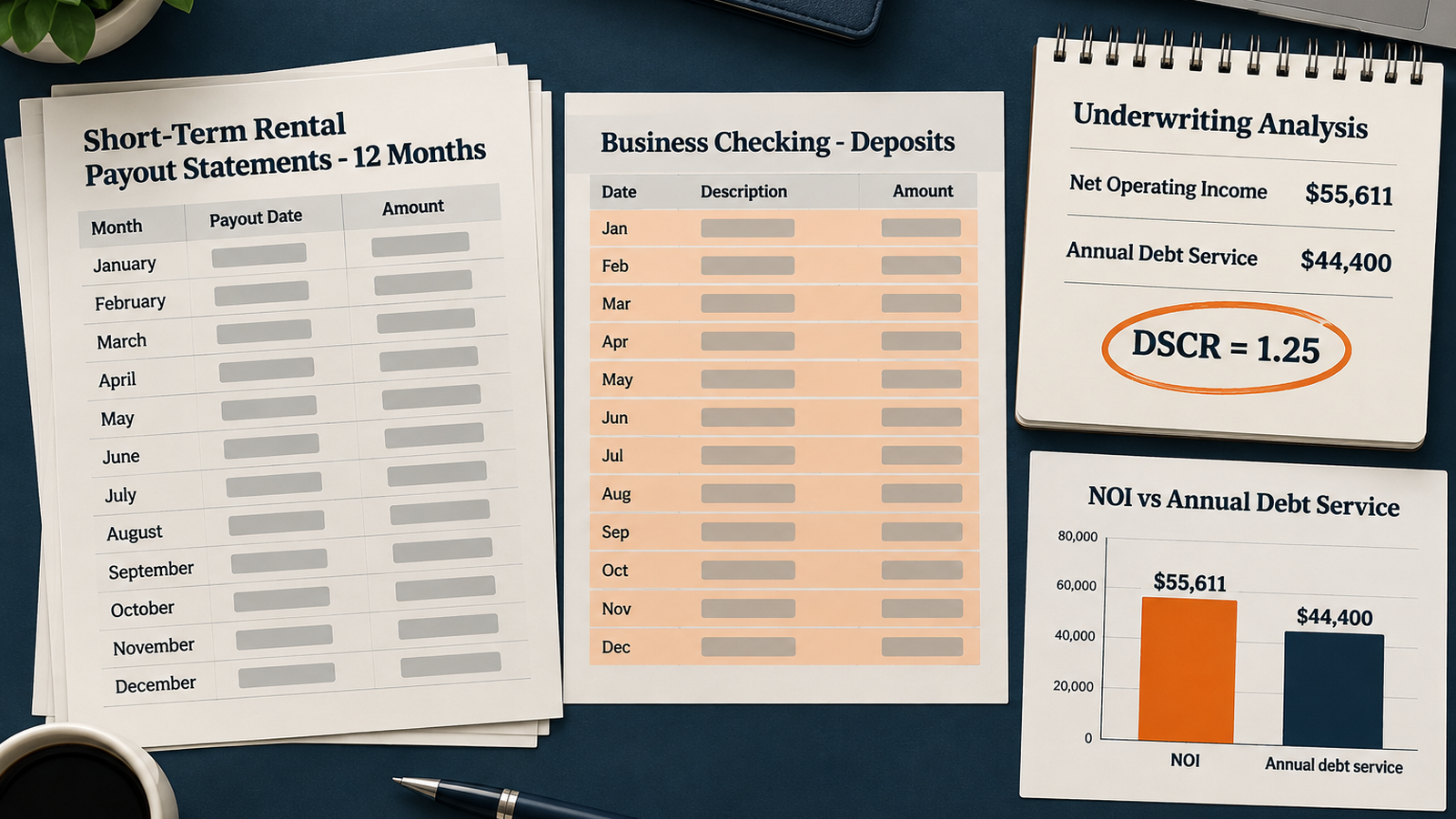
Short answer: a DSCR loan short term rental approval turns on the property's net operating income divided by its annual debt service, not on your personal debt-to-income ratio. Most lenders I work with want that number at 1.15 to 1.25 or better, and they will underwrite your STR revenue with a haircut you should calculate yourself before you apply. If your file cannot show twelve months of platform-verified revenue, expect a market-rent fallback that prices your deal like a long-term rental.
DSCR Loan Short Term Rental Underwriting: NOI vs DTI
A DSCR loan on a short-term rental is approved on the property's coverage ratio, not your personal DTI. Here is the math, the evidence tiers, and what to fix first.
· 9 min read
Disclosure: This post may contain affiliate links. If you purchase through our links, we may earn a commission at no extra cost to you. We only recommend tools and services J. Massey's team actually uses. Read the affiliate disclosure
Table of Contents
What a DSCR loan actually measures
Debt service coverage ratio is net operating income divided by total debt service, where debt service includes principal, interest, and lease payments (Wikipedia, Debt service coverage ratio). A ratio below 1 means the property does not produce enough cash to make its payments. In commercial real estate the minimum lenders set is commonly 1.25, and most commercial banks require 1.15 to 1.35.
That single formula explains most of what feels arbitrary about investor lending. You are not being scored as a person. The collateral is being scored as a small business, and the loan officer needs the business to clear a coverage floor with the numbers a servicer can defend later.
Two operators can bring the same property to the same lender and get different answers, because NOI is an underwriting construct, not a screenshot from your dashboard. The lender decides which revenue counts and which expenses must be added back.
Why your personal DTI stops mattering
A consumer mortgage on a dwelling triggers Regulation Z's ability-to-repay rule: the creditor must make a reasonable, good-faith determination that the consumer can repay the loan before consummation (12 CFR 1026.43(c)). That is the machinery behind income documents, employment verification, and the debt-to-income math the CFPB describes for household borrowers (CFPB, What is a debt-to-income ratio?).
Regulation Z exempts an extension of credit primarily for a business, commercial, or agricultural purpose, and credit extended to other than a natural person (12 CFR 1026.3(a)). A DSCR loan on an STR you hold in an entity, for rental income, sits in that exemption. The lender is not skipping documentation to be generous. It is underwriting a business-purpose loan where the rule set never required your pay stubs.
Two practical consequences follow. First, your W-2 or Schedule C write-offs stop hurting you. Second, the property has to carry itself on paper, so a weak-cash-flow deal you could previously buy on personal income no longer qualifies.
The revenue documentation ladder lenders use
Lenders rank STR income evidence. Where your file lands on this ladder moves your usable NOI far more than shopping rates does.
Top tier — a full year of operating history on the subject property
Tier 1. Platform payout statements plus bank deposits for the same twelve months, with the address matching. This is the only tier where a lender routinely underwrites actual STR revenue at close to face value.
Middle tier — partial history or a comparable-market report
Tier 2. Six to eleven months of history, or a third-party STR revenue estimate. Expect the lender to blend it with long-term market rent, or apply a discount before the coverage test.
Bottom tier — no operating history at all
Tier 3. New acquisition, new build, or a property converting from an owner-occupied use. Most lenders fall back to the appraiser's long-term market rent on Form 1007. That is the scenario that quietly kills deals in high-ADR seasonal markets, where STR gross can run several multiples of market rent.
Evidence tier | What the file contains | How lenders usually treat it | Practical effect on the deal |
|---|---|---|---|
Tier 1 | 12 months of payouts + matching deposits | STR revenue used, expense assumptions applied | Coverage test reflects real operations |
Tier 2 | 6-11 months, or third-party estimate | Blended or discounted toward market rent | Usable NOI drops, more equity needed |
Tier 3 | No subject-property history | Appraiser market rent, Form 1007 | Seasonal high-ADR deals often fail coverage |
Ask the question in this exact form on the first call: which tier does my file sit in, and what revenue figure will you carry into the coverage test? A loan officer who cannot answer that is not the person underwriting you.
Running the coverage test before the lender does: A Four-Step Process
Do this arithmetic yourself, in writing, before you order an appraisal. The mechanics take fifteen minutes.
Step 1 — build the annual revenue line you can prove
Use trailing twelve months of platform payouts, not gross booking value. Payouts already net platform fees, so they are the closer proxy to what a lender can tie to bank deposits.
Step 2 — subtract the operating expenses the lender will insist on
Property taxes, insurance, HOA, management, utilities, and a maintenance/reserve allowance. Most lenders will impose a management expense even if you self-manage, because a servicer has to assume the loan survives you.
Step 3 — build the debt service line at the rate you will actually get
Use a quoted investor rate, not today's owner-occupied headline rate, and include escrowed taxes and insurance if the program's coverage test does.
Step 4 — divide, then compare to the floor
NOI divided by annual debt service. Compare the result to the 1.15 to 1.35 band commercial banks typically require.
Scenario | Underwritten annual revenue | Underwritten expenses | Annual debt service | DSCR |
|---|---|---|---|---|
Tier 1 file, STR revenue used | $84,000 | $37,000 | $38,000 | 1.24 |
Same deal, Tier 3 market-rent fallback | $30,000 | $37,000 | $38,000 | negative NOI, declined |
Tier 3 with a larger down payment | $30,000 | $34,000 | $22,000 | 1.18 |
Figures in this article, in the tables and in the prose examples, are illustrative structures, not quotes or market data. The point is the shape of the outcome: the same property passes or fails on which revenue line the lender is allowed to use, and the only levers you control late in the process are equity and expense evidence.
What to fix before you apply, not after
Most declines I see are documentation failures wearing a cash-flow costume.
Route every payout to one dedicated business account for the subject property. Mixed deposits force the underwriter to discount what they cannot trace.
Keep the entity, the deposit account, and the insurance named insured consistent. Mismatches trigger conditions that stall closings for weeks.
Get a real STR-endorsed insurance quote early. An underwriter's placeholder insurance number can swing NOI by thousands and push you under the floor.
Document the management expense you actually pay. If you self-manage, know the market rate the lender will impose and model it.
Pull your own trailing-twelve payout report and reconcile it to deposits line by line, before a third party does it for you.
If you want a second set of eyes on the coverage math for a specific property, bring it to a free diagnostic call with the payout report and the quoted rate in hand.
When a DSCR loan is the wrong tool
Coverage-based lending rewards stabilized cash flow. It punishes three situations.
A heavy-renovation deal has no revenue to underwrite, so a bridge or renovation product usually beats forcing a coverage test on a property that will not produce income for six months. A high-ADR seasonal market with no operating history often prices better after one full season of documented payouts. And a deal that only works with your personal income propping it up should probably not be bought at that price, which is the honest read on most files that cannot clear 1.15.
Rate shopping is the last lever, not the first. A file that moves from Tier 3 to Tier 1 evidence changes usable NOI far more than a quarter point of rate does.
How this fits the rest of your financing stack
If you are still choosing between structures, start with our overview of how to finance a short-term rental, then run the property through the STR underwriting calculator walkthrough so the revenue and expense lines you hand a lender are the same ones you used to buy.
Keep the tracking discipline afterward. The metrics in what to track in an STR financial model are the same records a lender will want at your next refinance, which makes a Tier 1 file the default instead of a scramble.
Cash-out refinance changes the math again
A purchase and a cash-out refinance are scored with the same ratio and different tolerances. On a cash-out, the new debt service is larger by definition, so the coverage test has to absorb the payment on money you are pulling out. Operators routinely model the equity release and forget that the ratio is recalculated on the new payment.
Three things move together on a refinance file, and they move against you if you ignore any one of them.
Loan-to-value ceilings tighten as coverage falls
Loan-to-value is the ratio of the loan to the value of the asset securing it (Wikipedia, Loan-to-value ratio). Programs commonly step the maximum LTV down as DSCR approaches the floor, so a marginal ratio and maximum cash-out rarely coexist in the same approval.
Seasoning rules decide when your history counts
Some programs require the property to have been held, or operated as a rental, for a set period before trailing revenue can be used. A refinance filed two months after conversion can be underwritten as a Tier 3 file even when you have payouts to show.
Appraised value carries the whole structure
Coverage tests fail more often from a low appraisal than from a bad revenue line, because value sets both the LTV ceiling and the loan amount you were counting on. Build the file assuming value comes in below your estimate, and know which ratio breaks first when it does.
Frequently Asked Questions
Q: What DSCR do I need for a short-term rental loan?
A: Plan for 1.15 to 1.25 at minimum. Commercial minimums are commonly set at 1.25, with most commercial banks requiring 1.15 to 1.35, and STR collateral usually sits at the stricter end because the revenue is seasonal.
Q: Will a DSCR lender use my Airbnb revenue or long-term market rent?
A: It depends on your evidence tier. Twelve months of payouts tied to matching bank deposits on the subject property is what gets actual STR revenue used; thinner files get blended or replaced with the appraiser's market rent.
Q: Do DSCR loans check my personal debt-to-income ratio?
A: Generally no. Business-purpose credit is exempt from Regulation Z, including the ability-to-repay documentation that drives consumer DTI underwriting, so the coverage test on the property replaces it.
Q: Can I get a DSCR loan on a property with no rental history?
A: Often yes, but underwritten on long-term market rent from the appraisal rather than STR projections. In markets where STR gross is a multiple of market rent, that fallback is what fails the coverage test.
Q: Does holding the property in an LLC help?
A: It aligns the file with the business-purpose exemption most DSCR programs rely on, and many programs require an entity. It is not a substitute for coverage: the property still has to clear the ratio.
Q: What is the fastest way to improve my DSCR before closing?
A: Increase equity to cut debt service, and replace estimated expenses with real quotes, especially insurance and management. Both move the ratio in days; revenue history takes months.
Sources
Disclaimer: Educational content only — not financial, legal, or tax advice; results vary.
See our full Earnings Disclaimer and Affiliate Disclosure for complete details. © 2026 West Egg Enterprises, Inc. All rights reserved.