How to Finance a Short-Term Rental: Loan Options, Down Payments, and the DSCR Path
Every page-1 result on this topic is a lender selling a product. This is the operator's version: the five real financing paths, what each one costs, and who each one fits.
By J. MasseyJune 22, 2026· 11 min read
Share
Disclosure: This post may contain affiliate links. If you purchase through our links, we may earn a commission at no extra cost to you. We only recommend tools and services J. Massey's team actually uses. Read the affiliate disclosure
You finance a short-term rental through one of five paths: a conventional second-home or investment-property loan, a DSCR loan underwritten on the property's own income, a portfolio loan from a local bank, a HELOC or cash-out refinance against a property you already own, or partner and seller-financed capital. Plan on 10–25% down and post-closing reserves that are path-dependent: Fannie Mae's automated underwriting asks two months of payments on a second home and six months on an investment property, while most DSCR and portfolio lenders ask six to twelve. On an agency loan, your projected nightly income counts for nothing until it is documented by a lease or a filed tax return.
Last updated: 2026-09-17
That last sentence is where most first-time operators lose the deal. They model $6,000 a month in bookings, then a conventional underwriter values the property on long-term rent comps and qualifies them on a number less than half that. Nothing was wrong with the property. The financing path was wrong for the borrower.
I have spent more than 18 years in real estate, focused on short-term rentals since 2016, and trained more than 10,000 operators through CashFlow Diary. I do not originate loans. That means I can tell you which path fits the deal instead of which product pays a commission. This article is educational, not lending, tax, or legal advice — your lender's guidelines and your own tax professional govern your file.
The Five Financing Paths at a Glance
Pick the path from the borrower profile first, then shop lenders inside that path. Shopping across paths wastes weeks because the underwriting questions are completely different.
Path
Typical down payment
How income is qualified
Who it fits
Conventional second home
10%+ (up to 90% LTV)
Your personal income and debt-to-income ratio; no rental income credit
Buyers who will actually occupy the property part of the year and rent it only occasionally
Conventional investment property
15%+ (up to 85% LTV), often 20–25% in practice
Personal income, plus documented rental income only with lease or tax-return history
W-2 or documented self-employed borrowers with strong reserves and few financed properties
DSCR / non-QM
20–25%, more below roughly 680 FICO
Property income divided by the full monthly payment; no tax returns or DTI
Self-employed operators, portfolio builders, anyone whose returns show heavy write-offs
Portfolio / local bank
20–30%
Bank's own rules — deposits, global cash flow, relationship history
Unusual properties, cabins, non-warrantable condos, borrowers with a local banking history
HELOC, cash-out refi, or partner/seller capital
Varies (equity or negotiated)
Equity position, existing property income, or the counterparty's terms
Operators with equity or a partner, and buyers where the seller wants to carry paper
Two facts sit underneath the whole table. First, agency loan sizes are capped: for 2026 the baseline conforming loan limit for a one-unit property is $832,750, with a ceiling of $1,249,125 in the highest-cost counties. Above that you are in jumbo, portfolio, or non-QM territory whether you like it or not. Second, agency underwriting cares about occupancy. Fannie Mae's second-home requirements say the property "must not be rental property or a timeshare arrangement," must be occupied by the borrower for some portion of the year, and must be under the borrower's exclusive control. A footnote allows occasional rental income on a second home as long as that income is not used to qualify. Read all of that before anyone suggests you label a full-time rental as a second home.
Paths 1 and 2: Conventional Second-Home and Investment-Property Loans
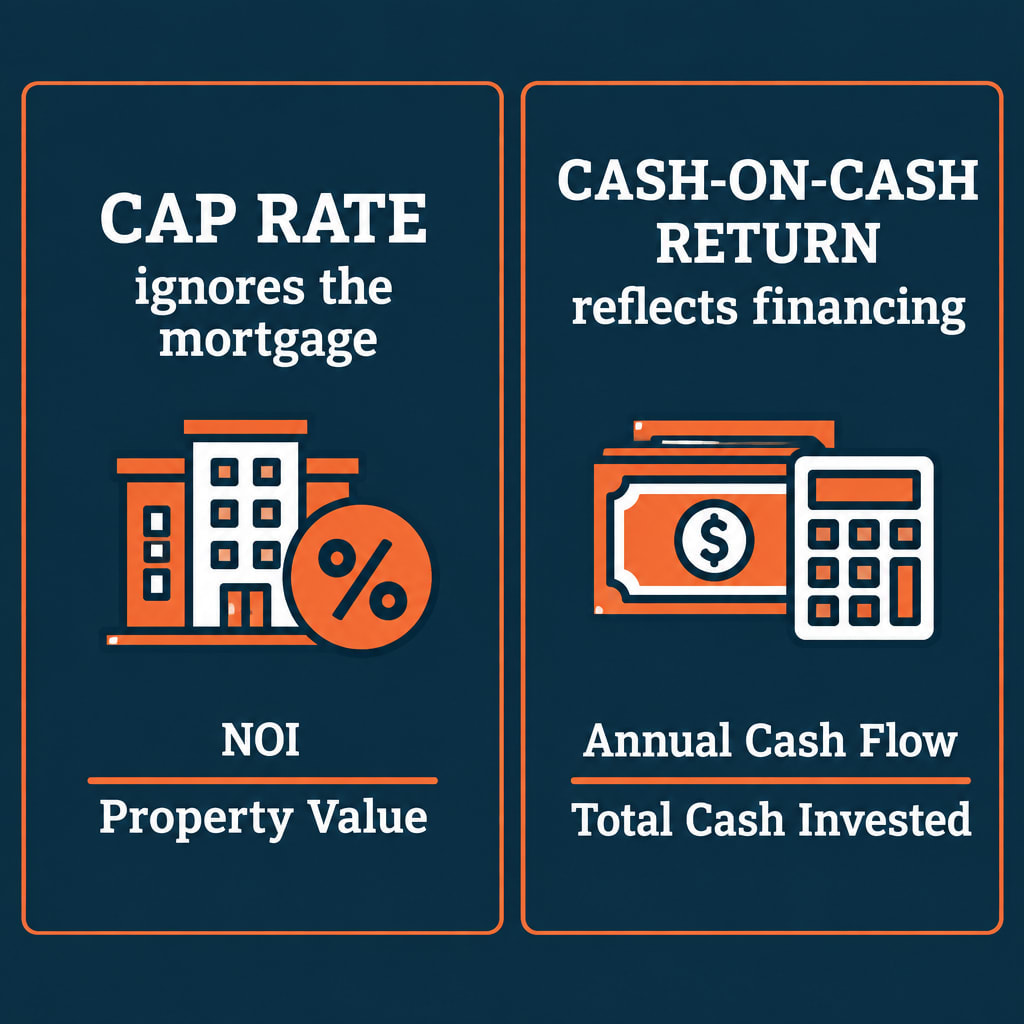
Four short-term rental loan types compared: conventional, DSCR, portfolio and bridge with down payments
These are the cheapest loans you will ever get on the property, and the hardest to qualify for as an operator.
The pricing advantage is real. Agency loans have published guidelines, 30-year fixed terms, and no prepayment penalty. The cost is a personal-income underwrite: pay stubs, W-2s, two years of returns if you are self-employed, and a debt-to-income calculation that counts the new payment. The Consumer Financial Protection Bureau's explanation of debt-to-income is worth reading, because that single ratio decides whether you qualify.
Down payment floors: 10% for a second home, 15% for a one-unit investment property. In practice, expect a lender to ask for 20–25% on a rental in a resort or high-tourism market, because pricing adjustments at higher loan-to-value make the low-down option expensive anyway.
The failure mode is income. Under Fannie Mae's rental income policy, rental income has to be documented — Schedule E history on filed returns, or a signed lease of at least 12 months to supplement a return where Schedule E does not show a full year of fair rental days. Projected nightly revenue from a listing that does not exist yet is not qualifying income. So on your first purchase, your day job carries the file. Once the property has one to two years of filed returns showing the rental, that income can start to help.
The other failure mode is occupancy misrepresentation. The rate gap between second-home and investment pricing tempts people to call a full-time rental a second home. Servicers cross-reference listing addresses. If it happens, the loan can be called due and the misrepresentation reported. Take the higher-priced investment loan and sleep.
Skip this path entirely if you are self-employed with aggressive write-offs, already carry several financed properties, or need to close in under three weeks.
Path 3: DSCR Loans, Where the Property Qualifies Itself
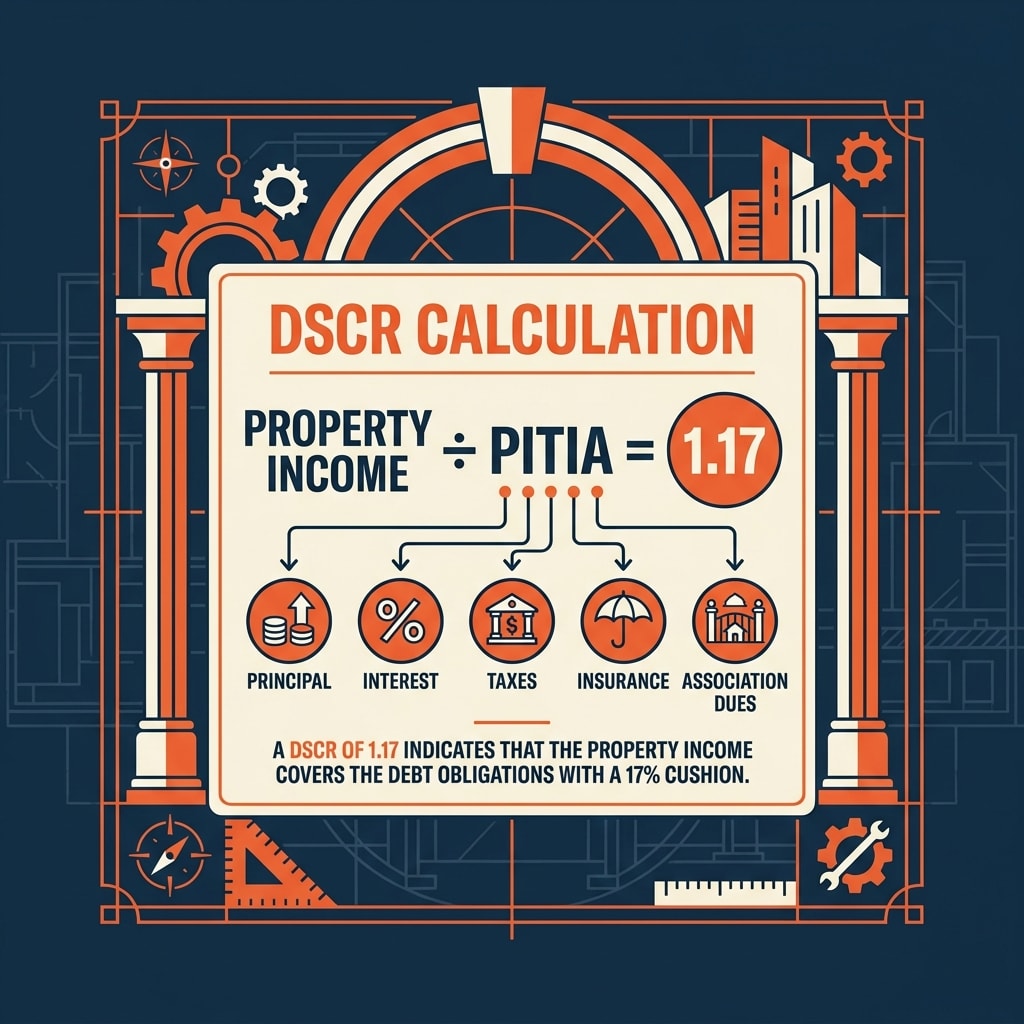
DSCR stands for debt service coverage ratio. The math: property income divided by PITIA — principal, interest, taxes, insurance, and association dues.
A ratio of 1.00 means the income exactly covers the payment. Below 1.00 you subsidize the mortgage every month out of pocket. Most short-term rental programs want a minimum near 1.00, and many want 1.10 to 1.25 for seasonal or resort markets. Better pricing usually starts above 1.25.
Here is a worked illustration. These are my assumptions, not a rate quote — I will not print a live interest rate I cannot source, and neither should anyone selling you a loan.
Assume a $400,000 purchase, 25% down, a $300,000 loan, and a $2,700 monthly PITIA. Assume $4,500 a month in gross bookings and 30% of gross in operating costs, so $3,150 net. That is a 1.17 ratio: the property covers itself with roughly $450 a month of margin before capital repairs. Change the payment assumption by $200 and the ratio drops to 1.09 — which is the difference between two lender programs approving and declining the same house.
What DSCR buys you: no tax returns, no W-2s, no debt-to-income test, closings usually inside 21–30 days, no agency cap on how many properties you finance, and the option to close in an LLC. What it costs you: a rate premium over agency pricing, higher down payment, often a prepayment penalty for the first one to three years, and lender-specific credit floors that generally start in the low-to-mid 600s with better pricing well above 700.
On a purchase with no booking history, a DSCR lender will typically use a market-rent survey (appraisal Form 1007, sometimes with a short-term rental addendum) or a third-party revenue estimate, and haircut projected gross income before running the ratio. On a refinance they want your trailing twelve months of platform payout reports. Actual performance beats any projection.
This path is not for you if the property only pencils at peak-season revenue. Model the ratio month by month. An annual 1.25 can hide a 0.60 in February, and February still needs paying.
Path 4: Portfolio and Local-Bank Lending
Portfolio lenders keep the loan on their own balance sheet, so they write their own rules. That is the whole appeal. No agency box means a cabin on well water, a non-warrantable condo, a five-unit compound, or a mixed-use building can get financed.
Expect 20–30% down, shorter fixed periods — often a five- or seven-year fixed that then adjusts, or a balloon at year seven to ten — and amortization over 20 to 25 years rather than 30. Some banks qualify you on deposit history or global cash flow across your entire balance sheet instead of a tax-return ratio, which helps operators whose Schedule C looks small after write-offs.
The real currency here is relationship. There is no rate sheet online. You walk into two or three community banks and credit unions in the county where you buy, ask who underwrites investor loans in-house, and bring a one-page deal summary: purchase price, down payment, projected and comparable income, your reserve position, and your operating history. Bankers fund people they can explain to a committee.
Skip this path if you need a 30-year fixed and cannot carry refinance risk at the balloon date.
Path 5: HELOC, Cash-Out Refinance, and Partner or Seller Capital
The lender-pitch trap: a funnel of loan ads pointing at a buyer's wallet
These are capital sources, not usually the whole purchase loan. Used well, they create the down payment for one of the first four paths.
A home equity line of credit or a home equity loan turns equity in a property you already own into cash. The CFPB's plain-language explanation of home equity loans covers the structure. A line is flexible and usually variable rate; a fixed second is predictable. Both add a payment and both put the property pledged as collateral at risk. Do not use a variable-rate line to cover a fixed monthly obligation you cannot pay from operations.
A cash-out refinance replaces the existing first mortgage with a larger one. It resets your rate on the whole balance, so it only makes sense when the new payment and total interest cost still work. Do the break-even arithmetic yourself: closing costs divided by monthly savings, against how long you plan to hold. Agency cash-out on an investment property generally tops out around 70–75% loan-to-value, and there is usually a seasoning requirement before you can pull equity from a recent purchase.
Partner capital and seller financing are negotiated instruments. With a partner, put the split, the capital account, the decision rights, and the exit in writing before money moves. With seller financing, you and the seller set the down payment, rate, term, and balloon — often the fastest way to close an off-market property, and often the only way when the property's condition or income history breaks bank underwriting. Get a real estate attorney to paper it. State law on owner financing varies, and tax treatment of the interest matters to both sides. Again: educational, not tax or legal advice. IRS Publication 527 is the starting point for how rental income and expenses are reported. Two rules in it change the math on a property you also use yourself: the unit counts as a residence when your personal use exceeds the greater of 14 days or 10% of the days it is rented at a fair rental price, and if it is used as a home and rented fewer than 15 days in the year, that rental period is not treated as rental activity at all.
Down Payment, Reserves, and the Appraisal Reality
Down payment is the number people plan for. Reserves are the number that kills closings.
Agency guidelines require a set number of months of PITIA left in verified liquid accounts after closing, and reserve requirements rise with additional financed properties. Fannie Mae's minimum reserve requirements page spells out the calculation: reserves are measured in months of the qualifying PITIA, and its automated underwriting looks for two months on a second home and six months on an investment property before other financed properties are counted. Freddie Mac's reserve section does the same for its programs. DSCR and portfolio lenders commonly ask for six to twelve months. Money usually needs to be seasoned in your accounts for roughly 60 days, so consolidate funds early. Retirement accounts often count at a discount because of withdrawal penalties.
Cost line
$400,000 purchase (illustration)
Notes
Down payment at 25%
$100,000
Path-dependent; 10–15% floors exist on agency loans
Closing costs at 3–4%
$12,000–$16,000
Title, origination, appraisal, escrows
Reserves, 8 months of a $2,700 PITIA
$21,600
Must remain liquid after closing
Furnishing and setup
Varies by property
Not financed on most paths
Ramp-up operating cushion
2–3 months of the payment
Bookings lag the listing going live
Cash needed before furniture
~$133,600–$137,600
Assumptions above; your file will differ
Every figure in that table is an illustration built on the stated assumptions. Run yours with your own quote.
Two appraisal realities to plan for. A standard appraisal values the house against sale comps, and the rent schedule attached to it — Form 1007 or its equivalent — reports market rent, which in most markets means long-term rent. If your deal depends on nightly revenue, ask upfront whether the lender orders a short-term rental rent schedule or accepts third-party revenue data. Second, appraisals come in low often enough that you should know your plan before it happens: bring more cash, renegotiate, or walk.
DSCR math: property income divided by PITIA equals a 1.17 ratio
Step 1 — Underwrite the property before you call a lender
Model gross bookings, operating costs, and the payment at a conservative rate. If it does not clear the payment plus a repair allowance, no financing path fixes it.
Step 2 — Pick your path from your own profile
W-2 income and one or two financed properties points to conventional. Self-employed, write-offs, or property four and beyond points to DSCR. Odd property or strong local banking history points to portfolio.
Step 3 — Assemble the file for that path
Conventional: returns, pay stubs, statements. DSCR: entity documents, credit, reserves, and the income evidence the lender accepts. Portfolio: a one-page deal summary and two years of statements.
Step 4 — Quote three lenders inside the same path
Compare rate, points, prepayment penalty, reserve requirement, and minimum ratio side by side. Ask each one in writing how they treat short-term rental income and which rent schedule they order.
Step 5 — Fund the full capital stack, then close
Down payment plus closing costs plus reserves plus furnishing plus a ramp cushion. If the total leaves you with no cash after closing, the deal is too big for this cycle. Buy the smaller one.
If you want a second set of eyes on which path your next deal belongs in, book a complimentary one-on-one diagnostic call and bring the numbers you have. We will work through the actual file, not a product pitch.
Frequently Asked Questions
Can I use projected Airbnb income to qualify for a loan? On a DSCR or non-QM loan, usually yes — the lender uses a market-rent survey or third-party revenue estimate and applies a haircut before running the coverage ratio. On agency conventional loans, no. Rental income has to be documented with leases or filed tax-return history, so your first purchase is carried by your personal income.
How much do I need for a down payment on a short-term rental? Agency floors are 10% for a true second home and 15% for a one-unit investment property. In practice most short-term rental buyers put 20–25% down, and DSCR programs push toward 25% for lower credit scores or seasonal markets. Add closing costs and post-closing reserves to get the real cash requirement.
What is a DSCR ratio and what minimum do lenders want? It is property income divided by PITIA — principal, interest, taxes, insurance, and association dues. A 1.00 ratio means income exactly equals the payment. Most short-term rental programs set the floor near 1.00, many ask 1.10 to 1.25 in seasonal markets, and pricing generally improves above 1.25.
Can I finance a short-term rental as a second home to get better terms? No. Fannie Mae's second-home requirements say the property must not be rental property, must be occupied by you for some portion of the year, and must be under your exclusive control; a footnote permits incidental rental income only when it is not used to qualify. A full-time nightly rental is an investment property, and telling a lender otherwise is occupancy misrepresentation, which can make the loan callable. Price the honest structure into the deal instead.
Should I use a HELOC on my primary residence to buy an STR? Only if you can cover the line's payment from income that is not the new rental. A line of credit is usually variable rate and secured by your home, so a slow booking season becomes a risk to the house you live in. Compare it against a cash-out refinance and a partner structure before you draw.