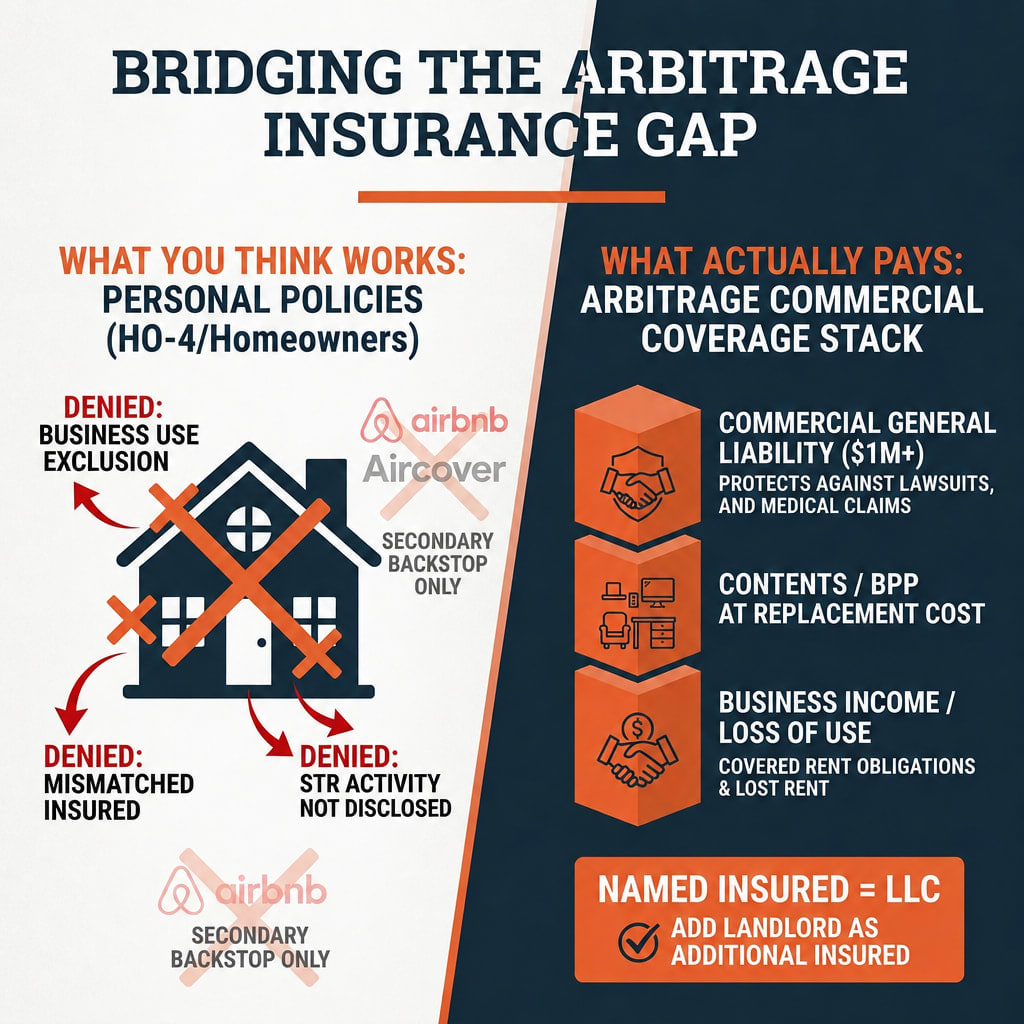
Rental arbitrage insurance is commercial short-term rental coverage held by the entity that signs the lease, and it normally has three parts: general liability for guest injury claims, business personal property at replacement cost for the furniture you bought, and business income coverage that keeps paying rent when a covered loss takes the unit offline. A personal renters or homeowners policy does not do this job, because nightly paid stays are business use, and the platform host programs sit behind your policy rather than replacing it.
Last updated: 2026-09-17
I have spent more than 18 years in real estate, focused on short-term rentals since 2016, and I have trained over 10,000 operators through CashFlow Diary. The pattern I see most in arbitrage is not a missing policy. It is a policy that exists, gets paid every month, and then does not respond at claim time because the name on it, the disclosed use, or the lease underneath it does not match how the unit is actually run. This article is educational, not insurance, tax, or legal advice. Coverage forms, exclusions, and pricing are set by carrier and state, so confirm anything here with a licensed agent in your state.
What Rental Arbitrage Insurance Actually Is
You lease a unit from an owner and re-rent it nightly. That makes you three things at once: a tenant on a lease, a business with contents in someone else's building, and a hospitality operator hosting strangers. Each of those creates a different exposure, and no single personal policy is written for the combination.
Your landlord's policy covers the building and the owner's interest. It does not cover your sofa, your guests, or your rent obligation. Your guest's travel insurance covers the guest. What is left over is yours, and that is what a commercial short-term rental policy is for.
The way to think about it: your policy is the primary layer, the platform program is a conditional backstop, and the lease is the document that decides whether either one will respond at all.
Why a Personal Renters or Homeowners Policy Excludes This
Personal lines are built around personal use. The Insurance Information Institute describes standard renters insurance as three buckets — personal possessions, personal liability, and additional living expenses — all written for someone living in the unit, not selling nightly stays from it. State regulators describe home policies the same way: damage to the home and contents, plus liability for accidents on the property, with named exclusions listed in the form.
Business use is one of those exclusions in most personal forms. The failure mode is not that a claim gets paid smaller. It is that the claim gets examined, the commercial use surfaces, and the file closes. Two adjacent problems follow:
Nondisclosure. If you told the carrier you were a long-term tenant while running nightly stays, the carrier may treat that as misrepresentation and address the policy, not just the claim.
Unrelated losses. A business use exclusion can be applied to a loss that had nothing to do with a guest — a burst pipe on a vacant night — because the risk being insured was never the risk the carrier priced.
I do not publish premium ranges, because quotes for the same unit move widely by state, building type, and limits. Get three quotes from carriers that write short-term rental risk, then treat the number you accept as a fixed operating cost in your model. If insurance does not fit the unit's numbers, the unit does not work.
The Coverage Stack, Line by Line
Here is the stack I ask operators to hold before a first guest checks in. The right column is the question that decides whether that line is doing its job.
Coverage line | What it pays for | The check that matters |
|---|
Commercial general liability | Guest bodily injury, damage to others' property, legal defense costs | Is the per-occurrence limit at or above what your lease and your city permit require, and is defense inside or outside the limit? |
Business personal property | Your furniture, appliances, linens, electronics inside a unit you do not own | Is the valuation replacement cost, not actual cash value, and is the limit close to what a full re-furnish actually costs today? |
Business income / loss of rents | Your continuing lease payment and lost booking revenue after a covered physical loss | How many months of income does the limit carry, and how long is the waiting period before it starts paying? |
Named insured | Nothing directly — it decides who can collect | Does the name on the policy match the entity that signed the lease and receives booking income? |
Additional insured (owner) | Extends your liability coverage to the property owner | Is the owner listed on the certificate of insurance, with the exact legal name from the lease? |
Platform host program | Conditional backstop for guest-caused damage and some liability claims | Do you know its exclusions and filing deadlines, and does it apply to your direct bookings? (Usually not.) |
Two lines get skipped most. Business income is the first, because nothing has gone wrong yet. Replacement cost valuation is the second, because actual cash value quotes look cheaper. The Texas Department of Insurance spells out the difference on personal property: replacement cost pays current prices, while actual cash value pays replacement cost minus depreciation for wear and age. Depreciation on three-year-old furniture is your money. Both show up as cash out of your pocket at the worst possible week.
An illustration, with the assumptions shown so you can swap in your own numbers: a unit at $2,400 per month rent, offline for three months after a covered water loss, is $7,200 of rent you owe with no bookings, before you replace a single mattress. That is arithmetic on my assumptions, not a claim about typical payouts. Run yours.
Named Insured, Additional Insured, and the Certificate
These three terms cause more denied arbitrage claims than any exotic exclusion.
Named insured is who the policy belongs to. If your operating LLC signs the lease, collects the payouts, and pays the vendors, the LLC belongs on the policy — as the named insured, spelled exactly as it appears on the lease and with your Secretary of State. Personal name on the policy plus an LLC running the business is a mismatch a carrier can act on.
Additional insured is someone else you extend your liability coverage to. For arbitrage that is normally the property owner, and often the owner's management company. It is also the single most useful concession you can offer a hesitant owner: your liability policy stands in front of theirs for claims arising from your operation.
The certificate of insurance is the one-page proof of all of it. Read the certificate the way an owner's attorney would: legal names, effective dates, per-occurrence and aggregate limits, the additional insured endorsement actually referenced, and a cancellation notice provision. A certificate is evidence, not the policy. If the lease requires something the policy does not contain, the certificate will not save you.
Then get the sublease or short-term rental permission in writing. Not a text message, not a verbal yes from a leasing agent. A signed lease clause or addendum naming nightly rentals, plus the insurance requirements in the same document. If the operation breaches the lease, you have a coverage argument and an eviction risk running at the same time.
What the Platform Host Programs Do and Do Not Do
Read the platforms' own words here rather than a summary from a broker's blog. Airbnb's AirCover for Hosts bundles guest identity verification, reservation screening, $3 million Host damage protection, $1 million Host liability insurance, and a 24-hour safety line. Those two dollar figures are Airbnb's published numbers, and Airbnb states plainly that Host damage protection is not an insurance policy. If you list on other platforms, pull that platform's own help-center terms the same way. Verify every limit against the live page before you rely on it, because platforms revise these programs.
Question an operator asks | Platform host program | Your commercial policy |
|---|
Guest damages your furniture | Damage protection may reimburse; you must file in the Resolution Center within 14 days of the responsible guest's checkout | Business personal property responds subject to deductible and valuation |
Guest is injured and sues | Host liability insurance may respond to claims where you are found legally responsible | General liability responds and pays defense |
Burst pipe with no guest involved | Not covered — acts of nature and non-guest causes are excluded from damage protection | Covered if the peril is covered |
Your direct or off-platform bookings | Not covered by that platform's program | Covered, if your policy is written for your full booking mix |
Rent you still owe while the unit is offline | Not a lease-obligation program | Business income coverage, up to its limit and period |
Proof for a landlord or permit office | A program description, not a certificate | Certificate of insurance naming the owner |
The honest read: the host programs are useful when they apply, and they are not a foundation. They are discretionary or condition-heavy in places, they carry filing deadlines measured in days, they exclude normal wear, currency, and acts of nature, and they know nothing about your lease.
Five Ways Coverage Quietly Gets Voided
Every one of these is fixable this week, and none of them announces itself until a claim.
Named insured mismatch. Policy in your personal name, lease in the LLC. Fix: match them, and re-issue the certificate.
Undisclosed nightly use. Application says long-term tenant. Fix: disclose the actual use in writing and accept the correct form, even if it costs more.
Operating against the lease. No written sublease or short-term rental permission. Fix: get the addendum signed before the listing goes live.
Coverage gaps between units. Policy cancelled on Unit 1 while Unit 2 is being set up, or dropped through the slow season. Fix: keep every unit continuously covered, year-round.
Limits and endorsements that never grew. The stack you bought at one unit still in force at five, with contents limits from your first furnish. Fix: review limits at every new lease and once a year regardless.
If your city or county requires short-term rental insurance for a permit, add a sixth check: confirm the required limit and the exact wording your permit office wants on the certificate. Requirements differ by jurisdiction, and a platform program will rarely satisfy them.
Your Pre-Lease Insurance Checklist
Work this in order. The order matters, because each step produces the document the next step needs.
Step 1 — Get nightly rental rights in writing
Signed lease clause or addendum that names short-term rental use, lists the insurance the owner requires, and states who is added as additional insured.
Step 2 — Confirm the entity
Decide which entity signs the lease, opens the bank account, and holds the listings. That entity is your named insured everywhere. Talk to your own tax and legal advisors about entity choice; this article is not that advice.
Step 3 — Quote the full stack, not just liability
Ask each carrier in writing for the liability limit, contents valuation basis, business income limit and period, and the exclusions that apply to nightly stays. Compare the three quotes on those four lines.
Step 4 — Bind before the first guest, and read the certificate
Coverage effective on or before your first check-in. Then check the certificate against the lease requirement, word for word, and send it to the owner.
Step 5 — Set a renewal and scale review
Calendar a 12-month review, plus a review at every new unit. Update contents limits after any major re-furnish, and re-confirm the platform program terms, since they change.
Step 6 — Write the claim procedure down
One page in your operations file: who photographs damage, who files in the platform Resolution Center inside the deadline, who calls the agent, and where the policy number lives. Claims are lost on timing far more often than on merit.
If you want a second set of eyes on the unit economics and the risk before you sign, book a complimentary one-on-one diagnostic call and bring your lease, your quotes, and your numbers.
If you are not going to hold real coverage, do not run arbitrage. That is not a scare line. One liability claim in a unit you do not own, with no policy behind it, reaches past the unit and into everything else you own. Long-term rentals or co-hosting for owners who carry their own coverage are better fits for that risk tolerance. For the full startup picture, see the rental arbitrage startup costs breakdown.
Frequently Asked Questions
Do I need special insurance for rental arbitrage?
Yes, in practice. Your landlord's policy covers the building and the owner's interest, not your contents, your guests, or your lease obligation, and personal renters or homeowners forms are written for personal occupancy rather than paid nightly stays. Arbitrage operators normally need a commercial short-term rental policy that carries liability, business personal property at replacement cost, and business income coverage, held by the entity on the lease.
Does AirCover replace my own insurance?
No. Airbnb's AirCover for Hosts includes $3 million Host damage protection and $1 million Host liability insurance, and Airbnb states that damage protection is not an insurance policy. It carries exclusions, a filing deadline of 14 days from the responsible guest's checkout for damage requests, and no coverage of your lease obligation or your direct bookings. Treat it as a backstop behind your own policy.
Whose name should the policy be in?
The same entity that signs the lease and receives booking income, spelled exactly the same way in both documents. A policy in your personal name while an LLC runs the business is one of the cleanest reasons a carrier has to contest a claim. Add the property owner as additional insured and send them the certificate of insurance.
What is the difference between landlord insurance and arbitrage insurance?
Landlord insurance protects the owner's building and the owner's financial interest in it. Arbitrage insurance protects your business inside that building: liability toward guests and neighbors, the contents you bought, and the income that pays the rent while a covered loss keeps the unit offline. Both can exist on the same unit and cover different things.
What happens if I never told my insurer I was renting nightly?
Expect the use to surface during a claim investigation. The likely outcomes are denial for the excluded business use, a misrepresentation dispute over the application, or action against the policy itself rather than only the claim. Disclosing the real use and paying the correct premium is much cheaper than arguing about it after a loss. This is educational, not legal advice.
Sources