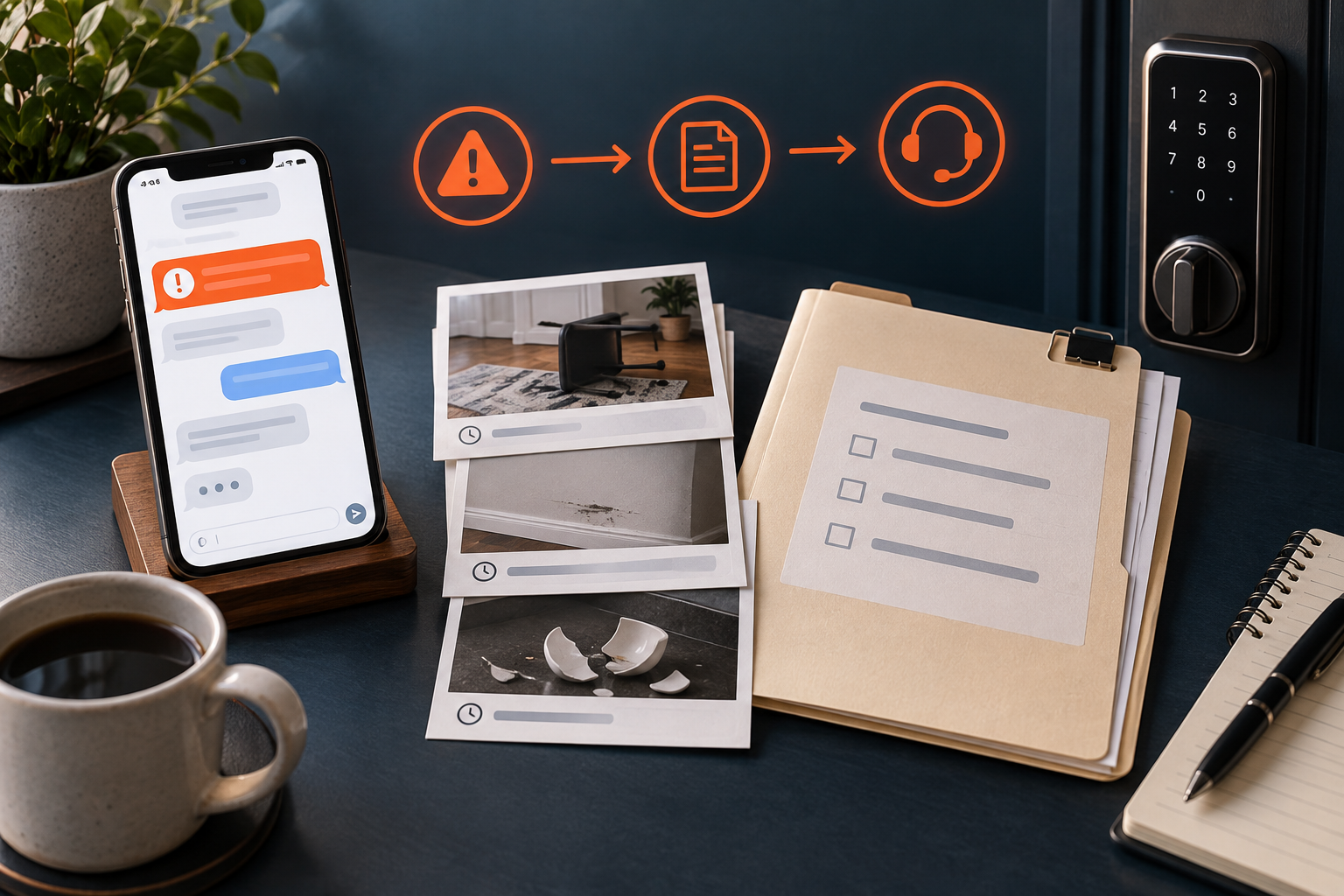
When a guest goes wrong, the first move is documentation, not confrontation: capture timestamped evidence, send one calm instruction inside the booking platform's message thread, and open a platform support case before you offer money, threaten a claim, or drive to the property. Every incident type — noise and parties, damage, overstay, safety, refund pressure — runs through that same opening. What changes after it is the ladder you climb and the evidence you need. Operators lose these situations for one reason more than any other: they argue over text, settle over the phone, and end up with no record a platform reviewer can read.
Last updated: 2026-09-16
Incidents are an operations problem, not a character problem. A stay is a stranger occupying your asset under rules nobody read closely. Your job is to make the outcome predictable when those rules break.
What to do in the first hour when a guest goes wrong
Use the first hour to build a record, not to win an argument — evidence collected before you make demands is what decides claims, refunds, and review disputes later.
Three things happen in the first hour. You learn what is actually true, you decide whether the stay continues, and you create the paper trail everything else runs on — in that order.
The common failure is inverted: the operator reacts to a neighbor's text, calls the guest, gets a denial, then starts collecting proof of a situation that already ended.
Run your first hour like this:
Confirm the report from a second source — a noise monitor reading, a neighbor's timestamped video, a doorbell event log, a cleaner's photos.
Write the facts down with times. Dates, decibel readings, message timestamps, names of who reported what.
Move all guest contact into the platform thread. Phone calls and personal texts are effectively invisible to a platform reviewer.
Send one instruction, one deadline, no threats, no accusations of character.
Open a support case with the platform if the behavior continues after that message.
💡 Key reframe: You are not trying to make the guest admit anything. You are building a file that a stranger reviewing your case in ten days can act on without your commentary.
Four incident types, four different first moves
Noise, damage, overstay, and refund pressure look similar in the moment and behave differently in resolution — treating them all as "a bad guest" is why operators over-refund and under-document.
Noise and party incidents are time-critical; the evidence disappears at sunrise. Damage is the opposite — evidence persists, but claim windows and the next check-in create the pressure. Overstay is a legal-exposure problem where your fastest lever is the platform and the calendar, not the door. Refund pressure is a negotiation where the currency is documentation, not sympathy.
Incident type | Time pressure | First move | Primary evidence | Where it gets resolved |
|---|
Noise / unauthorized party | Hours — evidence vanishes | Verify with sensor or video, then one in-platform instruction | Decibel log, video, neighbor statement, police report number | Platform trust and safety, local enforcement |
Property damage | Days — claim windows and next arrival | Photograph everything before cleaning or repair | Pre- and post-stay photos, itemized quotes, invoices | Platform damage program, then carrier |
Overstay | Hours to days, escalating | In-platform departure notice plus a support case; never a removal attempt | Reservation dates, message thread, lock logs | Platform support, then local counsel |
Refund demand or review threat | Whole stay | Ask for specifics in writing; answer each in writing | Message thread, listing screenshots, service records | Platform resolution tools, review policy |
Safety incident or threat | Immediate | Call emergency services; stop self-handling | Report number, dated notes | Emergency services, then platform |
Never attempt to remove, confront, or physically manage a guest you believe is unsafe, intoxicated, or threatening — and never send a cleaner or handyman into that situation on your behalf. Call emergency services and let the platform and local authorities work.
The escalation ladder: a 10-step process, in order
Climb one rung at a time and document each rung — skipping straight to a claim or a mid-stay cancellation without the earlier rungs is the most common reason a platform sides with the guest.
This is the ordered process we teach operators to run for a live incident. It works because each step produces the artifact the next step asks for.
Verify the report (0–15 minutes). Get a second, timestamped source before you act. A single angry neighbor text is a prompt to check, not a fact.
Log the facts (15–30 minutes). Open a dated incident note. Record times, readings, who reported, what you observed, and what the reservation allows.
Send one in-platform message (30–45 minutes). State the rule, the observation, the required action, and the deadline. Calm, specific, no threats. Example shape: "Our house rules cap occupancy at 6 and quiet hours start at 10 p.m. Our monitor recorded sustained levels above the limit at 11:40 p.m. Please bring the property back to 6 registered guests and quiet levels within 30 minutes."
Open a platform support case (45–90 minutes) if behavior continues. Attach your log and evidence. Ask for the specific outcome you want — guest warning, cancellation with rebooking support, case documentation.
Involve the right local party. For an ongoing party or disturbance, call the police non-emergency line and keep the report or case number. For a suspected emergency, call emergency services. Airbnb's Community Disturbance Policy states that reported disturbances can lead to warnings, suspension, or removal from the platform, and asks hosts and guests to be respectful of surrounding neighborhoods — which is exactly what your report feeds.
Decide on the stay. If the stay must end early, do it through platform support rather than unilaterally. Airbnb's Host Cancellation Policy for homes describes host cancellations as carrying consequences unless a valid, documented reason applies, so the documented reason matters more than your urgency.
Document the aftermath within 24 hours of checkout. Photograph, inventory, and price the damage before any cleaning, repair, or turnover.
File the platform claim before the next guest checks in. Airbnb's Host Damage Protection Terms set conditions and time limits on requests, so read the current version of that page before you file rather than relying on what was true last season.
Escalate to insurance above your deductible. A platform program is not your insurance policy. Coverage, exclusions, and deductibles are decided by your actual policy and carrier.
Close the loop internally. Record the root cause, the cost, and the one setting or rule you changed so the same incident cannot repeat quietly.
⚡ The math operators skip: A four-hour party that ends in a $1,400 repair, a canceled next booking, and a one-star review is rarely a $1,400 event. Add the lost night, the expedited cleaner, and the ranking effect, and the real number is often two to three times the repair. Prevention spending is priced against that total, not the repair line.
Noise, parties, and neighbor complaints
Noise is the one incident class you can measure in advance, which makes it the one class you can usually resolve without a claim.
Decibel monitoring is permitted on the major platforms within limits. Airbnb's policy on security cameras and other devices states that indoor security cameras and recording devices are not allowed, while exterior security cameras, noise decibel monitors, and smart devices are allowed when they follow the platform's guidelines and applicable law.
Read that as written: a device recording audio content differs from one reporting sound levels. Keep monitors on the reporting side and disclose them in the listing.
Neighbors are your early-warning system. A neighbor with your direct number and a same-night response promise calls you; a neighbor without one calls the city.
What a defensible noise file looks like:
The monitor alert with time, duration, and level.
Your in-platform message, its timestamp, and the guest's response or silence.
A police non-emergency report number if the disturbance continues.
A short written statement from the reporting neighbor, if they'll give one.
That file supports a platform case, a permit hearing, and your own decision about whether to keep the market.
Damage claims that survive review
Claims get paid on evidence density and timing, not on how unfair the damage feels — and no platform program guarantees any particular outcome.
Be plain about this with yourself before you file: filing a well-documented claim improves your odds. It does not promise payment. Platform damage programs run on their own terms, limits, and exclusions, and those terms change.
Build the evidence pack as a standing system so it exists before you need it.
Evidence element | When it's captured | Why reviewers care | Common operator failure |
|---|
Pre-stay photo set of every room | Every turnover | Establishes condition right before the stay | Photos are months old; the "before" is unprovable |
Post-stay photo set | Within 24 hours of checkout, before cleaning | Links the damage to that reservation window | Cleaner tidies first and the scene is gone |
Itemized replacement or repair quotes | Within 48 hours | Converts "ruined" into a defensible number | One lump-sum estimate with no line items |
Receipts for the original item | Permanent inventory file | Supports value, age, replacement cost | No inventory record exists |
In-platform message thread | Throughout | Shows notice, tone, guest's own statements | Admissions happened by phone or text |
Cleaner or contractor written statement | Same week | Third-party corroboration | Verbal report only |
Two hygiene rules do most of the work: photograph turnovers on a fixed shot list, and never clean before documenting when anything looks wrong.
For the operational side of turnover documentation and who owns each step, our short-term rental standard operating procedures blueprint lays out the checklist structure. For the claim-versus-insurance boundary, what STR insurance actually covers is the more useful read before you assume a program will cover a loss.
Refund pressure and review threats
Answer refund demands in writing, point by point, with a remedy tied to the actual defect — and never buy a review.
The pattern is familiar. A guest raises a list of complaints mid-stay, some real and some invented, and attaches a number. Sometimes the number arrives with a sentence about what the review will say.
Handle real defects fast and completely. A broken air conditioner on a July stay deserves a technician, a fan, and a partial credit; arguing costs more than fixing.
Handle invented ones with specifics. Quote the listing, attach the service record, state what you will do, and stop.
Do not pay to prevent a review. Airbnb's review policy on authentic and trustworthy reviews sets standards for reviews and provides for removal of reviews that violate those standards — so the correct path is a documented removal request, not a side payment. Whether any particular review gets removed is the platform's call, and you should plan as though it will stand.
Where a stay truly cannot be delivered, the platform's own remedy path usually beats your improvised one. Airbnb's rebooking and refund policy for homes describes when guests may be entitled to rebooking help or a refund for travel issues, which is the frame a reviewer will apply to your case whether or not you invoke it.
Your best protection against refund pressure is written pre-stay communication that sets expectations precisely. Our copy-paste STR guest message templates exist for exactly that reason: a guest who was told about the third-floor walk-up in writing rarely gets a refund for stairs.
Overstays and safety incidents
Treat an overstay as a documentation-and-platform problem with a counsel escalation, not a lockout problem — and hand safety incidents to emergency services immediately.
An overstay is where operators create real legal exposure for themselves. Changing locks, removing belongings, cutting utilities, or showing up to remove someone can expose you to claims regardless of what your house rules say, and occupancy law varies by state and city.
The defensible sequence is narrow:
Send a written in-platform notice of the reservation end time and the required departure time.
Open a platform support case the moment the departure time passes.
Keep the next booking, or block it deliberately, and document the revenue effect.
Contact a licensed local attorney before any self-help removal, and follow their instruction.
Do not assume a "guest" label settles the question of tenancy rights, and do not assume a longer stay is governed by the same rules as a weekend. Those determinations depend on local law and on facts that only local counsel can assess.
Safety incidents are stricter. Suspected violence, weapons, medical emergencies, fire, or a threat to you or your team goes to emergency services first, platform support second, your own presence never.
Prevention on the safety side is largely hardware and documentation: working detectors, tested extinguishers, clear egress, and a written record of inspection dates. The U.S. Fire Administration's smoke alarm guidance is the baseline reference for placement and maintenance; local STR rules often add to it, as we covered in Maryland's STR fire safety law.
Prevention: the settings that remove most of these incidents
Most incident volume is created at booking, not during the stay — the filters, minimums, and disclosures you set determine who ever gets a code.
Prevention lever | What it reduces | What it costs | Where it usually fits |
|---|
2-night minimum, longer on holidays | Party risk, high-turn wear | Single-night occupancy | Urban, party-prone neighborhoods |
Same-day booking cutoff | Impulse local bookings, a known party pattern | Last-minute revenue | Any market with local-guest party history |
ID verification and screening settings | Anonymous bookings, repeat offenders | A few legitimate bookings | Whole-home, higher-value assets |
Occupancy cap stated in rules and enforced in listing | Extra-guest parties and excess wear | Some larger-group demand | Every listing, no exception |
Noise decibel monitors, disclosed | Sustained noise, neighbor escalation | Hardware plus monitoring time | Dense or permit-sensitive markets |
Exterior camera at entry, disclosed | Disputed guest counts and unauthorized entry | Setup, disclosure discipline | Listings where guest count matters |
House rules inside the booking flow | "I didn't know" disputes | Conversion friction | Every listing |
Local co-host within 20 minutes | Response time on every incident type | Fee or equity share | Any property you can't reach fast |
Then price the risk instead of denying it. An operator running a system like this — screening, monitors, a documentation routine, a co-host, and a working claim process — can carry more units with less drama than someone running two properties from memory, — and that capacity is what makes replacing your full-time income a systems question, not a luck question.
Results are not typical. Past performance does not guarantee future results. This article is educational only and is not legal, tax, or insurance advice; platform policies change, local law varies, and your own counsel and carrier make the final call.
If incidents keep repeating, a complimentary one-on-one diagnostic call will find the setting or system gap behind them.
Frequently Asked Questions
Can I cancel a reservation mid-stay if a guest breaks the rules?
Go through platform support rather than canceling on your own. Airbnb's Host Cancellation Policy for homes describes consequences for host cancellations unless a valid documented reason applies, so your documented rule violation and message trail are what make the cancellation defensible.
Should I refund a guest to prevent a bad review?
No. Fix real defects and offer a remedy that matches the defect, but do not pay to suppress a review. Airbnb's policy on authentic and trustworthy reviews provides for removal of reviews that violate its standards, which makes a documented removal request the right path — while planning on the review standing, because removal decisions are the platform's.
When should I call the police about a party?
Call the non-emergency line when a disturbance is ongoing and your in-platform instruction has not stopped it, and call emergency services if anyone may be in danger. Keep the report or case number; it is the strongest single artifact in a platform case. Do not go to the property to confront guests.
How fast do I have to file a damage claim?
Treat "before the next guest checks in" as your internal deadline, and read the current Host Damage Protection Terms for the platform's own conditions and time limits before filing. Late claims and post-cleaning photos are the two most common reasons a well-founded claim fails.
Are noise sensors and cameras allowed in short-term rentals?
Airbnb's device policy states that indoor security cameras and recording devices are not allowed, while exterior security cameras, noise decibel monitors, and smart devices are allowed when they follow the platform's guidelines and applicable law. Disclose every device in your listing, and check local privacy rules, which can be stricter than platform policy.
Sources
All platform policies were accessed 2026-09-16 and are summarized conditionally; platforms revise these pages, so verify the current version before acting.