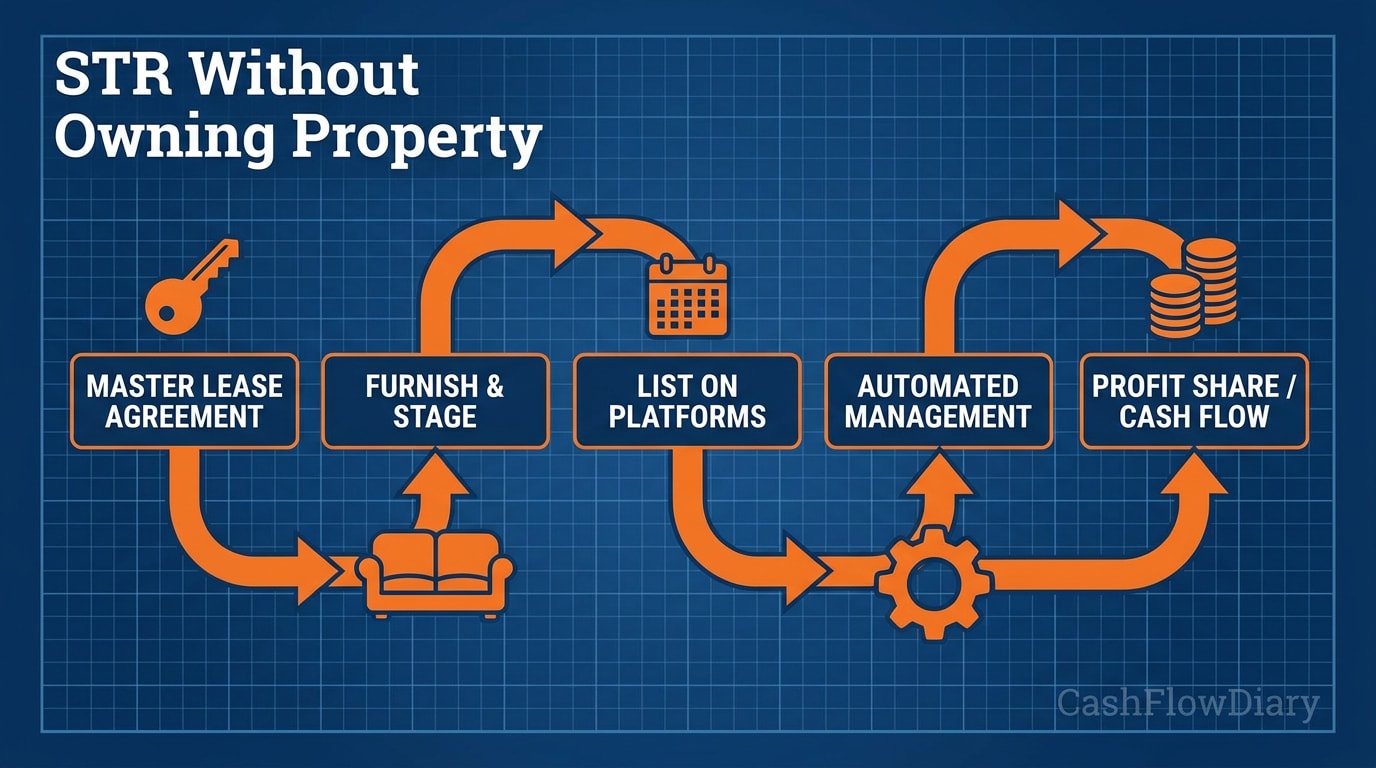
You can start a short-term rental business without owning property by leasing a unit with written landlord permission to sublet it as a short-term rental (rental arbitrage) or by co-hosting a unit someone else owns, then moving it through 5 gated stages. In the illustrative 1-bedroom below, a $1,500 lease covers its fixed costs at about 48% occupancy, and each stage has a gate you must pass before you spend money on the next one.
I have worked in real estate for more than 18 years and focused on short-term rentals since 2016. After building a list of more than 10,000 operators, the pattern I see is consistent: first units almost always fail at a skipped gate, not at the couch. They signed a lease before the numbers worked, listed before they had permission, or took bookings before the cleaning schedule existed. This blueprint is built around those gates.
It covers one thing: getting your first lease-based or co-hosted unit live. If you want the full execution list, the 47-step STR launch checklist goes item by item. If you are still choosing between arbitrage, co-hosting and a master lease, start with how to start an Airbnb business without owning property. If you want the income math for growing to several units, read how to make $10,000 a month with short-term rentals once this first unit is running.
The 5-Step Blueprint at a Glance
Work the stages in order. Each one ends with a go/no-go gate, and you do not move forward until the gate is passed. The one exception is Stage 5: build it while you prepare the listing in Stage 4, and finish it before the listing goes live.
Pick the market with numbers. Model one specific unit at conservative occupancy and confirm it still covers rent, utilities, cleaning, fees and supplies.
Secure permission. Get written short-term rental consent from the landlord (a lease addendum) or a signed co-host agreement with the owner, and confirm the city allows the use and what registration it requires.
Furnish for one target guest. Choose a single guest persona and buy for comfort first, function second, aesthetics third.
List and price for launch. Go live slightly below market for roughly the first 2 weeks to earn your first reviews, then move to demand-based pricing.
Automate messaging and turnovers before the first booking. Templates, scheduled messages, cleaner assignments and a supply restock routine all exist before a guest pays.
The table below turns those five stages into a planning sheet. The time and cash figures are my working estimates for a single 1-bedroom at a $1,500 monthly rent, not survey data, and your market will move them.
Stage | Gate to pass | Typical time | Typical cash (estimate) |
|---|
1. Pick the market | Breakeven occupancy at or below 50% using conservative ADR | 1 to 2 weeks | $0 to $150 for market data |
2. Secure permission | Signed STR addendum or co-host agreement, plus a confirmed legal path in the city | 2 to 6 weeks | $3,000 (first month plus a one-month deposit) plus local permit fees |
3. Furnish | Furnishing budget pays back in 18 months or less at the base case | 2 to 3 weeks | $6,000 to $9,000 |
4. List and price | At least 3 reviews within the first 30 days live | 1 week to list, 2 weeks at launch price | $150 to $300 for photos |
5. Automate | Every template, cleaner assignment and restock step tested before booking 1 | 3 to 5 days | Low monthly software cost |
Add those rows up and a first arbitrage unit needs roughly 6 to 12 weeks and $9,000 to $12,500 in cash before it earns anything. Co-hosting can cut the cash line sharply because the owner usually pays for furniture, but you give up a large share of the revenue in exchange. For a line-by-line version, see the rental arbitrage startup costs breakdown.
Stage 1: Pick the Market With Numbers
Most new operators choose a market based on where they live or where they vacation. Start with the numbers instead. Proximity helps with a first unit, but only after the unit passes the math.
What to do. Pull comparable listings for the exact unit type you plan to lease (same bedroom count, similar location, similar amenities) using a market data tool such as AirDNA or Rabbu, or by hand from live listings. Record the average daily rate (ADR) and occupancy for the typical listing, not the best one. Then price the lease you could realistically sign.
My screening rule of thumb, not an industry statistic: I look for markets where the top performers earn well above the median ADR, because that spread tells me operators are leaving money on the table. If the median comparable earns $150 a night and the top 20% earn $240 or more, better execution has room to pay. I also want comparables that are already filling most of their calendar, because that shows real demand rather than hopeful listings. Treat both as filters for where to look, then let your own unit model decide.
The worked example. Here is one illustrative 1-bedroom, modeled the way I model every first deal. Gross revenue is 30.4 average nights per month x occupancy x ADR. I assume an average stay of about 3 nights, so a $69 turnover works out to roughly $23 per booked night, plus $5 per night in consumables. The Airbnb host fee uses the 3% split-fee rate.
Line item (illustrative 1BR) | Monthly figure | How it is calculated |
|---|
ADR | $150 | Conservative comparable rate |
Occupancy | 65% | Base-case assumption |
Booked nights | 19.76 | 30.4 x 0.65 |
Gross revenue | $2,964.00 | 19.76 x $150 |
Airbnb host fee (3%) | -$88.92 | $2,964.00 x 0.03 |
Cleaning | -$454.48 | 19.76 nights x $23 |
Supplies and consumables | -$98.80 | 19.76 nights x $5 |
Rent | -$1,500.00 | Lease |
Utilities and internet | -$200.00 | Estimate |
Net cash flow | $621.80 | $2,964.00 minus all costs above |
Now run breakeven. Each booked night contributes $150 minus $4.50 in host fees, $23 in cleaning and $5 in supplies, which leaves $117.50. Fixed costs are $1,700 (rent plus utilities). $1,700 / $117.50 = 14.47 nights, and 14.47 / 30.4 = 47.6% breakeven occupancy. At 50% occupancy the unit books 15.2 nights and nets about $86. At 65% it nets $621.80.
Gate. Go only if breakeven occupancy sits at or below 50% using a conservative ADR and the fee structure your account will actually be on, and the deal still covers rent in the slow season. If breakeven needs more than 50%, the deal has too little cushion. Walk away or negotiate the rent down.
Time and cash. One to two weeks of evenings. Data subscriptions are optional; a spreadsheet and live listings will do for one unit.
Stage 2: Secure Written Permission
The most expensive mistake at this stage is signing a standard residential lease and then running short-term rentals without disclosure. That kills deals when the owner finds out, and owners do find out, through neighbors, HOA complaints, or a listing that shows up in a search. It can also mean an eviction with your furniture inside the unit.
What to do. Ask for permission in writing. Pitch the owner plainly and truthfully: explain that you will furnish the unit, handle cleaning and maintenance, and pay rent on time whether or not the calendar fills. Many owners will say no. That is normal, and it is why you contact more than one. When one says yes, get an STR addendum signed that states subletting to short-term guests is allowed, who carries which insurance, how many guests are permitted, and what happens if the city changes its rules. Airbnb's responsible hosting guidance for the United States tells hosts to read their lease agreement and check with their landlord. For the pitch language and clause list, see the landlord pitch script and lease clauses.
If you are co-hosting instead, the owner already controls the property. Your document is a co-host agreement covering your revenue share, who pays for furnishing and repairs, which platform account the listing sits in, and how either side exits.
Then check the city. Many cities restrict or register short-term rentals. New York City, for example, requires hosts of short stays to register with the Mayor's Office of Special Enforcement under its registration law before listing. Search your own city's code for "short-term rental" and confirm whether you need a registration number, a business license, or a lodging tax account before the listing goes live. The SBA's licenses and permits guide is a sensible starting checklist for the federal, state and local layers.
Gate. Signed landlord STR consent or co-host agreement in hand, plus a confirmed legal path in the city (permit, registration, or a written confirmation that none is required). No document, no furniture.
Time and cash. Two to six weeks, mostly waiting on owners and city offices. Budget first month's rent plus deposit, which is $3,000 in the example, plus whatever the local permit costs.
Stage 3: Furnish for One Target Guest
Every unit has one primary guest type: business traveler, family vacationer, romantic getaway, or digital nomad. Your furnishing budget and choices flow from that one decision. The mistake here is furnishing for your own taste, or buying a little for every guest type and nothing well for any of them.
Pick the persona your comparables show booking the most in that neighborhood, then buy for them:
Business traveler: fast WiFi, a dedicated desk, blackout curtains, a single-serve coffee maker.
Family: pack-n-play, high chair, outlet covers, streaming subscriptions.
Romantic getaway: mood lighting, good-quality linens, a jacuzzi if the unit has one.
Digital nomad: an external monitor or two, an ergonomic chair, a proper coffee setup.
Then spend in this order, which I call the rule of three:
Comfort (sleep quality, temperature). Mattress, bedding and climate control come first because they drive reviews.
Functionality (WiFi, workspace, kitchen). Test the internet speed before you buy anything decorative.
Aesthetics (photos, first impressions). This matters for clicks, but a beautiful unit with a bad bed collects 4-star reviews.
Gate. The furnishing budget should pay back within 18 months at the base case. In the example, $8,000 of furniture divided by $621.80 of monthly net is 12.9 months, which passes. If your quote pushes payback past 18 months, cut decor, not the mattress.
Time and cash. Two to three weeks including delivery and assembly. My estimate for a 1-bedroom is $6,000 to $9,000 depending on market and how much you buy used.
Stage 4: List and Price for Launch
Go live on Airbnb first, and add Vrbo once the listing is stable. A new listing has no reviews, so the job for the first weeks is to earn them.
What to do. Book professional photos after furnishing is complete, not before. Write the description for the persona you chose in Stage 3. Set a slightly below-market launch price for roughly the first 2 weeks to build reviews, then switch on demand-based pricing through a tool such as PriceLabs and let it adjust by season, weekday and lead time.
Know your platform costs before you set a floor price. Under Airbnb's split-fee structure most hosts pay a 3% service fee while guests pay roughly 14.1% to 16.5%. Under the host-only fee structure, which Airbnb makes mandatory for most hosts who connect property management software, most hosts pay 15.5% and the guest pays nothing extra. A 15.5% fee on the example's $2,964 of gross revenue would be $459.42 instead of $88.92, which would cut net cash flow to $251.30. At 15.5%, each booked night contributes $98.75, so breakeven rises to about 57% occupancy (17.22 nights), which fails the 50% gate. If you plan to connect a PMS such as Hospitable in Stage 5, model this case in Stage 1, not the 3% one. Confirm which structure applies to your account.
Gate. At least 3 reviews within the first 30 days live. That is my rule of thumb for knowing the launch price did its job. If you have fewer, look at the photos, the title and the first-image thumbnail before you cut price again.
Time and cash. About a week to build and publish the listing, then 2 weeks at launch pricing. Photos typically run $150 to $300 in my experience.
Stage 5: Automate Before the First Booking
Set up your messaging and turnover system before you get your first booking. In practice that means finishing this stage before you publish the Stage 4 listing. The first week of messages will overwhelm you if you are responding manually, and a missed check-in message on booking 1 costs you a review you cannot get back.
What to do. In Airbnb's own scheduled messages, or in a property management tool such as Hospitable (connecting one typically moves you to the 15.5% host-only fee), write and schedule:
A booking confirmation with house rules.
Check-in instructions sent 2 days before arrival.
A mid-stay check sent the first morning.
A checkout reminder sent the evening before.
A review request sent after checkout.
Then build the turnover side. Line up a primary cleaner and a backup, share a cleaning checklist with photos of how each room should look, and set a restock routine so consumables never run out. Test the whole chain with a friend booking a night if you can.
Gate. Every template, cleaner assignment and restock step has been tested at least once before booking 1 arrives. If a step in the chain depends on you remembering to do it, it is not automated yet.
Time and cash. Three to five days. Software costs are low relative to rent, and many tools price per listing.
Where First Units Fail
I've watched thousands of first units, and the failures cluster in a few places, and each one maps to a skipped gate:
The numbers only worked at peak season. The operator modeled 80% occupancy and a summer ADR. Run the model at your slowest month before you sign.
Permission was verbal or assumed. "The landlord seemed fine with it" is not consent. Get the addendum signed.
The city changed the rules. Registration laws can arrive after you launch. Include a lease addendum clause that covers what happens if STR use becomes restricted.
Furnishing ate the runway. Spending $12,000 on a unit netting $600 a month means a 20-month payback before any profit.
Taxes were ignored. Rental income is taxable, and IRS Publication 527 explains how residential rental income and expenses are reported. Short stays with substantial services can be treated differently, so talk to a tax professional before year-end.
If you want a second set of eyes on your first deal before you sign, book a complimentary one-on-one diagnostic call and we will walk through your numbers together.
Frequently Asked Questions
What are the steps to launch a first short-term rental without owning it?
Lease with written permission or co-host, then follow the 5 stages above. The two common routes are rental arbitrage, where you lease a unit and sublet it to short-term guests with the landlord's written permission, and co-hosting, where you manage a unit someone else owns for a share of revenue. Both require that the city allows short-term rentals at that address.
How much money do I need to start rental arbitrage?
For a single 1-bedroom at $1,500 a month in rent, my working estimate is $9,000 to $12,500. That covers first month plus deposit, $6,000 to $9,000 of furniture, photos and optional market data. Co-hosting can cost far less because the owner usually funds the furnishing.
Is rental arbitrage legal?
It is legal where the lease allows subletting to short-term guests and the city allows short-term rentals. Many cities require registration or a permit, and some restrict short stays heavily. Get written landlord consent and confirm the local rules before you list.
What occupancy do I need to break even?
It depends on your rent and costs, so calculate it for your unit. In the illustrative 1-bedroom, fixed costs of $1,700 divided by $117.50 of contribution per booked night equals 14.47 nights, or about 48% occupancy. My rule of thumb is to pass only deals that break even at 50% or lower.
Should I use Airbnb's split-fee or host-only fee?
Hosts who do not connect property management software are usually on the split fee, where the host pays about 3% and the guest pays a separate service fee. Host-only pricing puts about 15.5% on the host but shows guests a cleaner total price. Model both before you set your minimum nightly rate.
How long does it take to get a first unit live?
Plan on roughly 6 to 12 weeks from market research to first booking. Permission is usually the slowest stage because you are waiting on owners and city offices. Furnishing and automation can run in parallel once the lease or co-host agreement is signed.
Sources
Related Reading