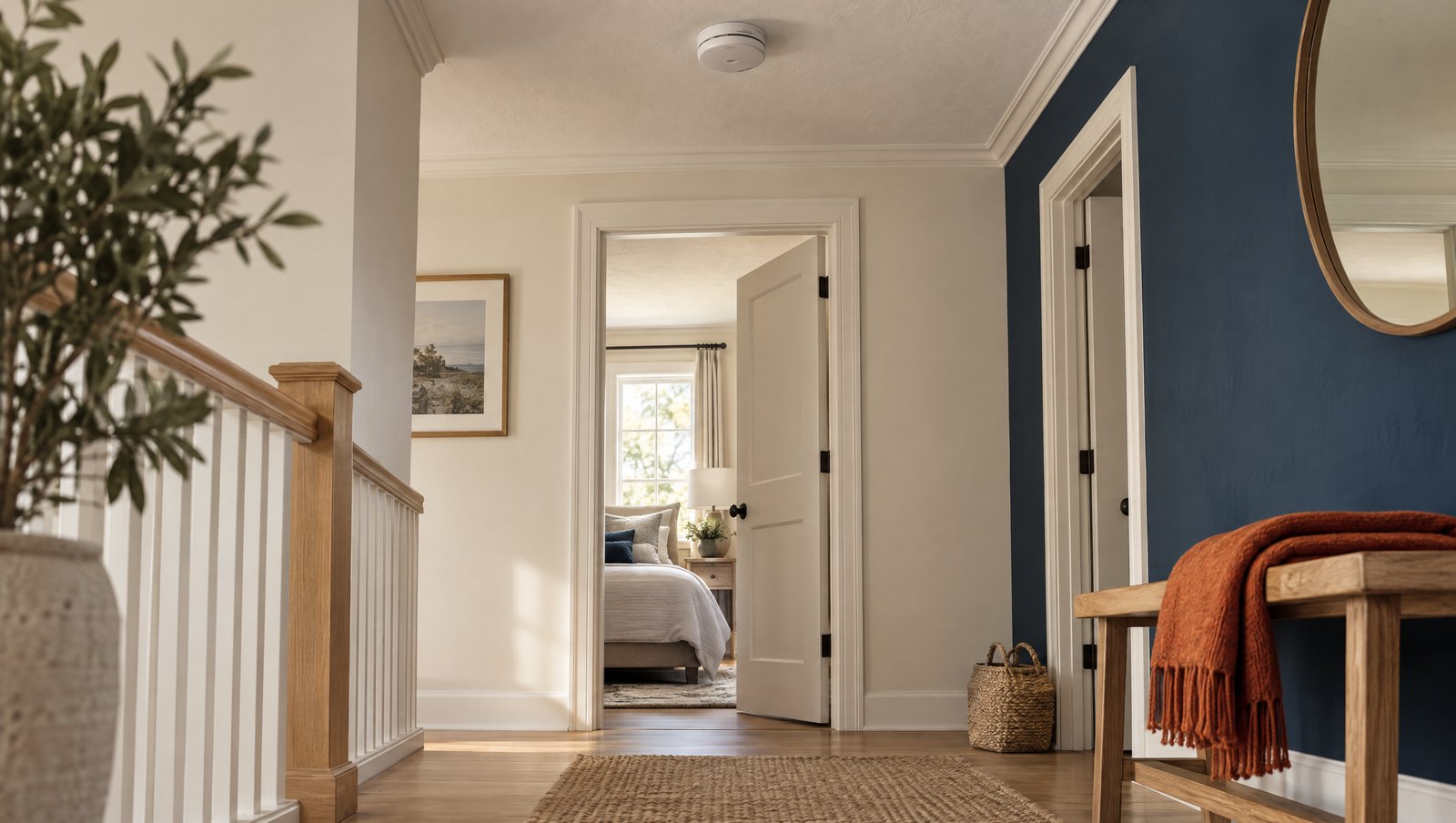
You can walk into your city's safety inspection ready, and give Airbnb no reason to act against your listing over a dead alarm, if you set up alarms for the code that applies to your address. Airbnb smoke detector requirements don't include a fixed number of devices for U.S. listings. Its rules say hosts should state whether smoke and carbon monoxide (CO) alarms are present and keep any that are present working and tested, and must follow local fire codes. The real minimum comes from your city, county or state. Phoenix, for example, points to NFPA 72, the national fire alarm code. The National Fire Protection Association's guidance puts a smoke alarm inside each bedroom, outside each sleeping area and on every level, with CO alarms outside sleeping areas and on every level.
Maybe you're standing in a hallway with one alarm on the ceiling, wondering if that's enough, or if the inspector will fail you over the third bedroom. Maybe a guest just messaged at 2 a.m. about a chirping alarm and you're not sure what Airbnb expects you to do. Getting this wrong can delay a permit, put the listing at risk and, in the worst case, leave a family asleep in your house without a warning. This guide shows you what Airbnb checks, what local rules add, where each device goes, and how to keep proof that every alarm works. If you already run several units, the testing log near the end turns this into one line on your turnover checklist.
What Airbnb Actually Requires for Smoke and CO Alarms
Airbnb's policy asks hosts to disclose their alarms, keep them working and follow local law. Its Help Center page on safety requirements for homes says hosts should clearly state whether smoke and CO detectors are present. If they are, the detectors need to be in working order and hosts should test them regularly. The same page says hosts must follow relevant laws and safety regulations, "such as applicable fire code requirements and safe occupancy limits."
That fire code clause is what ties Airbnb's rules to your local code. Airbnb lists "inoperable smoke detectors" as an example of a fire hazard hosts must address before accepting reservations. If Airbnb learns a host failed to fix a known hazard, the policy says it may issue warnings, require proof of the fix, cancel reservations, or suspend or remove the listing. Hosts are also accountable for violations by co-hosts, employees and others they allow to help with hosting.
Three more details matter when you set up a listing:
The listing editor records your devices. Airbnb's smoke and carbon monoxide alarm page walks through it: Listings, then Listing editor, then Guest safety, then Safety devices, where you select Smoke alarm and Carbon monoxide alarm.
"Not necessary" is narrow. The same page lets you mark a CO alarm as not necessary only if the place uses electric appliances only and has no attached garage. It also warns that local rules may require more than one working alarm of each kind.
The free alarm is one device. Airbnb offers one self-contained, battery-powered combination smoke and CO alarm to eligible hosts at no cost. That helps, but one unit can't cover a house that needs an alarm in every bedroom.
Airbnb's Carbon Monoxide Alarm Program, which sets a 60-day deadline and a payout withholding, currently applies to listings in Mexico. For a U.S. host, the deadline that matters is your local permit or inspection date.
Local Law Sets the Real Minimum
Your city, county or state decides how many alarms you need, where they go and who inspects them. The National Conference of State Legislatures' summary of carbon monoxide detector laws says states vary: some require CO detectors in multifamily buildings, some only where there's fuel-burning equipment, some only at sale or renovation, and several leave fire and building codes to local governments. NCSL notes its page may not reflect every requirement, so treat it as a starting map.
Short-term rental ordinances can go further than the state rule. Three examples show the range:
City | Alarms | Extra |
|---|
Phoenix, AZ | Per NFPA 72 | Kitchen extinguisher |
St. Augustine, FL | Bedrooms, levels | Yearly inspection |
San Diego, CA | Bedrooms, levels | Affidavit if uninspected |
Phoenix. City Code Section 10-205 requires a working smoke and CO detection and notification system "maintained as required under NFPA 72," plus a portable fire extinguisher in the kitchen and in any area with an open fire source, such as a fireplace or grill. Section 10-197 of the same article asks permit applicants for a written description or map showing where the smoke detector, CO detector and extinguisher are, and the city publishes a safety equipment map form for it.
St. Augustine. The fire department's life safety information sheet says the city's vacation rental ordinance requires a life safety inspection at registration and every year after. It lists smoke alarms in each sleeping room, in areas giving access to sleeping rooms and on each level, CO detectors in sleeping areas where there are gas appliances or an attached garage, a mounted extinguisher on each level, emergency lighting and a posted evacuation plan in each bedroom.
San Diego. San Diego Fire-Rescue's short-term rental self-inspection guide lists smoke alarms in all sleeping rooms, outside sleeping areas and on every level, and CO alarms outside sleeping areas and on all levels. Where no inspection is required, the host signs an affidavit of compliance under penalty of perjury.
If your town requires a permit, read its safety section before you buy a single device. Details such as Phoenix's posted emergency-contact notice or St. Augustine's evacuation plan in each bedroom are easy to meet when you know about them before you apply or schedule an inspection. If you're still deciding whether a market's rules fit your plan, a complimentary one-on-one diagnostic call can help you weigh the compliance work against the numbers before you commit. For the permit side of a lease deal, see the permit contingency guide for master leases.
Where Smoke and CO Alarms Go, Room by Room
Put a smoke alarm inside every bedroom, one outside each sleeping area and at least one on every level, including the basement. That's the National Fire Protection Association's guidance on installing and maintaining smoke alarms, which notes that NFPA 72 has required alarms inside every sleep room, even in existing homes, for many years. On a level without bedrooms, NFPA suggests the living room, the den or family room, or near the stairway to the upper level.
CO alarms follow a similar pattern. NFPA's carbon monoxide safety page says to install them in a central spot outside each sleeping area, on every level, and anywhere else local laws or codes require. San Diego's guide adds that a bedroom with a fuel-burning appliance such as a fireplace needs a CO alarm inside the bedroom.
Where | Smoke | CO |
|---|
Each bedroom | Yes | If fuel in room |
Sleep-area hall | Yes | Yes |
Each level | Yes | Yes |
Basement | Yes | Yes |
Two upgrades are worth considering even where your code doesn't require them. First, interconnect the alarms so that when one sounds, they all sound. NFPA cites a Consumer Product Safety Commission survey in which alarms sounded in 53% of fires in homes with interconnected alarms, compared with 37% where alarms were on all floors whether or not they were linked. Interconnection can be hard-wired or wireless, and NFPA says linked alarms should come from the same manufacturer so they work together. Second, buy only alarms that carry the label of a recognized testing laboratory, which NFPA advises for both smoke and CO alarms.
Count the devices for one house: a hypothetical example
This is a hypothetical house, not a code ruling: a two-story home with a basement, three bedrooms off one upstairs hallway, a gas furnace and water heater in the basement, a gas fireplace in the living room and an attached garage.
Level | Smoke | CO |
|---|
Upper | 4 | 1 |
Main | 1 | 1 |
Basement | 1 | 1 |
Total | 6 | 3 |
Upstairs, the four smoke alarms are one in each bedroom plus one in the hallway outside them. Combination smoke and CO units can cover the three spots that need both (the upstairs hallway, the main level and the basement), so this house could meet both counts with three smoke-only alarms in the bedrooms and three combination units. A city like Phoenix or St. Augustine would also expect extinguishers, and your local code may add rules this example doesn't cover. Check before you buy.
How to Set Up Safety Alarms for a Listing: A Seven-Step Process
Work in this order: rules first, then a floor plan, then devices, then proof. The sequence below keeps you from buying the wrong alarms or filling in the listing editor before the house matches it.
1. Pull your local requirements
Find your city or county short-term rental ordinance and its safety section, plus any fire department checklist. Note device types, locations, extinguisher rules and whether an inspection or affidavit is required.
2. Sketch the floor plan
Draw each level, mark every bedroom, hallway and stairway, and circle every fuel-burning appliance and the garage door. Phoenix asks permit applicants for a map or written description of where the safety devices are, and this sketch is the start of one.
3. Mark every alarm position
Use the room-by-room table above, then add anything your local rule requires. Count smoke positions, CO positions and extinguishers separately.
4. Buy and install listed devices
Choose alarms with a recognized testing laboratory label. Decide between hard-wired, wireless interconnected and sealed 10-year battery units, and follow each manufacturer's mounting instructions.
5. Test every device and photograph it
Press each test button, confirm it sounds, and take a dated photo of each installed device. Those photos become your proof for an inspector, an insurer or Airbnb.
6. Update the listing editor
In Guest safety, select Smoke alarm and Carbon monoxide alarm under Safety devices. Mark a CO alarm as not necessary only if the house has no fuel-burning appliances and no attached garage, and your local rule doesn't require one anyway.
7. Add alarm checks to the turnover checklist
Check that every alarm works as part of each clean. The schedule in the next section shows what to log and when.
If you're building the rest of your setup list, the 47-step STR launch checklist places safety work in the full sequence from property to first booking.
Test and Replace Alarms Between Guests
Test smoke and CO alarms at least once a month, and replace them on the manufacturer's schedule. NFPA gives the monthly test for both kinds of alarm. A sealed 10-year smoke alarm that chirps for a low battery should be replaced as a whole unit right away; alarms with any other battery need a new battery at least once a year. San Diego's guide uses 10 years as the outer limit for smoke alarms and 7 years for CO alarms, unless the manufacturer says otherwise.
Task | When | Proof |
|---|
Press test button | Monthly | Dated log line |
Non-sealed battery | Yearly | Receipt or photo |
Replace smoke unit | 10 yrs max | Date on back |
Replace CO unit | Per maker | Date on back |
Extinguisher tag | Yearly | Service tag |
Monthly is the minimum. If the rental turns over more often than that, a short check at each clean catches problems a monthly test can miss: a missing alarm, a cover a cleaner removed to stop a chirp, or a unit painted over during a refresh. Keep the log with your cleaning records. The maintenance schedule built on turn counts shows how to fold recurring checks like this into one calendar, and the hot tub turnover log uses the same record-keeping habit for another high-liability amenity.
Add one line to your house manual too. NFPA advises calling your fire department's non-emergency number to learn what number to call if a CO alarm sounds, and getting everyone to fresh air first. Put that local number and a one-sentence instruction where guests will see it.
What Happens When a Guest Reports a Problem
Treat a guest report of a chirping, missing or silent alarm as a hazard you fix before the next check-in. Airbnb's policy says hosts must address known hazards before accepting reservations, and an inoperable smoke detector is one of its examples. In practice, that means a spare alarm and batteries in the owner's closet, and a cleaner or handyman who knows how to swap them the same day.
Write down what you did: the time of the report, the replacement, a photo of the new unit sounding on test, and a message to the guest confirming the fix. If Airbnb asks for proof, you have it. If your insurer asks after a claim, you have it there too. The STR insurance coverage breakdown is a good place to check what your policy expects from you on safety and maintenance.
Operators in Maryland have a state law on top of all this; the Maryland STR fire safety law guide covers its deadlines.
Frequently Asked Questions
Does Airbnb require smoke detectors?
Airbnb doesn't set a device count for U.S. listings. Its safety policy says hosts should state whether smoke and CO detectors are present, keep any present alarms working and tested, and follow local fire codes. It also strongly encourages installing them and lists inoperable smoke detectors as a hazard hosts must fix before accepting reservations.
How many smoke detectors does an Airbnb need?
That depends on your local code and the house. Some cities, such as Phoenix, point to NFPA 72, and NFPA's guidance calls for an alarm inside each bedroom, one outside each sleeping area and at least one on every level, including the basement. The hypothetical three-bedroom, two-story house with a basement above needs six.
Do I need a carbon monoxide detector for my Airbnb?
If the house has any fuel-burning appliance, such as a gas furnace, water heater, stove or fireplace, or an attached garage, plan on CO alarms outside each sleeping area and on every level. Airbnb only lets you mark a CO alarm as not necessary when the home is all-electric with no attached garage, and local rules can still require one.
Is Airbnb's free smoke and CO alarm enough?
It's one self-contained combination alarm. It can fill one hallway or one level position, but it won't satisfy a rule that requires alarms in every bedroom and on every level. Count it as one device toward your total.
How often should I test the alarms in a short-term rental?
NFPA says to test smoke and CO alarms at least once a month. If you have more than one turnover a month, a quick test at each clean is a simple habit, and a dated log gives you proof if an inspector, insurer or Airbnb asks.
Sources
Airbnb Help Center, Safety requirements for homes (retrieved 2026-10-15)
Airbnb Help Center, Home safety: Smoke and carbon monoxide alarms (retrieved 2026-10-15)
Airbnb Help Center, Carbon Monoxide Alarm Program (retrieved 2026-10-15)
National Fire Protection Association, Installing and maintaining smoke alarms (retrieved 2026-10-15)
National Fire Protection Association, Carbon monoxide safety (retrieved 2026-10-15)
National Conference of State Legislatures, Carbon Monoxide Detector Requirements, Laws and Regulations (retrieved 2026-10-15)
City of Phoenix, City Code Chapter 10, Article XVI, Sections 10-197 and 10-205 (Phoenix City Code online, retrieved 2026-10-15)
City of Phoenix Planning and Development, Description / Map of Safety Equipment, Short-Term Rental (retrieved 2026-10-15)
St. Augustine Fire Department, Short-Term Rental Life Safety Information (retrieved 2026-10-15)
San Diego Fire-Rescue, Short Term Rental Self-Inspection Guide (retrieved 2026-10-15)
This article is for educational purposes only and is not legal, fire-code or insurance advice. The house in the device-count example is hypothetical. Fire and building codes vary by state and city and change; confirm your requirements with your local fire department or code office before you list.