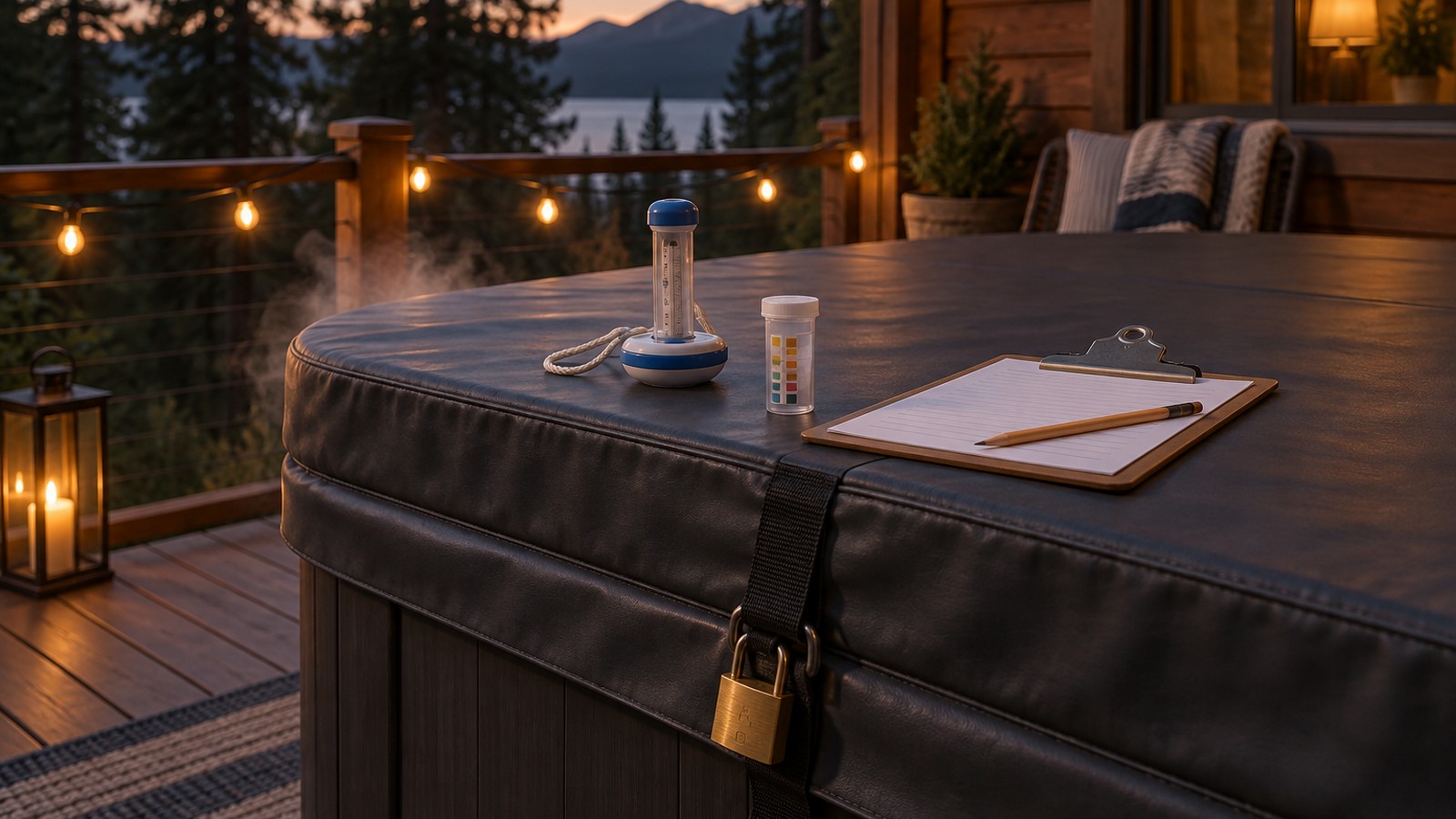
Log every turnover and you'll keep an Airbnb hot tub from turning into a refund, a one-star review or a liability claim. It needs a commercial-style routine: test and record the water before every check-in, keep the heater at or below 104°F, drain and refill on a set schedule, lock the cover between stays and put the rules in writing.
That routine costs less than one bad stay. A cloudy tub, a guest rash or an unlocked cover a neighbor's child can open will cost you far more than the test strips.
The story I hear most often goes like this: the owner adds a hot tub to lift the nightly rate, the first few weeks go well, and then a guest messages at 10 p.m. that the water is green, the jets smell like a locker room, or their kid has a red, itchy rash. The host refunds a night, the review mentions "dirty," and the amenity that was supposed to raise revenue starts costing it.
I've spent 18+ years in real estate and have focused on short-term rentals since 2016. In my experience, most hot tub problems at a rental start when the owner treats a tub that strangers use every few days like a backyard tub a family uses on weekends.
This guide covers why a rental tub is different, the health and safety risks, what drain-cover law and insurance actually say, a turnover maintenance schedule, illustrative annual costs, guest rules, and a five-step process for building a per-stay log that doubles as your evidence file.
The figures in this article, tables and prose examples, are illustrative and are not a quote, a forecast or legal advice. Check your local health and building codes, your insurer and the tub manufacturer's manual before you set your own numbers.
Why an Airbnb Hot Tub Is Not a Backyard Hot Tub
A family hot tub has the same few bathers, a predictable schedule and an owner who notices when the water looks off. A rental tub gets new bathers every few days, often wearing sunscreen, lotion and hair product, and nobody watches it between your visits.
That changes three things:
Bather load is higher and less predictable. Six adults on a ski weekend put far more sweat, oils and organic waste into the water than two owners on a Tuesday. Sanitizer gets used up faster.
Nobody reports early problems. A family notices the water getting hazy and adds shock. A guest assumes that is how your tub looks, uses it anyway and complains after checkout.
You are the operator of record. If someone is hurt, the question becomes what you did to keep the tub safe, and whether you can show it.
The amenity math belongs in a separate decision. If you haven't yet decided whether a tub will pay back in your market, start with the amenity ROI framework. This article assumes the tub is already there or already approved.
Water Safety: Legionella, Rashes and Temperature
Warm water is a good place for bacteria to grow. Two risks matter most for a rental.
Legionella. Wikipedia's article on hot tubs notes that outbreaks of Legionnaires' disease have been traced to poorly sanitized hot tubs. Its article on Legionnaires' disease explains that Legionella can contaminate hot water tanks, hot tubs and cooling towers, and that the disease is typically spread by breathing in mist that contains the bacteria. A bubbling tub makes mist, which is why sanitation is not optional.
Hot tub folliculitis. This rash is caused by Pseudomonas aeruginosa, a waterborne bacterium that thrives in warm, moist environments. According to Wikipedia's summary, it typically follows exposure to contaminated water in hot tubs, whirlpools or pools, and most people see the rash resolve on its own within one to two weeks. Medically that is mild, but a guest with a rash may well mention it in the review.
Temperature. The U.S. Consumer Product Safety Commission recommends that hot tub water never exceed 104°F, as summarized in Wikipedia's hot tub article. The same article notes that 100°F is considered safe for a healthy adult and that soaking in water above 102°F can cause fetal damage in the first trimester of pregnancy. Set the heater at or below 104°F and post the pregnancy and health warnings with your house rules.
Two practical habits keep you on the right side of all three:
Test before every check-in. Use test strips or a reagent kit, and keep sanitizer and pH within the ranges in your tub manufacturer's manual and any local health code that applies to you.
Record it. A reading nobody wrote down protects nobody.
Build those two habits and you'll know your tub is ready before the guest arrives. If you want help building the log, the cleaner checklist and the house rules around your own listings, book a complimentary one-on-one diagnostic call and we'll map your turnover routine.
Drain Covers, Locks and Legal Exposure
Two hardware items carry most of the legal risk at a rental tub: the drain cover and the lid.
The Virginia Graeme Baker Act
The Virginia Graeme Baker Pool and Spa Safety Act is a federal law signed on December 19, 2007. It is named after Virginia Graeme Baker, who died in 2002 after the suction from a spa drain trapped her underwater.
Under 15 U.S. Code § 8003(c), starting one year after that date, each public pool and spa in the United States must be equipped with anti-entrapment devices or systems that comply with the ASME/ANSI A112.19.8 standard. A public pool or spa with a single main drain, other than an unblockable drain, also needs at least one added protection. The statute lists a safety vacuum release system, a suction-limiting vent system, a gravity drainage system, an automatic pump shut-off system and drain disablement, among others.
The open question for hosts is scope. The statute's definition of a public pool and spa includes one open exclusively to "patrons of a hotel or other public accommodations facility." Whether a single-home short-term rental counts depends on how your state and local health department read that phrase and their own codes. I don't treat it as settled, and you shouldn't either.
I treat every rental tub as if the drain rules apply.
Check the drain cover for the compliance marking and its expiration or replacement date, which is usually listed on the cover or in the manual.
Replace cracked, loose or missing covers before the next guest, never after.
Ask your local health department whether your rental is regulated as a public spa, and keep the answer in your file.
Covers, locks and attractive nuisance
A tub cover is your first safety device and your cheapest one. A locked, rated cover keeps out children, pets and leaves, and holds heat.
The attractive nuisance doctrine is the legal reason locks matter. Wikipedia describes it as a doctrine that has been applied to hold landowners liable for injuries to trespassing children caused by things like trampolines and swimming pools. A hot tub on an open deck is the kind of hazard a child can be drawn to, even when no guest is staying.
Three controls cover most of the risk:
Locking cover straps closed at every turnover, with the key or code given only to registered guests.
A gate or barrier where your local code requires one around a pool or spa.
A line in your checkout instructions that tells guests to put the cover back on and lock it, and a line in your cleaner's checklist to confirm it.
Risk | Control | Proof |
|---|
Child access | Locked cover | Photo |
Drain trap | Rated cover | Label |
Overheating | 104°F cap | Log |
Bacteria | Test, shock | Log |
Shock risk | GFCI test | Log |
On the last row: Wikipedia's hot tub article cites CPSC guidance urging ground-fault circuit-interrupter (GFCI) protection for pools, spas and hot tubs. Have an electrician confirm the tub's GFCI and test it on the schedule in your manual.
Insurance: What AirCover Does and Doesn't Replace
Airbnb's AirCover for Hosts page lists $1M in liability insurance for the rare event that a guest gets hurt or their belongings are damaged or stolen. That is real protection, and it is not a reason to skip your own policy.
Read three things in your own coverage before the tub goes live:
Whether your policy names the hot tub or excludes pools and spas at short-term rentals.
Whether short-term rental use is covered at all, since a standard homeowner policy may exclude it; confirm with your insurer.
What records the insurer expects after a claim, such as maintenance logs and photos.
For the full policy checklist, see what an STR insurance policy covers and what it doesn't. For handling a claim after something is broken, see what to do when a guest damages your property.
The Turnover Maintenance Schedule
A rental tub runs on your turnover calendar, not on the weekly schedule printed in a homeowner manual. Tie each task to a trigger your cleaner or tub tech already follows.
When | Task | Who |
|---|
Each stay | Test, log | Cleaner |
Each stay | Skim, wipe | Cleaner |
Each stay | Lock cover | Cleaner |
Weekly | Shock | Cleaner |
Monthly | Rinse filter | Tech |
Quarterly | Drain, refill | Tech |
Yearly | Service | Pro |
The quarterly drain is my default for a moderately booked rental, not a rule. Shorten it when bookings are heavy, readings keep drifting or guests mention foam and odor. Follow the manufacturer's manual for filter replacement and service intervals, since they vary by model.
If you already run maintenance by turn count, add the tub to that same calendar. The method is in the turn-count maintenance schedule, and test strips, sanitizer and a spare filter belong on your supplies par-level list.
What a Hot Tub Costs to Run
In my experience, owners price the install and forget the running cost. Here is an illustrative year for one tub at a moderately booked rental. Replace each line with your own quotes and utility rates.
Cost line | Illustrative per year |
|---|
Chemicals and test strips | $600 |
Electricity | $900 |
Filters | $150 |
Tech visits and annual service | $1,200 |
Cleaner time, 2 hours per month | $600 |
Repairs reserve | $300 |
Total | $3,750 |
That $3,750 is about $310 a month. If your tub supports a $40 nightly premium and you book 12 nights a month, it adds $480 a month in revenue, or about $170 a month after running costs. One refunded night and one lost booking from a "dirty hot tub" review can wipe out that margin for the month.
Tubs can pay, but only if you count the log, the locks and the tech visits as part of the price. Watch the electricity line in winter, too; the utility cost and HVAC alerts guide shows how to catch a heater running all month.
House Rules That Protect Guests and You
Your listing and house manual should say the same thing your sign by the tub says. Keep the rules short and specific:
No children without an adult, and no one using the tub alone after drinking.
No glass in or near the tub.
Shower before soaking, and skip the tub if you have an open wound or a stomach illness.
Pregnant guests and anyone with a heart condition should check with a doctor before using it.
Keep the temperature setting as is; the heater is capped at 104°F.
Put the cover back on and lock it after every use.
Report problems right away through the app, with a photo.
The written rules do two jobs. They tell guests how to stay safe, and they show you warned them. Put the short version in your check-in message using your guest communication templates.
Building a Hot Tub Turnover Log: A Five-Step Process
The log is what turns a good routine into proof. Build it once and every stay adds to it.
Step 1 — Pick one log location
Use a shared spreadsheet or the checklist feature in your cleaning app. One place only. A paper sheet on the deck is fine as a backup, but photograph it every turnover.
Step 2 — Define the fields
Record the date, booking or guest name, sanitizer reading, pH reading, water temperature, cover locked yes or no, and who checked. Add a notes field for foam, odor, color or damage.
Step 3 — Set the pass ranges
Write the acceptable sanitizer and pH ranges from your manufacturer's manual and local code at the top of the log, plus the 104°F cap. Your cleaner should know exactly when a reading fails.
Step 4 — Decide what a fail triggers
A failed reading means one of two things: shock and retest, or close the tub and message the guest before arrival. Decide in advance who gets called and what the guest is told, so nobody improvises at check-in.
Step 5 — Review it monthly
Once a month, read the log for drift. Repeated low sanitizer readings point to bather load or a filter problem. Repeated missing entries point to a cleaner who needs retraining. Keep at least a year of logs.
Frequently Asked Questions
How often should I drain an Airbnb hot tub?
For a moderately booked rental, I default to a quarterly drain and refill. Drain sooner when bookings are heavy, readings drift or guests report foam or odor, and follow your manufacturer's manual.
What temperature should an Airbnb hot tub be?
At or below 104°F. Wikipedia's summary of CPSC guidance says water should never exceed 104°F and that 100°F is considered safe for a healthy adult.
Does the Virginia Graeme Baker Act apply to my rental hot tub?
It applies to public pools and spas, including those open to patrons of a hotel or other public accommodations facility. Whether a single-home rental counts depends on your state and local rules, so ask your health department and keep compliant drain covers either way.
Does AirCover protect me if a guest is hurt in the hot tub?
Airbnb lists $1M in liability insurance under AirCover for Hosts. Read its terms and check your own policy too, since your insurer may exclude pools, spas or short-term rental use.
Should my cleaner or a pool tech handle the hot tub?
Both. The cleaner tests, logs, skims and locks the cover each turnover, and shocks the water weekly. A tech handles filters, drains and repairs on a set schedule.
Sources