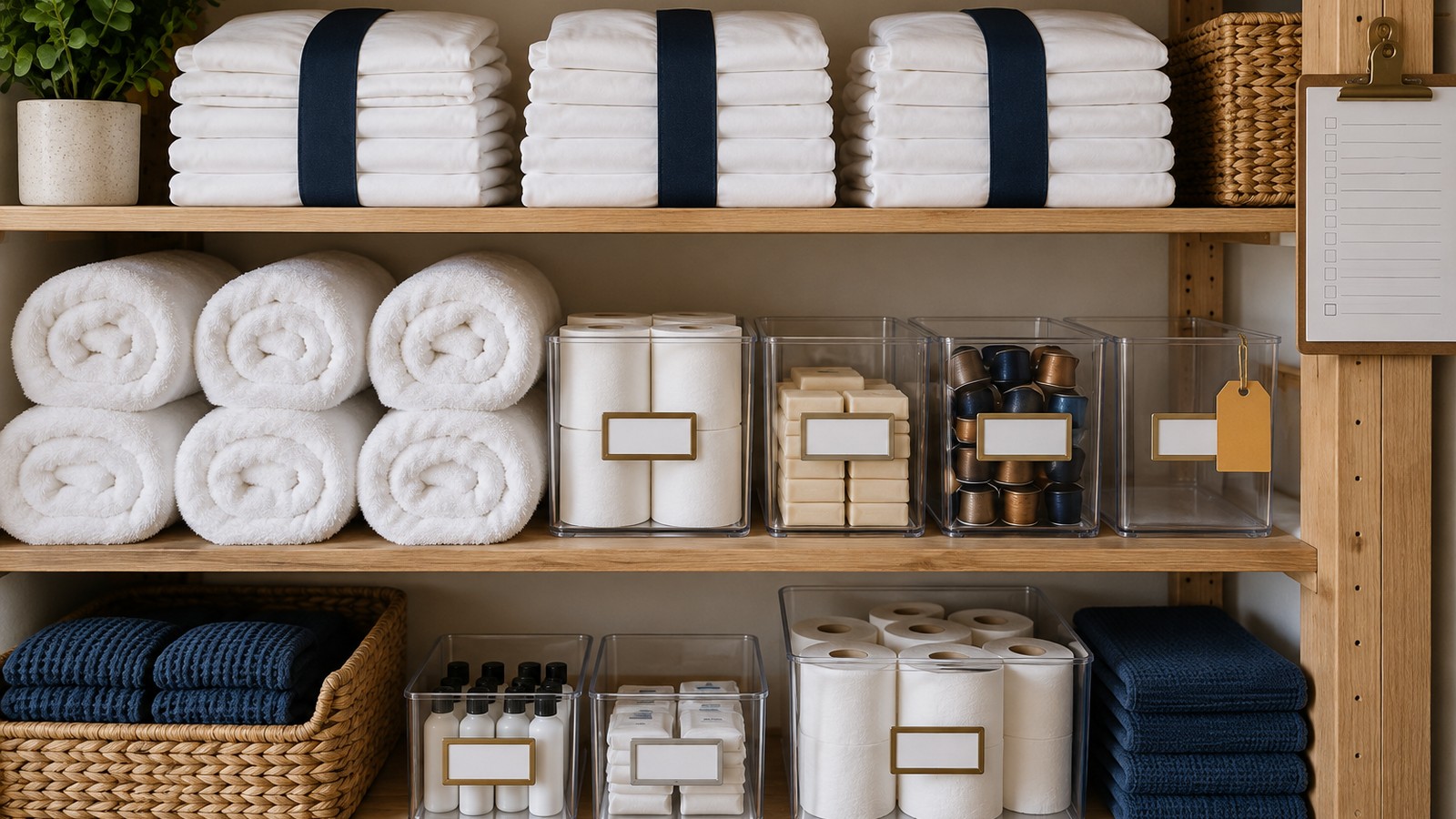
Setting par levels for your Airbnb supplies means a cleaner can finish any turnover from the closet, even when the laundry is behind and a delivery is late. A par level is the number of each item you keep on hand for one unit.
For linens, a good starting point is three sets per bed: one on the bed, one in the wash and one on the shelf. For consumables, you reorder when stock falls to what you will use before the next delivery lands, plus one turnover of cushion.
That turns a shopping list into a count your cleaner can check at every turnover.
In my experience, the stall looks the same every time. Two checkouts land on a Saturday, the second set of sheets is still in the dryer, the last roll of toilet paper went to the first unit, and the cleaner texts a photo of an empty shelf 40 minutes before check-in. The unit never had a number that said when to shop.
I've spent 18+ years in real estate and have focused on short-term rentals since 2016. The operators who stop running out treat supplies like inventory, with a par, a reorder point and a person who counts.
This guide covers what Airbnb expects you to stock, how to set par levels for linens and consumables, how to set reorder points from your turn count, and a five-step process to build the restock sheet.
What Airbnb Expects You to Stock
Airbnb's help center strongly encourages hosts to provide a short list of essentials in every listing: toilet paper, soap for hands and body, one towel per guest, one pillow per guest and linens for each guest bed (Airbnb Help Center). The same page suggests offering greater quantities for larger groups and longer stays.
Airbnb's hosting resources repeat that starting point and suggest reviewing every room to think through what guests might need during their stay (Airbnb Resource Center).
That list is the floor for one stay. A par level is what keeps the floor in place across every stay, including the week the laundry falls behind.
How Many Sets of Sheets and Towels to Keep
Hotels solved this problem long ago. A par level is the number of linen sets on hand, where one complete set for every bed equals one par, and three sets per bed is described as the ideal (American Laundry News).
The three sets rotate through a cycle. One set is in use by guests, a second is being laundered, and the third is folded and resting for at least 24 hours. The same source notes that a property not running at capacity may use a 2.5-par system instead.
A short-term rental changes every bed at every turnover, so I start at three par and adjust from there. Go to four par per bed if your laundry is off-site, if you have back-to-back same-day turnovers, or if you're more than an hour from a store.
The table below is the starting par I use for linens. These are my operating defaults. Adjust them to your damage and stain log after 60 days.
Item | Par level | Why |
|---|
Sheet sets | 3 per bed | On, in wash, on shelf |
Pillowcases | 3 per pillow | Stains fastest |
Bed pads | 2 per bed | Swap after spills |
Bath towels | 3 per guest | Guests use extras |
Hand towels | 3 per bath | One per sink, cycled |
Washcloths | 3 per guest | Makeup ruins them |
Kitchen towels | 4 per unit | Used as rags |
Count "per guest" against your listed maximum occupancy. The Saturday stall happens on the full-house booking.
Consumables: Par Levels by the Turnover
Linens rotate. Consumables leave the building. That means the par for a consumable depends on how many turnovers you run and how long a delivery takes to arrive.
Start by counting what one stay uses. Have your cleaner log, for three or four turnovers, how many rolls, pods, bags and tablets they replace. That per-turn number is the base unit for everything else.
The items that stall a turnover are rarely the expensive ones. Toilet paper, trash bags, dishwasher tablets, coffee and hand soap run out first because nobody watches them. Batteries for the smart lock and the remotes belong on the same list because a dead lock battery can keep a guest out at check-in.
Keep the owner's closet locked or coded. Guests treat anything in an open closet as theirs to use.
Reorder Points: When to Buy Before You Run Out
A reorder point is the inventory level that triggers an action to replenish the item (Wikipedia). The simple version of the formula is the demand you expect during the delivery lead time plus a safety stock (Wikipedia).
Safety stock is extra inventory held to reduce the risk of running out when supply or demand is uncertain. Lead time is the gap between starting a process and finishing it (Wikipedia), which for you means the days between placing an order and having it on the shelf.
For an operator, that becomes one line: reorder when stock falls to (turnovers during lead time + one safety turnover) × use per turnover.
Here is an illustrative example. The unit runs three turnovers a week, the delivery lead time is seven days, and the cleaner logged the per-turn use below. Three turnovers during lead time plus one safety turnover means you reorder at four turnovers' worth of stock.
Item | Per turn | Reorder at |
|---|
Toilet paper | 4 rolls | 16 rolls |
Coffee pods | 8 pods | 32 pods |
Trash bags | 3 bags | 12 bags |
Dish tabs | 2 tabs | 8 tabs |
Hand soap | 1 refill per 4 turns | 1 refill |
The figures in this article, tables and prose examples are illustrative, not measured averages. Replace them with your cleaner's counts. If your turnovers double in peak season, your reorder points double with them, so reset the sheet at the start of each season.
Adjusting for Long Stays and Peak Weeks
A 21-night stay has one turnover, but it uses far more toilet paper, soap and trash bags than a two-night stay. Airbnb's own guidance points the same way: offer greater quantities for longer stays and larger groups.
For long bookings, count use per night instead of per turn, and leave a sealed backup bundle in the unit so the guest never has to message you for toilet paper on day ten.
Peak weeks break the math in the other direction. When a unit runs five or six turnovers a week, the linen cycle gets tight, because the shelf set goes back on a bed before it has rested. That is the week a fourth par pays for itself.
Run the reorder check on the Monday before a holiday week. Suppliers slow down at the same moment your turn count spikes.
Build Your Restock Sheet: A Five-Step Process
This process takes one afternoon for a single unit and removes the guessing from every turnover after it.
Step 1 — Count One Stay's Use
Have your cleaner log every item they replace at three or four turnovers. Record exact counts, such as "4 rolls," so the log is usable. Use the average as your per-turn number.
Step 2 — Set Linen Par From Your Bed and Guest Count
Multiply the linen table by your beds, baths and maximum occupancy. Buy the missing sets in the same size, color and fabric as the current stock so sets never get mixed.
Step 3 — Set Reorder Points From Turn Count and Lead Time
Take your typical turnovers per week and the days your supplier needs to deliver. Apply the formula above and write the reorder number next to each item on the sheet.
Step 4 — Label the Shelf at the Reorder Line
Mark each bin or shelf with its reorder number. A cleaner who sees the stack at or below the line sends a photo or ticks a box on the checkout checklist. That is the whole trigger.
Step 5 — Assign One Person to Place the Order
Name the person who orders and the day they do it. Review the counts once a month against your booking calendar and adjust the reorder points before a busy stretch starts.
If you want a second set of eyes on how your turnover costs and supply spend fit into your unit's cash flow, book a complimentary one-on-one diagnostic call. We'll look at where each unit's operating costs are leaking.
Mistakes That Cause Stockouts
Setting par to the average booking. Par has to cover the full-house stay at maximum occupancy. The average booking hides the weekend you run out.
Mixing linen brands and sizes. A different-brand queen fitted sheet that won't fit the mattress is, in practice, a missing set.
Letting the cleaner shop. Ad hoc store runs cost labor time and receipts you have to reconcile. Pay for the count, then order centrally.
Ignoring lead time changes. Holiday shipping and supplier outages stretch lead time. When lead time grows, the reorder point grows with it.
No retirement rule for linens. Stained or thin sets stay in rotation because nobody decided when to pull them. Set a rule, such as retiring any set with a stain that survives two washes, and log it. Linen replacement is a per-stay cost, covered in our breakdown of cleaning fees and cleaner pay.
Where Supplies Fit in Your Operating System
Supplies sit between two other systems you already run. The first is your turnover checklist, which is where the cleaner counts and flags reorder lines. The second is your maintenance calendar, which tracks the replacements that come from wear rather than consumption; our turn-count maintenance schedule uses the same turnover count to time them.
If you're launching a new unit, the first linen and consumables order belongs on the 47-step launch checklist. Budget durable linens and furniture using the tiers in our cost-per-stay furniture math.
Frequently Asked Questions
How many sets of sheets do I need per bed for an Airbnb?
Start with three sets per bed: one on the bed, one in the wash and one on the shelf. Move to four if your laundry is off-site or you run same-day turnovers.
What supplies does Airbnb recommend hosts provide?
Airbnb strongly encourages essentials in every listing: toilet paper, soap for hands and body, one towel per guest, one pillow per guest and linens for each guest bed. It suggests more for larger groups and longer stays.
How do I know when to reorder Airbnb supplies?
Reorder when stock falls to the amount you will use before the next delivery arrives, plus one turnover of safety stock. Multiply your turnovers during the delivery lead time by per-turn use, then add one more turnover.
Should my cleaner restock supplies?
Your cleaner should count and restock from the owner's closet at every turnover. One named person should place orders on a set day, so buying stays centralized and receipts stay clean.
How many towels should I stock per guest?
Three bath towels per guest at your listed maximum occupancy is a practical starting par. It covers the set in use, the set in the wash and a spare for guests who use extras.
Sources