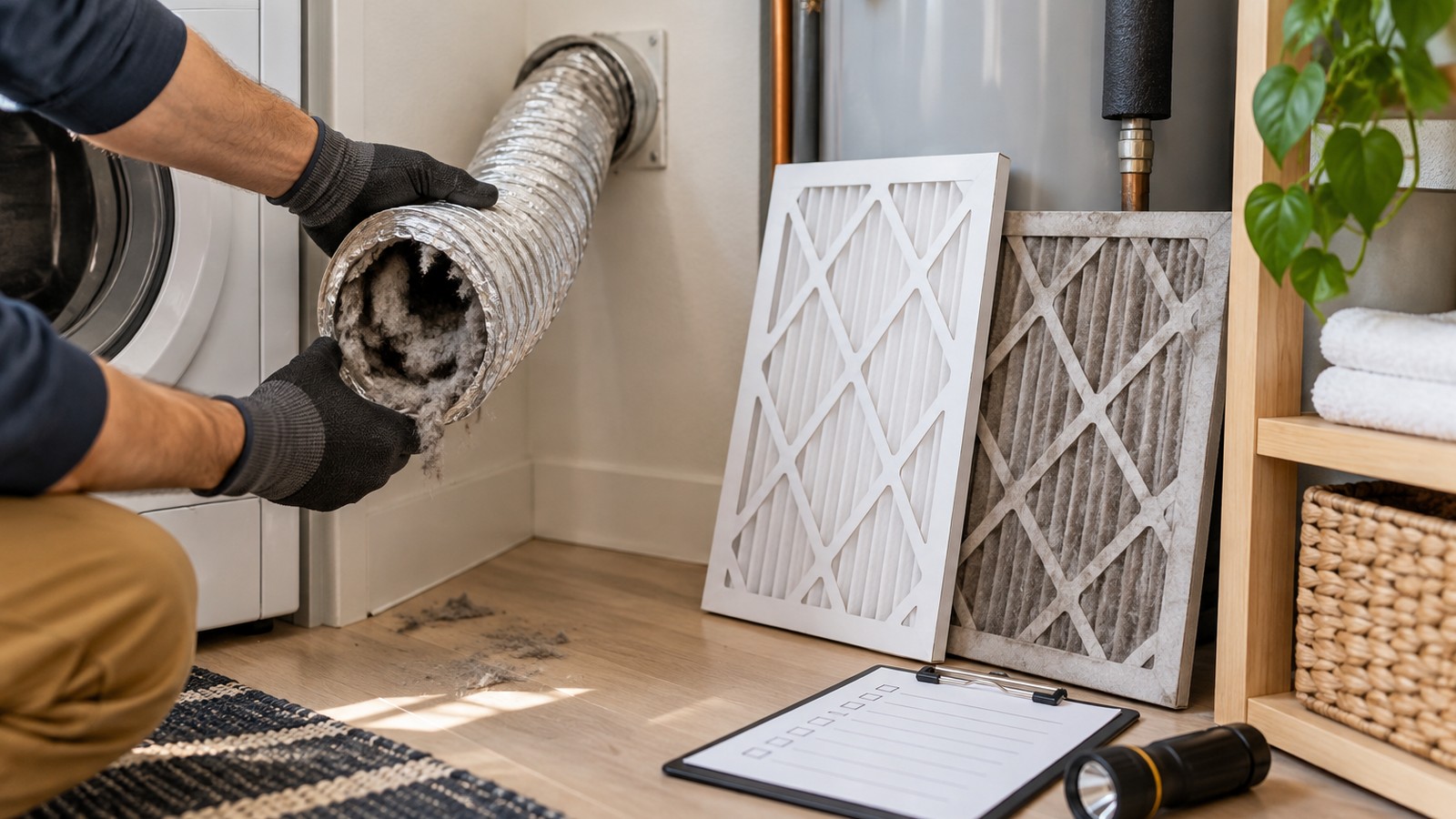
Short term rental maintenance works when you schedule it by turn count, not by the calendar on the fridge. A unit that turns 8 to 12 times a month can put far more wear on its filters, dryer vent, locks and linens than a single household would in the same period. Tie each preventive task to a number of stays, assign it to the cleaner, a handyman or a licensed trade, and log it.
Life-safety checks are the exception: smoke alarms get tested monthly and replaced 10 years after manufacture no matter how many guests came through (USFA).
Most rental maintenance emergencies I have been called about were not surprises. The dryer that stopped heating had a vent packed with lint. The AC that froze up on a July Saturday had a filter nobody had pulled since spring. The door code that failed at 11 p.m. was running on batteries the lock had been warning about for two weeks. Each one was a cheap check that happened too late.
The reason it keeps happening is that most owners inherit a homeowner's maintenance rhythm. Change the filter every few months, clean the dryer vent once a year, test the alarms when you remember. That rhythm assumes one household. A busy rental can get a new household every two to four nights.
Why a Homeowner Calendar Breaks in a Rental
Two of the basic types of maintenance matter here. Preventive maintenance is equipment checked and serviced in a planned manner, and corrective maintenance is equipment repaired or replaced after wear, malfunction or breakdown (Wikipedia). The stated goal of preventive work is for the equipment to make it from one planned service to the next without a failure (Wikipedia).
That goal only works if the service interval matches the load. In a rental, three things break the homeowner interval:
Usage is compressed. Guests run the dryer for towels and sheets after every stay, run the AC harder than an owner would, and open doors with codes dozens of times a week.
Nobody lives there to notice. An owner hears a dryer running long or smells a musty closet. A guest just leaves a review.
Failure costs more. At home, a broken AC is a bad weekend. In a rental, it can be a refund, a cancelled next stay and a review that follows the listing.
So the interval has to be measured in stays, and the person who sees the unit most often has to be part of the system. In most portfolios that person is the cleaner.
Converting the Calendar Into Turn Counts
The table below is how I translate a homeowner interval into a turn trigger. The turn counts are my working defaults for a busy two- or three-bedroom unit, not a manufacturer spec. Always check the equipment manual first, and shorten the interval if your unit sleeps more people, sits near the beach or has pets allowed.
Task | Typical homeowner rhythm | Rental trigger (working default) | Who does it |
|---|
Clean dryer lint screen | Every load | Every turn | Cleaner |
Visual check of dryer vent hose behind the unit | Rarely | Every 10 turns | Cleaner (look, don't disassemble) |
Full dryer duct cleaning to the exterior | Once a year | Every 60 to 90 turns | Handyman or vent service |
HVAC filter swap | Every 1 to 3 months | Every 8 to 12 turns, or monthly in peak season | Cleaner or handyman |
Smart lock battery check | When it chirps | Every turn (read level in the app) | Cleaner or ops lead |
Smoke alarm test button | Monthly | Monthly, even in slow months | Cleaner, logged |
GFCI test and reset | Rarely | Monthly | Cleaner or handyman |
Under-sink and water heater leak check | Rarely | Every turn (look and touch) | Cleaner |
Water heater service and flush | Every 1 to 2 years | Per manufacturer, often yearly | Licensed plumber |
HVAC system service | Once or twice a year | Twice a year, before peak seasons | Licensed HVAC technician |
Two rules keep this table honest. First, anything the cleaner does has to be a look, a press or a swap, never a repair. Second, life-safety items stay on the calendar even when turn counts are low. A slow February does not make a smoke alarm younger.
For the cost side of these lines, the STR operating costs guide shows where maintenance and reserves sit in a full monthly budget.
The Life-Safety Checks You Do Not Stretch
Here the calendar beats the turn count, and a fire-safety authority sets the rule.
Smoke alarms. The U.S. Fire Administration says to test the alarm monthly, replace 9-volt batteries at least once every year, and replace the entire smoke alarm every 10 years; hardwired units follow the same test and 10-year rule, with the backup battery replaced at least yearly (USFA).
The National Fire Protection Association gives the same monthly push-button test, and says alarms must be replaced 10 years after their manufacturing date (NFPA). NFPA also notes that chirping that continues after the battery has been replaced means the alarm needs replacing (NFPA).
Write the manufacture date from the back of each alarm into your log the first time you inspect the unit. The 10-year clock starts at manufacture, not at the day you bought the property.
Carbon monoxide alarms. Most CO alarms use a gas sensor with a limited life span, typically two to five years, and they will not work indefinitely (Wikipedia). If the unit has gas appliances, a fireplace or an attached garage, log each CO alarm's install date and follow the replacement date printed on the device.
GFCI outlets. A residual-current device is built to be tested: its test button safely creates a small leakage condition, and a separate button or switch resets it (Wikipedia). A monthly press-and-reset in the kitchen, bathrooms and any outdoor outlet takes a minute. If one will not trip or will not reset, it goes to an electrician.
Dryer vents. A partially blocked dryer duct makes drying take markedly longer and wastes energy, and a blocked vent raises the internal temperature and may result in a fire (Wikipedia). Long or restrictive ducts, nests in the exterior termination and crushed or kinked flex hose all speed up lint build-up (Wikipedia). In my experience, a rental laundry that runs sheets and towels after every stay fills a duct faster than typical household use.
Building the Short Term Rental Maintenance Schedule: A Five-Step Process
This is the process I use when I take over a unit or rebuild a portfolio's maintenance system. It takes an afternoon per property the first time and about ten minutes a month after that.
Step 1 — Walk the unit and list every system
Open every closet and cabinet. Write down each piece of equipment that can fail during a stay: HVAC and its filter size, water heater type and age, dryer and duct route, smart lock model, alarms with their manufacture dates, GFCI locations, appliances, hot tub or pool equipment. Photograph the model plates. This list becomes the spine of your log.
Step 2 — Set a trigger for each item
Give each item one trigger: every turn, every N turns, monthly or a manufacturer interval. Use the conversion table above as a starting point. Where the manual gives an interval, the manual wins; where you have a failure history, shorten the interval rather than lengthen it.
Step 3 — Assign an owner and a boundary
Every task gets one name. Cleaners handle look-press-swap checks and report anything else with a photo. A handyman handles duct cleaning, caulk, filter access that needs a ladder and small fixture work. Licensed trades handle gas, electrical faults, water heater service and HVAC system service. Write the boundary into the cleaner's checklist so nobody improvises a repair between stays.
If you are still deciding who does what, the DIY versus hire-out breakdown walks through the trade-offs.
Step 4 — Put the checks inside the turnover checklist
A separate maintenance day gets skipped. A line on the turnover checklist gets done because the cleaner is already standing there. Add the every-turn items as checkboxes with a photo field, and let your scheduling tool generate the every-N-turns tasks from the booking count.
The cleaner pay side of adding these minutes is covered in cleaning fees and cleaner pay; price the extra minutes into the turn rate rather than hiding them.
Step 5 — Review the log once a month
Once a month, read the log for each unit. Look for three things: tasks that were due and not done, the same item failing twice, and any repair that happened as a corrective call instead of a planned service. Each of those changes the schedule. A second failure of the same part means the interval is too long or the part is wrong for rental use.
Who Does Each Task: Cleaner, Handyman or Licensed Trade
The fastest way to break a maintenance system is to ask the wrong person to do the work. Cleaners are paid by the turn and measured on speed and guest-ready standards. If you load repairs onto them, you get rushed repairs and slower turns.
I use a simple sorting question: could this task injure someone or void a warranty if it is done badly? If yes, it goes to a licensed trade. If it needs tools beyond a screwdriver or a ladder over six feet, it goes to the handyman. Everything else that is a look, a press or a swap belongs on the cleaner's checklist.
The handyman relationship matters more than the rate. You want someone who will come on a same-day window during peak season, who keeps parts for your standard equipment, and who photographs the work. Standardizing equipment across units helps here: one filter size, one lock model and one alarm model per portfolio means fewer parts on the truck and faster fixes.
For locks, the smart lock failure cost math lays out the failure path and its cost. The same pattern applies to every system on this list: the check costs minutes, and the late-night failure can cost a stay.
The Cost Math: One Cancelled Stay Versus a Year of Checks
Owners skip preventive work because it feels like pure cost. The comparison changes when you price it against one failed stay. The numbers below are illustrative for a mid-market two-bedroom unit; replace them with your own quotes and your own average booking value.
Line | Illustrative annual cost (preventive) | Illustrative cost of one failure (corrective) |
|---|
HVAC filters, swapped every 8 to 12 turns | $80 to $200 in filters | Emergency AC call plus one refunded night: $300 to $900 |
Dryer duct cleaning, 1 to 3 times a year | $120 to $300 | Dryer replacement, unwashed linens and a delayed turn: $600 to $1,200 |
Smoke and CO alarm program (tests, batteries, scheduled replacement) | $40 to $150 | Not a cost you model; a failed alarm is a life-safety event |
HVAC system service, twice a year | $150 to $400 | Compressor failure mid-season plus a cancelled stay: $1,500 to $5,000+ |
Monthly GFCI tests and per-turn leak checks (cleaner time) | 10 to 15 minutes a month, illustrative | Water damage under a sink found after checkout: $500 to $3,000+ |
In this illustrative example, the preventive column adds up to roughly $400 to $1,050 a year for one unit, plus cleaner minutes. A single corrective event in the right-hand column can erase that saving in one weekend, before you count the review. That is the case for the schedule: it buys you fewer corrective calls in peak season.
Book the preventive column as a fixed monthly line, the way the STR financial model treats reserves, so the expense does not look like a surprise in the month the duct gets cleaned.
The Maintenance Log That Protects You
A maintenance log does three jobs. It tells the next person what was done, it shows you which parts fail too often, and it gives you a record if a guest, an insurer or a local inspector asks what you did and when.
Keep it simple. One row per task completed, with these columns:
Date and unit
Task and trigger (turn count or calendar)
Who did it
Result: pass, replaced, or escalated
Photo link
Next due date or turn number
Store it where every cleaner and contractor can add to it from a phone. A shared sheet works for a small portfolio; most property management tools can hold the same fields once you pass five or six units. Write each entry at the time of the work; a log rebuilt from memory weeks later is much weaker evidence.
When a guest does cause damage, a clean log also makes the claim easier, because you can show the item's condition before the stay. The process for that side is in what to do when a guest damages your property.
If you want help turning a patchwork of fixes into a schedule your team can run, book a complimentary one-on-one diagnostic call and bring your last three months of repair invoices.
Frequently Asked Questions
How often should I change the HVAC filter in a short-term rental?
Check the filter manufacturer's rating first, then shorten it for rental use. My working default for a busy unit is every 8 to 12 turns, or monthly in peak season, because guests run the system harder than a single household would.
How often should smoke alarms be tested in a rental?
Monthly, by pressing the test button. The U.S. Fire Administration says to replace the entire smoke alarm every 10 years (USFA), and NFPA says the 10 years run from the manufacturing date (NFPA).
How long do carbon monoxide alarms last?
Typically two to five years. The gas sensors in CO alarms have a limited life span, typically two to five years (Wikipedia). Follow the replacement date printed on your model and log it.
Can my cleaner do maintenance?
Yes, for look, press and swap tasks: lint screens, filter swaps, alarm tests, GFCI test-and-reset, leak checks and lock battery readings. Repairs, gas, electrical faults and water heater service go to a handyman or a licensed trade.
How much should I budget for preventive maintenance on one unit?
Build it from your own quotes. In the illustrative example above, the preventive program adds up to roughly $400 to $1,050 a year for a two-bedroom unit, less than the illustrative cost of one serious corrective failure during peak season.
What should a short term rental maintenance log include?
Date, unit, task, trigger, who did it, the result, a photo link and the next due date or turn number. Write it at the time of the work so it is a credible record if a guest, insurer or inspector asks.
Sources
Cost figures in this article, tables and prose examples are illustrative ranges, not quotes; get local pricing from your own vendors. Turn-count triggers are operator working defaults, and the equipment manufacturer's instructions and local fire and building codes take priority.