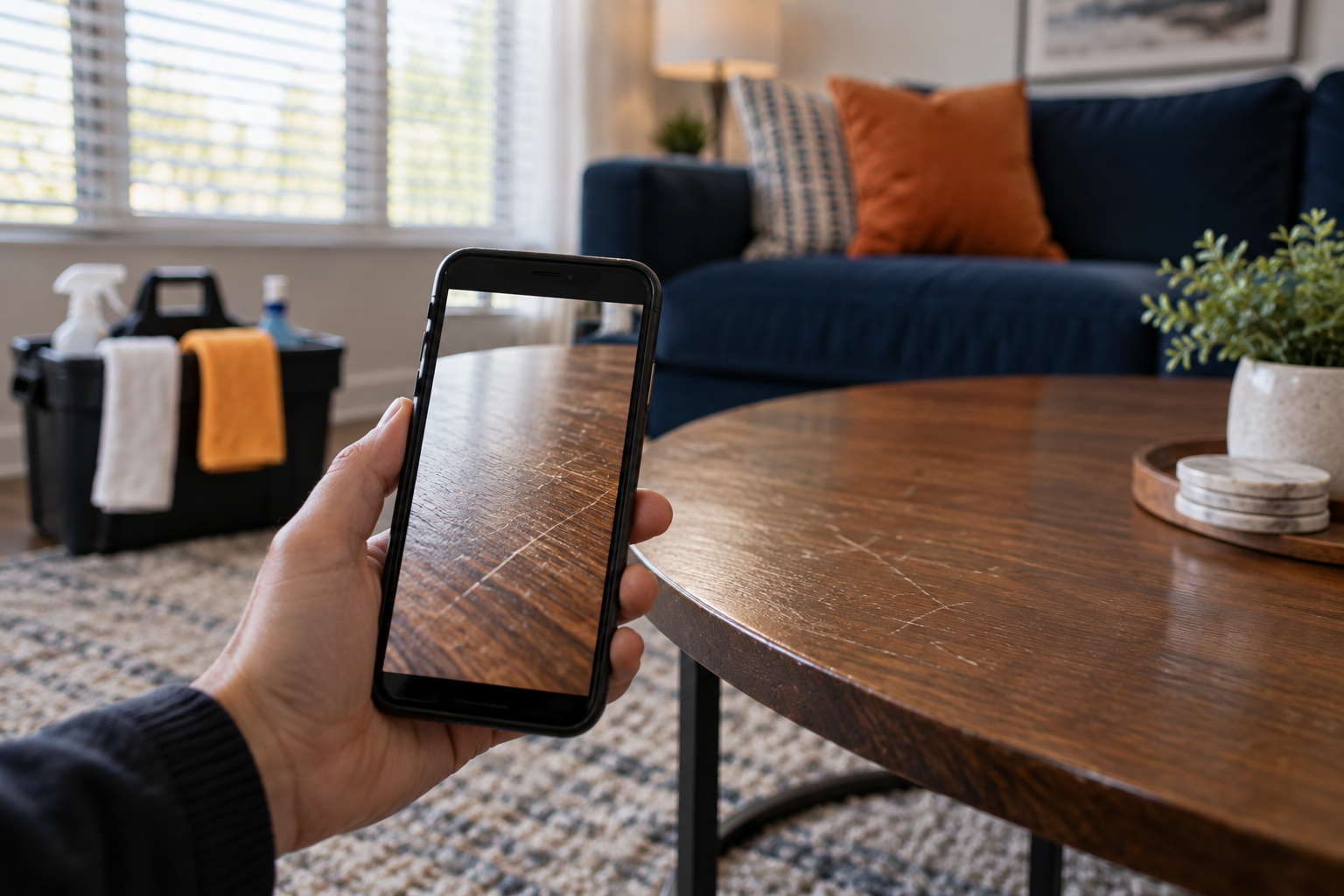
A guest checks out. The cleaner sends photos of a cracked quartz countertop, a burn ring on the dining table, and a bathroom door off its hinges. Your next arrival is in five hours. What you do in the next hour decides whether you recover the money or eat it.
Most hosts lose damage claims on process, not on merit. The damage was real, the guest was at fault, and the claim still failed because evidence was thin, the timeline slipped, or the policy in force excluded exactly this scenario. This is the operating playbook that keeps that from happening.
Document Before Anyone Touches Anything
The moment a cleaner or co-host reports damage, the property becomes evidence. Cleaning it is the single most expensive reflex in this business.
Get these five things on file before any repair begins:
Wide and close photos of each damaged item, with a time-stamped source. Your cleaner's phone photos carry metadata; screenshots of screenshots do not.
A short video walkthrough narrating what you see, room by room. Continuous video is harder to dispute than a folder of stills.
The matching "before" photo from your listing, your last inspection, or your prior turnover checklist. A claim reviewer is comparing two states, so you need both.
A written report from the cleaner, in their words, sent by message or email rather than spoken on a call.
A repair or replacement estimate, ideally from a third party. Your own guess at value is the weakest possible number.
Only then do you make the unit safe and rentable. If you must repair before the claim is filed because the next guest is arriving, document the damaged item, keep the removed part if it is small, and keep every receipt.
What Each Coverage Layer Actually Covers
Hosts routinely assume three protections overlap. They stack, and each one has a different trigger.
Layer | Triggers when | Typically covers | Usually excludes |
|---|
Guest pays directly | You ask and they agree | Small, obvious damage | Anything contested |
Platform damage protection | Guest refuses or does not respond, and you filed inside the platform window | Accidental guest-caused property damage, within program caps | Wear and tear, unreported prior damage, late filings, cash losses |
Short-term rental or commercial policy | Covered peril under your policy form | Property damage, liability, often lost income | Intentional acts by you, excluded perils, undisclosed commercial use |
Standard homeowner policy | Personal-use loss | Owner-occupied residential loss | Commercial or nightly-rental activity in most forms |
That last row is where uninsured losses come from. If a property is marketed nightly and the carrier was never told, a denial can arrive on a claim that had nothing to do with guests. Confirm in writing that your policy contemplates short-term rental use.
Platform damage protection programs also change terms. Caps, exclusions, and filing windows have all moved over the last few years, so pull the current program terms from the platform itself rather than trusting a summary you read in a forum two seasons ago.
Security Deposits, Damage Waivers, and Who Holds the Money
Three models exist, and picking one is an operating decision rather than a preference.
Platform-held deposit or authorization. Convenient, low friction, but you are inside the platform's process and its timelines. Collection depends on the platform's rules, not yours.
Damage waiver or protection fee. A small per-stay fee, often $30 to $100, that funds a third-party protection plan or your own reserve. Guests accept it readily because it reads as insurance rather than as a hold on their card. Direct bookings make this easy to implement.
Cash deposit on a direct booking. Strongest recovery position, highest booking friction. Expect measurably fewer conversions, and expect to handle refund timing carefully and consistently.
Whatever you choose, the rules have to appear in your house rules and your rental agreement in identical language. A term that exists only in your head is unenforceable, and a term that contradicts your listing is worse than no term at all.
Filing a Claim That Does Not Get Denied
Denials cluster around five causes: missing before-and-after evidence, filing after the window closed, a next guest already checked in, an amount unsupported by an estimate, and damage that reads as wear and tear.
Work the request in this order.
Message the guest through the platform, calmly and factually, with photos and the estimate. Ask them to cover the specific amount. Keeping the conversation on-platform creates the record the reviewer will read.
Give a short deadline, generally 24 hours, then escalate rather than negotiating in circles.
Open the platform claim before the window closes and before the next check-in. This is the mechanical failure that kills otherwise strong claims.
Submit one clean evidence package: before image, after image, video, cleaner statement, third-party estimate, invoice or receipt. No commentary about the guest's character.
If the claim is denied, appeal with what was missing, not with the same package plus frustration. If the loss is large, file with your own carrier in parallel and let the carriers sort out recovery.
Keep the tone dry throughout. Reviewers respond to documents. Nothing else in the file helps you.
Repairs, Improvements, and the Tax Side
Once the money side settles, the accounting split matters. Amounts paid for repairs and maintenance on rental property are generally deductible in the year paid, while amounts that better, restore, or adapt the property are improvements that must be capitalized and depreciated under the section 263(a) regulations. Patching a wall is one thing. Replacing all the flooring after a flood is the other.
Two more points worth knowing before you talk to your accountant:
Casualty and theft losses on income-producing property are reported on Form 4684 and are not subject to the federally-declared-disaster limitation that applies to personal-use property.
Insurance or platform reimbursements reduce your loss, so record what you received against what you spent. A recovery you forget to record can turn a clean deduction into an audit conversation.
If you want a structured way to see whether one bad stay is an outlier or a symptom of how the unit is set up, run the Cashflow Diary diagnostic and compare your reserve and screening posture against how the property actually books.
The Conversation With the Guest
The message you send in the first hour sets the tone of everything that follows, including how the platform reads the file.
Write it in four short parts: what was found, when it was found, what it costs to fix with the estimate attached, and the specific amount you are requesting. No adjectives about the guest. No history of your bad month. A reviewer skimming twenty disputes is looking for a host whose account of events matches the documents.
A workable template:
Hi [name], during turnover this morning our cleaner found a cracked countertop and a burn mark on the dining table, with photos attached. The repair estimate from [vendor] is $1,900. Could you send $1,900 through the Resolution Center so we can get the repair scheduled? Happy to share the full invoice once the work is done.
Two things that help more than they should: a same-day request, because memory and goodwill both decay fast, and an offer to share the final invoice, which signals that you are recovering a cost rather than assessing a penalty.
If the guest counters with a lower amount and the gap is small, take it and close the file. Two hours of arguing over $120 costs more than $120. If the gap is large or the guest disputes the facts, stop negotiating, thank them, and open the platform claim while your window is still open.
Pricing Damage Into the Business
Damage is not an anomaly. At any real occupancy it is a line item, and the operators who stay calm are the ones who funded it in advance.
Reserve line | Suggested funding | What it absorbs |
|---|
Minor damage reserve | 1-2% of revenue | Linens, dishes, small furniture, paint |
Maintenance reserve | 5% of revenue | Appliances, plumbing, HVAC service |
Capital expense reserve | 5% of revenue | Roof, flooring, full furnishing refresh |
Deductible fund | One full policy deductible, held in cash | The gap before insurance pays |
On a unit grossing $3,800 a month, that is roughly $460 a month set aside. It feels heavy until the first $1,900 countertop, at which point it feels like the only reason the month was survivable.
Preventing the Next One
Screen on stay pattern, not on instinct. Local one-night bookings, last-minute large-group stays, and vague trip descriptions are the reliable warning signs.
State the occupancy and event rules in the listing and the agreement, with the same numbers in both places.
Use noise and occupancy monitoring that respects privacy law. Exterior decibel sensors, no indoor cameras, all devices disclosed in the listing.
Photograph the unit at every turnover. Twelve dated photos per turn creates a continuous evidence chain that makes any claim trivial to support.
Make the high-cost items hard to damage. Sealed stone, coasters within reach, protective pads under everything heavy, a real trivet by the cooktop.
Keep a same-week repair bench. A handyman who answers is worth more than a discount on the repair.
Difficult stays that stop short of property damage are a separate problem with its own playbook: see guest management when guests go wrong. Guest damage never becomes zero. It becomes a documented, funded, twenty-minute process instead of a bad week.
Frequently Asked Questions
Can I charge a guest for damage after checkout?
Yes, if your rental agreement and house rules say so and you have evidence. Request payment through the platform first so the conversation is on the record, then escalate to the platform claim process if the guest declines.
How long do I have to report guest damage?
Platform windows are short and tied to checkout and the next guest's arrival, and the specific deadlines change, so verify the current terms in the platform's own help center. Operationally, treat the same day as your deadline and you will never be late.
Does a standard homeowner policy cover short-term rental damage?
Usually not. Most homeowner forms exclude commercial or nightly-rental activity. A short-term rental endorsement or a commercial policy is the appropriate coverage, and the carrier needs to know how the property is used.
Is platform damage protection the same as insurance?
No. It is a conditional program with caps, exclusions, and filing deadlines, and it typically applies after you have asked the guest to pay. Treat it as one layer, not as your policy.
Should I ask for a security deposit?
A per-stay damage waiver or protection fee usually converts better than a cash hold, especially on direct bookings. A cash deposit gives you the strongest recovery position and costs you bookings. Choose deliberately and apply it to every guest equally.
Are repairs after guest damage deductible?
Repair and maintenance costs on rental property are generally deductible in the year paid, while betterments and restorations are capitalized and depreciated. Reimbursements you receive reduce the loss you can claim, so track both sides.
Sources
IRS Publication 527, Residential Rental Property — supports the rental income, expense, and repair-versus-improvement treatment in Repairs, Improvements, and the Tax Side.
IRS Publication 547, Casualties, Disasters, and Thefts — supports the casualty-loss rules and the point that reimbursements reduce the deductible loss.
IRS Form 4684, Casualties and Thefts — supports the statement that casualty losses on income-producing property are reported on Form 4684.
26 CFR 1.263(a)-3, improvements to tangible property — supports the repair-versus-capitalized-improvement distinction under the section 263(a) regulations.
Airbnb Help Center, Host damage protection — supports the platform damage protection layer in What Each Coverage Layer Actually Covers, including that it is a conditional program with its own terms and filing requirements.