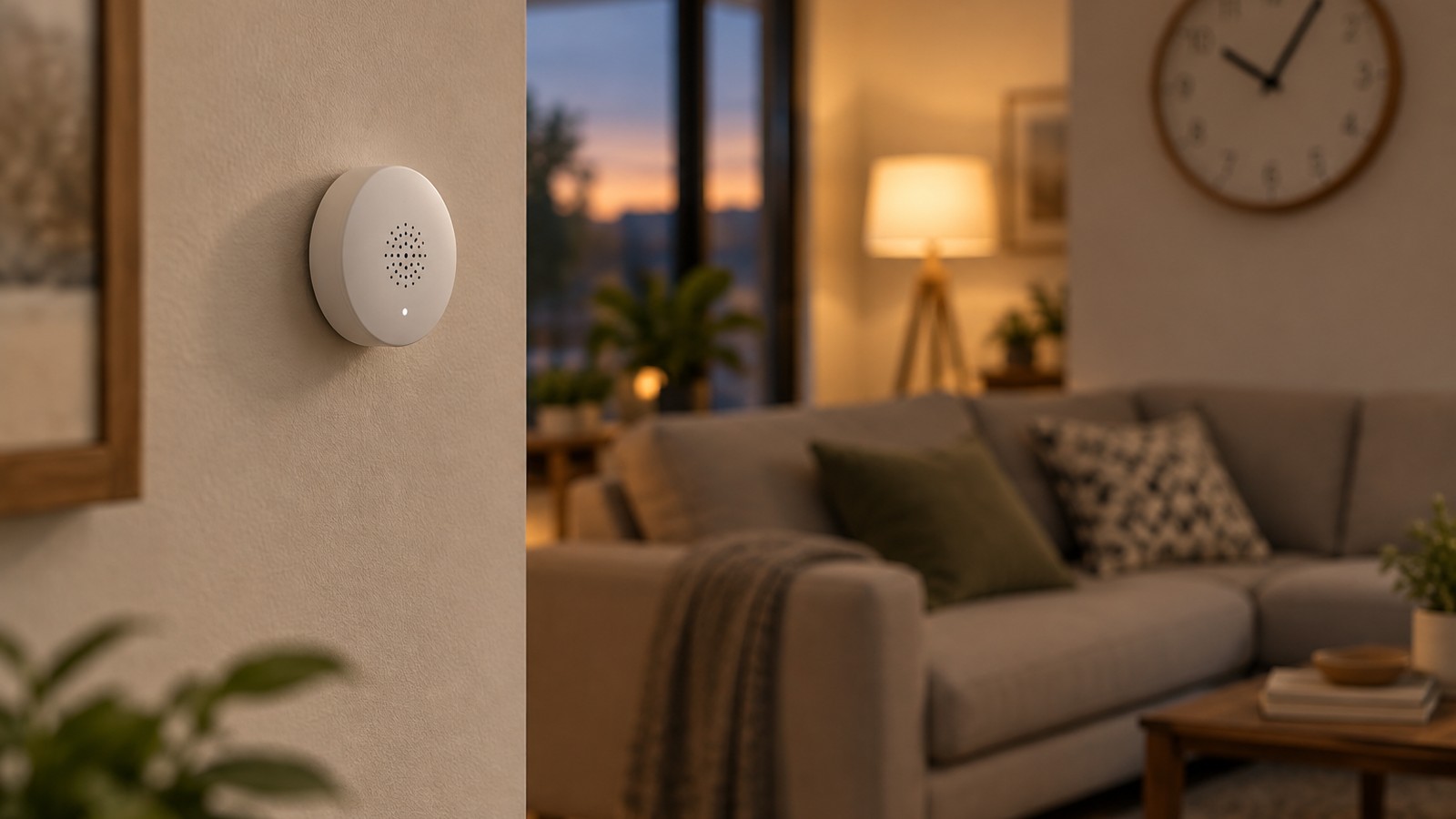
Set your short-term rental noise threshold as an A-weighted decibel (dBA) level that must be held for a sustained period, not an instant spike, and tie it to the quiet hours written in your local ordinance. For most indoor living-room sensors that lands near 70 dBA sustained for 5 minutes during the day and roughly 5 to 10 dBA lower at night.
A single number with no dwell time is what produces 2 a.m. texts about a laughing family. The threshold is the easy half; the escalation ladder behind it is what actually stops a party.
I have run noise monitors in arbitrage units since the devices were expensive and ugly, and the pattern has not changed: operators buy the hardware, pick a number off a forum post, get flooded with alerts in week one, mute the notifications, and then miss the one night that mattered.
The device is not the control. The written threshold, the dwell time, the placement, and the response script are the control.
What a noise monitor actually measures
A short-term rental noise sensor does not record audio. It samples sound pressure level and reports it in decibels, almost always A-weighted.
A-weighting is a frequency correction that discounts low frequencies because the human ear is less sensitive to them. Octave-band measurements are adjusted against a standard table and summed into one number written as dB(A) or dBA (A-weighting, Wikipedia). That matters for you in one concrete way: a bass-heavy speaker in the unit below the sensor will read lower in dBA than it sounds through a shared wall.
In my own use, A-weighted numbers are a practical proxy for how annoying speech and music feel to a neighbor — an imperfect one, and that judgment is mine, not the cited source's. It is the unit almost every ordinance and every sensor vendor uses, so you are stuck with it. Use it knowingly.
For scale, use the public-health reference points. Sounds at or below 70 dBA are unlikely to cause hearing loss even after long exposure, long or repeated exposure at or above 85 dBA can cause it, and normal conversation runs about 60 to 70 dBA (NIDCD). Nobody is getting hearing damage from your guests.
The number is useful only as an anchor: 85 dBA is loud-machinery territory, so a threshold set anywhere near it will never fire until the police are already outside.
Why there is no federal number you can copy
Operators keep asking what the legal decibel limit is. In the United States there is no single answer to copy.
Primary authority for regulating noise was transferred to state and local governments; the EPA retains authority to study noise, publish information, and evaluate existing regulations under the Noise Control Act of 1972 and the Quiet Communities Act of 1978 (US EPA).
Your enforceable number lives in a municipal code, and those codes differ in both level and method. Some cities use a fixed limit, some use a level relative to ambient sound, some use a plainly-audible standard measured at the listener's location rather than at a fixed distance, and many set different limits by zoning and time of day (Noise regulation, Wikipedia). As one published example, Charlotte, North Carolina limits indoor levels from sound-reproducing devices to 55 dB(A) between 9 a.m. and 9 p.m., and 5 dB less at other times.
Two practical consequences. First, pull your own city code before you configure anything, and write the citation into your listing's house rules. Second, set your sensor threshold below the ordinance limit, not at it. The ordinance number is the point at which you are already in violation. Your alert has to arrive with enough runway to fix the problem before a neighbor calls.
The three numbers that make a threshold work
A usable threshold has three settings, not one.
Level. How loud, in dBA, at the sensor.
Dwell time. How long that level must be sustained before an alert fires.
Quiet-hours offset. How much lower the night level sits.
Drop any one of them and the system misbehaves. Level alone fires on a dropped pan. Dwell time alone with a high level never fires. No night offset means a conversation at 11 p.m. is treated exactly like a conversation at 2 p.m., which is the opposite of how neighbors and ordinances see it.
Sensor placement | Day level | Night level | Dwell time | Typical false trigger |
|---|
Indoor, main living area | 70 dBA | 60–65 dBA | 5 min | Group cooking, TV sports |
Indoor, hallway near bedrooms | 65 dBA | 55–60 dBA | 5 min | Toddlers, hair dryer |
Outdoor, patio or hot tub | 75 dBA | 65 dBA | 3 min | Rain, lawn equipment, street traffic |
Indoor, shared-wall condo | 65 dBA | 55 dBA | 3 min | Bass through the wall reading low |
Figures in this article, in both tables and prose examples, are illustrative starting bands from operator practice, not measured research results or legal limits. Verify against your own ordinance and your own first two weeks of sensor data.
Calibrate on real occupancy. Run the sensor for two weeks with alerts logged but silenced, then look at the distribution. If your proposed level fired more than twice on stays that generated no complaint, the level is too low or the dwell is too short.
The false-alarm problem is a placement problem
Most operators fix false alarms by raising the level. That is the wrong lever, and it quietly disables the system.
Sensor placement drives more bad readings than sensitivity does. A unit mounted above a kitchen island reads clattering dishes. A unit in an open stairwell collects the whole house. A unit near an HVAC return reads the air handler every cycle. Move the device to a central living-area wall, at roughly head height, away from the kitchen, away from vents, and away from the TV. Then tune dwell before you touch level.
Dwell time is the single best false-alarm filter you have, because parties are persistent and accidents are not. A dropped tray is three seconds. A speaker turned up is thirty minutes. Setting five minutes of sustained level costs you almost nothing in detection speed and removes the majority of nuisance alerts.
One more failure mode worth naming: a monitor that nobody is assigned to answer. If alerts route to an inbox that goes unread after 10 p.m., the device produces documentation, not prevention. Decide who is on call before you decide what the number is. If your on-call is a co-host, the response duty belongs in the written agreement — see how to define what a co-host percentage actually covers.
Responding to a noise alert: a five-step process
The ladder below is what turns a reading into an outcome. Each rung has a time box, and you move up only when the prior rung fails.
Step 1 — Confirm the reading, 2 minutes
Check whether the level is still elevated and whether the pattern looks like music or a spike. One five-minute event that ends on its own is a log entry, not an incident.
Step 2 — Send the soft message, 5 minutes
Message the guest with the reading, the quiet-hours rule, and a specific ask: "Our living-room sensor has read above 70 dBA for eleven minutes. Quiet hours start at 10 p.m. Please bring the volume down." Most events end here. Reusable wording lives in our guest message templates.
Step 3 — Call the guest, 10 minutes
If the level has not dropped after the message, call. A voice call establishes that a human is watching and gives you a documented contact attempt.
Step 4 — Dispatch a person, 30 minutes
Send whoever is on your local roster: co-host, cleaner on call, or a neighbor you pay for this. Their job is presence and a count of people, not confrontation.
Step 5 — Escalate outside, same night
Unanswered and still above threshold after the dispatch window means the stay is a liability, not a guest. Contact the platform, document the sensor timeline, and involve local authorities if there is a safety issue. Handle damage separately afterward using your guest damage process.
What a missed alert costs
The reason to design the ladder rather than buy the device is arithmetic. Stack a citation, an emergency clean and two blocked nights on one bad stay and the illustrative total below can absorb a meaningful share of a month's revenue on a single unit.
Outcome of an unhandled event | Illustrative cost | How it shows up |
|---|
Neighbor complaint, no violation | $0 direct | Landlord pressure, permit renewal risk |
Municipal noise citation | $100–$1,000 | Fine plus time; repeat citations escalate |
Emergency deep clean and repairs | $300–$1,500 | Lost turnover day on top of labor |
Blocked calendar for repairs | 1–3 nights | Direct revenue loss at your nightly rate |
Lease termination in an arbitrage unit | Whole unit | Deposit, remaining furniture value, relocation |
The cheap version of all of this is a $100–$300 sensor, a written threshold, and a person on call. The expensive version is finding out from your landlord.
Write the rule so the alert is enforceable
A sensor reading is only useful if the guest agreed to the standard in advance. Put four things in the listing and the rental agreement:
Disclosure that a decibel-only noise monitor is installed, where in the unit it sits, and that it records no audio. Major listing platforms' policies require disclosing recording or monitoring devices in the space — not only shared areas — and an undisclosed device can get a listing removed. Check the current wording of your platform's policy before you rely on this.
The numeric threshold and quiet hours, stated in the same units the sensor uses.
The escalation ladder in plain terms, including that an unanswered alert can end the stay.
The consequence, tied to a specific dollar amount or to the platform's own policy, not to vague language.
Operators who skip the disclosure line lose the argument even when the data is clean. Write it once, template it, and put it in every listing. If your unit sits under a master lease, the noise clause in that lease usually has tighter language than the city code does, and that is the number you have to meet — the same way a permit contingency belongs in the lease before you sign.
Frequently Asked Questions
What decibel level should I set for a short-term rental?
Start near 70 dBA sustained for five minutes in the main living area during the day, and 5 to 10 dBA lower during quiet hours. Then adjust after two weeks of logged, silenced data on real stays.
Do noise monitors record conversations?
Purpose-built rental noise sensors report sound pressure level only and do not capture audio. Confirm the specification in writing with your vendor, and disclose the device in your listing regardless.
Is there a federal decibel limit for rentals?
No. Authority for most noise regulation sits with state and local governments, with the EPA retaining study and information roles under the Noise Control Act of 1972 and the Quiet Communities Act of 1978. Your enforceable limit is in your municipal code.
Where should the sensor go?
On a central living-area wall at about head height, away from the kitchen, HVAC vents, and the television. Add a second unit outdoors if you have a patio or hot tub.
How do I stop false alarms without missing real parties?
Lengthen dwell time before you raise the level. Parties sustain volume for many minutes; accidents do not. Placement fixes come before either adjustment.
What if the guest never responds?
Work the ladder on its clock: message, call, dispatch a local person, then escalate to the platform and, if safety is involved, local authorities. Document each step with the sensor timeline attached.
Where to take this next
Pick your ordinance number today, set your sensor 5 to 10 dBA below it with a five-minute dwell, and write down who answers the alert between 10 p.m. and 7 a.m. That is a one-hour task that removes your largest single-night downside.
If you want a second set of eyes on how your unit-level operations and lease terms fit together, book a complimentary one-on-one diagnostic call and bring your current house rules.
Sources