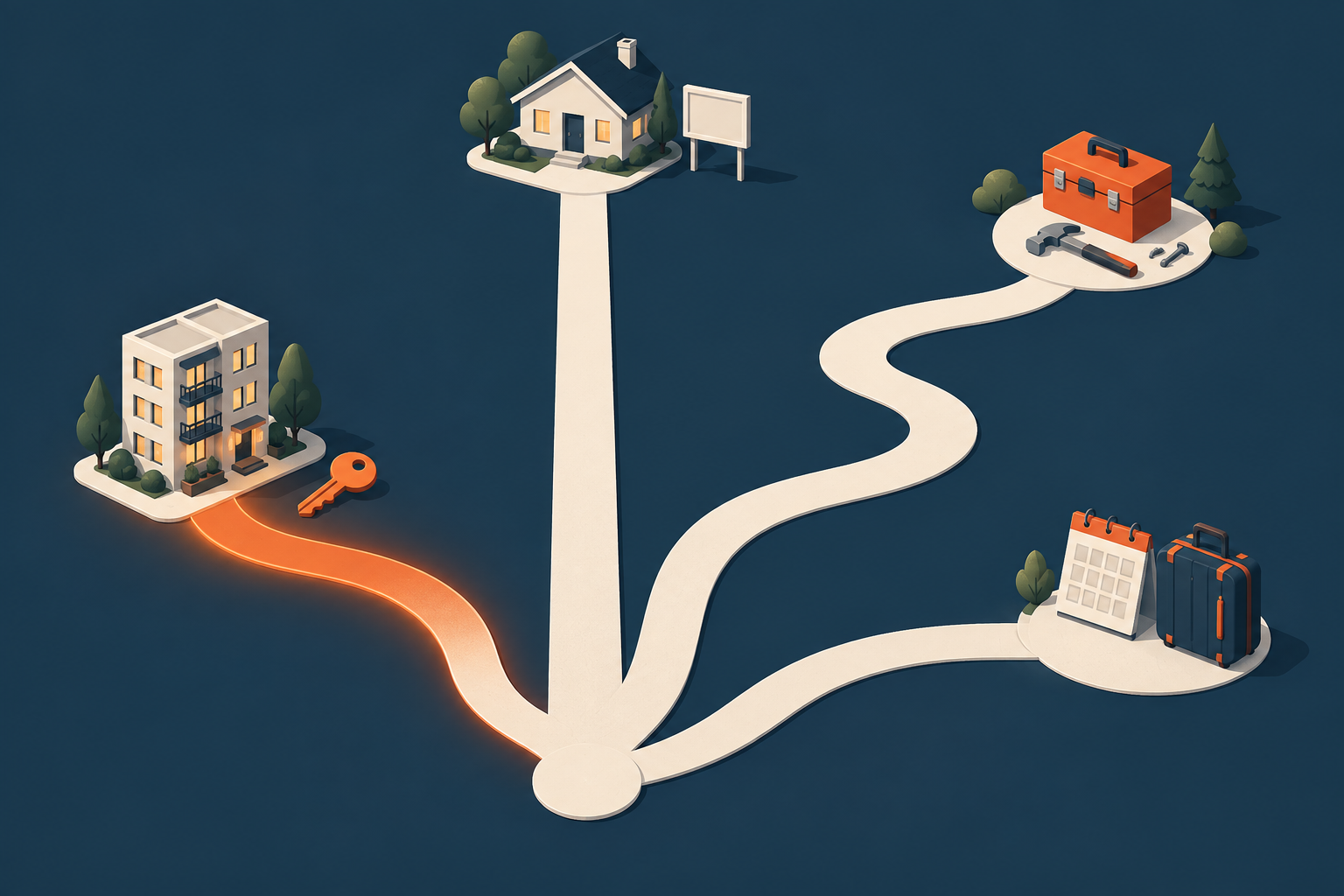
For most people with limited capital, the fastest way to start making money in real estate is a lease-based short-term or mid-term rental (rental arbitrage with written landlord permission) or co-hosting someone else's property. In my operator experience, a lease-based unit typically goes from first landlord conversation to first booking in 3 to 6 weeks, with $3,000 to $7,000 in setup cost. Those ranges are my estimates from launching and coaching units since 2016, not published research, and they only hold in a city where the rental is legal.
Most people who want to make money in real estate spend the first six months doing research instead of doing deals. They read the books, watch the channels, listen to the podcasts, and still feel like they're not ready. Meanwhile, someone in the same city with the same income and less knowledge signed a lease, furnished a unit, and took a first booking.
Before comparing anything, one caution: fastest is not the same as easiest. The quickest models to a first dollar are also the ones with the most ways to fail in the first 90 days. This page lays out five entry models side by side, shows the math on one illustrative apartment, and names the failure modes so you can decide with your eyes open.
Fastest Ways to Make Money in Real Estate: Five Entry Models Compared
Each model below is scored on the four things that decide whether a beginner survives year one: how long until the first dollar arrives, how much cash is exposed, whether the income repeats, and how many hours it takes each week.
Entry model | Time to first dollar | Capital at risk | Income type | Weekly hours |
|---|
Long-term buy-and-hold | 3–6 months | $40,000–$120,000 | Recurring, $200–$600/door | 1–3 once tenanted |
House flipping | 4–8 months | $30,000–$80,000 | One-time, $20,000–$60,000/flip | 15–40 during a project |
STR rental arbitrage | 3–6 weeks | $3,000–$7,000 | Recurring, varies nightly | 4–8 per unit |
Mid-term rental (30+ days, furnished) | 3–8 weeks | $3,000–$7,000 | Recurring, steadier monthly | 2–4 per unit |
Co-hosting someone else's property | 2–6 weeks | $0–$500 | Recurring, share of revenue | 3–6 per property |
Every number in that table is an operator estimate from my own units and the operators I've coached, not a survey. Your market will move them. The pattern holds anywhere: the ownership models tie up five figures and months of time before the first check, and the operating models tie up a few thousand dollars and weeks.
Why Buy-and-Hold and Flipping Are Slow Starts
Long-term buy-and-hold
Time to first dollar is three to six months at minimum: financing, search, closing, then finding a tenant. Capital required is a 20–25% down payment plus closing costs, which in most markets lands between $40,000 and $120,000. Monthly cashflow on a typical single-family rental after mortgage, taxes, insurance, and vacancy runs roughly $200 to $600 per door. At those numbers, recovering your setup cash takes anywhere from about six years ($40,000 at $600 a month) to well over a decade.
Long-term rentals are excellent wealth-building vehicles over 10 to 20 years. Appreciation, loan paydown, and depreciation do the heavy lifting. They are not the fastest way to generate monthly income, and the person who buys a first rental today should not expect it to change their monthly budget for years.
House flipping
Time to first dollar is four to eight months: find the deal, buy it, renovate it, sell it. Capital required is typically $30,000 to $80,000 in purchase and renovation costs, even with hard money financing. A well-executed flip can clear $20,000 to $60,000.
That income is a single event. When the house sells, the paycheck stops until you find the next deal. Flipping is also the highest-risk entry for a first-timer, because renovation cost overruns are the most common way new flippers lose money. Treat it as a job with a large lump-sum paycheck.
Lease-Based Short-Term and Mid-Term Rentals: The Fastest Route to Recurring Income
The capital goes into furniture, linens, supplies, photography, and first and last month's rent, which is where the $3,000 to $7,000 range comes from. A furnished unit cuts both setup time and cost, so I always look at furnished listings first.
The mid-term version
A mid-term rental is the same lease-and-furnish model, but you rent by the month to guests staying 30 days or more: traveling nurses, relocating employees, insurance placements, people between homes. Nightly revenue is lower than a short-term rental, but turnover, cleaning, and guest messaging drop sharply. In many cities, stays of 30 days or more fall outside short-term rental rules entirely. New York City's registration law, for example, exempts rentals of 30 consecutive days or more.
For a first unit, mid-term is often the calmer choice. You give up some upside in exchange for fewer turnovers and a smaller legal surface. Many operators run a unit as mid-term during slow months and short-term during peak demand, where local rules allow it.
Fastest is not easiest
The same features that make lease-based rentals fast also make them fragile. You owe rent every month whether guests show up or not. Your landlord can decline to renew. And cities rewrite short-term rental rules often. The failure modes section below walks through each one, and I'd read it before you call a single landlord.
Co-Hosting: Making Money in Real Estate With No Lease or Capital
Co-hosting means you run someone else's rental (listing, pricing, guest messages, cleaner scheduling) in exchange for a share of revenue. Arrangements I commonly see fall in the 10% to 25% of booking revenue range, depending on how much of the work you take on.
There is no lease and no furniture bill, so capital at risk is close to zero: a few hundred dollars for software, a lockbox, or a cleaning kit. The trade-off is that you own none of the upside beyond your cut, and the owner can end the arrangement. Co-hosting is the best way I know to learn operations with someone else's money on the line before you sign your own lease. The local-law obligations in the section below still apply to any listing you manage, even though your name is not on the lease.
The Worked Example: One $1,400 Apartment
Here is the math on a unit renting for $1,400 a month in a market where comparable two-bedrooms book at a $200 average daily rate and 60% occupancy. An average month has about 30.4 nights, so 30.4 × 60% = about 18.2 booked nights, and 18.2 × $200 = about $3,650 in gross booking revenue.
Airbnb's service fee page says most hosts on the split-fee structure pay a 3% host fee, while hosts on the single-fee (host-only) structure most often pay 15.5%. The same page says the single-fee structure is mandatory for most hosts, so plan on the 15.5% column unless you know your account qualifies for split fee. The table shows both, using illustrative operating costs I'd expect on a two-bedroom:
Line item (monthly) | Split fee (3%) | Host-only fee (15.5%) |
|---|
Gross revenue (18.2 nights × $200) | $3,650 | $3,650 |
Airbnb host service fee | −$110 | −$566 |
Rent | −$1,400 | −$1,400 |
Utilities and internet | −$250 | −$250 |
Cleaning (6 turns × $90) | −$540 | −$540 |
Supplies and consumables | −$100 | −$100 |
Illustrative net | about $1,250 | about $794 |
The net is illustrative. It assumes six turnovers from an average three-night stay, and it ignores the cleaning fee you would normally charge guests, which offsets part of the cleaning line. It also ignores insurance, software, repairs, and your own time. At $1,250 a month, a $5,000 setup pays back in about four months. At $794, it takes more than six.
The breakeven occupancy tells you more than the net. Fixed costs are rent plus utilities plus supplies, or $1,750. Each booked night contributes $200 minus a $6 host fee (the 3% split fee) minus about $30 of cleaning (one $90 turn every three nights), so about $164. $1,750 ÷ $164 = about 10.7 nights, which is roughly 35% occupancy. My rule: if breakeven sits below 50% occupancy using conservative rate assumptions, the unit is worth a landlord call. If it sits above 50%, pass.
For the rent side of the math, HUD publishes Fair Market Rents by county and metro area. It is a useful sanity check on whether a listing's asking rent is in line with the area before you run revenue numbers against it.
Where Fast Goes Wrong: Legality and Failure Modes
The two-permission rule
Arbitrage requires two separate permissions, and you need both in writing before you spend a dollar on furniture:
The landlord's written permission. A lease clause or STR addendum that explicitly allows short-term or mid-term subletting. A verbal "sure, that's fine" does not protect you.
A legal short-term rental in that city. Zoning, permits, registration, taxes, and building rules all have to line up. Airbnb's responsible hosting page for the United States tells hosts to check local laws before listing.
New York City is the extreme example. Local Law 18 requires short-term rental hosts to register with the Mayor's Office of Special Enforcement and prohibits booking platforms from processing transactions for unregistered short-term rentals. The city also keeps a Prohibited Buildings list. A lease-based short-term arbitrage unit in most of New York is a non-starter, which is exactly why you check the city before the landlord.
The four failure modes I see most
City bans and permits. The market math works, the operator signs a lease, and then learns the city caps or bans non-owner-occupied short-term rentals. Confirm legality first, every time.
Landlord refusal or non-renewal. Most landlords say no on the first call. The ones who say yes can still decline to renew in year two. Budget your payback period inside the first lease term.
Undercapitalized furnishing. Cheap furniture photographs badly and wears out fast, and early reviews set your ranking. Spending $3,000 when the unit needed $6,000 is a common reason a listing never climbs.
Low occupancy. A new listing has no reviews. Plan cash to cover two or three months of rent while you build your first 5 to 10 reviews, and price below comps until you do.
Taxes
Income from renting furnished units is taxable. IRS Publication 527 covers reporting residential rental income and expenses, and it explains when providing substantial services to guests moves the activity from Schedule E to Schedule C. Some short-term rental operators land in that second category, depending on the services they provide. Talk to a tax professional before your first payout, not after your first year.
Steps for Your First 30 Days
This sequence is the fastest legal path I know from zero to a live listing. Do the steps in order; skipping step two is how most first units die.
Pick the market with math, not feelings (days 1–4). Pull comparable listings for ADR and occupancy, check HUD Fair Market Rents for the rent side, and run the breakeven formula above. Keep only markets where breakeven sits below 50%.
Confirm legality (days 3–6). Read the city's short-term and mid-term rental rules, permits, registration, and occupancy-tax requirements. If short stays are banned, check whether 30+ day stays are allowed and switch the plan to mid-term.
Find a landlord (days 5–14). Call individual landlords who own a few properties rather than large management companies, which usually won't negotiate addendums. Bring insurance documentation and a draft lease rider. The opening I use: "I run a professional furnished rental operation and I'm looking for quality properties to partner with. The arrangement works like a standard lease: you get reliable monthly rent, paid on time, and I handle all the management and maintain the property to hotel standards. Can I tell you more?"
Sign the lease with an STR addendum (days 12–16). Get subletting permission, occupancy limits, cleaning standards, and damage responsibility in writing. Register or apply for any city permit now.
Furnish and photograph (days 16–26). Deliver and assemble furniture, stock linens and supplies, and book professional photos. Budget to the upper half of your range rather than the lower.
List and price (days 25–30). Create the listing, connect a demand-based pricing tool, set up messaging templates, and price slightly under comps to earn early reviews. Track the date you signed and the date of your first booking; that timeline is your first system.
If you want someone to pressure-test your market numbers and legality check before you sign, book a complimentary one-on-one diagnostic call. If you want a written plan for your specific market after that, the $997 action plan builds it with you.
Frequently Asked Questions
What is the fastest way to make money in real estate with little money?
A lease-based short-term or mid-term rental, or co-hosting someone else's property. Co-hosting is the lowest-capital start because it needs almost no cash, but it pays only a share of revenue. A lease-based unit adds more upside and also adds rent risk, since you owe the landlord whether guests book or not.
Is rental arbitrage legal?
It is legal only when two conditions are met: the landlord gives written permission to sublet, and the city allows the rental type you plan to run. Some cities, such as New York, require registration and restrict most short-term rentals. Check local rules before you sign anything.
How much can one arbitrage unit net per month?
It depends on rent, rate, occupancy, and fees. In the illustrative $1,400 rent example on this page, a unit booking 60% at $200 a night nets about $794 on the 15.5% host-only fee most hosts now pay, or about $1,250 on the 3% split fee. Your numbers will differ, so run the breakeven math on your own market.
Is a mid-term rental better than a short-term rental for a first unit?
Often, yes, for a beginner. Mid-term stays of 30 days or more mean fewer turnovers and less guest messaging, and in many cities they fall outside short-term rental rules. You usually earn less per night than a short-term rental in exchange for that stability.
What is the biggest risk with lease-based rentals?
You owe rent every month whether guests book or not. The four failure modes I see most are city bans and permits, landlord refusal or non-renewal, undercapitalized furnishing, and low occupancy while you build reviews. Keep two to three months of rent in reserve before you launch.
Do I pay taxes on short-term rental income?
Yes. IRS Publication 527 covers how to report residential rental income and expenses, and it explains when providing substantial services moves reporting to Schedule C. Work with a tax professional before your first payout.
Sources
Related Reading