World Cup Income Can Be Tax-Free: The 14-Day Rule Most Hosts Miss
Renting your home for 14 days or fewer in a year can mean zero federal tax on that income. Day 15 erases the break entirely. Here is how the rule works and how to document it.
By J. MasseyJune 24, 2026· 11 min read
Share
Disclosure: This post may contain affiliate links. If you purchase through our links, we may earn a commission at no extra cost to you. We only recommend tools and services J. Massey's team actually uses. Read the affiliate disclosure
If you rent a home you live in for 14 days or fewer during a calendar year, federal law lets you keep that rental income out of your gross income entirely: you do not report it, and you do not deduct expenses against it. That is Internal Revenue Code Section 280A(g), and the 2026 World Cup — played June 11 through July 19 — was the clearest recent example of a demand window short enough to fit inside it. The same arithmetic applies to the next marathon, convention, state championship, or eclipse that lands in your market.
Last updated: 2026-09-18
I have spent more than 18 years in real estate, focused on short-term rentals since 2016, and I have built a list of over 10,000 short-term rental operators through CashFlow Diary. Every time a big event comes to a city, I watch the same two mistakes: people who qualified for this exclusion never used it, and people who did not qualify claimed it anyway. This article is educational. It is not tax or legal advice — run your facts past your own CPA before you file.
What Section 280A(g) actually says
The statute excludes rental income from gross income when a dwelling unit used as a residence is rented for fewer than 15 days during the tax year. Section 280A(g) of the Internal Revenue Code sets two conditions in one sentence: the unit is used by the taxpayer as a residence, and it is rented for fewer than 15 days that year. When both hold, no rental income or deduction attributable to that use is taken into account.
The IRS restates it in Topic No. 415: if you use a dwelling unit as a residence and rent it for fewer than 15 days, do not report any of the rental income and do not deduct any expenses as rental expenses.
Three practical readings people get wrong:
"Fewer than 15" means 14 or fewer rental days. Day 15 is over the line.
The days do not have to be consecutive. Two separate six-night rentals in different months total 12 days and still qualify.
The count is per calendar year, per dwelling. An event window in June plus a holiday rental in December are added together.
Your ordinary homeowner deductions — mortgage interest and property taxes on Schedule A, if you itemize — are untouched by this rule. What you give up is the ability to deduct cleaning, supplies, or a share of utilities against the rental days, because there is no rental income on the return to deduct them from.
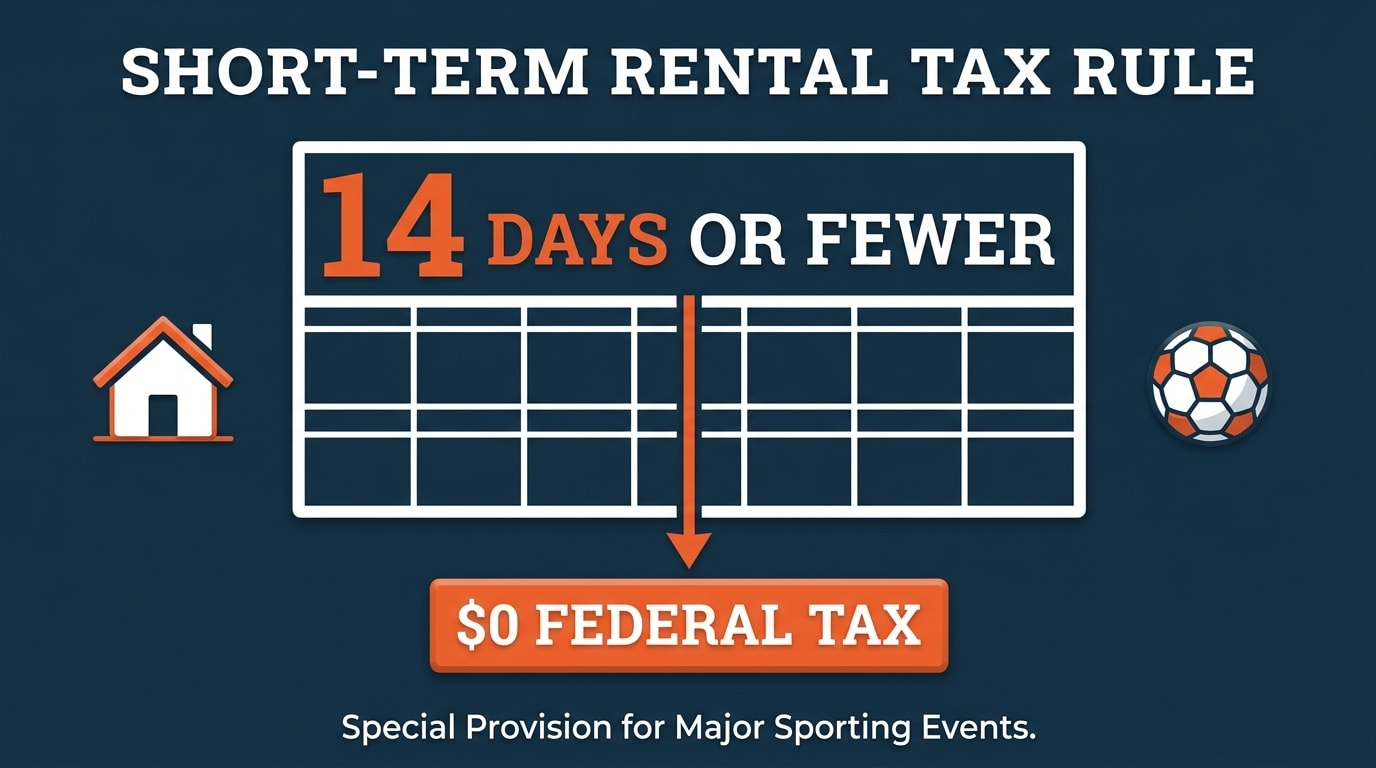
14 days or fewer equals zero federal tax on World Cup rental income
This is a cliff, not a phase-out: cross into a 15th rental day and every dollar from day one becomes reportable rental income. That is the part most hosts do not price in before they accept one more booking.
The table below shows the shape of the decision with round illustrative numbers — not market data, and not a projection for your property. Substitute your own nightly rate and your own marginal tax rate.
Scenario (illustration only)
Rental days
Gross rental income
Federal treatment
Deductible rental expenses
Single event window
10
$8,000
Excluded under 280A(g)
None
Event window plus a long weekend
14
$10,400
Excluded under 280A(g)
None
One night too many
15
$10,900
All of it reportable on Schedule E
Allocated share, subject to the 280A personal-use limits
Year-round operation
180
—
Reportable rental activity
Ordinary and necessary rental expenses
Read the third row twice. The 15th night adds a few hundred dollars of revenue and moves five figures of previously excluded income onto your return. Once you are over the line, the rest of Section 280A governs the split between personal and rental use, and your deductible share is limited by that allocation. The fix is a calendar rule, not a tax strategy: decide your annual rental-day budget in advance and treat it as a hard stop.
A second reason to hold the line: crossing into reportable rental income can create a quarterly estimated-tax obligation you were not planning for, with penalties for underpayment.
How to Decide: A Five-Step Process
Run these five steps before you accept a single booking for an event window.
Confirm the unit is your residence. The exclusion is for a dwelling you use as a residence, not a property you already operate as a rental. If the home is your primary residence or a second home you personally use, you are in scope. If it is already a year-round listing, you are not.
Count every rental day you have already used this calendar year, and every one you plan to use. Include the event window and anything else — a graduation weekend, a film shoot, a December let. Write the total down. If the plan exceeds 14, decide now which booking you are giving up.
Price to fair market value and capture the evidence while it is live. Pull three to five comparable listings for the same dates, same bed count, same neighborhood, and save them as PDFs or screenshots. Publication 527 describes comparing purpose, size, condition, furnishings, and location when judging a fair rental price. Do this during the demand spike; the comps disappear afterward.
Price the local taxes separately. Section 280A(g) is a federal income tax exclusion only. City and county lodging, transient occupancy, or hotel taxes generally still apply, and so may state income tax. Check your own jurisdiction's short-term rental page before you quote a guest an all-in number.
Tell your CPA and your insurer before the rental, not after. Your CPA should document the exclusion in their workpapers so a large deposit has an explanation. Your insurer should confirm in writing that a paid guest is covered, or issue the endorsement that makes it so.
Each step produces an artifact: a rental-day tally, a comps folder, a tax memo, an insurance confirmation. If a step produces nothing you could hand to an examiner, it is not finished.
Who qualifies and who does not
The line that disqualifies most people is not the day count — it is that the property is already a rental business. You cannot take a listing that runs 200 nights a year, call two weeks of it a personal-residence rental, and exclude that slice.
Situation
Qualifies for 280A(g)?
What to do instead
Primary residence, rented 10 nights for an event
Yes, if total rental days for the year stay at 14 or fewer
Document comps, track days, keep the payment record
Second home you use personally, rented 14 nights
Yes, same day limit applies
Watch the combined count across both properties separately
Year-round short-term rental
No
Report on Schedule E and deduct ordinary operating expenses
Arbitrage unit you lease and re-rent
No — it is not a dwelling you use as a residence
Treat it as the operating business it is
Room rented in the home you occupy for 14 nights
Yes, the statute applies to the dwelling unit
Keep the same records; allocation questions start at day 15
Property rented to your own business entity
Case-specific
Get written CPA guidance before relying on it; fair rental value and a real business purpose are the pressure points
One more disqualifier that has nothing to do with tax: your lease, HOA, or city registration rules. A federal exclusion does not grant permission to host. Several large markets require registration before a single paid night, and enforcement units check listings against the register.
The 15-day cliff: crossing 15 rental days makes all income taxable
The tournament was the cleanest live test of this rule in years, and the lesson from it is about calendar discipline, not about soccer. The 2026 FIFA World Cup ran from the opening match on 11 June to the final on 19 July across 16 host cities in Canada, Mexico, and the United States. Very few homeowners in those cities rented for more than two weeks; the matches relevant to any one city clustered into short windows, which is exactly the shape the exclusion rewards.
What I heard from operators in host markets during and after the tournament fell into three buckets:
Residents who left town for one match weekend, rented at an elevated rate, and stayed well under 14 days. These are the clean cases.
Residents who added a second and third window "since the listing was already set up," crossed into reportable territory without noticing, and found out in the spring.
Existing year-round operators who assumed the rule applied to them. It did not.
I will not restate the per-host dollar figures that circulated before the event. Pre-tournament projections published by platforms and consultancies were marketing forecasts, not results, and the honest version is that rates varied enormously by city, distance to the stadium, and how early the listing went up. Our own read on how that demand actually landed is in our World Cup bookings analysis.
The transferable part: any concentrated demand window — a conference, a championship, a festival, a graduation weekend — can be run the same way. The event changes. The 14-day arithmetic does not.
The record set that survives an audit
Because you report nothing, the return itself carries no explanation — your file has to. Build it while the rental is happening.
Record
Why it matters
Where it comes from
Rental-day log for the calendar year
Proves you stayed at 14 or fewer
A one-tab spreadsheet you update on the day of each booking
Booking confirmation or signed agreement
Establishes dates, parties, and nightly rate
Platform reservation record, or a two-page agreement for a direct booking
Proof of payment
Ties the deposit in your bank account to the rental
Payout statement or bank record
Comparable listings for the same dates
Supports fair rental value
Screenshots or PDFs saved during the demand window
Lodging-tax filing or platform remittance record
Shows the local obligation was met
City portal receipt or the platform's tax collection statement
Insurance endorsement or written confirmation
Shows the rental was covered
Your agent, in writing
Short note to your CPA
Explains a large untaxed deposit
An email you send in December, not April
Keep it all in one folder per year. If you cannot reconstruct the rental from that folder three years later, it is incomplete.
Where the money actually goes
Tax-free at the federal level is not tax-free. Before you count the proceeds, subtract the items the exclusion does not touch: city or county lodging tax, state income tax where it applies, platform service fees, cleaning, the cost of somewhere else to sleep during the rental, and any insurance endorsement. On a short high-rate window those are a smaller share of revenue than they are in a year-round operation, which is part of why the event rental is attractive — but the net is what you plan around, not the gross.
If the numbers tempt you toward running the property as a real short-term rental for the rest of the year, that is a different business with different economics, and the exclusion goes away the moment you cross day 15. Underwrite it as a business before you drift into one; our short-term rental investing guide walks the assumptions.
Want a second set of eyes on your specific situation — the day count, the pricing evidence, and the local tax question — before you accept the booking? Bring your dates and your market to a complimentary one-on-one diagnostic call and we will work through it together.
Frequently Asked Questions
Is event rental income really tax-free? It is excluded from federal gross income when you rent a dwelling you use as a residence for fewer than 15 days in the tax year. You report nothing and deduct nothing for those days. State income tax and local lodging or transient occupancy taxes are separate obligations and usually still apply, so confirm both with your city and your CPA before treating the full amount as yours.
What counts as a rental day for the 14-day limit? A day the property is rented to someone else at a fair rental price. Days you or your family occupy the home are personal-use days, not rental days, though they matter for other parts of Section 280A once you cross the threshold. Count the nights on every booking for the whole calendar year — not only the ones around the event — because the limit is annual, not per event.
What happens if I rent for 15 days? The exclusion is gone for the entire year, not just the extra day. All rental income becomes reportable, the activity moves onto Schedule E, and the personal-use allocation rules in Section 280A decide how much of your expenses you can deduct against it. Crossing the line can also trigger estimated-tax payments. Treat 14 days as a hard stop you set in your calendar in January.
Does the rule apply if I already run the property as a short-term rental? No. Section 280A(g) applies to a dwelling unit you use as a residence. A property already operating as a nightly rental business does not convert to a personal residence for two weeks, and a unit you lease and re-rent under an arbitrage agreement is not your residence at all. Both report rental income normally and deduct ordinary operating expenses.
How do I prove my nightly rate was fair market value? Capture the evidence while the demand window is live. Save three to five comparable listings for the same dates in your neighborhood at similar bed counts and condition, as PDFs or screenshots with the date visible. Publication 527 points to purpose, size, condition, furnishings, and location as the comparison factors. An elevated event rate is defensible; an elevated rate with no surviving comps is an argument you have already lost.