
A short-term rental ban does not outlaw your building. It outlaws a defined category of use — a stay length, an occupancy type and a zone, written into the definitions section of a local code — and the same four walls can often serve a different, unregulated category of housing demand. That distinction is the difference between exiting a California market in 2026 and restructuring inside it. Nothing here is legal or tax advice; every address sits under its own code, and you should confirm your own facts with the jurisdiction and with your own attorney.
California's 2026 Short-Term Rental Bans: The Definition Operators Miss
A short-term rental ban regulates a defined category, not a building. Read the definitions section and you find the boundary: length of stay, occupancy type and zone. Here is how to read a California ordinance before you exit a market.
By J. MasseyMay 15, 2026· 14 min read
Disclosure: This post may contain affiliate links. If you purchase through our links, we may earn a commission at no extra cost to you. We only recommend tools and services J. Massey's team actually uses. Read the affiliate disclosure
Table of Contents
What Changed in California in 2026, and When

Two California jurisdictions moved in the spring of 2026, and both are still the reference points operators ask about.
The City of San Bernardino's council voted 4-3 on April 15, 2026 to prohibit short-term rentals citywide rather than regulate them. City staff had brought both options — regulate or ban — and the city manager recommended regulation in the agenda materials; the majority went the other way over enforcement, fire and nuisance concerns. The city's community development director told the council that about 108 properties were listed across platforms and that the development code did not specifically recognize the use, and staff put the potential annual contribution of a permit-and-tax program at up to $324,000. Per the reporting on that hearing, operators are expected to be identified through third-party listing monitoring and notified to stop, with enforcement to follow, and the city intends to begin applying its existing 10% transient occupancy tax language to short-term rentals. The city's own meeting record shows the follow-through: "Adoption of Ordinance No. MC-1661 Banning Short-Term Rentals (All Wards)" was Item 8 on the council's June 17, 2026 agenda. I have not found a published penalty schedule or effective date on a city code page I can open today, so do not plan around a specific fine figure — get that from the City Clerk.
The City of South Lake Tahoe went the other direction — cap, not ban. Under the amendment adopted March 24, 2026 and in force since April 23, 2026, the city removed its 150-foot buffer between vacation home rental properties and replaced it with a hard ceiling: no more than 900 VHR permits in residential zones, a waitlist once the ceiling is reached, a minimum renter age of 25, and a prohibition on VHRs in multifamily dwellings with a carve-out for certain attached condominiums. The city has since confirmed the cap is live: as of August 21, 2026, new applications go onto a waitlist as issued permits approach 900. The ordinance also limits issuance to no more than 150 VHR permits per month. Tourist Core and commercial zones are not subject to the cap.
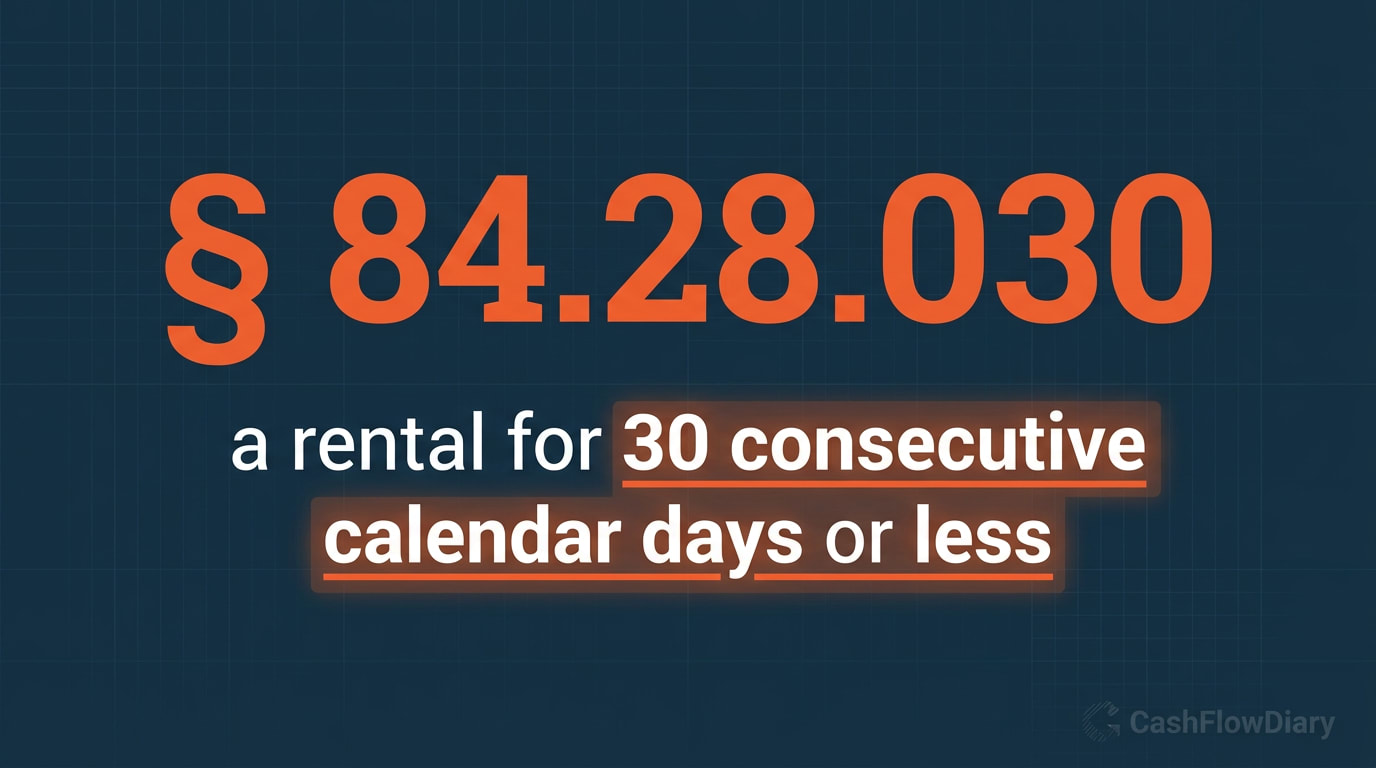
Unincorporated San Bernardino County is a third, separate regime from the city that shares its name. The County allows permitted short-term rentals in the Mountain and Desert Regions under Chapter 84.28 of its Development Code, where transient occupancy means 30 consecutive calendar days or less and the unit may not be used for commercial activity such as weddings or corporate retreats without a separate County permit.
Three jurisdictions, three answers, one metropolitan area. An operator who reads "San Bernardino bans Airbnb" as a regional verdict gets all three wrong.
The Definition Is the Boundary

Every one of those rules starts in the same place: a definitions section that fences off what the ordinance governs. San Bernardino County's language is the clearest teaching example. A short-term residential rental unit is a residential dwelling unit, or a portion of one, rented or used for residential transient occupancy — and transient occupancy is occupancy of 30 consecutive calendar days or less.
Read that as a set of conditions rather than a prohibition and the structure appears:
Stay length. Thirty days or fewer triggers the rule. Thirty-one days does not.
Occupancy type. Transient residential occupancy triggers the rule. A furnished lease to a relocating employee is a different animal in the code.
Zone and structure. The County allows the use only in the Mountain and Desert Regions, and only in certain structures — single-family homes, duplexes, guest houses, condominiums, some accessory dwelling units, never apartments or RVs.
"The ban changes WHERE you operate, WHEN you book, WHO you serve, and HOW you bill — not WHETHER STR works."
— J. Massey · CashFlowDiary
Miss any condition and the ordinance you were reading stops applying — which does not mean nothing applies. Something else does: the residential lease provisions, the transient occupancy tax code, a zoning table, a state landlord-tenant statute. The operator's job is to find out which body of rules governs the use they actually intend to run, not to assume that falling outside one chapter means falling outside all of them.
New York City wrote the same boundary. Its Short-Term Rental Registration Law, created by Local Law 18 of 2022, defines a short-term rental as a rental for fewer than 30 consecutive days of a dwelling unit within a private dwelling — and it requires hosts to register with the Mayor's Office of Special Enforcement while prohibiting booking platforms from processing transactions for unregistered stays. Stays of 30 days or more sit outside that definition and outside that registration scheme.
I have watched operators in both kinds of market since 2016, and the split is consistent. The ones who read the definitions section first keep serving housing demand. The ones who read the headline first sell the asset.
Definition-Boundary Matrix: Which Code Applies

Use this as the first page of any market file. The point is not that the right column is unregulated — it is that the right column is regulated by a different chapter, with different costs and different failure modes.
Stay length | Occupancy type | Zone / structure | Which code usually applies | Practical consequence |
|---|---|---|---|---|
1–30 nights | Transient guest, nightly booking | Residential zone, single-family | The local STR/VHR chapter (San Bernardino County Ch. 84.28; South Lake Tahoe VHR article) | Permit, cap, or outright prohibition; per-day fines where banned |
1–30 nights | Transient guest | Tourist core / commercial zone | Local commercial lodging or area plan rules | In South Lake Tahoe, outside the 900-permit residential cap |
1–30 nights | Event, retreat, filming | Any | Separate special-use or commercial-activity permit | County code bars commercial activity in an STR without its own permit |
31+ nights | Furnished month-to-month tenant | Residential zone | Residential lease law, local rental registration, state tenant protections | Outside the STR definition; tenancy rules, notice periods and habitability now govern |
31+ nights | Corporate or relocation housing billed to an employer | Residential or mixed | Residential lease law plus business licensing; transient tax often ends at the 30-day line | Lower turnover, longer stays, contract counterparty instead of a guest |
31+ nights | Insurance placement or traveling clinician | Residential zone | Residential lease law; payer is a company, not the occupant | Demand tied to claims and staffing cycles, not tourism |
Any | Hotel or motel operation | Commercial zone | Hotel and lodging chapters, plus transient occupancy tax | A separate regime from residential STR chapters; confirm with the city whether a residential prohibition reaches commercial lodging |
Two cautions on the 31-day line. First, a longer stay does not erase tax: some jurisdictions tax the first 30 days of a longer stay, and some require refunds or exemption certificates after the threshold. Second, crossing into tenancy means crossing into eviction procedure. A guest leaves at checkout. A tenant has rights, and removing one takes a court.
How to Read an Ordinance Before You Enter or Exit a Market: A Five-Step Process
Run this before you sign, and again before you sell. It takes an afternoon.
Confirm the jurisdiction of the exact address. City or county, incorporated or unincorporated, inside or outside a coastal zone or regional plan area. San Bernardino City and San Bernardino County reach opposite conclusions about the same use. Verify with the parcel record, not the listing agent.
Open the definitions section and copy it into your file. Write down the stay-length threshold, the words describing occupancy type, and the allowed structures. If the threshold is "30 consecutive calendar days or less," your boundary is 31 nights. Quote the code language; do not paraphrase it into your notes.
Find the zoning and permit table, then locate your parcel on it. Caps, buffers, waitlists and zone carve-outs live here. South Lake Tahoe's 900-permit ceiling applies to residential zones and not to the Tourist Core — a fact that only matters if you know which zone you are in.
Read enforcement and transferability before you read revenue. Per-day fines, third-party listing monitoring, whether a permit survives a sale, and whether a waitlist exists. A permit that dies at closing is not an asset you can sell, and that changes your exit price, not just your operations.
Price the two nearest legal alternatives for the same asset. For most residential properties that means a 31-plus-day furnished lease and a conventional annual lease. If the furnished midterm number covers debt service, taxes, insurance and reserves, you have a restructure. If it does not, you have a sale — and now you know why, with numbers.
Write the answers down with the date you checked and a link to the page. Ordinances change on a council calendar; your file should show which version you underwrote.
Exit or Restructure: A Decision Table
Most operators facing a ban ask the wrong question — "should I leave?" — before answering the cheaper one: "what else can this asset legally do, and does that math work?" This table is the order I work in.
Situation | Test to run first | Restructure option | Exit is the better call when |
|---|---|---|---|
Citywide prohibition, no grandfathering | Does a 31-plus-day furnished lease cover debt service, taxes, insurance and reserves? | Furnished midterm housing: relocations, insurance placements, traveling clinicians, contractors | Midterm rent misses full carrying cost and the annual-lease rent misses it too |
Cap reached, you are on a waitlist | How long is the waitlist, and what does the property earn while you wait? | Operate as a furnished midterm rental while the application sits in queue | Carrying cost during the wait exceeds what an unlicensed use can earn |
Permit held, not transferable at sale | What is the property worth to a buyer with no permit? | Keep operating, build direct and repeat demand, plan the exit around a non-STR valuation | Your equity plan depended on selling the permit with the house |
Zone-only restriction (residential capped, commercial not) | Is there a compliant parcel in the uncapped zone at a price that works? | Relocate the operation rather than the business model | Uncapped-zone acquisition prices erase the margin |
Regulated market, you hold a lease not a deed | What does the lease allow, and what does termination cost? | Renegotiate to a furnished corporate sublease with the landlord's written consent | Landlord will not consent and the termination penalty is smaller than the losses |
Single market, single model, all units | What share of gross revenue sits in one ordinance's path? | Split inventory across stay-length categories and at least two jurisdictions | Nothing to fix here — this is the diagnosis, not the remedy |
The pattern behind the table: the asset is rarely the problem. The problem is that one ordinance can reach every dollar you make. That is a portfolio design flaw, and it is fixable before the next council vote rather than after.
What the New York City Precedent Actually Supports
New York is the case study operators cite, usually with a number attached that nobody sources. Here is what the city's own pages support: Local Law 18 of 2022 created a registration system administered by the Mayor's Office of Special Enforcement, it bars booking services from processing transactions for unregistered short-term rentals, and it defines the regulated stay as fewer than 30 consecutive days. Enforcement runs through the platforms, which is why compliance moved quickly once the law took effect.
I have seen a widely repeated claim that listings fell by more than 90% in the first two years. I could not verify that figure on a city page today, so it is not in this article. The structural lesson does not need it. When enforcement is routed through booking platforms, the nightly channel closes fast, and the operators still standing are the ones whose leases run past the definition's threshold — 30 days or more in New York, 31 or more in San Bernardino County. Same building, different chapter of the code.
One California caveat before you copy the New York logic: if the parcel sits in the coastal zone or inside a regional plan area, the local ordinance may not be the last word on what a city can restrict, and that question belongs with a land-use attorney rather than a spreadsheet.
Concentration Risk Lives in the Business Model
What you sell is temporary housing. Nightly booking is one delivery method for it. An ordinance cannot ban the need for a furnished place to sleep for six weeks; it can only ban one way of filling it.
So measure exposure the way a lender measures it. Take gross revenue for the last twelve months and sort it three ways: by jurisdiction, by stay-length category, and by demand source. If one ordinance can reach more than half of it, you do not have a regulatory problem in a specific city — you have a single point of failure everywhere you operate.
Three moves that reduce that number without selling anything:
Add a 31-plus-day product to existing inventory. Furnished midterm demand comes from relocations, insurance displacement placements and clinical staffing, and it is billed to companies with net terms rather than to travelers with credit cards.
Put the legal use case in the lease, not just the listing. If you control property through a master lease, write permitted-use and permit-contingency language before the ordinance forces the conversation.
Keep the definitions file current for every market. Date each entry. Re-check before you add a unit, and before you accept an offer.
None of this requires a new asset class or a new market. It requires reading the paragraph that most operators skip, then structuring the business so no single paragraph can end it.
If you want a second set of eyes on which of your units can legally move to a 31-plus-day model and what that does to your numbers, book a complimentary one-on-one diagnostic call and bring the last twelve months of revenue by unit.
Frequently Asked Questions
Did the City of San Bernardino ban short-term rentals in 2026?
Yes. The city council voted 4-3 on April 15, 2026 to prohibit short-term rentals citywide instead of regulating them, and "Adoption of Ordinance No. MC-1661 Banning Short-Term Rentals (All Wards)" was Item 8 on the council's June 17, 2026 agenda. Reporting from the April hearing described roughly 108 listed properties, identification of operators through third-party listing monitoring, and the city's intent to apply its existing 10% transient occupancy tax language. Confirm the current ordinance text, effective date and penalty schedule with the City Clerk before acting; this is not legal advice.
Are short-term rentals still allowed in San Bernardino County?
The unincorporated County is a separate jurisdiction from the City. Under Chapter 84.28 of the County Development Code, permitted short-term rentals are allowed in the Mountain and Desert Regions, transient occupancy means 30 consecutive calendar days or less, and commercial activity such as weddings or corporate retreats is not allowed in the unit without a separate County permit. Check which jurisdiction your parcel sits in before assuming either rule applies.
What is the South Lake Tahoe vacation home rental cap?
The amendment adopted March 24, 2026 and effective April 23, 2026 replaced the city's 150-foot buffer with a ceiling of no more than 900 VHR permits in residential zones, added a waitlist once that ceiling is reached, set a minimum renter age of 25, and barred VHRs in multifamily dwellings with a carve-out for certain attached condominiums. As of August 21, 2026 the city places new residential-zone applications on the waitlist. Tourist Core and commercial zones are not covered by the cap.
Does a 31-day stay get me out of short-term rental rules?
It usually moves you out of the chapter that defines short-term as 30 days or fewer — that is the whole point of reading the definition — but it moves you into residential tenancy law, local rental registration and, in many places, a different tax treatment. Longer stays also mean eviction procedure instead of checkout. Verify the threshold wording in your own jurisdiction and have a lease reviewed; this is not legal advice.
How do I know if my portfolio is over-exposed to one ordinance?
Sort the last twelve months of gross revenue by jurisdiction, by stay-length category and by demand source. If a single city's ordinance can reach more than half of the total, the exposure is in your business model rather than in any one property, and the fix is adding a longer-stay product or a second jurisdiction before the next council vote.
Related Reading
Keep reading:
Sources
San Bernardino County — About Short-Term Rentals (Code Enforcement) — County definition of a short-term residential rental, the 30-consecutive-day transient occupancy threshold, allowed structures, and the Mountain and Desert Region limitation.
City of South Lake Tahoe — Vacation Home Rentals — The 900-permit residential cap, buffer removal, minimum renter age of 25, zone exclusions, and the August 21, 2026 waitlist notice.
City of South Lake Tahoe — Council Adopts Ordinance Amending VHR Regulations (March 24, 2026) — Adoption date and the substance of the 2026 VHR amendment.
City of South Lake Tahoe — Ordinance 2026-1203 (full text) — Adoption on March 24, 2026, effective date April 23, 2026, the 900-permit cap, the 150-permits-per-month issuance limit, minimum renter age 25, and the multifamily provisions.
City of San Bernardino — City Council meeting record, June 17, 2026 — Agenda item for adoption of Ordinance No. MC-1661 banning short-term rentals citywide.
Inland Empire Community News — San Bernardino bans Airbnb, Vrbo rentals in 4-3 vote — Contemporaneous reporting of the April 15, 2026 vote, the enforcement approach, and the reported penalty framing.
NYC Mayor's Office of Special Enforcement — Short-Term Rental Registration Law — Local Law 18 of 2022, host registration, and the prohibition on booking services processing unregistered transactions.
NYC Mayor's Office of Special Enforcement — FAQ for prospective hosts — The city's definition of a short-term rental as fewer than 30 consecutive days.
Disclaimer: Educational content only — not financial, legal, or tax advice; results vary.
See our full Earnings Disclaimer and Affiliate Disclosure for complete details. © 2026 West Egg Enterprises, Inc. All rights reserved.