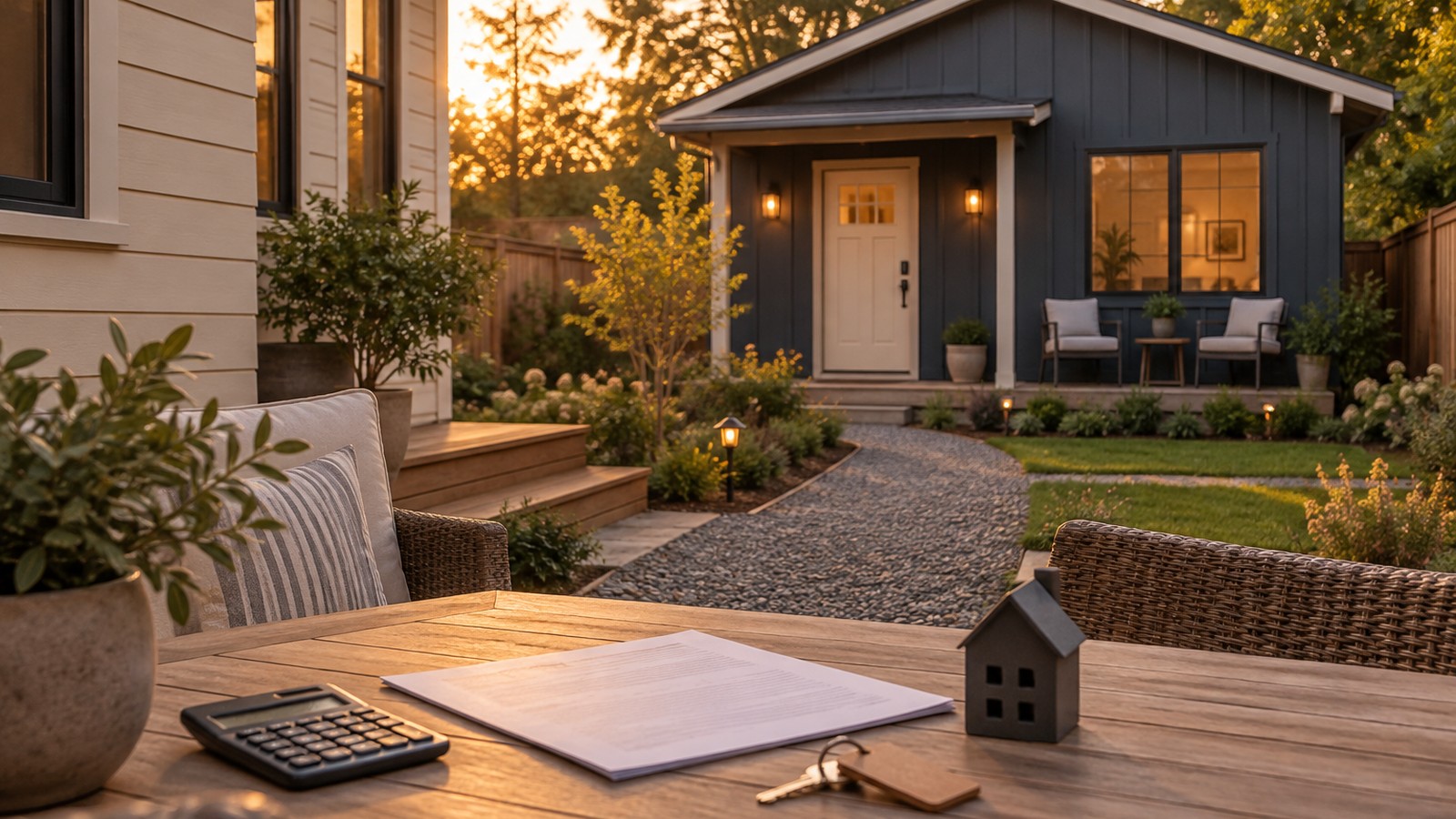
Pick your ADU rental mode before you finance, design or permit the unit and you'll avoid building a cottage your city, your lender and your tax return won't treat the way you planned. For most owners the answer comes down to three gates: whether local rules allow rentals under 30 days, whether your lender will count the income (Fannie Mae will not count short-term rental income from an ADU), and how much of your shared costs the IRS lets you assign to the unit.
Clear all three and Airbnb can win. Fail one and, in my experience, a 30-day or 12-month lease often nets more for less work.
I've spent 18+ years in real estate and have focused on short-term rentals since 2016. The ADU story I hear most often starts with a spreadsheet showing Airbnb income at roughly twice the long-term rent. The owner borrows against the house, builds the unit, furnishes it for guests, and only then learns the city caps stays at 30 days or the refinance won't count a dollar of the nightly income. By then the loan is signed, the furniture is bought and the unit is built for the wrong tenant.
This guide walks through the three gates in the order they bite, then compares short-term, 30-day and 12-month numbers side by side, covers what it's like to live fifty feet from your guests, and ends with a five-step process you can finish before you pay an architect.
Three Gates Decide Your ADU Rental Mode
An accessory dwelling unit is a second, self-contained home on the same lot as your main house: a backyard cottage, a garage apartment or a basement suite with its own entrance. Wikipedia's summary of secondary suites notes that rules vary widely: some places allow them with limited regulation, others prohibit them through zoning, restrict who may live there, or regulate whether the units may be rented at all.
That last clause is the one that matters for an ADU rental. Three separate systems each get a vote:
Local rules. Zoning, the ADU permit and any short-term rental ordinance decide whether stays under 30 days are legal on your lot.
The lender. Underwriting rules decide whether rental income helps you qualify for a refinance or your next purchase.
The tax code. The personal-use day test and expense allocation decide how much of the income you keep.
Insurance and any HOA covenants sit on top of all three. Airbnb's own page on responsible hosting in the United States tells hosts to check local regulations, the permissions they need and their insurance before listing. I'd add a timing rule. Check them before the unit exists, while the design can still change.
Gate | Check | Proof |
|---|
Zoning | Rental OK? | Code |
Permit | Min term | Permit |
Lender | Income | Guide |
HOA | Rules | Letter |
Tax | Use days | Log |
Insure | STR use | Policy |
Gate One: What Your City Allows
Start with the zoning code and the ADU permit conditions, then the short-term rental ordinance if your city has one. These are often three different documents, written in different years, and they don't always agree.
California shows how fast the ground moves. Wikipedia's summary of the state's reforms reports ADU permitting rising from under 10,000 in 2017 to over 83,000 in 2022 after a run of laws that removed parking minimums and sped up approvals.
More ADUs mean more of them landing on Airbnb, and in my experience many cities have responded by writing minimum stay terms into ADU permits or STR ordinances. In my experience, a 30-day minimum on ADUs is one of the most common local conditions, which is exactly why the 30-day column in the comparison below exists.
Questions to answer in writing before you design anything:
Does the ADU permit or zoning code limit rentals shorter than 30 days?
Does the STR ordinance require the owner to live on site, and does your ADU qualify as a "hosted" rental if you live in the main house?
Is there a cap on STR permits, a waitlist or a registration fee?
Do HOA covenants restrict rentals separately from the city? Our HOA short-term rental restrictions playbook covers how to get that answer on paper.
If any answer is "no short-term stays," you have your mode. Don't build the guest version and hope enforcement is light.
Gate Two: What Your Lender Will Count
In my experience this is the gate owners most often skip, and it changes your financing math. Fannie Mae's Selling Guide topic on short-term rental income from the subject property (B3-3.8-03, updated 09/02/2026) limits eligibility to one-unit investment properties that are legally permitted to operate as short-term rentals. It then says plainly: short-term rental income cannot be derived from an ADU.
Long-term rent is treated differently. The guide's topic on rental income from the subject property (B3-3.8-02) lists a one-unit ADU with a one-unit primary residence as eligible, and its purchase formula starts by multiplying gross monthly rent by 75% to get net rental income. The same topic limits ADU rent to one existing unit, purchase or limited cash-out refinance transactions only, and no more than 30% of total qualifying income. On an illustrative $1,650 monthly lease, that is $1,237.50 the lender starts from.
The same guide's short-term topic multiplies gross monthly rent by 50% where STR income is allowed at all, to cover vacancy and maintenance.
The guide also defines what an ADU is for underwriting (B2-3-04): only one per parcel, smaller than the main home, with its own entrance, kitchen, sleeping area, bathing area and bathroom. The kitchen needs a stove or stove hookup; a hotplate or microwave doesn't count. A unit you can only reach through the main house is not an ADU under that topic.
Two practical consequences:
If you plan to use ADU income to qualify on a conforming loan, a 12-month lease is the version that shows up, and even then with limits: Fannie Mae only counts rent from one existing ADU, only on a purchase or limited cash-out refinance, and caps it at 30% of your total qualifying income. Airbnb income from the same unit counts for nothing there.
Furnished 30-day stays sit in a gray zone. The guide describes short-term rentals as furnished and typically rented for less than 30 consecutive days, rather than on a standard long-term lease. Ask your loan officer how they would treat monthly furnished stays before you count on them.
Portfolio lenders and DSCR loans follow their own rules, which we cover in DSCR loans for short-term rentals. Get the answer in writing, by email, and save it with your loan file.
Get those two answers from your lender and you'll know which income counts before you borrow to build. If you want a second set of eyes on your own ADU numbers, book a complimentary one-on-one diagnostic call and we'll walk through the gates for your lot and your loan.
Gate Three: How the IRS Sees a Unit Behind Your House
The tax rules decide how much of the rental income you keep. IRS Publication 527 sets out the rules that matter most here.
Personal use days. You are treated as using a dwelling unit as a home if you use it personally for more than the greater of 14 days or 10% of the days it's rented at a fair price. Family staying in the ADU over the holidays counts. Once you cross that line, your rental deductions can't exceed your rental income.
Is the ADU its own dwelling unit? Publication 527 defines a dwelling unit as a house, apartment or similar property with basic living accommodations such as sleeping space, a toilet and cooking facilities, and says it also includes structures belonging to the dwelling unit. Whether your backyard cottage is its own unit or part of your home for these tests is a question for your CPA, and the answer changes how the day counts work.
Dividing shared costs. When an expense covers both rental and personal use, such as one mortgage, one water bill or one insurance policy across the lot, you divide it by any reasonable method. The publication names the two most common: number of rooms and square footage. In an illustrative example, a 600-square-foot ADU on a lot with 2,400 square feet of total living space would carry 25% of a shared expense.
Losses. IRS Topic 415 notes that rental losses are generally limited by the at-risk and passive activity rules. Short average stays may change how those rules apply, which is a deeper conversation covered in STR taxes, the 14-day rule and deductions.
Keep a simple log from day one: nights rented, rate, nights used by you or family, and the square footage split you chose. That log is what your CPA needs.
Short-Term vs 30-Day vs Annual Lease: The Math
Here is a side-by-side for a one-bedroom backyard ADU. The figures in this article, tables and prose examples, are illustrative assumptions to show the method, not market data or tax advice. Plug in your own rates.
Assumptions: Airbnb at $140 a night for 219 nights with 73 turnovers; furnished 30-day stays at $2,000 a month for 11 months with six turnovers; an unfurnished 12-month lease at $1,650 with the tenant paying utilities.
Line | STR | 30-day | Lease |
|---|
Gross | $30,660 | $22,000 | $19,800 |
Cleans | $4,380 | $720 | $0 |
Fees | $1,530 | $1,100 | $0 |
Utility | $2,400 | $2,400 | $0 |
Supply | $1,200 | $400 | $0 |
Upkeep | $1,500 | $1,000 | $800 |
Net | $19,650 | $16,380 | $19,000 |
Gross income in the Airbnb column is about 55% higher than the lease. Net is $650 higher a year. That gap has to pay for 73 turnovers, guest messages at all hours, furnishing replacement and the risk that a slow winter drops occupancy. The 30-day column lands $2,620 below the lease in this example because the owner carries utilities, turnover costs and a month of vacancy.
Change one input and the ranking flips. At $175 a night with the same nights, the short-term column clears the lease easily. Lose a third of those nights to a new STR cap or a seasonal market and it falls well below. Run your own version with our Airbnb calculator walkthrough and stress-test occupancy before you decide.
The table also leaves out two things that favor the lease: lender treatment from Gate Two, and your time. I'd put a real hourly value on the guest work, even if you plan to self-manage.
Living Fifty Feet From Your Guests
An ADU rental is the only kind where you share a yard with the business. This is where I've seen more owners change their minds than over any spreadsheet.
Things that look minor on paper and aren't:
Entry and privacy. A separate path and door matter for guests and for you. Fannie Mae's ADU definition already requires separate ingress, so design it well.
Noise both ways. Your kids, your dog and your 6 a.m. lawn mower become review material. Guest parties become your Saturday night. Our guide to noise monitoring thresholds covers the tools.
Parking and trash. Decide where guests park and where bins go before the first check-in.
Your schedule. A same-day turnover means someone cleans while you're home or at work. A 12-month tenant doesn't need you on a Tuesday at 11 a.m.
Insurance. A homeowners policy written for a family home may not cover paid guests. Ask your carrier in writing what changes for nightly, monthly and annual tenants; our STR insurance guide lists the questions.
If you plan furnished monthly stays for traveling professionals, the trade-offs in Airbnb monthly stays, including when a guest can become a tenant under local law, apply directly.
Choosing Your ADU Rental Mode: A Five-Step Process
Work through these in order. Each step can end the decision, which saves the cost of the later ones.
Step 1 — Read the code and the permit
Pull the zoning section, the ADU permit conditions and any STR ordinance. Write down the minimum rental term, any owner-occupancy rule and any permit cap. If stays under 30 days are banned, skip to Step 3 with two columns instead of three.
Step 2 — Ask the lender before the plans
Email your loan officer: will rental income from this ADU count, under which mode, and at what percentage? Ask specifically about furnished 30-day stays. Save the reply.
Step 3 — Run three-column math
Build the table above with your own nightly, monthly and annual rents, real cleaning quotes and your utility bills. Add a line for your time. Then cut occupancy by 20% and see which column survives.
Step 4 — Test the shared-yard tolerance
Spend one weekend imagining a stranger checking in every two or three days. Talk it through with everyone who lives in the main house. If the answer is a reluctant yes, price that reluctance into the decision.
Step 5 — Design for the switch
Build so you can change modes later: a separate utility meter if the budget allows, a lockable owner closet, a keypad lock, durable finishes and a layout that works furnished or empty. Rules change, and a unit that can move between Airbnb, 30-day and 12-month tenants keeps its income when they do.
Frequently Asked Questions
Can I list my ADU on Airbnb?
Only if your zoning, ADU permit, STR ordinance and any HOA rules allow stays under 30 days. Check all four in writing before you furnish or list, since some cities set minimum terms specifically for ADUs.
Will a lender count Airbnb income from my ADU?
Not on a Fannie Mae conforming loan. Its Selling Guide says short-term rental income cannot be derived from an ADU, while long-term rent from an ADU with a one-unit primary residence can count. Portfolio and DSCR lenders set their own rules, so ask in writing.
Is a 30-day ADU rental a short-term rental?
In my experience, most local ordinances treat a stay of 30 days or more as outside the short-term definition, but check your own code. Lenders may still treat furnished monthly stays differently from a standard lease, so confirm with yours.
What earns more, short-term or long-term ADU rental?
Short-term often earns more gross income, but after cleaning, utilities, fees and supplies the net gap can shrink to a few hundred dollars a year, as it does in the illustrative example above. Run your own three-column comparison and stress-test occupancy before deciding.
Do I report ADU rental income if I only rent it a few days a year?
IRS Publication 527 says that if you use a dwelling unit as a home and rent it for fewer than 15 days in the year, you don't report that rental income or the rental expenses. Above that, the personal-use and allocation rules apply, so keep a log and talk to a CPA.
Sources
Fannie Mae Selling Guide, B3-3.8-03, Rental Income from the Subject Property: Short-Term Rental
Fannie Mae Selling Guide, B3-3.8-02, Rental Income from the Subject Property
Fannie Mae Selling Guide, B2-3-04, Special Property Eligibility Considerations
IRS, Publication 527, Residential Rental Property
IRS, Topic 415, Renting Residential and Vacation Property
Wikipedia, Secondary suite
Airbnb Help Center, Responsible hosting in the United States