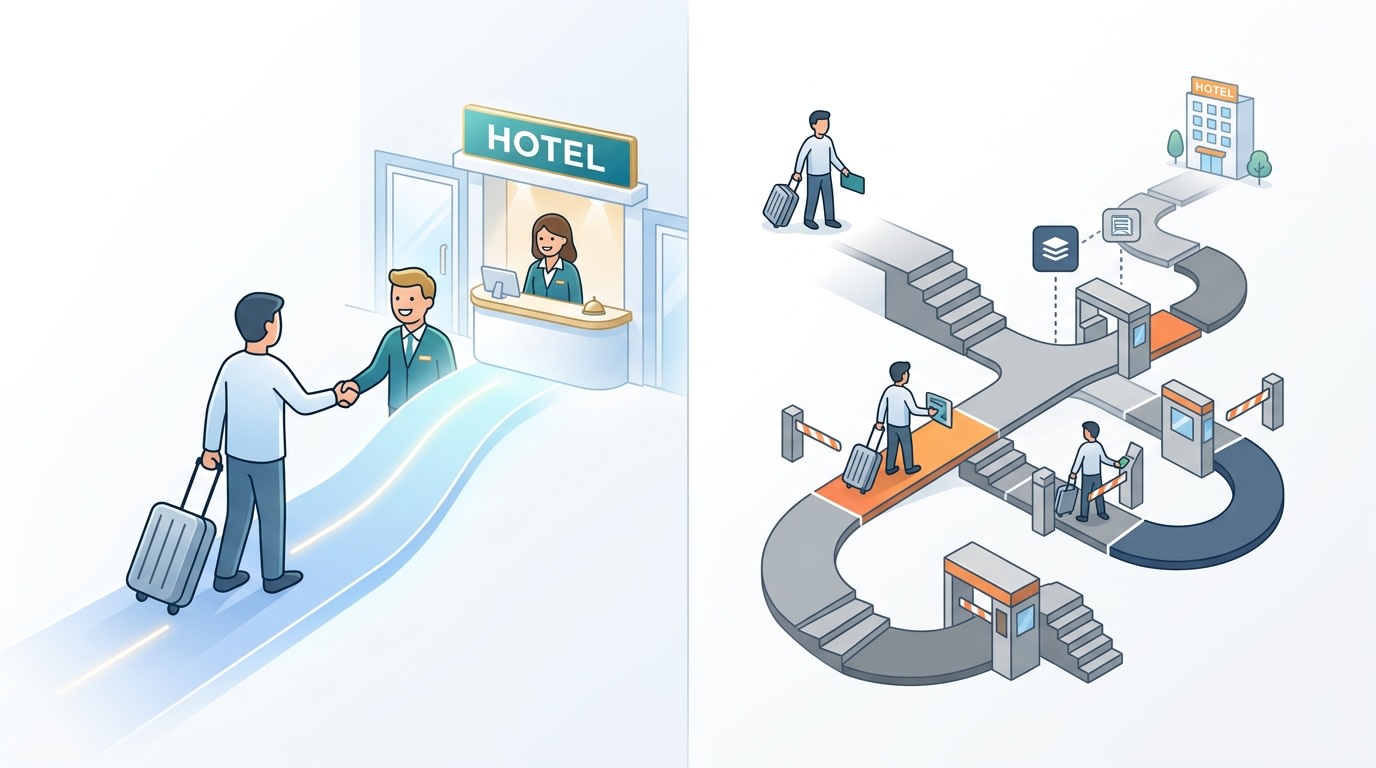
Off-platform revenue means two things: paid add-ons during the stay, and repeat guests who book you directly next time. Both are operations work, not marketing tricks.
By J. MasseyJune 27, 2026· 12 min read
Share
Disclosure: This post may contain affiliate links. If you purchase through our links, we may earn a commission at no extra cost to you. We only recommend tools and services J. Massey's team actually uses. Read the affiliate disclosure
Off-platform revenue means two specific things: paid add-ons sold during a stay that is already booked, and repeat guests who come back to you directly instead of through the listing site. Both add money to the same property at the same nightly rate, and both are operations work — a message template, a price, a cleaner who can show up mid-stay, and a record of who stayed with you. Neither one is a marketing trick, and neither one lets you ignore the platform rules about how money moves.
Last updated: 2026-09-18
I have spent more than 18 years in real estate, focused on short-term rentals since 2016, and I have trained more than 10,000 operators through CashFlow Diary. The mistake I see most often is an owner reaching for a rate increase when the cheaper move is sitting in front of them: the guest already said yes to the property and is still willing to spend money on the trip. This article is educational. It is not tax or legal advice.
Two Places the Extra Money Comes From
There are only two off-platform revenue streams worth building: in-stay add-ons, and repeat bookings you take directly.
In-stay add-ons — what most hosts call Airbnb upsells — are services attached to a confirmed reservation. Early check-in, late checkout, a mid-stay clean, a stocked fridge, a pet fee, a referral to a local operator who runs an activity. The guest has already committed to the dates and the property, so you are not competing on price against every other listing in the market. You are answering a question the guest already has about their trip.
Repeat direct bookings are the second stream. A guest who liked the place and liked how you ran it is the cheapest booking you will ever get. You do not pay to acquire them twice, and on a return stay booked directly you both keep the money that would otherwise go to platform fees. Airbnb publishes two stay fee structures — a split fee and a single fee — and under the split fee the service fee is shared between host and guest, which is why the same stay costs less to transact when it does not run through the platform.
A rate increase works differently. It asks the market to agree with you before anyone books, and if the market disagrees you find out by losing the reservation. An add-on asks a guest who already booked whether they want one more thing. The downside is a polite no.
Start with guest add-ons that solve a scheduling or logistics problem the guest already has, not with amenities you find interesting.
Add-on
Guest problem it solves
Typical price basis
Effort per sale
Early check-in / late checkout
Flight lands at 10am or leaves at 8pm
Priced under the local hotel's fee for the same flexibility
One message, cleaner schedule check
Mid-stay clean
Stays of five nights or more, families with kids
Your cleaner's rate plus a coordination fee
One booking with your cleaner
Grocery or fridge stocking
Late arrival, dietary needs, kids
Cost of goods plus a coordination fee
20–30 minutes, or a local delivery service
Pet fee
Guest is traveling with a dog
Set to cover the extra cleaning and wear
None — it is a listing setting
Local activity referral
Guest wants something to do and does not know the area
Referral fee paid by the operator, not the guest
One-time partner setup
The two at the top of that table carry most of the load. Flexible arrival and departure times require no inventory, no vendor and no permit — only a cleaner turnaround you can actually promise. That last part matters. If you sell an early check-in and the unit is not clean, you have traded twenty-five dollars for a review problem that costs you far more.
Pick one. Do not build a fifteen-item menu in week one. Offer flexible timing on your next ten bookings, write down how many said yes, and add the second add-on after sixty days of running the first one.
The Platform Rules You Have to Follow
Mandatory charges belong on the platform; optional extras have narrower rules, and moving a confirmed booking off-platform is a policy violation, not a growth tactic.
Airbnb's own guest-facing guidance says the full cost of a reservation is collected by Airbnb with few exceptions, that hosts may in some cases collect additional payments outside the platform, and that all mandatory charges must be included in the listing's price breakdown at checkout. The same page says payment for optional amenities should be sent on Airbnb using the Resolution Center. It also states plainly that asking a guest to take a booking off Airbnb, or to communicate off-platform before booking, is against Airbnb policy. Read both of those pages before you price anything, because the line between an optional in-stay extra and a mandatory fee is where accounts get penalized.
The safer pattern I use and teach:
Anything required to stay — cleaning fee, pet fee, extra-guest fee — goes in the listing's fee settings so it appears in the guest's total.
Anything optional and requested mid-stay is charged through the platform's own money-request tool. Airbnb's Resolution Center exists for sending and requesting money tied to a stay, which keeps the paper trail on the platform.
Direct payment happens only on a return stay the guest books with you outside the platform, after the first stay has ended.
You never ask a guest to cancel a platform booking and rebook directly.
Vendor policies change. Verify the current text of both Airbnb pages before you launch an add-on, and check your city's rules separately, because some add-on services — transportation, food handling, guided activities — carry licensing or permit requirements independent of anything a platform says.
How to Add Your First Add-On: A Five-Step Process
Run one add-on through all five steps before you add a second, or you will not know which change produced the revenue.
Choose the add-on. For a first pass, choose early check-in and late checkout. No inventory, no vendor, no permit — only a cleaner turnaround you can confirm.
Set the price against a local substitute. Check what two nearby hotels charge for the same flexibility and price under it. If the hotel charges $50 for late checkout, $25 to $35 is a clear win for the guest and clean money for you.
Put the offer in your pre-arrival message. One sentence: "If an early check-in or later checkout would fit your travel day better, tell me and I will see whether I can arrange it for a small fee." You are offering, not selling.
Charge it through the platform's money-request tool once the guest accepts, and confirm the new time in writing so your cleaner and your guest have the same information.
Record every sale in a sheet: guest, add-on, amount, date, whether they asked or you offered. After 90 days you have a take rate instead of an opinion, and that take rate tells you whether to raise the price, change the wording, or drop the add-on.
Step five is the one operators skip, and it is the one that turns this from a hobby into a line item. Without a record you cannot tell the difference between an add-on that converts a third of the time and one that converted twice by luck.
A repeat booking is won during the stay and asked for once after checkout — not in a newsletter six months later.
What earns the return is ordinary: the place matched the photos, arrival worked, messages got answered, and something small went wrong and you fixed it quickly. Guests rebook operators who were easy to deal with. There is no message sequence that rescues a stay that ran badly.
Then ask, once. After checkout, send a single line: thanks for staying, and if you are back in the area, reach out to me directly. No pitch, no multi-paragraph letter, no discount code. Guests who travel to your market on a schedule — a family visit, a recurring work trip, a race, a seasonal event — are the ones who use it.
Keep the record. A guest list with name, contact, dates stayed, and the reason for the trip is the only asset in this article that compounds. When you have somewhere for a returning guest to book — your own site, a direct-booking tool, or a simple invoice and agreement — that list is what fills it.
Two cautions. First, off-platform bookings do not carry the platform's payment processing, damage coverage or dispute handling, so you need your own rental agreement, your own deposit or screening rule, and your own insurance conversation before you take one. Second, a direct booking that goes sideways has no resolution desk. Price that risk in rather than pretending it is free money.
What This Costs to Run
Add-on revenue is not free revenue; each stream has a real cost, and two of them cost you time you may not have.
Stream
Direct cost
Time cost per stay
Main failure mode
Early / late timing
None, if the turnaround already fits
5 minutes of messaging
Selling a time your cleaner cannot deliver
Mid-stay clean
Cleaner's fee, passed through
10 minutes of scheduling
Cleaner cannot make the window
Grocery stocking
Cost of goods, plus delivery
20–30 minutes, or a vendor
Wrong items, refund, unhappy guest
Activity referral
None
One-time partner setup
Partner delivers a poor experience under your name
Direct repeat booking
Payment processing, agreement, insurance review
15 minutes per booking
No damage coverage or dispute process
The old version of this article reported roughly $2,300 of added revenue over twelve months on a single listing. Treat that as one property's reported result across one year, not as a forecast for yours. It came from a mid-market listing with frequent short stays and a cleaner who could turn the unit quickly, and every one of those conditions moves the number. What is repeatable is the structure: one add-on, one price, one message, one record.
The tax treatment is the same as your other rental income in the ordinary case — add-on income is income, and how it is reported depends on your days of rental, days of personal use, and how much service you provide. IRS Topic 415 and Publication 527 are the starting points. Take your specific facts to your own tax professional.
Who Should Skip This
If you are not answering guest messages within a few hours today, add-ons will make your operation worse, not better. Fix response time and turnover reliability first. A sold early check-in on a unit that is not ready is a one-star review with a receipt.
If your average stay is one or two nights at a low rate, the mid-stay clean and grocery add-ons will not fire often enough to matter. Run the timing add-on and the post-checkout message, and put your attention on occupancy and pricing instead.
And if you are hoping add-on revenue will rescue a property whose ordinary twelve-month numbers do not work, it will not. Four figures a year does not fix a deal that is short by five. Underwrite the property on the nightly rate and the occupancy it can hold.
If you want a second set of eyes on one listing — which add-on fits it, what to charge, and whether a direct-booking channel is worth building yet — book a complimentary one-on-one diagnostic call and we will work through your numbers together. No guaranteed income; results vary by market, property and how consistently the system gets run.
Frequently Asked Questions
How can I make more money on Airbnb without raising my nightly rate? Sell one optional add-on on stays that are already booked, and ask past guests once after checkout to come back directly. A rate increase asks the market to agree with you before anyone books, so a wrong guess costs you the reservation. An add-on is offered to a guest who already committed to the property, so a wrong guess costs you a polite no. Start with early check-in and late checkout, because they need no inventory and no vendor.
Is it against Airbnb's rules to charge guests off-platform? Airbnb's guidance says the full reservation cost is collected by Airbnb with few exceptions, that all mandatory charges must appear in the listing's price breakdown at checkout, and that payment for optional amenities should be sent on Airbnb through the Resolution Center, while noting hosts may in some cases collect additional payments outside the platform. Separately, asking a guest to move a booking off Airbnb is against policy. In practice: put required fees in your listing settings, charge optional in-stay extras through the Resolution Center, and only take direct payment on a future stay after the platform stay has ended.
What should I charge for early check-in or late checkout? Price it under the local substitute. Check two nearby hotels' fees for the same flexibility and come in below them. As an illustration, if the hotel nearby charges $50 for a late checkout, something in the $25 to $35 range reads as a clear win to the guest. Only sell a time your cleaning turnaround can actually deliver, and confirm the change in writing so the guest and the cleaner have the same schedule.
How much extra revenue do add-ons and repeat bookings produce? It depends on your stay length, your rate, and how often you offer. The version of this page published earlier reported about $2,300 over twelve months on one listing — one property's reported result, not a projection. Rather than adopting a number, track your own: log every offer and every yes for 90 days and calculate your take rate per add-on. That figure is the only one worth planning against.
Is add-on income taxable? Yes, in the ordinary case it is rental or business income like the rest of your revenue, and the reporting path depends on your days rented, days of personal use, and the level of service you provide. IRS Topic 415 and Publication 527 set out the rules for renting residential and vacation property. Some add-on services also carry local licensing or permit requirements. This is educational, not tax or legal advice — confirm your situation with your own professional.
Airbnb Help Center — Airbnb service fees — confirms Airbnb charges a service fee on confirmed bookings under one of two structures, a split fee or a single fee.
Airbnb Help Center — If a host asks you to pay outside Airbnb — states the reservation cost is collected by Airbnb with few exceptions, that mandatory charges must appear in the checkout price breakdown, and that optional amenities should be paid through the Resolution Center.